Oh no, it appears to have received the hug of death?
I am interested in this, I have been using Raspberry Pis for various projects and home servers since the original - Currently one is hosting my navidrome music server, my password manager, and several other local network servers.
I feel the upgrade each time, and then get used to it, as I suppose we tend to do. I still remember the upgrade from 1 to 2 being the most impactful to me personally though. (I think maybe because that's when game emulation became viable?)
I absolutely loved The Settlers 1 and 2 as a kid. I feel like they are responsible for a fascination with distribution logistics that carried into adulthood.
By the way, there is also an open source clone of these games that is very well done: https://www.widelands.org/
I’ve tinkered with pixel art now and then but I’m far from skilled. This may sound silly, but the idea of having two windows one zoomed and one unzoomed has never occurred to me, and I feel like it's going to change a lot for me.
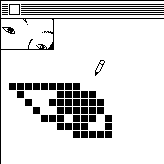
The original MacPaint had "Fatbits" which allowed zooming in to edit specific pixels: https://cdn.arstechnica.net/wp-content/uploads/archive/staff... I think it's the first time that was implemented in a graphics program. It was really the killer feature of MacPaint. (Which itself was the killer app for the original Mac in 1984.)
Seems like this may have been common in vintage image editing software. Arbitrary zoom doesn't seem to have been available in most raster graphics editing software until some point in the mid-to-late 90s. I've seen a couple programs that compensated for this with a dual-view arrangement where you could move the zoomed-in view around by dragging a box around inside the zoomed-out view.
IIRC, the classic Deluxe Paint II (mostly for Amiga, but also PC) had this as a standard feature when zooming. Classic graphics work was almost all pixel editing.
It is first-class support, as far as I know everything is accessible from C#. I developed YKnytt, an open source game, fully in C# and never had the issue of something not working in C# as it did in GDScript.
GDScript is very comfortable for doing simple game and UI logic, but it can be problematic that there's standard/easy way to import other people's code libraries besides copy-paste jobs.
When trying to do some sort of complex logic or when I really could use an external library for something, I simply go to C# to scratch that itch, and it's been working out pretty well for me. You can even have the two languages inter-operate to a degree within a project.


I am interested in this, I have been using Raspberry Pis for various projects and home servers since the original - Currently one is hosting my navidrome music server, my password manager, and several other local network servers.
I feel the upgrade each time, and then get used to it, as I suppose we tend to do. I still remember the upgrade from 1 to 2 being the most impactful to me personally though. (I think maybe because that's when game emulation became viable?)
reply