>why is it not possible that the O-rings were inadequate for the old design, but adequate for the new design?
Boneheads getting lucky, happens to the worst of them more often than lots of people want to admit :\
I came from Florida and am not a fan of cold weather.
That morning of course nobody knew about defective engineering at NASA contractors when it comes to o-rings. I got in to work, and the office people had turned on the seldom-used little black & white TV in the office manager's room so they could watch the Challenger launch. That was about the only time anybody watched TV at work, except for baseball playoffs when they occasionally occur in the afternoon.
It was 19 Fahrenheit at the launch site so I never thought for a minute that they would go through with it. It was simple common sense. You don't even try anything "normal" during the one day per decade when it gets that cold, and that would be in north Florida. You wait years for it to get below freezing at 32 F, especially on the central Florida Atlantic coast. And no matter what, you never have to wait long for it to get above freezing. I just naturally couldn't imagine anyone not fully on board with living to wear shorts another day. I was thinking about the rubber seals that must be there to keep the crew hatches airtight, for one thing, but aware there were countless other variables which I didn't have a clue about that could also be cold sensitive, like electronics.
I went into the back where my lab office was, thinking they were surely going to delay the launch, at least to later in the day. I didn't get back to the front office until a little after liftoff time, where I expected to find out how much of a delay or reschedule there was. It was very quiet. I asked what happened and they said "it blew up!" I actually thought they were kidding me because I missed the liftoff. Then I saw the tragic replay that was enough to make anybody sick.
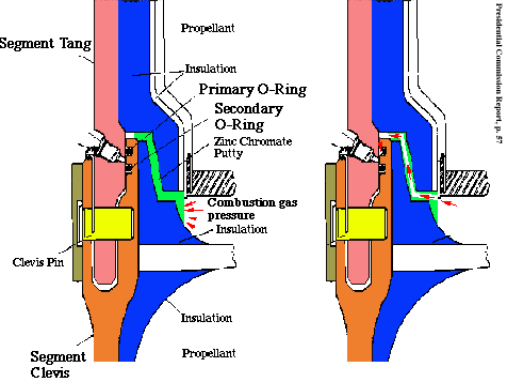
Eventually, the o-rings were pointed to, and publicly disclosed and it was stupidly worse than I imagined.
A few years earlier I had experienced a dramatic o-ring blowout on some high-pressure apparatus that one of our engineers had designed at a previous employer. That was an engineering lab, and I'm no engineer but it turned out they needed more help than just chemistry lessons for experiment design. Since I was the one who had taken a reading within the blast zone minutes before I went back to my desk, I took over the redesign of the heavy-walled high-pressure custom cylinders, going over every little thing from alloy properties, dimensional characteristics, reinforced thread strength, etc. It was helpful that I had worked in a machine shop before, but I was the only one there who had any full time experience at metal fabrication. Well constant overtime really. When I got to the critical o-ring design parameters, that alone required more engineering effort than the rest of the project. Each standard o-ring has its own precision design parameters, highly dependent on the durometer hardness of the rubber among many other things.
Without considering durometer, here's a very simplified chart of some key parameters (primarily US inch units):
Never did look into the Challenger o-rings this much until now, all I knew was that defective o-ring design is more likely than not, and you would be a fool to use any o-ring that was not standard size without the equivalent of decades of destructive testing yourself.
All I needed to know was these o-rings circled the entire booster, so that alone was a no-no since it was nowhere near standard. Now in the clearthinking article I see the nominal measurements, 38 feet in circumference but only 1/4 inch thick. Yikes, what were they thinking? No wonder they used two o-rings, it was plain to see that one would never be enough :\
Look back at the d2t1xqejof9utc.cloudfront chart. Notice that a 1/4 inch thick o-ring is not expected to have nominal reliability outside the tolerances listed.
Notice the Groove depth and the gland depth are two different things but actually need to be as close as you can get in practice, within 3 thousandths of an inch altogether across the entire (38 foot!) diameter, or half of that when measured at any one point on the arc. This requires some precision machining and quite rigid metal substrates or it will never come true. This is precise enough that large temperature swings would always be a factor, but more so the greater the diameter of the substrate. And the maximum eccentricity of the groove relative to its substrate must be within 0.005 inch. The widest tolerance on this little chart is the "squeeze" of the rubber to be between 0.040 and 0.055 which is not for the machine shop but depends on the o-ring thickness being within its own design specifications. Not surprised to find out they were Viton rubber which is widely known to be some of the most chemically resistant for a non-teflon compound. Probably would have been better if Thiokol also was aware how "good" Viton is for its intended purpose, strong resilience at temperatures 200 F and above, below which it doesn't seal as well as ordinary rubber. Viton is just too hard and non-tacky at room temperature by comparison.
After all these decades, now I'm even more convinced it was always an accident waiting to happen :(
Gasoline and diesel usually sell by volume, and if the temperature of the fuel is cold when you purchase it, you get more kilos per volume than you do when the dispensing tank is warmer.
There is quite a bit more expansion & contraction of hydrocarbons with temperature than many peoople expect.
In the US we're considering pounds per gallon rather than kilos per liter then ;)
Fuels containing a higher amount of Aromatic class hydrocarbons, (or just lesser "light" hydrocarbons) will have a higher density (lb/gal) compared to fuels having lower amounts of the heavier molecules.
Also the aromatics bring with them higher antiknock ratings which can also be better for efficiency in a number of different engines.
When acceptable octane rating is achieved by ethanol content instead, it works good too, but fuel efficiency is reduced chemically because alcohol does not consist of only carbon & hydrogen, alcohol molecules also contain oxygen which provides bulk but not energy, so alcohols can be considered to already be "partially oxidized hydrocarbons" to begin with. It's really the oxidation process of the burning fuel that provides the energy, and alcohols just have less to give than hydrocarbons.
Miles per gallon is the conventionally understandable measurement units, and even fuel injectors meter the fuel in by volume, but actual energy obtained and resulting engine efficiency depends on performance per weight of fuel, not exactly per gallon directly.
During changing seasons I like to feel the metal part of the gas nozzle for temperature during dispensing. One of the worst times is when a tank trailer has been sitting in the sun a while before delivery, and it's 95 Fahrenheit when it's not even that hot outside. I like it much better when a trailer comes from northern locations where the fuel is less than 60 degrees, then I buy more but don't fill it up. It's nice when it is colder fuel to purchase and if it's a hot summer once the gas warms up to ambient conditions you end up with more gallons than you pumped, but if you are not careful the gas tank will overflow "autonomously" if you fill it too much with cold fuel when it warms up like that :0
There are a number of other factors too, but this one is often overlooked.
Before Apple ever came along, failure to engineer in all kinds of extreme repairability was a recognized hallmark of unsuitability for mission-critical applications. Widely distributed repair manuals were of course table-stakes too.
Woz was well-aware of this from HP's legendary performance at the time.
It's just not easy to stay on the most correct path when there are so many shiny distractions.
Now the Neo sounds like a step in the right direction.
>one of the most repairable macs in decades.
With the Neo they could be jumping right back on the right path from a distance. Which is an improvement but it does also show they could have been doing it the entire time if they had the serious commitment to mission-critical users.
The only real way for it to be a game-changer is if they actually change their game :)
They will change their game in some ways, or they'll have to stop selling in the EU. I'm sure the Neo was engineered for this. Apple really hate re-engineering mac cases. Even the plastic macbook that had a huge design flaw (the cracking topcase because of the screen bezel spacers crushing it), had this flaw for 4 years until they finally fixed it, and that was not really to fix the problem but because they wanted to do a glossy new design. For some reason they preferred fixing the topicase over and over for free instead of just fixing the problem. And it wouldn't have needed much. All that would have been needed was to modify the screen bezel: Make the plastic spacers either a lot wider (to spread out the pressure) or of a softer material. It's pretty insane they didn't even bother to redesign such a simple plastic part.
I had mine replaced 3 times over the 6 years I used it. Sometimes with some complaints as I had replaced the LCD with a matte panel (the plastic macbook used an atrocious quality ultra-reflecting TN screen with shit viewing angles). But they always did it for free after some pressure.
So I can imagine they wanted to be ahead of the game this time because the EU will set a deadline and they hate doing redesigns. I can't fathom why they hate doing that so much though. I worked in manufacturing too and we did small tweaks periodically, every 2-3 months or so there'd be a minor hardware revision to take comments from QA into account or to optimize for pricing & availability of components. Usually not the kind of redesign an untrained eye actually would notice. But Apple somehow just hates it.


reply