It should also be mentioned, Linux Load Average is a complex beast[1]. However, a general rule of thumb that works for most environments is:
You always want the load average to be less than the total number of CPU cores. If higher, you're likely experiencing a lot of waits and context switching.
On Linux this is not true, on an IO heavy system - with lots of synchronous I/Os done concurrently by many threads - your load average may be well over the number of CPUs, without having a CPU shortage. Say, you have 16 CPUs, load avg is 20, but only 10 threads out of 20 are in Runnable (R) mode on average, and the other 10 are in Uninterruptible sleep (D) mode. You don't have a CPU shortage in this case.
Note that synchronous I/O completion checks for previously submitted asynchronous I/Os (both with libaio and io_uring) do not contribute to system load as they sleep in the interruptible sleep (S) mode.
That's why I tend to break down the system load (demand) by the sleep type, system call and wchan/kernel stack location when possible. I've written about the techniques and one extreme scenario ("system load in thousands, little CPU usage") here:
The proper way is to have a idea of what it normally is before you need to troubleshoot issues.
What is a 'good load' depends on the application and how it works. Some servers something close to 0 is a good thing. Other servers a 10 or lower means something is seriously wrong.
Of course if you don't know what is a 'good' number or you are trying to optimize a application and looking for bottlenecks then it is time to reach for different tools.
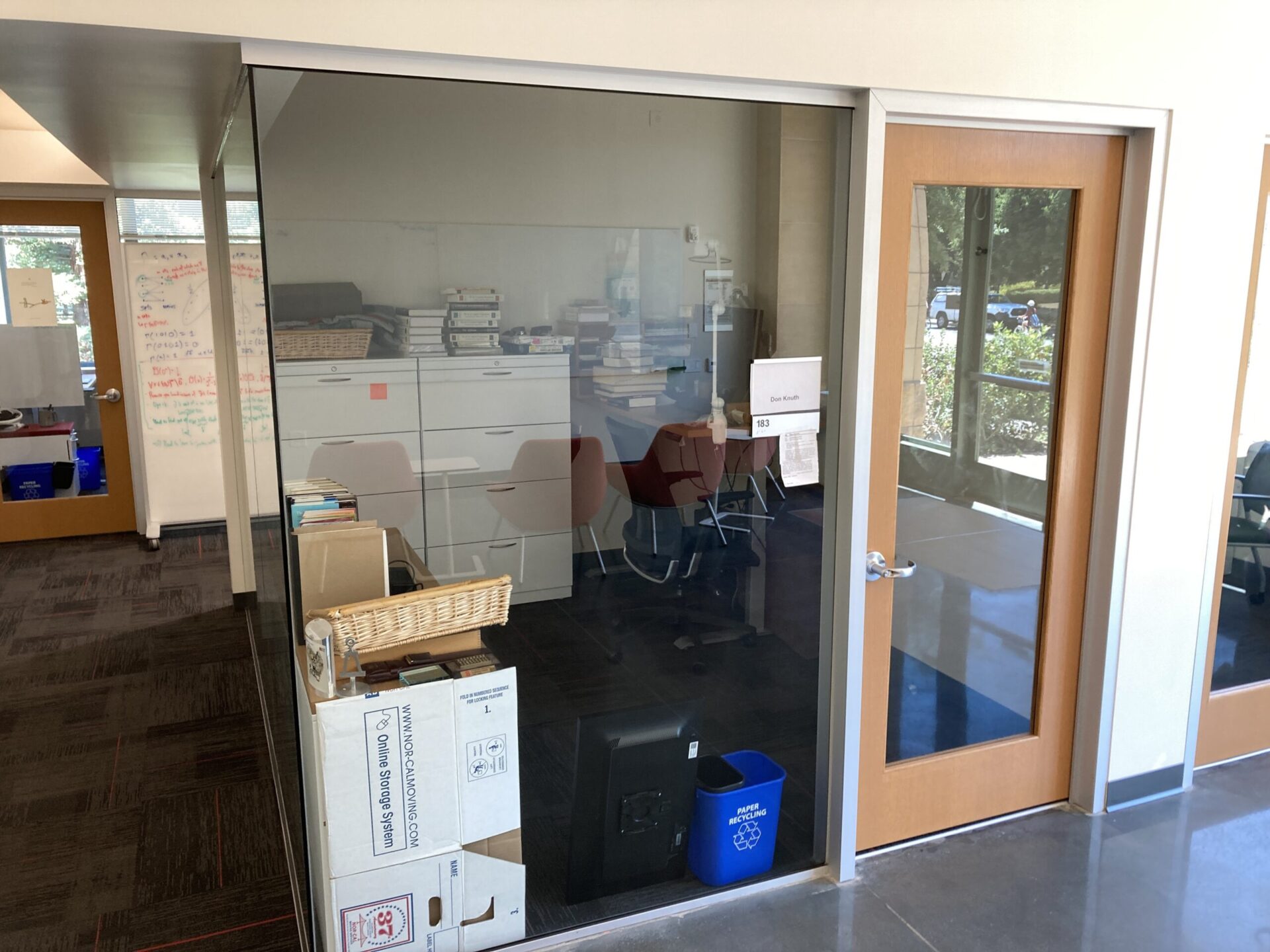
Anecdote: In 2022, while visiting San Francisco, I had the chance to explore the campus. Wandering through the quiet, empty halls of the summer buildings, I was just about to leave when I unexpectedly came across Knuth's office [1]. I had to do a double take—it was surprisingly small for someone of his stature. Yet, in a way, it felt perfectly fitting, a reflection of his unassuming nature.
It's public knowledge that he's a prof at stanford and publicly available directories can lead you to his office. Not to mention that he's famous enough that this is almost certainly not the first time someone shares a photo like this.
If it was a photo of his home I'd understand but this is essentially public knowledge.
Great, I am gonna watch this. Hopefully this video also explains what the name 'Netscape' means or implies or is based on. Because I've always found it kind of striking that the name has the same letters (and sort of sounds) like 'NCSA' where Mosaic was originally developed, that seems like more than a coincidence?
  > "We've got to make progress on [renaming the company]." And I said,
  > "We've got a couple of ideas, but they're not great." Then it just kind
  > of popped into my head, and I said, "How about Netscape?" Everyone kind
  > of looked around, saying, "Hey, that's pretty good. That's better than
  > these other things." It gave a sense of trying to visualize the Net and
  > of being able to view what's out there.
Does anyone know what the name 'Netscape' means or implies or is based on?
It's kind of striking that the name has the same letters (and in the same order) as NSCA where Mosaic was originally developed, that seems like more than a coincidence?