A pedestrian with headphones needs to ensure that he can hear any relevant traffic noise, e.g. my bell or an approaching car. Noise-blocking headphones or loud music impeding the hearing of a pedestrian are a traffic offense.
Leaving your computer unlocked usually also breaks policy (except if the policy is very much useless). The non-embarassing way would be to report the user leaving the computer unlocked, leading to disciplinary action and eventual dismissal. I think something slightly embarassing is the kinder option here.
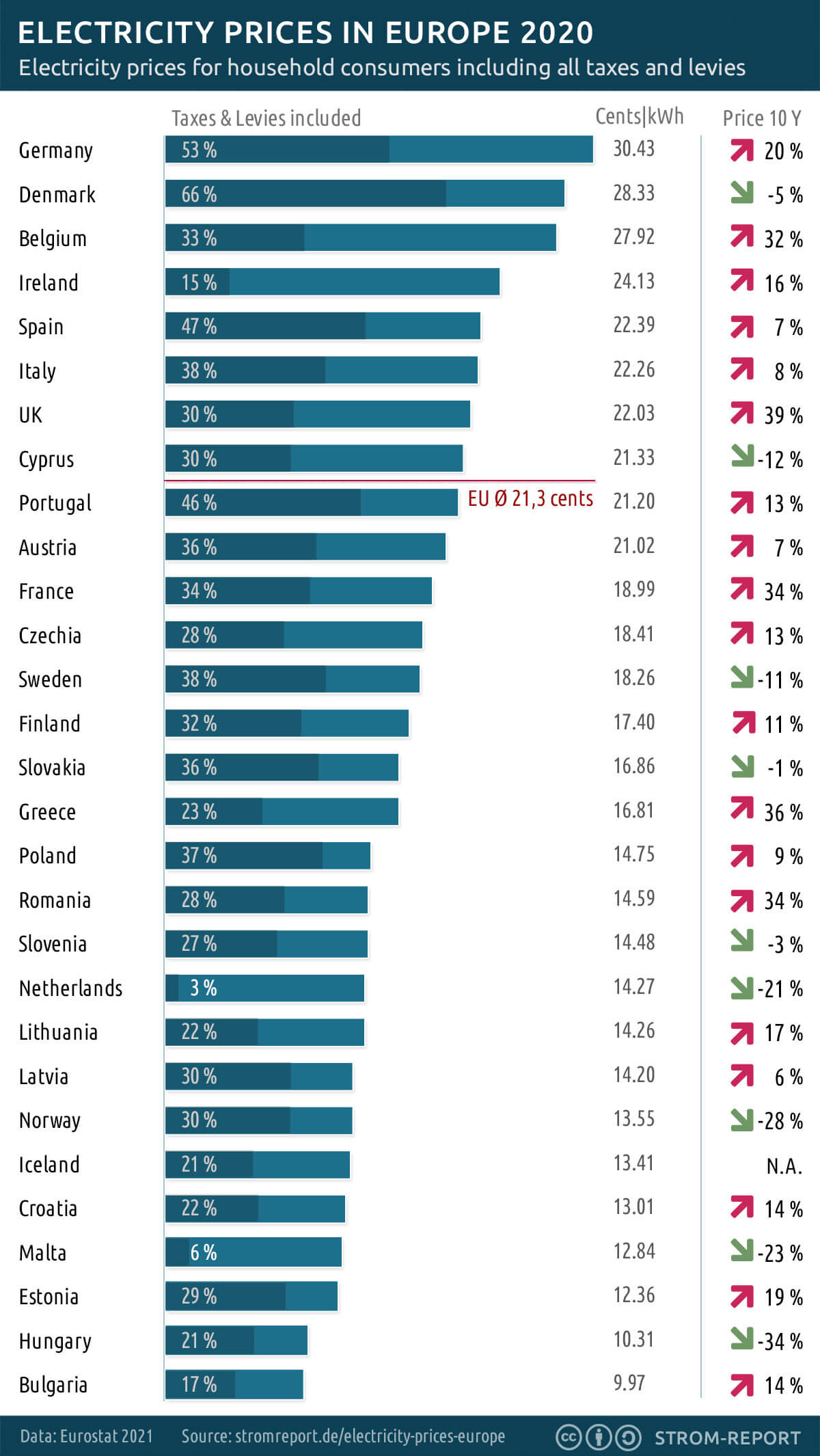
Quite impossible, except if you run a steel mill or something. End-user prices for electricity have been >0.20Eur/kWh for around 10 years now, currently approaching >0.40Eur/kWh (sometimes even more).
See e.g. some comparison website like verivox.de (beware the dark patterns, use "Postleitzahl" 20095 for Hamburg center).
Edit: and those are 2022 prices, usually most suppliers have a 12month fixed price which changes on 1st of January. So all the current price hikes in power and gas will only be priced in in 2023, current offers usually don't include those yet.
Yes, but the parent post specifically referred to Germany. And due to taxes, renewable subsidies in the range of 3 to 10ct/kWh (which every household pays (but not all industries)) and sky-high generation prices due to prematurely switching off cheaper power plants like nuclear and coal in favour of far more expensive gas (even back then), Germany has had far higher household electricity prices than most of Europe.
There are easy, non-offensive, non-interrupting methods of communicating while another person is talking. Signal yes/no, dissent, agreement? Thumbs up or down, Nod or shake head. Applause? Deaf people's clap (raise both hands, oscillate quickly around z-axis). Want to say something? Raise one hand. Want the speaker to get on with it? Circular motion with the tip of the index finger around the y-axis. Strongly disagree with speaker and intend to insult? Show middle finger (ok, that one is offensive, intentionally).
There is a rich repertoire of non-verbal communication available to us that most people will understand. And if you use them, the problem instantly vanishes.
That people don't use them is imho not a problem of not knowing or not understanding. It is a problem of lacking civility. Of the desire to assert dominance by interrupting. Of asserting dominance by talking for a long time. And of the myopic concentration on verbal communication.
Now if you are on the phone, there isn't much else you can do, of course...
The problem vanishes—assuming the speaker has plenty of free mental capacity to keep track of the audience (which is also small enough to keep track of, ≤ 15 people or so if meeting in person).
If I am lecturing on a familliar subject with 1:1 or greater preparation time : lecture time ratio, maybe I do.
If, on the other hand, I’m retelling a paper I’ve banged my head against for the last couple of days and probably still don’t get a good part of, then sorry—I’m barely holding on here, I have to sort dependencies and not miss anything and remember to bring attention onto subtle points or the whole thing will apart and I have to backtrack and lose everyone because nobody can apply a verbal diff that goes half an hour back.
Again, I’m so sorry, but I don’t have the brain time to process your visual cues. Wait for the nearest syntactic boundary and shout over me. Please. I can suspend my flow—I can’t work out of it.
(From the other end, the problem vanishes assuming I’m either taking prodigious notes or already know half of what you’re saying, because people only poll for nonverbal interrupt requests once per logical point, so 2—7 minutes, and at best I’ll forget half of what I wanted to ask, at worst you lost me at the very beginning and you’ll have to spend the 5 minutes all over again, in addition to the two or so minutes it’s going to take us to negotiate an understanding of the question. And how do I deal with a presenter who mistook my simple question for a similarly-sounding advanced question? Interrupt their long advanced explanation?.. Right.)
> Want the speaker to get on with it? Circular motion with the tip of the index finger around the y-axis.
If someone did this to me I'd find it pretty offensive, much more so than being interrupted. Unless that person was explicitly asked to help keep time beforehand.
Details aside, all of these examples are basically substitutes for 1-3 words. Hardly anyone is interrupting to say just a word or two, and such interruptions aren't really disruptive anyway.
In what culture is it acceptable to make a "wrap it up" motion to your peer when they're speaking? I'm genuinely curious because in US culture that would be seen as condescending.
The translation is accurate. "Bei Level-2-Fahrzeugen bleibt die Fahrerin oder der Fahrer grundsätzlich immer in der Verantwortung." can be translated this way. The only nit I would pick is about the translation of "grundsaetzlich" by "as a matter of principle", it could also be read to mean "generally", "usually", "always" or "basically". In this case, they probably wanted to say "always", but there would also be the legalistic meaning of "grundsaetzlich" which is "normally, but with exceptions".
All in all, no matter the above nits, they are obviously trying to shift blame away from their vehicle.
If you read carefully, they are talking about the difference in responsiblity between level 2 and level 3 autonomous driving, with the explicit remark that the driver is fully responsible in a level 2 vehicle and that the vehicle in question is level 2, not level 3. They fully avoid saying whether the autonomous driving was active at the time of the accident or had anything to do with it. It really reads like something has gone wrong and they want to avoid bad publicity and shift the blame on the driver by tiptoeing around the real issue of whether their autonomous driving software caused the accident. Instead they are trying to redefine the general notion of "autonomous" to mean "level 3" which their vehicle isn't.
Translation of the part of the article I'm talking about:
BMW said on tuesday: "The car has a driver assistance system of level 2, which are even today shipped in normal consumer vehicles and which support the driver if they so desire. With level 2 vehicles, the driver is generally always responsible." Only with highly automated vehicles of level 3, the driver may, under certain circumstances, delegate driving fully to the vehicle.
BMW said: "At the moment we are researching the exact circumstances. Of course we are in a close exchange with the authorities. But it is already certain: The BMW involved was not an autonomously driving vehicle".
> a hash of an ip address could still be 'personal data' under the eyes of gdpr.
We did something similar for a project, which got approved by the relevant data protection officer: hash(IP + daily secret) as an identifier in the logs. This will be used to count unique visitors, the wraparound at 24:00:00 didn't matter to us. The daily secret is just a random number that our one (small setup) application server generates each day. It is never written out to disk or database, so an appserver restart also recreates that secret, it is strictly kept in RAM. That way, we could argue that, barring extreme measures like attaching a debugger to get the secret, we technically prevented deanonymisation.
But that was just a small-scale project, has never been tested in court and the usual YMMV, IANAL, ...
Edit: I think some webservers can be configured to do something similar
Analytics is generally (in detail this might or might not apply for this project) seen as an invasion of privacy, wasting bandwidth, increasing load time and lowering performance. There is a population of users who would gladly accept advertisements without analytics, because they see the invasion into their privacy as the predominant evil. This is why most adblockers nowadays either block analytics by default, or at least provide a configuration to also block analytics.
I agree with your statement. I did originally build this for myself, with privacy in mind. I don't like being tracked either. Pathview doesn't rely on personal data but the general perception remains true. Any thoughts on navigating through that stigma?
It's worth mentioning that the first hit generally loads in ~200ms and subsequent hits in ~120ms. The difference between first and subsequent is SSL. Speed and footprint represent two of my main design considerations.
I guess the stigma is too established to get rid of. Maybe you can sway some users by transparency, i.e. a very thorough but user-friendly explanation about what your software is doing and how it cannot possibly be used to invade their privacy.
But unfortunately, as far as my opinion goes, any kind of analytics and tracking just results in an instant "yuck" reaction, like a spider landing on my lap. I don't bother with analyzing it, I'll just try to get rid of it as quickly as possible.
The notion of privacy-friendly analytics has also been thoroughly burned by sleazy marketing departments outright lying. Or technical solutions that claimed to be privacy-friendly, but actually didn't really because of technical reasons. Or technical solutions being so complicated and obscure that it might as well be a privacy-protecting voodoo ritual for all a user knows.
This is tough. I dislike tracking but approve of analytics. Without data, websites cannot improve. Without improvements we'd only have Craigslists.
In your opinion, is there a way to balance the need for feedback with respect for the user? What might that solution look like? Do you have any absolute demands?
As a user, I've yet to see the user-facing benefits of analytics. I suspect there might be some which I don't know about. But mostly what I see is "we cancelled feature X you care about because analytics told us nobody uses it" and "you now get this annoying newsletter popup, because analytics told us we get more subscriptions that way".
For that perception to change, you have to educate users about their concrete, relevant and obvious benefit from analytics. I think this is hard or impossible. I also think that all the bad players in the market make this even more impossible, because you get lumped in with them.
I think the easiest solution is log analytics, preferably from anonymized or pseudonymized logs that are present anyways. That way, you don't collect any extra data, and as long as you do not keep the logs but only aggregated results, privacy isn't an issue. While a privacy policy and legal team need of course be aware of log analytics, the users cannot adblock it away, so that might be a plus. Also, no scripts, no cookies, no performance impact, etc. But of course the insight is limited by whatever is logged. Maybe some (privacy-preserving) data can be added to the URL parameters to augment the logs and provide a little more insight.
Another solution (that I just thought of, no idea if it would work) is that of recruiting users for testing your website under observation by the UI team. While this might invoke the image of recruiting 20 people off the street and sitting them down in a lab, I have something totally online in mind: Offer a voucher (or something) in return for participation. Participation should be instant. The users session should be connected such that the UI people on duty can see the website interaction (ala VNC, but limited to the website in question, so this should be possible by getting geometry, mouse position and keypresses alone via javascript). In case of difficulties, the UI team can interact with the user via voice chat (preferred) or text chat. After the user has finished their task, maybe ask them a few extra questions. You will gain much better insights, because you can ask for motivations and problems. You can point the user at the intended way and see if it works at all. But of course this approach requires lots of manpower and is technically challenging.
My absolute demands would be: Respect the relevant laws ala GDPR. Respect the DNT bit my browser sends. That way, you would already be above 99% of the analytics industry imho.
"I think the easiest solution is log analytics, preferably from anonymized or pseudonymized logs that are present anyways."
"Maybe some (privacy-preserving) data can be added to the URL parameters to augment the logs and provide a little more insight."
Pathview iterates on the server log approach. JavaScript collects two pieces of information: the current page and the referring page. The rest of the data is acquired by parsing HTTP Messages in real-time.
RedHat licenses are just too expensive by sticker price. Beancounters haunt us for deploying RedHat because "the Windows license for that box would have been cheaper in our licensing model". That there is support included which we never use doesn't matter to them, the usual suggestion being "buy support for one box, test everything on that one, and open a support case for that one box, replicate the solution everywhere".
If you want to fix this, make a RedHat license be significantly cheaper than the equivalent Windows product. Charge for support by ticket/case and only support licensed boxes. You'll earn a lot more because it'll look cheaper to the beancounters.