> Many vision tasks in the real world can actually be constrained by camera angles
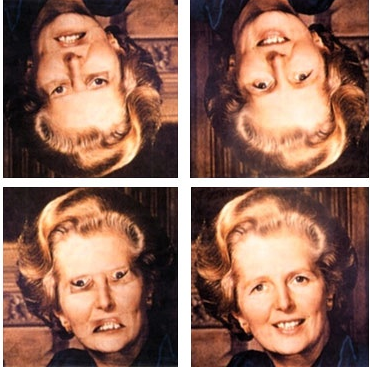
Great example - because it can be extended to show that even human brains have great difficulty with that. Just turn the scene upside down and see how the brain has to go into overdrive and still miss a lot of stuff. There are quite a few optical illusions photos based on that, for example the face that seems to smile - until you flip it.
>There are quite a few optical illusions photos based on that, for example the face that seems to smile - until you flip it.
Ah, the Thatcher effect! [0][1] Although IMO this is a bad example because (er, AFAIK) we don't have the same sort of hardcoded facial-feature-recognizer systems in computer-vision neural nets as we do in boring old hew-mons. The Thatcher effect works on people with prosopagnosia [2] ('face blindness', people who have to work out who you are by your clothing, gait, voice and body language). These, taken together, proved that the known full-face-detector in humans, the fusiform gyrus, is aided by other systems that recognize features of a face (eyes, mouth) independently of that face's vertical orientation.
[1] http://static.independent.co.uk/s3fs-public/styles/story_med...
< here's the trope-namer, straight outta the 80s. The effect is much more pronounced in this image than in the wiki one; it's way more obvious that the mouth/eyes are 'properly oriented' despite being upside down
The brain is amazing in that if you for example, feed it images that have been flipped by some inversion glasses, it will learn to either do the proper correcting transformation or compensate for the distortions further up, on its own.
Check out neural prosthesis to see how clusters of neurons in the brain are at just excellent at learning whatever signals you throw at them on the fly.
The brain does not really have difficulty with camera angles. Almost every single optical illusion / visual trick / visual quirk is actually an example of how incredibly clever and well-optimized the brain is.
The fact is the brain takes convenient shortcuts whenever possible. The ability to detect smiles is indeed conducive to social behavior in humans. But the ability to distinguish smiles on upside down faces is not particularly useful for anything in real life. It's just an interesting quirk. The brain just recognizes the smile, and shortcuts any additional (useless) post-attentive processing.