I agree with your overall point that the talk's claims are overblown.
> unless you focus the hell out of them
By this you mean, increase the intensity of the radiation? Obviously, a person would die inside a microwave oven that uses the same frequency as wifi (2.4Ghz). But it seems myopic to dismiss the possibility that there are no other dangerous effects besides heating. There is still much ongoing research on the effect of pulsed/modulated microwave radiation (as opposed to continuous radiation). As another example, certain RF harmonics are particularly dangerous:
At frequencies near the body's natural resonant frequency, RF energy is absorbed more efficiently, and maximum heating occurs
Look at it this way: regardless of how dangerous you believe WiFi to be, there's a much, much greater chance that you'll die in a car accident on your way to work. Or an unrelated heart attack.
Furthermore, the FCC limits router wattage to 1W. The IEEE says that you shouldn't worry about radiation below 7W. That's on the same page you linked above.
There are specific limits on this sort of radiation. If anything you've said were true, a lot of people would've gotten sued by now.
And myopic or not, true or false, I have more things to think about than WiFi radiation. Link me a peer-reviewed study or else stop fear-mongering.


> unless you focus the hell out of them
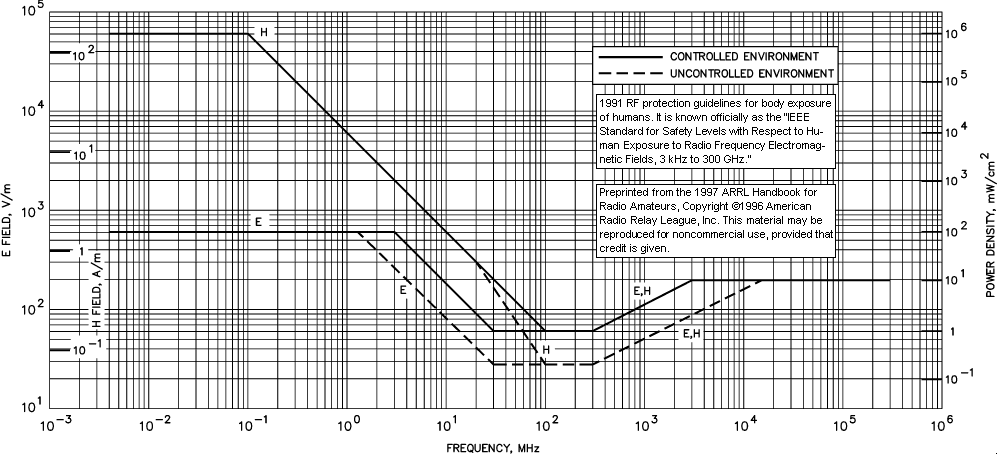
By this you mean, increase the intensity of the radiation? Obviously, a person would die inside a microwave oven that uses the same frequency as wifi (2.4Ghz). But it seems myopic to dismiss the possibility that there are no other dangerous effects besides heating. There is still much ongoing research on the effect of pulsed/modulated microwave radiation (as opposed to continuous radiation). As another example, certain RF harmonics are particularly dangerous:
At frequencies near the body's natural resonant frequency, RF energy is absorbed more efficiently, and maximum heating occurs
http://www.arrl.org/rf-radiation-and-electromagnetic-field-s...