One feature of the transport market (from a mile high view) is that demand is almost infinite.
If you can get 40kms in 45 minutes, then you can live within 40 miles of work and commute in that time. If you could go 400kms, then that becomes your commuting radius. We've seen people spread this way as earlier mechanized transport was invented. IE, average commute times didn't go down because of faster transport, distance traveled (KMs consumed) went up. Total commuting time can even increase as transport gets faster/cheaper.
If I could get to hong kong in 15 minutes, I might go there this afternoon for some dumplings.
That creates some strangeness in transport. You can't really solve transport the way people want, which is to make getting where they're going better/faster. If you could get there faster, more people would be going there (congestion) or maybe you would be living farther away.
This definitely doesn't mean it's not worth innovating, just that predicting how this will play out can be unintuitive.
Yes, but it creates huge economic positive impacts
1. You can live in a less expensive area, (i.e. miles away), and work in a major center. This makes both possible of talent being able to live cheaper, and be able to work where they want (less geographical restrictions), which unlocks greater efficiency of the work place.
2. The alternative? Most people living with few tens of miles of workplaces, prices of living raise up of these hubs, you end up with both more expensive workforce, and less flexibility, and some people just decide to leave. The only winners in this scenario are current landlords.
Right now SF is experiencing scenario #2.
Basically once you have super fast transportation, it relieves pressure to housing prices on the work hubs/city centers, and the values of homes where the high speed train/hyperloop/whatever stops increase to match the new accessibility.
Real Scenarios: You can comfortably live in Baltimore or Philadelphia (2hrs of driving currently) and be able to work in NYC if this commute was cut to 40mins or less.
It is a win win scenario, as all these cities become part of one single hub.
That's a very rosy view, only looking at the positive side of the coin and ignoring the negative side.
>1. You can live in a less expensive area, (i.e. miles away), and work in a major center.
...causing property values to rise in the "less expensive area" to match those in the urban center minus the cost of transport. Ultimately you're gentrifying the current residents out of their homes, causing more urban sprawl, and increasing land use pressure on agricultural land and wilderness.
>Basically once you have super fast transportation, it relieves pressure to housing prices on the work hubs/city centers
...shifting that pressure to surrounding rural areas. TANSTAAFL.
You talk about "huge economic positive impacts," but it sounds awfully like wealth transfer from rural people (which we're apparently ignoring?) to urban people. Given the audience on HN this bias is unsurprising, but still disappointingly common.
> ...causing property values to rise in the "less expensive area" to match those in the urban center minus the cost of transport.
This is a valid concern made invalid by the speed of the Hyperloop. If we estimate very conservatively that the Hyperloop can cut the average commute time 4x, then the radius that a city worker can live increases 4x. However, while the radius increases 4x, the area increases 16x (A=pi*r^2: area increases exponentially as a function of r). Thus, the rise in property values in surrounding areas would be distributed over a large area so as not to make life unsustainable for those already there.
More importantly though, it doesn't fix the travel time issue that well. It only speeds up a particular section of the journey and only between two specific points. You would need vast amounts spreading out with lots of stops to get close to a squaring.
Why commute ? Remote working is a thing and everything the topic comes up, something that a significant part of HN is already enjoying. No need to pour billions in public transport.
Also companies have proven that they are more than willing to outsource everywhere, hiring people anywhere. There are reason they still hire in very expensive place like SF. You bet that it is a problem that will go away at some point, and very likely a significant part of HN readership is working hard solving it.
You need to realise that moving commuter to the city centre is a race to the bottom. Stuff like hyperloop are a perfectly fine way to spend private investment money, but as far as public money is concerned, that would be better to invest it in area that look beyond a world where physical location is an employee primary competitive advantage.
Well... observable trends atm is that physical location still matters. Remote work is more common, but at the same time major centres for tech industries (SF famously, but also others around the world) are pulling in more residents who are going there for work
Getting people to workplaces is a thing we need in 2017, and I expect in 2027. Beyond that, who knows.
> observable trends atm is that physical location still matters
Sure, we're still in the shallow part of the disruption curve. The real world (established player) has two features that Skype/Hangouts/Slack/VR (disruptive player) can't do yet:
- eye contact
- a semi-conscious background channel
Group video calls are confusing without eye contact. You can't really pay half attention to Slack. You read, or you don't read.
But within 5 years or so you should be able to buy a $400 VR headset which lets you make eye contact with someone, and place a semi-interesting conversation between coworkers in the background behind your virtual desk.
And of course the VR workplace has many benefits which will never be replicated by a real world workplace. It's a classic disruptive technology. Small market now. Will eat almost all of office space within 20 years.
I would be lonely doing remote work. I prefer to go to an office and interact with people every day. Sometimes I don't want to interact with them, but I wouldn't want to spend 8 hours a day alone in my house.
Coworking spaces might work. I haven't tried it, but I imagine its different interacting with people who aren't relevant to what you're doing all day.
That sounds suspiciously close to "I go to work to drown my loneliness". Might have not been your intention but it definitely sounded that way.
To me, work is work -- no attachments. I happen to like several of my remote colleagues quite a bit but I am doing just fine in my life if I don't chat with them for a month or two.
> Also companies have proven that they are more than willing to outsource everywhere, hiring people anywhere.
Debatable. Googlers complain of pressure to relocate to Mountain View (despite using video even for intra-campus meetings), Mayer shut down telecommuting at Yahoo, Facebook built the biggest open office in the world.
With great collaborative tools, a greater concern for carbon emissions, and the cost-saving benefits of working remotely, daily commutes to the office will decline.
..in theory. In practice, SF, can probably grow it's commuting catchment area (supply) by quite a lot before housing prices start to give. I would predict that you'd just end up with a bigger SF.
One feature of classical mechanics is that the world must abide by it. With transportation, the vehicle must start and stop at a speed of zero. The energy required to accelerate the vehicle to its top speed and then decelerate it to back to zero increases quadratically as the top speed increases.
Another feature of classical mechanics is, of course, that Aristotelian concept of kenophobia, or horror vacui, or resintenza del vacuo, or natura abhorret vaccum, or nature abhors a vacuum. Of course we now know we can produce vacuums these days... but it's not easy to make one. The largest is in Sandusky, OH, and it's 122 feet high and 100 feet wide. It takes 8-12 hours to achieve vacuum conditions. https://en.wikipedia.org/wiki/Space_Power_Facility
> The energy required to accelerate the vehicle to its top speed and then decelerate it to back to zero increases quadratically as the top speed increases.
What? No. You can, in fact, recover a substantial portion of the energy used to accelerate the vehicle when you decelerate it (quite a lot of it, if it's running in a vacuum with minimal frictional losses). The track would act as a linear motor during acceleration, and a linear generator during deceleration.
> Of course we now know we can produce vacuums these days... but it's not easy to make one.
You don't need a vacuum anywhere near as hard as the Sandusky facility for a transportation system. That operates at 10e-6 torr, while the Hyperloop will operate at 100 Pascals (about 0.75 torr, or 75,000 times higher).
The energy required only grows quadratically if you stay on one technology.
Simultaneously switching from internal combustion to linear electric motors with efficient regen. braking and bumping the speed up 10x turns out to be a wash.
To clarify, you are stipulating that electric engines and regenerative breaking are ~100 times more efficient than a combustion engine? Because mv^2 means a 10 fold increase in speed is a 100 fold increase in kinetic energy.
Thanks for the catch, I wrote that comment a little too flippantly and left out important factors, the motors/regen alone certainly don't get you there.
Adding in the reduced drag of levitation vs soft tires combined with central control to avoid stop-n-go intersections/traffic gets you to 100x more efficient.
Edit: Also, I should just drop this link to some envelope math I did last Fall:
And since I didn't think of this either before the first comment: I'm currently an employee of Hyperloop One, but none of the statements made in this thread are at all based on H1's design or proprietary info. They're based on the envelope math above, which was done before I started working there. I don't actually know H1's efficiency numbers because it's not my department.
> With transportation, the vehicle must start and stop at a speed of zero. The energy required to accelerate the vehicle to its top speed and then decelerate it to back to zero increases quadratically as the top speed increases.
Don't be so sure. The vehicle could move continuously at cruising speed while individual people are brought to/from it and then "dock".
> If I could get to hong kong in 15 minutes, I might go there this afternoon for some dumplings.
And that's a good thing, because it increases the amount of demand available to businesses. The more potential customers you have, the more product you can make to sell to that market, and the more product you can make, the better your economies of scale.
The large population of New York is what allows it to offer so many niche and specialty stores, which would otherwise struggle to stay in business.
counterpoint: it's also a bad thing because society functioning now becomes more reliant on this transportation method.
It destroys "walkable" spaces and encourages centralization of services, when a more uniform spread of services across space is in fact healthier.
I heard of a study recently that showed that cities in Japan that ended up getting Shinkansen stations ended up almost always shrinking, because people got used to going to Tokyo all the time and ended up just moving there. You see similar centralization in places like France (everything goes through Paris)
I realize your point but food deserts exist for a reason.
> a study recently that showed that cities in Japan that ended up getting Shinkansen stations ended up almost always shrinking
I welcome you linking to this study, because a naive explanation for parts of Japan shrinking would be Japan's overall population decline (i.e. shrinking demographics). So unless the study controlled for that, I'm rather disinclined to think that the Shinkansen by itself caused areas outside Tokyo to shrink.
If anything, centralization happens because of the difficulty of transportation. Highways were what drove "white flight" to the American suburbs. Jammed highways and hellish commutes are driving gentrification.
And centralization improves walkability, if anything. If I need to take a train to get into the city, then I need the city to be walkable after I get there, because I don't have a car with me anymore.
You see the same in London too, where even within London, boroughs that'd be viable large cities of their own if they were further separated from London, has big gaps in various types of things because you can just go in to the centre.
E.g. nightlife is a typical one, where there are a few centres in London (and they change over time), and clubs and bars outside of those regions suffer compared to even smaller towns elsewhere.
On one hand it's great - you can head where the action is. On the other hand it means a night out might easily be an hour travel each way and/or expensive tax rides, instead of a 20 minute walk.
I heard of a study recently that showed that cities in Japan that ended up getting Shinkansen stations ended up almost always shrinking, because people got used to going to Tokyo all the time and ended up just moving there.
This is so counter intuitive. This is the exact opposite of suburbia. Faster and cheaper transport led to the growth of suburbs. Can the movement of people to Tokyo be attributed just to the faster trains ? Can you please share a link to the study if you have it handy.
OTOH, it reduces the amount of such businesses, since each one now has to compete with many more for the same customer base. In the limit (cheap teleporters) this leads to what we have on the Internet - winner-takes-all global competition.
On the contrary, such competition drives business to hyper-specialize, in order to carve out its own market niche. There was so little competition in Ye Olde Medieval European Village that you didn't have a choice what kind of meat or metal you could buy - there was a guild-protected artisan, and what he made was what was available for sale. Now you have a choice between organic and free-range (usually both) and between Game of Thrones replicas and Lord of the Rings replicas.
Yes, but the point was that if you could get to Hong Kong in 15 minutes for dumplings, you couldn't get to Hong Kong in 15 minutes because everyone else was going there, too.
And some of us don't live in New York because of the friction involved.
The point (at least my point) is that if you could go to Hong Kong in 15m, we would be consuming a lot of "transport," thousands of times more KMs than we currently travel for dumplings or work or whatever. Whatever teleportation technology is responsible, needs to be almost unlimited in its capacity because our demand is almost unlimited.
When supply is limited (teleportation wormhole congestion) and demand is unlimited, something will negotiate the difference. This can be prices or congestion.
If you aren't too pedantic about the definition of nobody it actually makes sense though. In this case "nobody" could be 5 billion+ people not going because it's too crowded, yet there would still be large crowd.
I live in London, and this is a pet peeve of mine. Central London traffic moves slowly above ground and the trains are usually full. So of course we need more trains? Billions gets poured into it.
But like you I don't think it will help.
Instead I wish government here would stop all expansion of Central London lines. Very publicly. And instead focus on picking, say, a dozen towns near the motorways and rail lines surrounding London, and expanding the connections between them and further out. Especially towns where there'd be little resistance to high density development.
Instead we get high speed links to other cities so people can travel from even further out to the centre of London in less time.
E.g. I live in a suburb where better train connections along the edge of London + further out could easily make it a viable commuter destination for 4-5m people where it's now viable for about 2m. In some cases the rail is already there, but there just aren't any direct trains. There are many similar opportunities. Developing satellites like this would be so much better than the relentless focus on the centre.
And there are many hubs like London around the world where we're just shooting ourselves in the foot by seeing congestion and thinking the problem is lack of roads, rather than seeing congestion and thinking it reflects a lack of alternative destinations.
Almost infinite but still very much finite. If you could get anywhere in the world in seconds, Star Trek transporter style, then demand would level off. The number of people in the world is finite. Once everyone can get where they need to be as easy as sending a text message, we will have different problems to solve.
If you could get anywhere in the world in seconds, Star Trek transporter style, then demand would level off.
Hell no. People raised on "jump cut" vlog culture will just start jump cutting in real life. (Before anyone takes offense, they should first read Larry Niven's seminal articles about how Sci-fi authors should extrapolate sociological issues, using teleportation as his prime example.)
I'm interested in these articles you mention, but am having trouble finding out more. Do you remember what they were called, or any details about their publication?
I remember one particular sci-fi story (I don't remember right now if it was by him though). In it they have booth to booth teleporters that can take you virtually anywhere on the planet that's been hooked up.
One of the consequences of the technology is that immediately spectator value goes off the chart. As soon as people hear about something interesting happening anywhere then there is an an influx of a few million people playing spectator, which as you can imagine, has some consequences.
A round trip economy ticket from New York to Hong Kong [1] is about $700. Kayak shows decent hotels at about $200 a night. Let's say 2 nights. That's $1,100 for travel and board.
To match the $3,000 a romantic dinner for two costs at Thomas Keller's Per Se, I'd have to spend almost $1,900 on dumplings and knick knacks.
But most things people consume don't scale that way. You only need so much clothes or square footage of house. Some people might get extreme given infinite amounts of stuff, but most won't have that much more of it than many people have currently.
Transpo wonks call this "induced demand" - the component of transportation demand caused by people reacting to the availability of transportation. Every infrastructure improvement induces a certain amount of demand, including incremental ones like adding lanes to roads. It's the reason new lane additions always seem to reach a point of being congested, faster than anticipated.
In this way transportation spending is both the purported cure and the cause of congestion, and fits the definition of an addiction. See my comment from a few days ago:
https://news.ycombinator.com/item?id=14850885
It's 100% observable. I used to work for a regional transportation council that made high level decisions for where to alleviate congestion. There were many hundred-million dollar projects that counterintuitively increased congestion, because the increased availability created by the infrastructure caused even more people to move to the area. After the original project was completed, decreased congestion would be observed, but 2-3 years later it would be even more congested than before the project began.
One feature of the transport market (from a mile high view) is that demand is almost infinite.
It seems this is also true for cars and trucks. No matter how many roads we build, there is congestion. I think automated cars are going to show that one of the limiting factors to how much our society uses such transportation is the supply of piloting labor.
Also to chime in: It's not literally infinite. It's just much higher than the current economy can supply.
This is known as the Pigou-Knight-Downs Paradox (or Downs-Thomson Paradox). Building new roads creates its own demand. Congestion is a function of the speed of alternative modes of transport, rather than road capacity. This is because when you build a new road that improves journey time, it becomes more appealing to drive. Congestion increases to the point when it becomes quicker to get public transport instead of driving. If you want to cut congestion, don't build roads, build railways.
You could also just legislate that every time one uses a car you have to stand in a shaking room packed with people for half and hour. I bet that would really cut down on congestion. If not, just up the wait time in the hot box until it does. People, could of course, would have the option pay for someone to do their waiting for them.
And self-driving cars may increase congestion yet.
Whatever speed gains self-driving cars may attain by reducing time spent at a (now deprecated) traffic light or at an intersection/yield sign, people may just make more trips because road conditions have temporarily improved, thus cancelling that benefit.
Say you decide not to drive to work but instead take the rail because you don't want to deal with the hassle of traffic. Maybe the rail has its downsides too, but they are acceptable to you. Now if self-driving cars makes highway congestion to work better, you may just be that person who switches from rail to car.
I think for it (demand) is very high, but it's not really possible to say for sure without supplying a lot more, free piloting can give us. I think infrastructure will continue to be the limiting factor.
* I think infrastructure will continue to be the limiting factor.*
Autopilots with superhuman reflexes and "telepathic" sharing of sensor data/intelligence could be used to increase the carrying capacity of roads by almost an order of magnitude. Photos of roads indicate that we are only using 1/10th of them to carry cars, spatially speaking.
How is demand infinte? Demand is a function of price. We could fly to London from NYC on supersonic jets for decades, but we decided that it's too expensive. How is transportation different from any other service industry?
Right, but that can't be done by fixed infrastructure like rails. What happens to area as radius goes up? What happens to population density and demand?
The vague notion of Hyperloop is awful for cities for the reasons mentioned in this article. Municipal governments are fighting a very hard, uphill battle right now to get basic funding for proven conventional public transit services which would dramatically make life better for everyone. Musk dropping the promise of Hyperloop (with no interest on following up on the idea) has provided ammo for transit cynics and opponents of public transit to seed doubt, delay and derail the public transit conversation by inquiring why investment in conventional tech is necessary when Hyperloop is surely on the horizon. Even keen pro public transit futurists may find that they're accidentally injuring progress in public transport doing the same thing.
The Boring Company's "cars in tunnels (maybe on sleds?) idea", which Musk is following up on, is even more dangerous and has worse impacts on cities. For one thing Induced Demand is a well studied, proven fact, so we know that the expansion of road infrastructure will incentivize more people to drive and create more traffic in the long term. This means not only that these tunnels will inevitably get as full as the roads above, but more importantly that the broader road network of the region will be severely negatively impacted by the new traffic induced by the tunnels. This is precisely the wrong solution at a time when municipal governments are more interested in reducing car use, because they understand very well the benefits in pivoting toward creating denser, more walkable, cities and are currently engaged in making this shift.
One thing I don't understand about the "induced demand" thing - surely there must be a limit to this? If you keep expanding roads, at some point you must hit the situation in which your capacity is greater than the number of people even remotely interested in traveling the road...
I suppose the limit might be quite high, but I've never seen it discussed at all.
There is a functional limit for induced demand! But it effectively can't be reached in urban and suburban areas because cars scale really poorly. Cars don't scale well for three main reasons:
(1) Cost. Building roads and highways inflicts both huge upfront capital costs and maintenance costs. A typical highway line has a throughput of 2,000 cars per hour.
(2) Real Estate. Building the level of roads necessary to meet induced demand+ would take up an extremely large amount of land that can only be used for vehicles.
(3) Local Roads. Local roads can only absorb so much capacity and they have functional throughput limits. If you wanted to make them faster, homeowners couldn't have driveways.
If you really wanted to, you could possibly make a city where driving is king and there is effectively no congestion. It would just be absurdly expensive and hostile to everyone who doesn't have access to car.
> you could possibly make a city where driving is king and there is effectively no congestion. It would just be absurdly expensive and hostile to everyone who doesn't have access to car.
This is exactly what has been done in most of North America, except for the "no congestion" part.
Only if you build tunnels that no one can get to. Road tunnels still need to obey grade and (horizontal and vertical) curvature restrictions. For example, every story down you push a tunnel, every city block longer an access ramp needs to be. And the deeper you make tunnels, the more difficult ventilation and pumping becomes.
This may slow down traffic, based on the vertical speed of the elevators and how quickly people in cars can board the elevator.
I'm not sure which one would be quicker: having a really long access ramp (long because of the tunnel's depth), or having to wait in line to board an elevator that moves quite slowly.
In discussions of supply and demand, something that isn't often discussed is the real, physical limits of supply creation in terms of construction time, costs, manpower and such. Demand is more flexible.
This reality is also frequently ignored in the housing conversation when people advocate the solution to high prices is to simply add more supply, as if it's a given that supply could be created fast enough to overtake demand. I find that no one really ever does the work, taking into account the friction of real life on supply creation, to figure out if that's likely to be the case.
The limit is very high because it is not just the current pooulation, but all the new housing that is also induced. Where people live is a functon of transportation.
I agree that Musk and other proponents of transportation innovation could do more to support the efforts of their municipalities by promoting walking, biking, buses, etc, but that seems like a poor argument against pursuing innovative concepts.
Musk's propositions should and will coincide with years of statistical analysis before actual implementation to prevent exactly what you're talking about. Hyperloop could be to the detriment of a lot of cities, but that doesn't mean there aren't implementations that can improve transportation time, congestion, and quality of life. The attitude that pursuing futuristic transportation technologies will hinder ALL cities seems detrimental to human progress. What brought about our "proven" public transit systems, like subways, to begin with?
Developing Hyperloop or the Boring Company doesn't need to mean replacing current infrastructure or stopping municipal efforts. It means we could put our brightest engineers towards some of humanity's most annoying problems (https://www.wsj.com/articles/SB913090787638355000), forcing them to pay attention to municipal data along the way. If analysis indicates that tunnels would be detrimental to New York, then by all means, let's not build tunnels in New York. But if other analysis indicates that Los Angeles, a city incredibly dependent on cars for transportation (http://www.smithsonianmag.com/history/nobody-walks-in-la-the...), might actually benefit from such an idea, we should pursue it.
Don't be so quick to reject an idea before proper analysis has been done to understand the impact. It's the innovative ideas that end up actually improving humanity, and believe it or not, a lot of the things we consider to mundane today, sewers, subways, roads, skyscrapers, were at one time innovative and new.
I agree that Musk and other proponents of transportation innovation could do more to support the efforts of their municipalities by promoting walking, biking, buses, etc, but that seems like a poor argument against pursuing innovative concepts.
Before pursuing innovation, it's worth knowing what came before you.
The sheer number of people who speculatively re-invent bus lines when thinking about what Uber/Lyft could do in the future is proof of this.
I believe personally that the Hyperloop is vaporware that will exist only seasonally on the cover of Popular Mechanics. If somones actually produces even a semi-functional hyperloop testbed maybe I'll sing a different tune.
> For one thing Induced Demand is a well studied, proven fact, so we know that the expansion of road infrastructure will incentivize more people to drive and create more traffic in the long term. This means not only that these tunnels will inevitably get as full as the roads above, but more importantly that the broader road network of the region will be severely negatively impacted by the new traffic induced by the tunnels.
In other words, "You can't build more roads. If you build more roads, people will drive more, and then there'll be more cars on the road. And we can't have more cars on the road. So you can't build more roads."
The problem with the Hyper-loop and Elon Musk in general, isn't that Elon Musk is wrong or that the Hyper-loop won't work. The problem is that he engages in a nepotistic political-industrial complex. That is, he subsidizes his risk for the benefit of the shareholders and himself at the expense of the taxpayer. The same tax payers who are often in a state of financial uncertainty and destitution of education. The same tax payers who know if they get sick, they won't be able to pay for it.
The result of this political-industrial complex, at least in this case, is a large benefit to the upper class (not that I'm a classist) who can afford a foray into the city for brunch at the cost of the livelihood of everyone less financially fortunate and vigilant. It is often the case, and continues to be so, that the political-industrial complex taxes everyone for the benefit of the wealthiest.
> The problem ... isn't ... that the Hyper-loop won't work.
Actually, that is the problem. The thermal expansion problem has not yet been solved, or even seriously addressed. Hyperloop proponents are completely ignoring it, giddily betting that a solution will somehow magically present itself because technological optimism always wins. Well, no, it doesn't. The only thing that always wins is the laws of physics.
I said that because it turns out, it doesn't even matter if Hyperloop works or not. In the best case of implementation, it's still not even beneficial to the common tax payer.
> In the best case of implementation, it's still not even beneficial to the common tax payer.
The point of the Hyperloop is to be better for the tax payer than the proposed rail system [0]:
> Hyperloop transit system concept which [Elon Musk] claimed would travel over three times as fast and cost less than a tenth of the rail proposal
So in the best case implementation it would be beneficial to the tax payer.
Also Musk's point was for the US to be pushing to improve technology, rather than watching the French, Germans, Japanese and Chinese do it. Were the proposals on a similar level to the Japanese Maglev trains [1] that are coming online at a similar time, then people would be less interested in the Hyperloop.
The Maglev trains can run at 314mph max vs 220 max, but even with a completely new technology and with 86% of the new line will be through tunnels - it's going to be a comparable cost (roughly 2x more expensive per mile by my calculations). [1]
I thank you for bringing this up and the chance to read about this issue elsewhere, but no it isn't a problem. We have 2000km long gas pipelines. They dont worry about it (on the surface where temperatures actually change). Serpentines work... there are so many solutions that one could be accidentally introduced. I think we're discussing a bikeshed.
So you expect this to be above ground? I'd expect that it would be bored since (in states where mineral rights aren't held by the land owner) it's cheaper than above ground right of way. At boring depths (greater than 60ft or 20m) temperature change is less than 0.1c and thermal expansion ~10ppm. Serpentines 100km in diameter could easily be used with radial deflections of only 10cm. The g-load at 1080km/hr=300m/s with 100km radius is less than 1/10th of a g.
You should be designing with much larger margins than 10cm and 0.1g for anything carrying humans. Shock absorbers in the pod to deal with short range ripples (100um/100m) would be a much bigger issue. That's what I mean by accidental serpentine that makes the problem completely secondary.
If you've got calculations, then show them... otherwise please find a different bike shed.
The original Hyperloop proposal was elevated, so ... yes.
As far as I am aware of, there are three different things: 1) Hyperloop as originally planned, for above-ground long-distance travel 2) tunnels under dense cities, for existing cars carried on, perhaps, electric sledges, 3) a "verbal agreement" mentioned by Musk about an Easy Coast tunnel hyperloop which no government official has confirmed, and with no concrete plans that anyone can say anything about. Will it be bored? Will it be 20+m down? What route will it take?
So, what is it that you expect will be bored? A, ~5 meter wide high-speed tunnel from L.A. to San Francisco across multiple active faults? (Or rather, two such tunnels as you want traffic in both directions.)
Gas pipelines are only, what, 100-150 cm across? They are built to either move with the ground or force the earth move around them. Any such movement is going to have rather less than a 100km radius. How do we scale up that knowledge to a Hyperloop tunnel? Will we also built the Hyperloop tunnel out of steel?
This isn't bike shedding. We know it's possible to build a Hyperloop by throwing enough money at the problem. For example, we can solve above-ground thermal issues by simply enclosing the hyperloop in a flexible insulated chamber and running heaters or chillers to keep the temperature inside constant. But that would be prohibitively expensive.
Since there isn't a concrete proposal for what some high-speed long-distance tunnel is supposed to be, there's nothing to bike shed. Tom Swiftian dreams of the World of Tomorrow must first demonstrate they can overcome the hard realities the the World of Yesterday discovered.
Why didn't Tom Swift dream of upgraded sewage treatment systems?
Yes, I always thought those pictures of above ground hyper-loop looked silly. It's not like you're going to be in a transparent tube (first mass use of VR please B^). But all of these comments are off the original expansive topic, and in fact much more relevant. Thermal expansion simply isn't a problem that needs to get solved, because holding sub-mm tolerances over a km is unrealistic, and if cost was an issue, you'd put the dann thing in the ground.
Don't confuse me with someone who finds hyper-loop realistic... but don't tell me it can't be done because it needs 5 doors and to be painted a particular color of red. I don't particularly care what some ex-paypal guy who runs a car company says about it either. Engineering matters.
I suppose you can make some variant of this argument about the modern economy, but I don't see why you're singling out Musk for this. Is it because transport infrastructure tends to be subsidized? If so, could we not make the same argument for roads, trains & such?
Roads aren't a speculative technology, they are proven to work, and are not owned by a private enterprise. Elon Musk is being subsidized to create a monopoly of transportation on commonly owned land. But yes, this isn't just a problem with Elon Musk, the political-industrial complex is a newer but persistent problem thats become exacerbated with age. Elon Musk is just a master at exploiting this hole.
One is investment into speculative vs proven ideas. I don't have a single/principled answer to that. Another is subsidization, though that is fairly common (almost universal) in transport . A third is monopoly. Again, almost unavoidable in transport.
I guess if you put the last two together, publicly subsidized private monopoly than you get to some "political-industrial complex" issues. If you object to these arrangement entirely in principle, than that's effectively an objection to privately built/run transport infrastructure in general. Public only. That's not that unusual a position.
I think that's fine, but I still don't see the hostility towards the idea of hyperloop or Elon Musk. Hyperloop is a concept/design. You could build it without Musk. You could build it without private money.
The entire point is that there is no problem with private transportation, as that's on the risk of private individuals instead of the common tax payer. You can have a system like the Hong Kong rail, operated and owned by MTR Corporation Limited. A monopoly that is profitable without subsidy by government but instead by companies; it remains one of the cheapest transportation services in the world. It pays for the privilege of being a monopoly to the government of Hong Kong. But yes, a publicly subsidized private enterprise is the political-industrial complex; and it's becoming more rampant at the expense of competition, along with the tax payers. The Hong-Kong MTR demonstrates that there is no reason why tax payers need to subsidize significant private risk, when private individuals can do it alone, especially in cases where they stand to benefit the most. If Elon Musk was so sure of his technology, he wouldn't hesitate in taking a loan.
Refer to my initial comment. Elon Musk is using massive subsidies to support his businesses, and Hyper-loop will be no different (even escaping externality costs). A mag-lev train is not speculative, a subway system is not speculative. There are many cheaper ways to create a transportation system for similar performance. Musk's isn't particularly needed at all, he is solving a problem that doesn't really exist. There would be no problem if the technology is proven to be significantly beneficial to everyone. There would be no problem with a private company paying and taking the risk on a large-scale Hyper-loop. But in Musk's current attempts, he is creating a redundant enterprise that only benefits the rich, at the expense of the common tax payer, which is money that could be used in any other government branch that has proven benefits. In general, the government should not subsidize unproven technology being implemented at large-scale with unknown real benefits to the common tax payer.
Huh? Transportation technology massively benefits the poor more than it does the rich.
The biggest expense that the working class pay is rent.
If you can cut long distance commute times in half, then that means that someone who works in the city is able to save 50% or more on rent by living outside the extremely expensive city.
Transportation and housing (2 sides of the same coin) is arguably the single most important issue facing the working class.
Isn't the hyperloop focused on fast city-center-to-city-center transportation between major commercial districts? I don't see how making it fast to go nonstop between Manhattan and D.C. (the current proposal) helps the working class with affordable housing.
Well I suppose it would open up job opportunities assuming the price to go city-to-city is comparable to say, driving multiple hours each way in order to get to work. Of course that assumes you live near one city in order to get to another. Wouldn't help rural folks I'm afraid but there really isn't a transportation solution that can function on sparsely populated areas. Even the trains in London, for example, go through suburban areas that are still relatively densely populated.
Where in manhattan? Travel from battery park to DC involves can take 50 minutes to get from the office to the platform at Penn station.
Now if hyperloop has stations at various NY locations (JFK, downtown, midtown, uptown) and a couple of Washington locations, that will save a fair amount of time.
I'll believe it when I see it, and when it can cope with 3000 people an hour in each direction
If it really is beneficial, then Elon Musk and the share holders, should use their same influence they have on the government, on the financial institutions that exist to acquire low interest loans.
There is of no reason, that the tax payers should be forced to support the risk or even a project that few people under the upper-middle class will benefit from. There is no reason that Elon Musk should be subsidized to create a private monopoly of transportation––quite contrary, he should be paying the government for the externality caused by being privileged to the exclusive right of the vast common land underneath the states; a common land that other tax payers are now deprived from.
Most citizens of the USA don't even live in the city, especially the ones who you claim would benefit from it. They already live in cheap housing in New Jersey 30 minutes away.
Their shareholders are spending their own money to finance this. They are not being subsidized.
Lobbying the government to pay for this instead, would be doing the thing that you are arguing against. Why should the taxpayers pay for this when other people are perfectly willing to spend their money instead?
Not only that, but it would take decades for the government to do it, AND if they were to do it then it would be 10 times more expensive.
Concorde failed financially, partly due to USian "not invented here" policy, but mainly because not enough rich people were willing to pay for the speed.
However Ryanair was very successful by targettk f "poor" people
> The same tax payers who know if they get sick, they won't be able to pay for it.
You've made a grave mistake in your appeal.
The top 40% of income tax payers are paying more than 100% of the total income tax base. The people that specifically do pay a massive share of the tax base, can overwhelmingly afford great health coverage. They're why we still have the health system we have, precisely because the system works well for them (short wait times, great coverage, and they can afford the cost of the insurance, most of which is paid for by their employers as part of their total compensation).
The bottom 25% have their health needs paid for by that top 40% income block, via Medicaid and other assistance programs. It's in fact the slightly sub middle block of 35% that are struggling greatly with health costs, and they barely pay any income taxes (they do pay FICA related taxes, which they get back in theory via late life entitlement programs).
Here's the actual fact of the matter: if your premise is the tax payers are getting ripped off, what you're talking about is the top 1/3 of US income earners getting ripped off. That top 1/3 is extraordinarily well off, in fact they're among the best off people on the planet in nearly every possible regard (average income, median income, net wealth, unemployment, health coverage, education, etc), and they pay modest tax rates compared to most developed nations.
Your riposte is a strawman argument on whether the rich should benefit more from the government because they pay more and their taxes help others (their same wealth that wouldn't have been possible without the government).
The government does not collect taxes, to privilege the wealthy to exclusive services. Quite the opposite, government provides services that benefits everyone instead of one minority group.
In redundancy, as I stated, I'm not a classist and I'm not disparaging the wealthy.
> Your riposte is a strawman argument on whether the rich should benefit more from the government
That's incorrect. My post was about two simple things: the parent argument was wrong, presenting an overwhelmingly false narrative factually; and second, that there is very little to be concerned about regarding the top 1/3 of income earners partially subsidizing a Tesla or SpaceX (or NASA, they also pay for that too), it's a non-problem.
You've ignored the body of my reply, you're being extremely parsimonious. Any money from taxes that does not benefit the general tax payer, is at the expense to the common tax payer (not to mention the neglect of the collection of payment for the externality costs for the privilege to common land).
You are now arguing that it doesn't matter where taxes are spent because it comes mostly from the rich. If that was the case, imagine if government only spent taxes on frivolous and unproven projects for private enterprise. It is doubtful that any government would continue to exist. It's a strange claim considering that the government continues to be over-budget year after year.
I think you're ignoring payroll tax and public subsidy of private sector by allowing them to hire people at below subsistence (because medicaid and food stamps are a subsidy to Walmart)
No, I'm not. Income taxes carry the extreme burden of the tax regime in the US.
The only alternative to partial subsidies for poor workers, is total subsidy (which is what happens if you try to make Walmart pay workers $20 / hour, tax payers end up paying for a total subsidy as those workers lose their jobs). That is your only choice. Highly developed nations in eg Europe also follow that exact model, despite their very advanced welfare state systems. Do you think the bottom 1/3 of workers in Britain - given how much lower Britain's median income is versus the US - are paying their full way in terms of costs via their very low incomes? No, they're being subsidized. Their healthcare and numerous other government benefits are being subsidized by richer people via taxation. The same is true in France and Germany as well, and essentially all developed nations.
The Medicaid and food stamp programs you reference (the part that are partial subsidies to Walmart), are overwhelmingly paid for by the top 1/3 in the US via taxation, just as in most developed nations. What exactly is your argument against that? You'd rather force Walmart to fire a million people courtesy of aggressive automation, by raising wages on them, just so the very well off top 1/3 aren't put in the position of having to subsidize that labor (to the benefit of Walmart shareholders, which are overwhelmingly made up of the tax payers footing that subsidy bill to begin with)?
Payroll taxes are about 3/4 the size of income tax, and again you're ignoring the amount of federal outlays that are corporate welfare that benefits the rich. Again, Medicaid and food stamps allow people to take low income jobs and (barely) survive. In most OECD countries, higher incomes allow most employed people to meet their own living expenses (although their healthcare is still effectively subsidized).
Taxpayer money is being diverted from services that are in dire need presently. That money is being used to privilege Musk and company to vast commonly owned underground land. In the past, fortunately still in some cases, companies were forced to pay the government for the externalities caused by the exclusive right to common land which deprives other tax payers of the same opportunity.
Curious, do you know the EROI difference for fossil fuels? How much difference is there in the opportunity cost? All energy is subsidized. Solar actually doesn't qualify for the subsidies oil does, same for electric cars. That's why they have a separate subsidy. Unlike oil's 15% the subsidy declines to 10% for solar and the EV car subsidy vanishes. All the things you mention can be covered by that 5% difference. That's opportunity cost.
Through avoiding externality payment due to the cost of "the tragedy of the commons" to the tax payer, as well as the massive subsidies to SolarCity, Tesla, and Space X. It is suspect to believe Hyperloop won't be massively subsidized as well, given his track record.
A subsidy, a tax cut, and an MLP walk into a bar. Each pays $5 for a draft beer. Each saved $1. The only difference is when they receive that $1. The punchline is thinking they're different.
Tesla doesn't benefit financially from the tax credits, they mostly benefit other automakers.
SpaceX doesn't have subsidies, it has contracts.
Elon Musk isn't any more reliant on subsidies than anyone else. How do you feel about the Koch brothers? They receive far more government assistance than Musk. Look anywhere else in the energy industry and you'll find more government assistance than what Elon receives.
Excuse me, but I'm willing to pay for the kind of advances to society Musk is attempting. Musk using tax credits is not why we don't have a good healthcare or education system. Blame defense spending an lobbying for that one. But don't try this false dichotomy crap, where our choices are either 'food and healthcare' or 'subsidizing earnest technological advancements'
Hyperloop is such a bad idea on so many levels. Mass transportation is the future: trains, suburban trains and metros. Not cars or "mini metros for cars".
Super fast trains are already there. Europe lives in the future compared to the USA.
Europe North-South is comparable to the US East-West coast distance.
Europe East-West is comparable to the US North-South.
The US has more land mass (and there is Alaska, which is the jolly joker card here - we can counterbalance this with the russian-speaking regions of the European continent, it is debatable whether they are "Europe" or not), let's say the lower 48 US is maybe two times the area of "classical" Europe. Europe is also much more densely populated.
So if you consider the USA to be the size of two postage stamps, then you might actually be correct :)
Area of Western Europe: depends on which definition you use. But smaller than Alaska by most.
"Europe is also much more densely populated."
Yes, it is. It is smaller and more densely populated, which means that rail transportation makes sense (note that you also see rail transportation in the more densely populated regions of the United States, such as the BosWash Corridor, Chicagoland, etc.)
You merely present an opinion without an argument. You need to actually argue why trains are better than "mini metros for cars". You might be correct, but just stating your opinion is not constructive.
It definitely seems problematic to put your entire foundation of travel in the hands of government or companies, though. They especially do not represent the concerns of all people. A car on the other hand is complete freedom. I would have expected to hear that driverless cars are the future since it's not contingent on an non-existent infrastructure, rather on the roads that already exist.
> It definitely seems problematic to put your entire foundation of travel in the hands of government (...) They especially do not represent the concerns of all people. A car, on the other hand, is complete freedom.
Well, car needs roads and roads are public goods. And, of course, they need a lot of public funding, planning and maintenance. All with public money.
Governments pushed for cars as a mean of transportation because in the Keynesian era was good for the whole economy (car factories employed a lot of people), and nature was less of a concern. But pushing for cars was a deliberate public policy that involved a lot of public infrastructure, city planning, etc...
Driverless cars would need a lot of infrastructure as well, but I don't think they are a good investment for the whole economy like normal cars were in the '50s. With putting a lot of public money for infrastructure to help a few companies that do not employ so many people anymore?
The future is not for cars, IMHO. But who knows...
The utility of a car is hard to overstate. Our entire modern economy rests upon it. Self-driving only magnifies the awesome utility of cars even further, and will drive even more automation throughout the system.
Self-driving pickup of my groceries? Check. Self-driving pickup of my dry cleaning? Check. Self-drive me overnight to next vacation? Double check.
The future is bright, and it's chock-fucking-full of (self-driving) cars.
Such a negative, do-nothing article. "taking every billionaire’s quirky visions at face value". Elon Musk is a bit different than every billionaire. Re-usable orbital class boosters and the Model S is what gives Elon the street cred others don't have. "so-called Boring Company" WTF? The New Yorker was always a purveyor of a certain type of elitism, but since the Trump election they have really upped the intensity. Not sure if I'll renew my subscription I've had for decades when it expires.
Obviously, Musk is killing it with Tesla and SpaceX. There is no doubt about that. He will be remembered in the history books for this.
But is he really serious about this Boring company stuff? The whole thing sounds ludicrous. Even if he reduces cost 10x, they are still crazy expensive and have a lot sorts of strange complications. I don't get it.
The subway systems in major cities around the world were all privately owned before cities bought them up - mainly because different lines were owned by different companies. Those would have been massive undertakings and super expensive. What Elon is proposing are simply similar systems except for different distances. He's serious and it's brilliant - and his humour embedded in the The Boring Company's name is grand. Also to add, people confuse the Hyperloop technology because of the company called Hyperloop One (not sure how they're able to use that name), Hyperloop One which is using and proposing maglev technology - and I don't believe Elon will use it, it really kills efficiencies at scale - cost wise and otherwise.
Five years ago people were saying that about both Tesla and SpaceX.
"Is he really serious about going into space? The whole thing sounds ludicrous. Even if he reduces the cost 10X, launches are still crazy expensive and have al sorts of strange complications."
"Is he really serious about electric cars? The whole thing..." etc.
That's a trick question. Have we solved congestion? No, and we won't any time soon.
But have we improved travel speed and convenience before? Sure: high speed trains, commuter airlines, superhighways, etc. And, maybe one day, Hyperloop?
I was thinking the same thing. Armchair critic that has nothing better to do than criticize people who are actually trying to innovate and improve society.
"Musk’s visions are valuable because they show that even people far outside the field of urban planning can be frustrated with the world others have built for us. They, too, should have a say."
That is a good point. Taking Musk and the HyperLoop seriously is a mistake---unless something has changed that hasn't percolate down to me, it has major problems and probably wouldn't solve the problem it purports to solve in the same way the Concord never revolutionized air travel---but it is a valid criticism of the state of things.
On the other hand, if you take it seriously, it distracts attention from actual solutions.
As someone else in this thread noticed: so far all Musk did was incremental improvements to existing technologies (electric cars, autopilot, space rockets). He has no track of record of actually creating a new technology.
Except that the established players in those markets did not manage to do any of that stuff. Not a huge Musk fan but still let's give credit where credit is due. I see people that have built two web apps call themselves serial entrepreneur, I think Musk is actually worthy of that title and so far he did deliver the goods.
Ok, so he is a great entrepreneur: knows how to run the company to be profitable, low cost, high revenue, knows how to advertise, how to make a lot of hype. Those are great skills, but have nothing to do with technology. There are many companies that are better at creating new, disrupting technologies: Google with all of its AI research and Android, Amazon with a cloud platform, even Microsoft with Windows and Office was more disruptive than Tesla or SpaceX will ever be.
Yes, but you should compare SpaceX with other space entities and Tesla with other car manufacturers. Apples to apples. Comparing Tesla or SpaceX with Google, Amazon or Microsoft is pointless, they are in completely different fields.
But the point is: both Tesla and SpaceX already had their respective fields, with established players that proved the whole thing at least possible despite being far from perfection. Google or Amazon pioneered completely new fields, something that Musk is just now trying to do with Hyperloop
> But the point is: both Tesla and SpaceX already had their respective fields, with established players that proved the whole thing at least possible despite being far from perfection.
It is super hard to make something entirely new in an established field.
> Google or Amazon pioneered completely new fields, something that Musk is just now trying to do with Hyperloop
Google did not pioneer the search engine, Amazon did not pioneer e-commerce.
How can you possibly call Tesla not disruptive? They're a shining example of a disruptive company. They're turning the automotive industry on its head. No other company has made any comparable, widespread, viable attempt at a good electric car.
Does the automotive industry appear to you to be on its head? What are the indications? If anything, government subsidies for evs have caused any changes you see more than Tesla itself. I think you might be engaging in a bit of wishful thinking.
On the other hand, NASA did make a man-rated reusable spacecraft, back in the '70s, while dealing with a huge pile of political horseshit. (This is sort of a Fred Astaire/Ginger Rogers moment.)
Difficult topic. You can make this argument on any new transformative tech. You could have made the same arguments about smartphones 10 years ago. On the other hand, I am still not clear how a pod that can carry max 12 people can compete with trains that can carry hundreds.
Very much agreed, lots of FUD for a technology that's only now being prototyped. Would the author rather technologists not get excited by interesting possible solutions to long-standing problems?
You can make this argument on any new transformative tech, but in the case of the Hyperloop, there's actually no new transformative tech as of yet. It's merely science fiction, which is the point of the article: it's more fun to talk about science fiction and less fun to maintain and improve the solutions we already have.
If we take two lines (one rail and one hyperloop) and compare the number of people that can be transported in an hour, then we can judge if multiple 12 person pods can transport more/less than trains over the same period. I suspect that pods might have a pretty good shot at winning.
Oh, absolutely, cost is a huge factor. I’m sure Californians are well aware of the cost of a rail project these days.
I do hope part of the cos analysis is likely rent / housing costs paid by the commuters as a result of the build. I tend to think an extended range from higher speeds would decrease total housing costs but I too would want to see figures.
Maybe, but a stop that can be twice as far away while taking the same commute time will probably yield lower housing costs since the amount of housing in an acceptable commute area is going to be much larger.
I was thinking about the amount of infrastructure needed to service the whole project corridor.
Of course it isn't clear how the hyperloop would work in practice, but I doubt a station would be less footprint than a train stop. And running the services simultaneously is probably harder with small shuttles than with a train that just stops at each station. Likely faster, but a lot more complicated.
"Sealed capsules carrying 28 passengers each that travel along the interior of the tube depart on average every 2 minutes from Los Angeles or San Francisco (up to every 30 seconds during peak usage hours)"
So, that's 28/pod, not 12. At 30 second intervals, that would be 56 passengers/minute or 3360/hour.
"Tram and light rail systems have in theory very high route capacities, but in practice route capacities of 12 trains per hour is a practical upper limit. For High Speed Rail a route capacity of up to 18 trains per hour may be possible. The Punggol metro line in Singapore uses a moving block system to achieve a headway of 90 seconds, so the route capacity is 40 trains per hour."
So, I think an optimistic view would say you need two hyperloop tubes to get capacity of a single subway rail line (optimistic because it rounds down train capacity, and accepts Musk's claim of 120 pods/hour)
On the other hand, https://en.wikipedia.org/wiki/British_Rail_Class_374, used on Eurostar, has 900 seats. So, I guess TGV and Acela use multiple carriages in a single train. That, again, would mean you need two hyperloop tubes for one train.
>You could have made the same arguments about smartphones 10 years ago
That true, but the lesson from that is that no criticism of speculative sci-fi projects is allowed anymore or what?
Besides, smartphones didn't come from nothing. Prototypes and similar things had been around since the 90s. And they are arguably a much easier problem than infrastructure.
> That true, but the lesson from that is that no criticism of speculative sci-fi projects is allowed anymore or what?
No, but maybe the lesson is, people should chill a bit with criticism. It's easy to armchair-criticize anything, but the west has serious problems with infrastructure projects right now. Shooting down any attempt at doing something large-scale is counterproductive to the growth and survival of our society.
Do you link them physically, do you have enough braking distances, or do you, as musk suggests, run pods that are separate close enough that in case of a disaster all pods will crash?
The issue is the required gap to slow down from those speeds.
You might want to take a look at the train crash in Emden at the Transrapid facility.
A maglev train crashed into a maintenance vehicle at a speed of 500km/h because it takes too long to slow down.
The required gaps to operate a maglev system efficiently would end up with one capsule every 10 seconds - which means it can carry less passengers than a lane of highway.
The only way to get more capacity is by running actual trains.
"I am still not clear how a pod that can carry max 12 people can compete with trains that can carry hundreds."
Max persons per trip seems a metric of little relevance, if a pod is much faster and can make many more trips within the same time period. In any case, that would point to how the pod could compete: carry just as many people each day, but each person would reach his/her destination much faster than if they used the train. (Wouldn't even need to carry as many people, if each person were motivated to pay more to reach destination in much shorter time.)
High-speed trains are dispatched around one train per hour between major city pairs, with similar or higher frequency for local trains on the same line. Even if you ignore the low-speed alternatives, you'd have to dispatch pods in the region of one per minute to achieve the same passenger throughput.
Well, there's the real problem with Hyperloop. It's not really feasible to operate switches more frequently than 45-second headways, even on conventional rail. Modern approaches generally have a capacity of 30 trains per hour, which means the same approach can service a dozen different routes. In Hyperloop, you would have to build a different approach for each of those routes, which requires duplicating the most expensive part of the infrastructure.
> High-speed trains are dispatched around one train per hour between major city pairs,
Depends on what you mean by high speed.
Currently high speed in the US means the speed that the British HST achieved in the early '70s, about 200kph. The airport train in Norway (Drammen to Gardermoen) can do that where the track and traffic allows and runs every 20 minutes.
And you are right about local trains, last time I was in Bonn (about 15 years ago) there was a train leaving the station every two minutes (not to the same destination of course).
> High-speed trains are dispatched around one train per hour between major city pairs,
Which seems in itself to be a huge problem.
If Hyperloop can dispatch pods at shorter intervals, then high speed transit becomes a lot more user friendly. For the same reasons buses that run every half an hour are not the solution to mass transit, but put buses out that run every 5 or 10 minutes and the usefulness shoots way up.
The article has a taste of criticism but offers no points of criticism. Sort of a passive-aggressive play on words, which is ok just for a read, but not something that I expect from New Yorker.
Comparing Hyperloop to Concorde and it's eventual demise does seem valid at a cursory level. What's key to understand is that Concorde's failure can mostly be attributed to a combination of design, safety and maintenance factors (sonic boom being the foremost). In addition, what plagued the Concorde was the upkeep and maintenance of the aircrafts, and of course the spiraling fuel costs. Are there such equivalents in the Hyperloop world. If so, can they be resolved.
Yes, that's a classic style for negative reviews. The reviewer implies all sorts of bad, but makes no disputable arguments. And yes, that's not what you'd expect from NY Times (except for some book and theater reviews). But this is the New Yorker, and pretty typical for them.
Japan's maglev project is much more impressive than Hyperloop. Japan is building a maglev from Tokyo to Nagoya and Osaka. 438km in 67 minutes. The first 42km section is already running. The trainsets work. Tourists can ride it.
This was a disappointing "article" which conflated The Boring Company (intracity tunnels) and the hyperloop (usually conceptualized aboveground) and never really made a concrete point, just provided FUD about anything that smells like a Concord or SciFi.
The general idea that the hyperloop is more of a North Star than a proposal stands, but that was always its stated nature.
This is written by someone who's never lived in LA. "Trains that run on the tracks" is a joke in a region with virtually zero effective public transport.
How about improving public transport by investing in existing technologies that work for other cities? I'd consider that a more sensible approach than pouring public funds into an experimental technology which may or may not solve LA's transportation woes in 20 years.
LA has as many bus stops as New York City, but about a third of the daily riders. It has as much subway track as Washington, D.C., but about half the daily riders. The city just isn't suited to traditional mass transit—it's too sprawled out.
Has that not already been tried? And if not, why not? LA has a government and they're surely aware of the transportation problems. One would think they could just pour their funds into this sensible approach and the problem would have been fixed two decades ago. And if that's not going to happen, maybe a desperate move is warranted.
Look up Measure R. LA has mostly given up on roads and is very aggressively building new public transportation lines. The city has repeatedly voted for taxes to fund these endeavors.
Could someone tell me how these tunnels will be cooled and vented?
Sure, put a car on an electric sled. But the people want A/C (or heat), and lights, the wheels provide friction. If the car was running beforehand then the engine block is cooling off. Even if it's an electric car, the brakes, tires, and skin will be hot, dumping heat into the well-insulated tunnel.
This is a well-known problem in London, where decades of heat have built up in the Underground. Putting new cooling in is expensive, because they require expensive surface access.
If the goal is to have multiple layers of tunnels under a city, then how are they all cooled? How much surface access does each one need?
The same question applies to a hyperloop tunnel.
There must also be vents, for people to breath of course, and also for smoke and evacuation management in case of fire. How many are needed?
You can transport heat quite efficiently in pipes (via water), it just takes a lot of money to build a cooling network. And a lot of energy to run it (both the regular and the heat pumps).
And surface area for the cooling towers, or a convenient body of water for dumping the heat.
Thinking about it some more, I believe one way to answer my question is to look at what Helsinki has done with their underground city. But their surface density is nothing like the US Eastern Seaboard, and they have perhaps one of the best places for doing an underground tunnel system, with excellent rock, cool temperatures, and easy access to the Baltic.
Some hypnotized people think that a Hyperloop in tunnel under the Baltic sea between Stockholm and Helsinki is a good idea - two sparsely populated capital cities of two small countries.
Even if it's only there to siphon of some taxpayer's money to someone or another, I just can't fathom how things like this can be allowed to go on. Even if the entire population will spend half of their income on tickets, it will not be economically viable.
This is largely a fallacy in the understanding of economics. Profitable, at least shouldn't, mean profitable to the government but to the shareholders of the government, its citizens. Costly government projects on large-scale speculative technology detracts from budgets of other presently needed services. There is not one existing branch of government that can't definitively improve its services to the benefit of its citizens and therefore the entire system.
Economically viable doesn't necessarily imply profit. It just means that the benefits of the project (including stuff like making people happy) are at least reasonably comparable to the costs.
I would suggest that for many countries, even 1:1 is a poor standard, simply because there are many ways to spend that are obviously better than that.
"services to the citizens" that no one wishes, no one would pay for if had a chance (considering the actual prices), but still somehow paid by the citizens.
We live in a time when journalism is not about promoting good or truth. But about finding flaws in the most sensationalistic way. Was it ever different ? ...
I feel like one could have written this article back in the days of Tesla and Edison. The problem Geoff bemoans - that it's not good city planning, may even be true. That is rarely the only reason why things happen or not happen though, and that's been true as long as people have had cities.
While wanting "whatever is really the best, boring or not, gets done" is a great ideal, it's simply unrealistic for how the world works, and as any city planner who plans on a 50 year timeline will tell you - that isn't going to change without more fundamental changes in what drives people.
Instead, yes, PR, coolness/desire, and will play a significant part in what actually ends up being done. Saying we'd be better off if that wasn't true is not a particularly interesting insight. The more interesting insight would be giving some mechanism for convincing people to achieve that.
Because this article doesnt' do anything real on that front.
I don't know. Since I see "hyperloop" as more akin to a pipe-dream, dangling this "cool" idea in front of people is destructive if a) it never gets done (probably because it's not cost-feasible, not from alack of imagination on the part of the public) and thus b) money to fund systems that actually do work and need funding (Amtrak) get short shrift.
I disagree. We're very short on dreams these days. And I also don't think "pipe dreams" will siphon money away from work that needs to be done - it's the general lack of will to do anything other than very incremental fixes that currently eats that money.
For fun, let's say we'd sat Geoff down 20 years ago and asked him to rate the following futures in units of 'preposterousness': "Geoff, how preposterous is it to believe that in 20 years..."
1. We live in a world of self-driving, all electric automobiles, the safest and fastest ever built in mass production.
2. We live in a world where private space companies build profitable space transportation systems that can land themselves after orbiting the Earth.
3. We travel from city to city in vacuum tubes that enable 700+ mph speeds on land.
4. The mind-numbing gridlock of urban auto traffic is relieved by tunnels that whiz cars across town at speeds exceeding 120 MPH.
I'm pretty sure he'd scoff at all of it. I would have, too, but then I'd be pretty giddy that even one of them had materialized.
Wouldn't Geoff be correct? None of those have materialized. Maybe another 20 years? 3 and 4 still haven't scaled past prototypes and might never exist in quantity.
His ventures have also has catered to deep pockets. I'm not saying that's easy (or we could all be billionaires) but that's a fairly reliable way to make a go at a business.
Unless his hyperloop were framed as rapid-transit for the hyper-rich, it would be quite a departure for Musk to succeed in an area that benefits the "common man".
Future-proof public transportation needs to steer away from the word "mass" as much as possible.
Mass transit, of any kind, is doomed by increasing security risks and vulnerabilities. Its strict timetables and geographic scopes are incompatible with a world that is now connected, 24/7 and mostly wants to move away from big urban centers.
We need more shared or individual transportation instead. Cars, planes and pods that are efficient and low cost. That's the only way humanity can scale and better adapt to the planet while freeing people that want to desperately break away from 9 to 5, rush hour and suburbs.
Couldn't finish this. It started off badly by calling the hyperloop "vacuum-powered". First, it's not even vacuum sealed (just low air pressure), and second, how can something even be powered by the vacuum? Are we just throwing terms around for effect here?
Then, the author continues with more material errors. The hyperloop/tunnel combo apparently "requires a hard reboot" of the modern city. No it does not. The whole point is that it is tunnels underneath the modern city.
Finally, it starts mentioning ambitious projects that didn't work, such as the Concorde. Yes, people have tried things that failed before. And then it talks about putting more money into Amtrak, when Musk's prime concern has been how slow and expensive the high-speed rail project in CA has been, precisely because of how hard it is to get land rights. Getting around existing commitments of surface land is the whole point of tunelling!
As far as I was able to read, not a single mention that Musk has been able to take two or three other previously considered impossible tasks and bring them to completion. Call me a fanboy if you will, but at least my fanboyism is evidence-based.
It seems the author's point is "Let's never fund anything else speculative ever again". What's that network you're using to blast this tripe straight to my eyeballs right now? The inter-what? Who ever funded that waste of money? Why didn't they just fund the post office a little more?
The fact that we've lost faith in humanity's ability to improve things by taking on large, ambitious projects, even if some, even if most, will fail, saddens me every day. It doesn't prevent me from trying to make the world a better place though, and I hope nobody else was discouraged by low-quality, knee-jerk thinking like this, either.
> Couldn't finish this. It started off badly by calling the hyperloop "vacuum-powered". First, it's not even vacuum sealed (just low air pressure), and second, how can something even be powered by the vacuum? Are we just throwing terms around for effect here?
There's not really any such thing as a vacuum in a macroscopic sense, only how little air pressure you have. Hyperloop is a vactrain--it's using the same basic principle of "get rid of the air to eliminate air resistance"; it just avoids the name to make it not sound like a repackaging of a 100-year old failed concept.
> And then it talks about putting more money into Amtrak, when Musk's prime concern has been how slow and expensive the high-speed rail project in CA has been, precisely because of how hard it is to get land rights. Getting around existing commitments of surface land is the whole point of tunelling!
Tunnels are where you start measuring costs in hundreds of millions of dollars per mile--Japan's new, mostly underground maglev Shinkansen is costing $200m / km. Urban tunnels are expensive, because you often can't cut-and-cover (certainly not for long, linear corridors), which means expensive underground TBMs. You also have to avoid a maze of underground tunnels, wires, and pipes. Outside urban areas, land is quite cheap. It's just slow acquisition process because everyone wants to milk you for more money.
> Call me a fanboy if you will, but at least my fanboyism is evidence-based.
Civil engineers have looked at Elon Musk's Hyperloop proposal. They've generally agreed that it is about as attached to reality as Donald Trump's campaign promises.
>Musk has been able to take two or three other previously considered impossible tasks and bring them to completion
Such as? SpaceX and their reusable rockets might be the closest thing I guess. Tesla and his solar company use pretty conventional technology, on the other hand. He is willing to invest a lot of money, that's true. But when talking about the Hyperloop, it's hardly just his money that's at stake if government is supposed to be involved.
>What's that network you're using to blast this tripe straight to my eyeballs right now?
A network that evolved from humble origins decades ago. Maybe if Musk financed a hyperloop prototype in the desert for a decade and showed its economic viability, then you can make that comparison. But who knows, maybe that's what he plans to do with the government approval he's supposedly gotten - good for him then, hopefully it works.
> Tesla and his solar company use pretty conventional technology
The technology might be conventional, but having useful Electric cars on the road was looking like impossible task back in the days before Tesla roadster
Was it? If Tesla didn't exist would things look dramatically different today?
All electric cars use pretty much the same technology. It's been developed by a variety of companies. No doubt Tesla has moved things along faster than if they weren't here, and they've made some fantastic products, but I think the economic argument for electric cars plays a far bigger role in their development than any one specific company.
> Was it? If Tesla didn't exist would things look dramatically different today?
Yes. Because the market didn't want electric cars, and if Tesla didn't force them down our throats it probably still wouldn't. At some point in the future the shift would eventually happen, but Tesla sped that process up.
The economic argument was this; we won't get off IC engines because it wasn't viable (for car companies). They have a stranglehold on regulators and lawmakers in almost every country. Their sunk costs and supply chain and derivatives are all set up to continue with petroleum (whom the producers are in similar situations, therefore in agreement with this arrangement). Do you not remember what happened with Tesla and the car-dealerships?
The economic argument was: we're staying with IC, electric cars "aren't viable." Which means the entire global economy (yuge scale) is dependent on the IC / Petrol cartel, everyone with any amount of money is happy with the arrangment. If you want to go up against us, with no sponsorship from a big money distributor (they like petrol) then good luck!
Even into the present there are a lot of legitimate concerns about Tesla. The rate at which he wants to ramp up production, whether public demand will be there for the 3, etc etc. It was and still very much is an unknown for Musk to pull this off. Not disagreeing with you, just trying to underscore that Tesla still has a lot of risk in it.
Edit: Also before the S no one had produced an EV with the range/polish to make anyone think they were anything more than a pipe dream at our current stage.
> The whole point is that it is tunnels underneath the modern city.
And I suspect part of the point the author is making is that this is the problem. Look at the East Side Access project in New York. Building a tunnel underneath a modern city is an extremely difficult project - and largely for political and legal reasons, not technological ones. Hyperloop wouldn't solve a single one of those problems.
We have enough transportation problems with known solutions that are underfunded. Why would we spend government money on a risky Hyperloop bet rather than invest in technology we already know works well? The article isn't really about the technology being used in Hyperloop (hence, I suspect, the inaccuracies you point out. I don't see how the detract from the point being made, though), it's about our desire to always chase the new shiny thing at any cost rather than spend money on the boring, functional stuff.
Maybe we have lost sight of the marvels we can achieve with grand projects. Or maybe people are arguing we should fix the sewers before we make our gleaming tower in the sky.
I lost faith in the average tech writer's ability to not trigger Murray Gell-Mann Amnesia effect a long time ago. Thanks for saving me the time. Nothing more annoying than reading a journalist with a soap box and more time for word count than correctness.
> The fact that we've lost faith in humanity's ability to improve things by taking on large, ambitious projects, even if some, even if most, will fail, saddens me every day. It doesn't prevent me from trying to make the world a better place though, and I hope nobody else was discouraged by low-quality, knee-jerk thinking like this, either.
Exactly! The author pick and chose grand ideas from the past that didn’t work. We’re a nation that built the interstate highway system as well as the transcontinental railroad. Both of those ideas were considered impossible by many at the time but completely revolutionized transportation.
> We’re a nation that built the interstate highway system
I think you mean this as a positive example, but a lot of people would disagree. It was an enormous public subsidy for a lot of behaviors that now don't look so good, including increased energy dependence, destruction of natural habitat, and a significant increase in racial segregation.
History is what it is, but I hope we can learn some lessons about the downsides of uncritical techno-utopianism.
Those were both networks built off of scaling existing technologies (the highway is as old as people, and the railway was ~40 years old at that point).
It's a very different thing than entirely new tech outcompeting old and outscaling it, which is what Musk is attempting.
The question is why don't we have a national high speed rail network and if that hasn't or can't work, what's Hyperloop and Boring gonna do better?
We don't have a national (or contintent wide) high speed rail network because North Americans by and large don't believe in community efforts and social investment (except for military). There is absolutely incredible private wealth and an incredible poverty of public wealth.
And so we are beholden to private visionaries like Musk.
It's rather misleading to ignore the convenience of existing modes fo transit (cars in particular) in North America relative to other places in the world. People don't widely support rail investment because cars work well enough. There is just enough parking, inefficient but tolerable traffic, etc. As a result, a lot of people just don't see the problem with the car culture here. Given an immediate problem, they (as with anyone else) will support a solution.
National high speed rail network sounds like something that requires a political consensus (and public money). Probably not feasible to try to build something like that as private company.
For me Elon's ideas feel more like something private company could take.
How is it "not even vacuum sealed"? If you look at their white paper, then it obviously isn't space-equivalent vacuum - but it is so far from one atmosphere how could it not be sealed?
The article is not really addressing the technical merits of the hyperloop, but rather focuses on the PR behind it and why we're inherently drawn to it. The cool sci-fi project.
>Then, the author continues with more material errors. The hyperloop/tunnel combo apparently "requires a hard reboot" of the modern city. No it does not. The whole point is that it is tunnels underneath the modern city.
One of the advantage of bullet trains in Europe is that they get to reuse the existing infrastructure in cities. That lets them reach the city centers without having to invest an ungodly amount of money laying new tracks or digging tunnels.
They're also "backwards-compatible" to a certain extent, for instance in France it's not rare to have bullet trains to have seasonal destinations, for instance in the Alps during winter. Often there's no high-speed track all the way to those rather remote cities so they just go as close as possible and then use the old tracks at a lower speed so that you don't have to change.
Clearly hyperloop requires a brand new infrastructure. I don't see ho digging tunnels changes anything, it's not like it's cheap.
>Getting around existing commitments of surface land is the whole point of tunelling!
Digging tunnels is cheaper than buying land rights? That surprises me. How we talking specifically about the LA city center here? Because I can't imagine building a tunnel between LA and SF would be exactly cheap.
>As far as I was able to read, not a single mention that Musk has been able to take two or three other previously considered impossible tasks and bring them to completion.
Musk has been extremely successful and managed to bring his vision to reality and sell it to people. I'm not a Musk hater at all, but I don't think it's reasonable to say that he did the "impossible". There were space rockets and electric cars before him. He pushed the concept further, managed to do things other couldn't but I don't think anybody reasonable would've said that what he did was impossible.
Furthermore his hyperloop paper looked more like a high school science project or maybe preliminary work for a sci-fi book than a very practical design. He hand-waves on a ton of stuff and seems extremely optimistic with the cost and the risks involved.
>Call me a fanboy if you will
Okay.
>The fact that we've lost faith in humanity's ability to improve things by taking on large, ambitious projects, even if some, even if most, will fail, saddens me every day.
That's a bit overly dramatic. Take the Eurostar tunnel between the UK and France, take the Millau viaduct, take the LHC, take the ISS... People and government can invest in large projects. It's risk we don't like. Hyperloop still looks a lot like a moonshot and I don't see why public money should fund his R&D. If he really thinks the hyperloop is viable (he seems to) then he should explain much better and in much greater details what he wants to do exactly. And especially how he comes up with his extremely optimistic figures.
The "Musk stamp of approval" shouldn't be sufficient to pour millions, if not billions of tax dollars in a highly experimental and unproven technology when we're not even certain that said technology would actually solve the problems we're facing.
If he thinks Hyperloop is viable he should build it with his own money. One of the reasons private businesses apply for public subsides is that they know they would never succeed without them. It's just easier to take risks with someone else's money :)
As far as I was able to read, not a single mention that Musk has been able to take two or three other previously considered impossible tasks and bring them to completion. Call me a fanboy if you will, but at least my fanboyism is evidence-based.
It's not personal. Musk is not anyone's personal juvenile delinquent (cable TV edit). Why do you care so much whether a single billionaire is validated or not? Why is every time there is an article like this, there's half a dozen Musk fans complaining that someone dare challenge the great Musk?
The fact that we've lost faith in humanity's ability to improve things by taking on large, ambitious projects, even if some, even if most, will fail, saddens me every day. It doesn't prevent me from trying to make the world a better place though, and I hope nobody else was discouraged by low-quality, knee-jerk thinking like this, either.
No, there are simpler questions, like why build inefficient systems like Hyperloops and car sleds when we have tech that works at scale already for the former and we have solutions to the latter that don't require right of way under the most expensive real-estate in the world to build transport systems for transport systems (that Musk just happens to be selling), and will make our urban centers car based for the forseable future when we could be going the other direction?
It's good to praise vision and have heroes but one of the constants of history is that heroes fail (because they're people) and that rate increases as they get further and further outside their original domain. We should be thankful for the visionaries but the way of refining their visions is criticism, not bristling when someone dare do that.
Napoleon ruled the world right up until he didn't.
Could care less about challenging Musk's reputation, that's his problem. It's the fallacies of argument. Good engineers are awash in self doubt and questioning.
And when those responding to those arguments say stuff like "my faith is more evidence based than yours", the rebuttal is just as fallacious. It's turning into "X must be right because they are X", which isn't any better.
I'm not the person that wrote that. My discord is the state of journalism. This article doesn't inform anything that prevents the business model from working. People also attempted flight many centuries before succeeding. Arguing why the physics won't work or the ROI is not possible would be informative. This is just sad click bait.
I'm a fan of the hyperloop concept and I hope it gets implemented. However, the Concorde example is useful to think about to me. Perhaps the reason we don't have better city-to-city transportation when there are options available and even implemented in other countries is actually that we lack the true will to build them.
This article does make the common mistake of suggesting the Hyerloop competes with intra-city subway systems though. I find the "just fix the subways" response to the Hyperloop disingenuous.
> In a lecture several years ago at the University of Southern California, the architect Rem Koolhaas suggested that the city of Dubai had reached a logical dead end. By locking itself into the premise that every new building had to be a unique formal or structural experiment, he argued, Dubai had become not a paradise for ambitious architects and their engineers but something more like a series of ever-louder action films.
I wonder how much did Steve Jobs lock up Apple's fate the same way. The breathless hype for all Apple's products ultimately doomed Apple's future offerings to the same fate. If it didn't excite audiences as much as the iPhone or the iPad, it wouldn't survive on the Apple ecosystem.
If Apple has been circumspect of late, I attribute part of it to this
Hyperloop would be incredible some day if it's techically possible. But I can't help thinking that Elon is a 21st century Brunel, and this is his Atmospheric Railway.


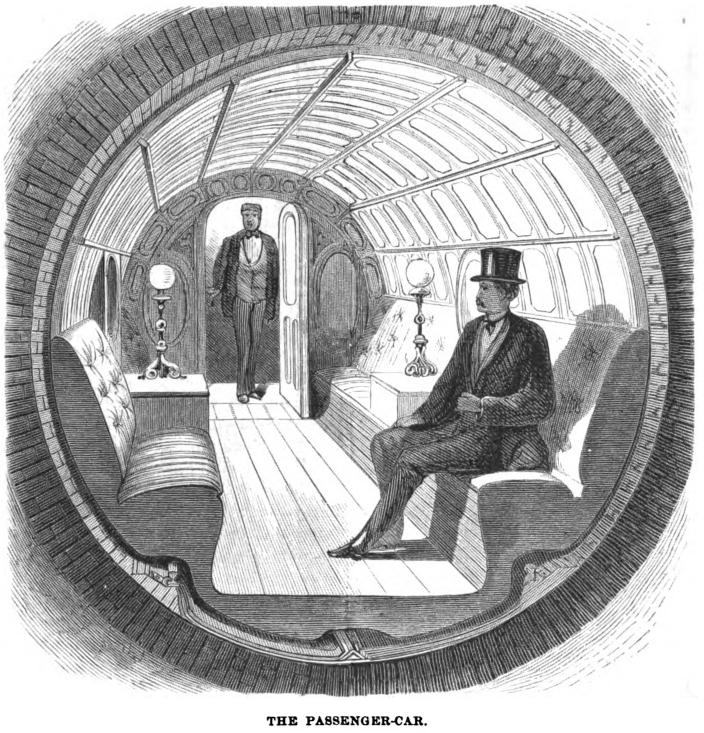
If you can get 40kms in 45 minutes, then you can live within 40 miles of work and commute in that time. If you could go 400kms, then that becomes your commuting radius. We've seen people spread this way as earlier mechanized transport was invented. IE, average commute times didn't go down because of faster transport, distance traveled (KMs consumed) went up. Total commuting time can even increase as transport gets faster/cheaper.
If I could get to hong kong in 15 minutes, I might go there this afternoon for some dumplings.
That creates some strangeness in transport. You can't really solve transport the way people want, which is to make getting where they're going better/faster. If you could get there faster, more people would be going there (congestion) or maybe you would be living farther away.
This definitely doesn't mean it's not worth innovating, just that predicting how this will play out can be unintuitive.