You get hexagons because of close-packing.[1] Circles (or a 2D array of spheres) of the same size fit closest together when they are arranged in a hexagonal pattern. Push a bunch of marbles together and that's what you get.
The bees don't know anything about hexagons. They just make circles close together and then as the cells are filled, stepped on, and come into contact with other wax cells, they "ballon out" into a hexagon shape.
There are several different criteria you might want to optimize for that result in hexagons, not just close-packing of circles. (Obviously they are somewhat related, but if you step up to 3 dimensions then you start getting different shapes/structures for different criteria, such as a diamond lattice, an FCC lattice (voronoi cells make a tiling by rhombic dodecahedra), a tiling by truncated octahedra, ....)
In particular, bees probably make hexagons because that minimizes the amount of wall you need per area, for a given cell size. If bees were really just making something like a voronoi diagram from somewhat spread out points, you wouldn’t get quite so regular a hexagonal tiling.
I imagine there’s some research about the precise method by which bees build their honeycombs, if anyone wants to go dive into the literature.
Bees make hexagons. I've seen tons of horizontal and odd shaped burr comb that is still hexagonal - which if they were truly making circles would remain circles as there is no vertical load.
I wonder if it could be related to an insect equivalent of grid cells, neurons involved in dead reckoning found in mammals. The firing pattern of a grid cell is a triangular or hexagonal pattern depending on how you look at it. Drosophila's ellipsoid body neurons have been shown to behave similarly to head direction cells so it's not implausible.
Is this the generally accepted explanation now? (I thought so, but the article itself doesn't mention it - then again, the article seems full of pseudo-science)
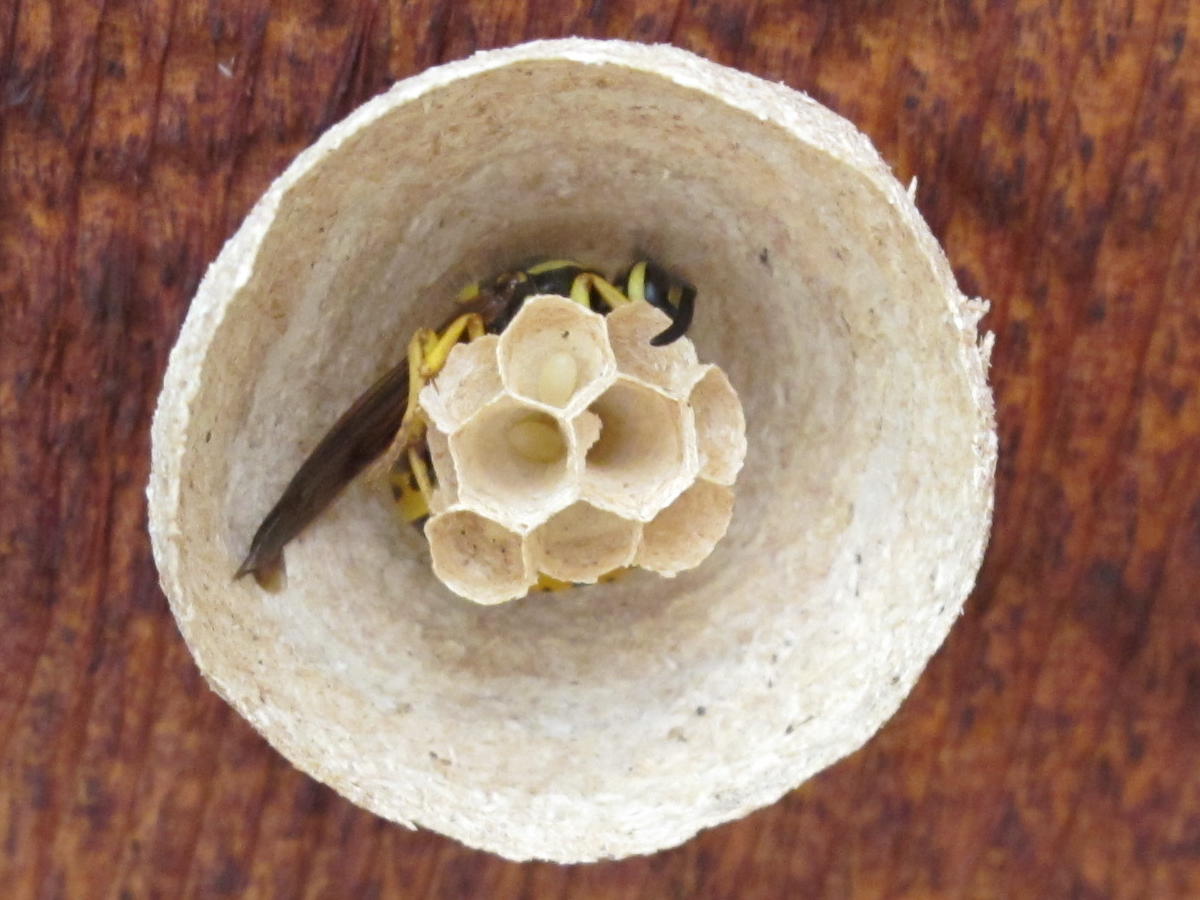
Not sure if bees might do it this way - but just looking at pictures of early stages of nests such as [1] or [2], wasps apparently don't: It looks as if they do construct proper hexagons from the get-go.
Jürgen Tautz's "The Buzz about Bees" mentions this.
It says the bees build cylindrical cells around themselves initially, but then raise the temperature of the wax to 37-40 degrees C, when the wax is warm enough to flow into the hexagonal shapes.


The bees don't know anything about hexagons. They just make circles close together and then as the cells are filled, stepped on, and come into contact with other wax cells, they "ballon out" into a hexagon shape.
[1]https://en.m.wikipedia.org/wiki/Close-packing_of_equal_spher...