Wages aren't growing because people aren't worth more. Most job growth is in low-skill jobs.
For wages to grow, people have to be paid more than they're worth as an economic unit. That's what unions are about. "More", as Samuel Gompers would answer when asked what he wanted.
This was a well understood concept in the 1950s, and was accepted by both management and labor in the major US manufacturing industries. The UAW - auto company contracts of that era explicitly tied wages to increased manufacturing productivity. It still is somewhat accepted in Germany, but is dead in the US.
Part of what killed wage growth was the demise of Communism. Communism was once a serious ideological threat to capitalism. From the 1920s to the early 1980s, there was real fear in the business community that communism might work. It might deliver a better life to workers. There was competition in ideology, and capitalism had to provide an increasing standard of living or risk countries going communist. Communism never did deliver a better standard of living, but the presence of a competing system which more or less worked kept capitalism honest.
With the demise of the USSR, and China moving away from its strict communist roots, the competition disappeared. Capitalism became a monopoly. Then it started acting like one. There was no longer any need to deliver a better life to workers.
That doesn't explain it at all. If you look closely, corporate profits have been increasing (example compared to 90), but wages haven't. That means that workers have been more productive, but are getting paid less (they increased output/efficiency, but their wages have been stagnant).
That means that corporates have leverage over labour (ie, either importing from cheaper countries, or automation, or guest workers, etc)....
My hunch is the increase of globalism (since the 90s) caused this. Communism fell, more skilled people available in the market, more open borders, etc... which gives global companies more leverage. It is very easy to spot:
The productivity gains are due to capital, not to any improvement on the part of the worker. When a more advanced machine lets you replace 10 unskilled workers with 1, you don't pay that operator 10 times the wage, you pay him the same wage or even less. Why less? Because there are 9 people waiting to take his job if he quits.
> The productivity gains are due to capital, not to any improvement on the part of the worker.
Tools that increase productivity however do come from improvements made by workers - namely the workers whose labor is absorbed into the firm that sells the technology.
The money to pay for the machine comes from revenue earned by workers. The company has to value the employee's work more than their wage for this to happen - so there is selection pressure for willingness to accept low wages; lower wages means greater profit; greater profit means greater precarity... etc. Technology devalues worker specialized knowledge by rendering it less useful, while keeping production at least constant (e.g. being computer-literate is as valuable as it is specialized)
Many fewer people (can) produce a disruptive technology compared to the number of people it displaces, but that does not exempt them from the same selection pressure. A technology firm that depends on outcompeting others in its sector still has to make its own productivity gains. They'd likely prefer to do with one inventor what they could do with two. Maybe very long from now there will be a kind of artificial intelligence/singularity perpetual motion machine that - because of its near-zero cost of tinkering to discover improvements in its self over the competition -
no other firm can compete with. A cloud "SaaS-as-a-service" like John Lilly's fears of solid state intelligence (SSI)
> The money to pay for the machine comes from revenue earned by workers.
That's kind of the contract between workers and their employer. Workers get short-term benefit of not having any risk, and employers take the risk but receive the long-term benefit of capital.
But that's the thing, imo. There is a big difference between a contractor and an employee (whose contract is very different).
Does this really mean that the amount of profit the employer makes is an adjustment reflecting how little risk the employees take on because they didn't take a chance to start their own companies? With employees whose income they would then hypothetically make the same adjustments to?
It's not obvious that the employer is justified in protecting themselves from their own risks with money skimmed (relative to market value) from consenting employees. These workers allow it because they still prefer it to being unemployed or a contractor themselves. But in theory they are doing worse being a part of the company than if they did the exact same actions (magically disembodied from the company monad) would be compensated, if they took the risk for themselves. The employer's risk is if they don't find enough people who are willing to risk not taking enough risks!
If having more employees means having more sources of income, big employers would not have as pressing a demand to hedge against catastrophic events; so they would recalculate the risk adjustment fee built into wages. Rarely do you see large employers give their employees better wages to reflect the company getting past earlier stages of high risk.
Basically in the long-term the value to being a capitalist is getting others to pay you for working for you. The ability to suppress wages pays for this profit - and that ability comes from contracts being costly to arrange themselves. If we could reduce the cost of contractual work and more people did it, most if not everybody would be better off, except for the people profiting from mutually-satisfactory contracts being difficult to do often.
Taleb gives this a good treatment:
"If the company man is, sort of, gone, he has been replaced by the companies person, thanks to both an expansion of the gender and a generalization of the function. For the person is no longer owned by a company but by something worse: the idea that he needs to be employable
...
A free market is a place where forces act to determine specialization and information travels via price point; but within a firm these market forces are lifted because they cost more to run than the benefits they bring. So the firm will be at the optimal ratio of employees and outside contractors, where having a certain number of employees, even when directly inefficient, is better than having to spend much resources negotiating contracts.
To be fair, many of these jobs are things like "Irasshai" callers and bank door openers and the guy who literally just stands on a podium at Nagoya station. (Is he still standing there?)
I wonder where those 9 people are though. Locally, for a given job opening, that could perhaps be true. Nationally however, unemployment is at historically low levels in many Western economies; 4.3% in the UK, 4.4% in the US, 3.9% in Germany, 6.2% in Canada, 4.8% in New Zealand.
Which should then drive an increase in wages. But it hasn't, and economists don't know why - or at least as far as this armchair economist has read ;-)
The US unemployment rate is based on the labor participation rate, a measure of the percentage of people who are unemployed and currently looking for work. It does not account for people who are unemployed and not looking for work. There is a real surplus of labor and employers know it. The vanity statistic that the US publishes has no basis in reality.
I don’t think that’s a very good description of U3, which is the headline rate the US typically uses. Specifically, labor force participation is usually a shorthand for overall workforce participation, looking at everyone of prime working age; that’s not U3. All unemployment measures are linguistically indistinguishable from “labor force participation rate”, so there’s nothing special about the US there.
I agree that U6 and prime age labor force participation rates are both weak, and relevant to worker bargaining power, but to argue that U3 has no basis in reality is absurd.
If I’m looking for labor this month, my pool of applicants will be coming from the U3 pool, people who are actively looking for work.
High U6 unemployment suggests I might do better to raise wages slightly, rather than aggressively, if I urgently need workers.
That guy who works 12 hours a week in the grocery store, because the company doesn't give him any hours most days? Doesn't count as unemployed, but might as well be.
> When a more advanced machine lets you replace 10 unskilled workers with 1, you don't pay that operator 10 times the wage, you pay him the same wage or even less.
But this is an unacceptable, or at least undesirable, outcome - for the majority of people anyway. If there is more wealth sloshing around the system, and fewer people involved in creating it, more of it should go to the person helping to create it. If this is what our economic system encourages our system is sub-optimal.
If it's due to capital then the companies will reduce prices of the goods they produce (assuming there is enough competition). The consumers then can use the savings to spend it on more labor intensive products.
Is that happening at any scale though? Theoretically capitalism would do exactly as described but we are not operating in a purely capitalistic society by any margin
> corporate profits have been increasing (example compared to 90)
Survivorship bias. Amazon, Wal-Mart and Costco profits have been increasing. Profits of Borders, Mervyn's, The Limited, CompUSA, Linens'n'Things, Fresh'n'Easy, Payless Shoe Center, Blockbuster Video, Hastings Entertainment, Tower Records, FAO Schwartz, KB Toys, Circuit City and RadioShack - not so much.
Internet (or wide availability of catalog shopping combined with reasonable delivery options) concentrates things like retail or media distribution in the hands of the very few.
Corporate profits have risen as a share of the economy[1] and, correspondingly, the share of gdp that's paid in wages and salary has been declining[2].
The very same St. Louis Fed no longer considers wage/salary data to be a reliable measure - employer healthcare costs per worker are now much more substantial and are growing at much faster rate. "Real compensation" is the preferred nomenclature to account for the total compensation package.
Remove the tax deductibility of employer healthcare plans and watch the wage/salary graph magically grow, as the funds get reallocated. Sure, the worker now must buy their own health insurance, which potentially leaves them with even less disposable income than before, but the gross wage/salary graph will go up and to the right.
A good reason why healthcare should be removed from employers hands. In fact we should only allow salary increases or money for benefits, not benefits such as healthcare for employees. "Real compensation" is not a good measure because it is so unique to situations, and in most cases benefits are not all that great, workers would always take more money and the consumer economy and individual/family insurance market would benefit from that as well.
Everyone needs to be in their own individual/family insurance, group everyone together across the nation and move it away from business/employers and selective grouping. Employers do not pay your auto, home, liability insurance of your personal property, why should they have anything to do with your health, that alone is an invasion of privacy and not secure for workers when they can't work due to health.
Allowing employers and insurance companies to fix prices in backrooms is part of the problem of wildly inflating healthcare costs due to bad insurance grouping. It also let's companies off from wage increases by saying it is all part of "real compensation" when in actuality the velocity of money is at an all time low[1] in a consumer economy, red alert...
I have a fundamental issue with a building block of your argument - Real compensation being a bad measure.
REAL compensation will always exist.
Simple systems, like first order approximations, can always do away with complex balancing constants, or recursive functions/costs, and feedback loops.
Similarly, in any real world situation, some fraction of firms will always find a way to plump up their employee compensation, without having to put a real cost to it.
So for example -
Major tech firms have on campus gyms, doctors, free food and so on. (We'll be ignoring the fact thaty they have campus-es in the first place)
Startups do it by offerring risk/reward tradeoffs.
In India I know Firms that provide complimentary transportation - and manage the insurance for that transportation.
Pilots and their families fly free, hospitals give admin staff better health care access, so on and so forth.
These are descriptive, non exhaustive examples.
The point being made is that Real Compensation in the real world will always have to be a calculated/inferred field/value.
So do you prefer getting more money or that same value or less in benefits that you don't decide?
Cash/pay let's YOU decide what benefits you need.
Yes there may be freebies and certain benefits available such as flying for free if there is a seat available, free food, or free passes to places you work etc, these are designed to keep you at work or involved as well.
However healthcare and insurance should NOT be managed by companies that you don't work at typically longer than 1-2 years on average. Should our companies also pay our auto, home and other insurance? so we can change them all when we change jobs? Benefits should only be freebies that aren't private.
You also have to be careful with benefits if they go too far i.e. in the future work will have apartments on campus like in China and a throwback to feudal/sharecropper kingdoms, then your company completely owns you. Better to just get pay, freebies and handle insurance/health and your own private business on your own.
The problem with real compensation is it is not evenly dispersed, cash/pay is. The real value also needs to be spent. You might have benefits that only 25% of a workforce take advantage of, well the 'real compensation' includes everyone using that, it is a bit like a gift card that you only spent a portion of. It isn't real money and sometimes costs the company little compared to the value that is stated.
You are asking me what I like, I like having freebies. I am unsure how my preference makes a difference to the substance of fact.
They are economically easier, because the firms I know can bring economies of scale to bear on them, which I can't do on my own.
But that's opinion.
You are arguing the merits of Real Comp - as if there is some world in which Real comp will NOT exist.
The issue I am pointing out, is that this is a theoretical world, like round cows.
In the real world, this will always be the case, so aside from a rhetorical device, or thought experiment to examine certain models, its not a practical item.
There will always be a situation, Such that, firms in different industries, will possess capital and service advantages, which make it easier for them to pay X$ in costs to the firm, and provide (1+C)*X$ of benefit to their employees.
Real compensation includes these items below and in typical cases employers say they pay 30-35% in benefits, 65-70% in wages:
- gross wages and salaries earned by employees and payable in cash.
- cash allowances, overtime pay, bonuses, commissions, tips, and gratuities if paid by the employer to the employee.
- remuneration in kind paid by the employer to the employee valued at purchaser's prices, including meals and drinks, personal accommodation, uniforms worn outside of the workplace, vehicles or other durables provided for the personal use of employees, free personal travel, free personal fuel, recreational facilities, transport and parking subsidies, and creches for the children of employees.
- real or imputed social contributions and income taxes to government payable by the employee in respect of employment.
the value of the social contributions in respect of labor hired, which are paid by employers – these may be actual social contributions payable by employers to social security schemes or to private funded social insurance schemes for employees; or imputed social contributions by employers providing unfunded social benefits.
- income of students from paid work, including the value they contribute through work for an educational institution.
- income received by shareholders who are also employees of the corporation, and who receive paid remuneration (e.g. stock options) other than dividends.
- income by outworkers who are paid by an enterprise for work done.
- the value of the interest foregone by employers when they provide loans to employees at reduced, or even zero rates of interest for purposes of buying houses, furniture or other goods or services.
My guess is you don't take advantage of all those items but your 'real compensation' includes it. Companies are paying you 30% in benefits that they retain. Yes there will always be freebies, but those should just be that freebies, nothing to do with personal health insurance and healthcare. Just pay people more.
For businesses it all comes down to deductibility. Company cars were deductible back in the days, so everyone and their brother drove a company car. Then the tax reform removed that deduction, and all of a sudden company cars were no more.
Making insurance deductible is also advantageous to large caps over small businesses - Amazon will likely negotiate a better insurance package than Joe's E-Commerce Emporium, and all else being equal rational employees will choose Amazon for their amazing benefits. Which then negatively impacts new business creation, small business employment, entrepreneurship rates, geographic mobility, etc.
True, but they could easily get the same deduction for wages/salaries/pay, same rules apply really and labor costs are probably less gamed in terms of balance sheets.
Benefits on the job were probably needed at a time but currently they are favoring large caps like you mention. This is ultimately the worst legacy thing that unions left behind eventhough they helped pay go up and brought some good things. Unions should have always been on more pay not benefits. We have got to start leveling the playing field for small/medium business and even self-proprietors. Removing health insurance from employers is key, this will also help being able to change jobs more frequently and not contribute to ageism so much.
Insurance companies group people by company usually so small companies are high risk, and individuals even more, the worst way to spread risk. Plus as companies grow more and wages grow less, companies will start to reach a feudal/sharecropper like state where you starting a business is nearly impossible because there is no way to compete.
Which then negatively impacts new business creation, small business employment, entrepreneurship rates, geographic mobility, etc.
Agreed, this also makes it much easier to start companies in places other than the US that also have a single-payer/individual or private market option and not require the employer to provide it. Employers handling our healthcare and benefits really has added drag to our economy and entrepreneurial/innovative spirit.
> Removing health insurance from employers is key, this will also help being able to change jobs more frequently and not contribute to ageism so much.
Agree. Unfortunately, there's zero political will to do this. Republicans seem to be hell-bent on destroying Obamacare as a concept, no matter the consequences, and view decreased number of sign-ups and decreased number of insurance sellers, as positive developments and proof that the system "doesn't work".
Democrats would surely welcome decoupling of employment and health insurance, right? Except ACA mandates employers with headcount 50+ offer health insurance, which robs the exchanges of a fairly healthy portion of the population that's fit enough to be in the workforce (prior to ACA mandatory health coverage applied to employers with 100+ headcount).
Some employers have run the numbers and figured out that if they paid the ACA fines and transferred the employee health coverage to a public exchange, their balance sheet would still be better off. Double win for a federal government - not only there's extra revenue in terms of fines (the money that previously went to a private insurer), the exchange gets bolstered with a significant number of new participants, which dilutes the risk pool and hopefully make everyone's coverage cheaper. Not so fast, said Obama administration, and slapped an extra fine to discourage such behavior https://www.nytimes.com/2014/05/26/us/irs-bars-employers-fro...
> Internet (or wide availability of catalog shopping combined with reasonable delivery options) concentrates things like retail or media distribution in the hands of the very few.
Which is crazy if you think about it, decentralization was supposed to allow others in but really the internet gave the bigger companies such an exponential advantage that they ate everything else. Combine that with wage stagnation since 2000 and the consumer economy dwindled and thus killed off many players compounded with the innovation and technology of the web + mobile.
Higher profits aren't always due to increases in productivity. Profits can grow due to decreases in the price of raw materials (e.g. oil), decrease in competition (e.g. due to an aquisition or a bankruptcy of a competitor), relaxation of regulation (e.g due to lobbying), and a variety of other chnges in the market.
> It's not the managers or capital owners that have been driving these productivity gains either
Citation needed.
I'm under the impression most of the productivity gains since the early 1990s were due to large capital improvements, which aren't paid for by employees. And productivity increases due to decreased costs thanks globalization and open source software.
> yet they have been the ones benefiting from the gains
I think lots of arguments ignore the fact that health care has outpaced wages and CPI by more than 100% in the last 15 years. Companies still pay the lion's share of health insurance costs for employees. You don't see your paycheck getting bigger, but your total compensation (if you get employer sponsored health insurance) has risen.
> I'm under the impression most of the productivity gains since the early 1990s were due to large capital improvement
Money doesn't magically increase productivity, those gains came from that money going to very smart people who created and/or applied technology to increase productivity. They're called workers, and they are the ones who increased productivity, not the capital holders.
Throwing a billion dollars at a problem to solve it only buys you people capable of solving it, it doesn't mean you solved it.
> You don't see your paycheck getting bigger, but your total compensation (if you get employer sponsored health insurance) has risen.
This is wrong. While the majority of people haven't been seeing an increase in wages, the upper-middle class has[1]. Workers don't see things like "total compensation" when it all goes to insurance premiums. If the lower classes continue to experience a declining quality of life while the upper classes live opulently, there will come a time of destabilization. Don't you understand this? Shouldn't we try to avoid that?
Total compensation is up that is a fact, healthcare costs have risen dramatically post Obamacare and paying that cost is the raise most Americans got over the last 8 years.
>> It's not the managers or capital owners that have been driving these productivity gains either
> I'm under the impression most of the productivity gains since the early 1990s were due to large capital improvements, which aren't paid for by employees.
Expanding here, the improvement in information and communication technology (one aspect of capital investment) has dramatically increased the effectiveness of intelligent management at the top. They have vastly more signals, and vastly higher granularity, with which to make decisions.
I don't have data one way or another, but I could believe that managers' productivity-per-unit-talent has improved more than line-workers' productivity-per-unit-talent.
As other posters have mentioned above, the technology itself is not "invented" on the spot by the capitalist himself, the capitalist is not a magician who can make things show up out of thin air, the technology and the related improvements are put in place by the workers. You pay workers less they have less and less reasons to think about improving the technology owned by the capitalists. It's as simple as that.
Uh, which is why pay for IT/programmers is high, and pay for sales clerks is low. It doesn't matter if your low end worker is doing half as much if technological productivity gains increase 10x.
I've thought that that would be one of the responses, and you're partially right, of course. But in the grander scheme of things better wages for workers (including sales clerks) would, among other possible outcomes, also increase the "talent pool" (for a lack of better word) from which future capitalists will pick their "inventors" and "technicians" 15-20 years down the road.
More to the point, under the present conditions only the kids of capitalists themselves and the kids of some privileged social strata (like IT people's kids) are free to fulfill their intellectual potential 100%, because they don't have to worry if their parents have enough money for rent/putting food on the table/education, and as such they can spend their late teens - early 20s (when they've grown up a little) trying and playing with new stuff, studying whatever university courses they feel fulfills their intellectual potential etc, and not having to worry about finding a McDonald's job because their parents have left them with nothing. But if you pay all the workers a little more then their kids will also be able to follow the intellectual subjects they're really interested in instead of studying and learning only to get a job, any job, in order to pay down the future student-loans faster. These people would very rarely be interested in inventing new stuff for their "capitalist" owners or in becoming entrepreneurs (which it has been proven that it's good for capitalism, I mean, there being more entrepreneurs).
The same argument (only much better put into words) was made by J.S. Mill when he wrote about why women should be fully allowed in the workforce on the same level as men. He found it really, really inefficient that about 50% of the human population was taken out of the intellectual pursuits, which for us, as a species, means that we get to have 50% less inventors/great artists/technicians.
Why would let say business owner care about the increase the "talent pool" 15-20 years down the road ? By then maybe the technology is improving to the point you need even less talent.
Your second paragraph, why would the business owner care about their workers kids ?
> Why would let say business owner care about the increase the "talent pool" 15-20 years down the road ?
Because said capitalist presumably has kids, and he wants his kids to have a bigger talent-pool from where they can choose their future employees so that the company can continue to prosper. But you're right, nowadays "business owners" doesn't mean "capitalist" (or a bunch of capitalists, let's say maxim 3 or 4), it usually means some anonymous pension funds which appoint administrators (i.e. CEOs) to run the business for them. Of course that those CEOs don't have any incentives to look forward in time because their kids' future success doesn't depend on what their present company is doing. Schumpeter decried this phenomenon as early as the 1930s, and predicted that will "help" with the demise of capitalism.
> Your second paragraph, why would the business owner care about their workers kids ?
I hope I answered this in the previous paragraph. In short, the business owners' kids will need to have employees on their own (and good ones at that) and relatively speaking prosperous clients. If you don't care about the kids of today's workers then you're reducing both the numbers of your kids' potential very good employees and prosperous clients.
> Wages aren't growing because people aren't worth more. Most job growth is in low-skill jobs.
This is a silly, self-defeating argument.
Wages aren't determined by "worth". Wages are dictated through negotiations, and they are set based on the worker's negotiating power. If a worker is incapable of negotiating, nor does he have negotiating power over their company's representatives, then he is bound to get the raw end of the deal.
This is precisely where unions and worker's commissions play a central role in the problem. When an isolated worker tries to negotiate with the company, more often than not he faces professional negotiators skilled in cutting down salary expenses. The odds are, from the start, stacked against the worker's interests. This problem is mitigated with the help of an organized worker force, as they can provide professional services negotiating job offers and leverage more power over the company's representatives. Therefore are able to get much better deals than the average worker acting alone.
>The odds are, from the start, stacked against the worker's interests.
If I negotiate a contract with a child for them to work for me, it is illegal because we realize the power difference between the average child and average adult is bad enough to justify banning child labor. Yet the power difference between trained negotiators and the average job seeker is as big a gap.
True. Also the employer often has leverage. There may be other candidates for the job. The job seeker may be in dire need of a job. Hardly a fair stand for any negotiations at all.
> The job seeker may be in dire need of a job. Hardly a fair stand for any negotiations at all.
Precisely, and that job seeker may be completely oblivious to the fact that the employer may be offering 100 but actually pays 200 to all workers on similar positions within the company filled by less qualified people, and may have some urgency trying to fill the job opening.
As the job seeker falls victim tho the information asymmetry, he proceeds to get screwed over and receive half of what he would otherwise get.
>This problem is mitigated with the help of an organized worker force, [...]. Therefore are able to get much better deals than the average worker acting alone.
Yes, that's the simplified happy ending for voting in a union but the reality is complicated by factors outside of the union's control.
E.g. A $15/hour worker considering a union weighs the possibilities: a raise of wages to $20/hour or a reduction to $0/hour because there are no jobs at all.
That's the complicated calculation. Union representation can negotiate a Collective Bargaining Agreement to raise wages but a union can't guarantee the existence of the jobs[1] to pay those wages. Many employees know this which is why they reject unions. UAW has tried to unionize workers at Toyota in Kentucky for decades and failed. Nissan workers in Mississippi just rejected a union vote last month. FedEx Freight drivers in North Carolina and Pennsylvania recently voted and decertified their union in July 2017 after voting for it in 2014.
Some workers genuinely feel a union will make their economic lives worse. The unions' promises of better wages mean nothing if the plant closes and workers weigh that possibility when rejecting union representation. What arguments do we use to convince these people that they haven't already heard from pro-union organizers?
[1] examples:
Seattle union can't stop Boeing from locating the new 787 Dreamliner factory in South Carolina with no unions.
Steelworkers union in Indianapolis doesn't stop Rexnard from eliminating $25/hour jobs which cost more than $3/hour jobs in Mexico.
Nabisco (Oreo cookies, etc) moves production to Mexico instead of keeping the higher wage union jobs in Chicago.
The common theme is that the fear of no jobs is not FUD nor a theoretical threat. Workers know it actually happens.
If you're interested in the topic, Jane McAlevey, a labor organizer, has done a lot of interviews (and written a book I haven't read) detailing her theories of why unions have become less effective and less appealing to workers, as well as what she thinks they can do.
> Yes, that's the simplified happy ending for voting in a union but the reality is complicated by factors outside of the union's control.
If some factors are outside of of the trade union's control then it's also outside of the worker's control. Therefore, forming an union has no impact on the problem.
A trade union has in fact control over important aspects such as wages. The odds of a negotiation between a candidate and a HR representative benefiting the candidate are fare more favorable to the candidate if he has at his side someone who is informed about the company's hiring practices and salaries and has a vested interest in improving salaries paid by the company to his fellow colleagues. If a job seeker goes into a negotiation room alone then this information asymmetry alone is bound to screw him over during negotiations. The presence of a union representative is very effective at mitigating this problem.
>If some factors are outside of of the trade union's control then it's also outside of the worker's control. Therefore, forming an union has no impact on the problem.
I think you're oversimplifying again. Many workers who vote "no" and reject union representation believe that unions create problems for workers including the problem of jobs being moved elsewhere.
Also, does "no impact" include workers paying extra ~$1000/year in union dues and the possibility of not having jobs? Many workers don't see the logic in paying more money to make their lives worse. E.g. Why pay my Bakers union rep to play hardball with Nabisco management for high wages of $26/hour so that I end up getting $0/hour? The theoretical "win" of $26/hr becomes a real-world "loss" of no job which pays $0/hour.
There are interesting game theory dynamics of "workers vs unions vs management" that your comment ignores. Each party has different leverage and different ultimatums. A bakers union is in a more precarious economic situation than a teachers union.
>A trade union has in fact control over important aspects such as wages.
Yes, I already stipulated that. Your comment ignores the other things that workers consider besides wages -- e.g. no jobs.
It seems you're not aware of the reasons for workers to deliberately reject unions.
> I think you're oversimplifying again. Many workers who vote "no" and reject union representation believe that unions create problems for workers including the problem of jobs being moved elsewhere.
You're somehow assuming that forming a union involves forcing everyone to join an organization whose membership is purely voluntary.
> Also, does "no impact" include workers paying extra ~$1000/year in union dues
That's an imaginary number that you made up yourself, and it represents only your own imagination.
> Your comment ignores the other things that workers consider besides wages -- e.g. no jobs.
That's your strawman. You somehow made up this argument that having someone at your side helping you out on your negotiation will somehow force a company to stop hire people to fill the positions they've just opened. Meanwhile, agents are a thing, and having third-party help in your negotiations didn't brought the end to western civilization.
>You're somehow assuming that forming a union involves forcing everyone to join an organization whose membership is purely voluntary.
Well, the Seattle union is "closed shop" at Boeing which makes union membership mandatory for employment.
>That's an imaginary number that you made up yourself,
The GM union dues are ~$957.[1] The Ford amount is ~$693. The estimated union dues were ~$800 for Nissan workers who voted "no" to union representation. For all 3 examples, the union dues are not static -- they are expected to increase.
We can use the lower $693 figure if you wish. Can you see that many workers don't agree with you that $693 is "no impact"?
Somehow, you've turned a blind eye to the fact that your own source states that the US national average for union dues are $377 per year.
Let that sink in for a minute. The average union within the US receives only $377 per year.
That's about $32 a month.
So, the median wage for workers in the United States is around $3400 per month. And somehow a $32/month fee is made out to be a deal breaker?
Is that what's stopping you from being repeatedly screwed over by employers who spend more on professional services dedicated to screw employees over than adjusting salaries?
>And somehow a $32/month fee is made out to be a deal breaker?
Yes, it is _if_ workers believe it makes their economic situation worse.
I'm stating that workers weigh the balance of both
the positives and the negatives of union representation. You are only stating one side: the positives.
Yes, even $377 can be too much money to pay especially if it has the unwanted effect of incentivizing the company to move somewhere else. Since workers are concerned about this bad outcome, you can't just handwave it away as if their fears are just imaginary.
Perception is an issue. I had a non-unionized coworker claim that union dues were high when I suggested unionizing. When I told her what I payed, she was stunned at how low they are. People often miss the point that unions are about more than exerting power. They also much more efficient at representing workers. (Organizations benefit from that as well, but they are far more concerned with the average worker gaining negotiating power.)
He's using hyperbole, but his arguments are valid in explaining the rationale that some workers feel when considering a union.
Some unions are so hawkish that they impose hiring blacklists on affected employers, making membership mandatory instead of voluntary. Additionally, in the rank and file, there's a common fear of union corruption.
That hypothetical problem is anecdotal, and assumes that a job seeker has no say in how he is represented.
Meanwhile, the whole world is packed with examples of how unions do in fact work for the interests of their associates. For instance, there are companies in Sweden that inform job seekers right at the start of the job application process that they should contact union representatives to help them during the hiring process. This offer is presented to anyone, whether they pay union quotas or not, and anyone decides if they even want to contact the union or not.
Do you believe this is a draconian measure imposed by unions on unsuspecting job seekers, or that this is remotely against the best interest of any worker?
A union is what you make it out to be. Right now, workers are getting screwed over to the point where HN receives a constant scream of posts on how workers should improve their negotiation skills. Hell, if that's so important then why isn't everyone doing the smart thing to do and delegate that activity to a dedicated third-party representing the worker's best interests and specialized in negotiating job offers and working conditions? It's simply stupid to assume that everyone can pick up an O'Reilly-type book on negotiating job offers and suddenly be able to go head-to-head with a professional negotiator paid to drive down your wage.
If it's anecdotal - that is, it happened at least once, so there's an anecdote of when it happened - then it's not hypothetical.
And, in fact, it's not hypothetical. It happens. It has happened. Instances have been cited in this thread. It may not be the statistically most likely outcome, but it does happen.
I'm probably not adding much to discussion after many commenters, but this one rings for me as non capital-oriented citizen:
>The common theme is that the fear of no jobs is not FUD nor a theoretical threat. Workers know it actually happens.
Iow, not the one who negotiates wins, but the one who has time on their hands. If workforce "feels" too expensive, average capital can just sit on deposit and wait for new ideas. If worker's salary feels too low, she cannot just sit and wait or requalify for new job quickly. This asymmetry pushes workers down on their wages without a chance to negotiate, because there is nobody to blame. Investments are diversifiable, professions aren't.
While capitalism shown world-wide success, it forces everyone to follow only one life style, otherwise you're wasted. Personally, I'm pretty fine with how I live due to the path chosen from the start and personal interests, but I don't like what all this does to "regular" profession workers. People are almost punished for what they liked to do, or simply for the fact they aren't interested in business, aka someone else's sky-high profit wars.
Otoh, while theoretical basic income program could buy time for workers, it would also demotivate capital builders more. It seems like pretty thin balance there, if it exists at all.
This is entirely accurate. The union has been trying to get workers at Boeing in Charleston to unionize ever since it opened.
The workers don't want to unionize. The reason?
Well, as it turns out...there are jobs there now that weren't there before. Those jobs could have gone somewhere where the union existed...but didn't.
So the people there...pretty happy to have quality jobs from a great company. A company that adds jobs continuously even through a recession...and the union forces a strike every 7 years or so costing the company about $1 billion every time.
Union negotiating power is based almost entirely on it's ability to hold the company hostage. It's the job of executives to look out for the best interest of the company and that, just like infrastructure planning, means redundancy.
It's the same approach as tax policies or raising minimum wage...it only works if the people involved have no other options.
Maybe someone in a union can answer this but from an outsider it appears that unions flatten the salary discrepancy between outstanding performers & poor performers.
I see this in education a lot where bad teachers that parents try to avoid end up making the same as the amazing teachers that parents beg to have. The bad teachers don't get removed so new teachers are prevented from getting a job at that school.
Exactly. The worth argument is a diversion and bait set out by hiring side. It is only in play when the employee is purely driven by performance, like in professional sport. That is also why sport personalities have agents.
Just because regular business profits are several layers removed from a regular employee does not mean that there's no link to performance as well, but business usually does not like to share( raise salary ) to not set a precedent.
I for one would love to have an professional agent that looked after me in return for good career progression. Even the rock starts among us know that it takes skill and luck to get paid what we are really worth
If a union wants to negotiate, then you just move the manufacturing to a cheaper country. There is plenty of labor willing to work at a lower price, and that is what happened.
> If a union wants to negotiate, then you just move the manufacturing to a cheaper country.
This is a disingenuous comment. Having a professional negotiation negotiating with a HR representative on behalf of the worker does not force a company to move their offices abroad.
Moreover, moving a company somewhere else entails a heavy cost that more often than not the company is unable to pay.
I don't understand why people assume that the worker force has to bend over repeatedly and perpetually, particularly when we are faced with stagnant wages in a time of low unemployment. This clearly shows that the job market is being manipulated to serve the interests of these corporations, in a time where high-skilled workers remain peddling for cash and without any job security.
The workforce doesn't have to bend over, but there is an inequality in negotiations when the company threatens to ship the work to somewhere where they can pay workers a fraction, even if the quality will be shit.
We don't exactly have a legal framework to prevent companies from doing this either
> I don't understand why people assume that the worker force has to bend over repeatedly and perpetually
At first I was going to correct you and say "bend over backwards" - then I realized you got it exactly right. Some of the high-skilled workers - on hn no less - will say "I'm better off negotiating the angle at which I bend for myself"
I’m not assuming anything. The “heavy cost” you are referring to is obviously not heavy compared to paying US wages and cost of regulations. The proof is the fact that everything you pick up in your room will probably say Made in china and your shirt will say Made in bangladesh.
If the union was any good, they would negotiate a price that was better than the individual could get on their own but cheaper to the company than moving a whole factory half way across the world. There is a spectrum between the two extremes where negotiation should take place.
I mean I know factories in India which have buildings with asbestos roofs.
China has grizzly videos of workers moving metal scaffolding and then accidentally getting electrocuted as it moves into exposed high voltage cable.
And that is still a step up from the misery there was before.
I don't see how you can afford environmental protections, worker safety, when instead for a small fraction of the cost you can just send the request to a contractor, and then say "Oh we didn't know the conditions in the factory were bad. We thought those quaint third world concepts were just rumors! Oh those poor souls!".
> I mean I know factories in India which have buildings with asbestos roofs.
And how much would your company be forced to pay and abdicate to relocate their headquarters to that asbestos-packed hell-hole?
Do the company's middle and upper management tolerate the idea of moving to a different continent and be forced to live with inhumane infrastructures setup by inhumane and careless middle and upper management types?
Not every job is a factory job or involves low-skilled grunt work. Not all companies are willing to lift the proverbial anchor and relocate to a different continent just because a job seeker has a trade union representative with him during negotiations.
No matter how you cut it there's less overhead in those countries.
Depending on the nature of the good and the scale it's almost impossible to have the price of the good be competitive when it gets to the first world.
At high volume it's easy to amortize the cost cost of teaching a factory in overseas how to make for example a high quality forging that a first world supplier could produce properly the first time without asking questions.
If you're gonna need to make a different forging every year then you might want a supplier closer to home that you don't have to hand hold.
If you're making something with less safety/environmental overhead than the steel forging then that tips things less in favor of off-shoring.
I think the previous comment makes a good point that most new jobs are at Starbucks, Target and Wal-Mart. There is no negotiation for typical hourly wages at these places. They pay the going rate and that's typically poverty level.
This is something Robert Reich wrote about in his books, but he described it in terms of a postwar "pact" between labor and management wherein in exchange for stability in labor availability (no strikes and revolts), management would accede to unions' demands for living wages and other benefits for workers.
The idea was that this provided a mutual benefit for both sides by enabling both growth and predictability. As another benefit, better pay allowed workers to increase their own consumption of goods, which also fueled growth, continuing a pattern stretching back at least as far as Henry Ford.
But according to Mark Blyth, the result of this was major inflation, caused by a positive feedback between between the cost of labor and the cost of goods. This inflation was great for debtors (predominantly labor), who saw the real size of their debts (mostly mortgages) whittled down [1], but bad for creditors (predominantly capitalists), who saw the value of the debt as an asset crumble.
Blyth claims that the globalist system was fashioned by the creditor class to hobble inflation by lowering the costs of production by lowering trade barriers and allowing goods to be produced in the places that could do so at the lowest cost. The idea was that it would simultaneously lower the cost of goods and labor, while also checking inflation, creating a more favorable situation for the debt owned by creditors.
The upside of this has been a dramatic reduction in the number of people living in poverty globally, especially in Asia. But there were unintended(?) consequences, including the demise of entire US domestic economic sectors (i.e. textiles) that used low skilled labor.
The part that segues with the demise of Communism was that at the time (the 80s), there was growing belief among labor that the advocacy of unions was unnecessary, that they could get by, and perhaps even do better, as individuals without such organizations fighting for them.
This probably was and is true for certain industries where workers inherently had more power due to either the uniqueness of their skill-sets or some other factor. But for a lot of workers, this has not been the case, and their total compensation as employees has diminished over time. This doesn't even consider the situation with the growing segment of lower-skilled "gig" contract workers.
[1] As a corollary, those who couldn't get favorable mortgages in those days due to the systemic biases at play was not able to participate in this upside of inflation. https://en.wikipedia.org/wiki/Redlining
> Part of what killed wage growth was the demise of Communism.
Also, communism was so inefficient that it basically took the countries under it from international competition - they couldn't develop anything advanced that would match products created under capitalism, and so were essentially forced to sell resources (eg. minerals, food) or low-processed industrial products (eg. steel) in exchange for more advanced stuff such as medicine or electronics, for which they paid through the nose. Basically, the process was not dissimilar to colonialism that preceeded it, and created massive growth for capitalist countries - so much so that in the US people doing unskilled work could afford a good life for their family on a single salary. Now that communism is dead, those unskilled people in the West are unfortunately in for some rude awakening (already in progress).
Well, from a long term scale, it was inefficient because workers were not incentivized to work. I would imagine stagnant wages have the same affect long term. They also spent way to much on their military. Perhaps the West is due for a collapse too.
They pretend to pay us and we pretend to work.
The Soviet system is not working because the workers are not working.
Single salary households existed because women were out of the labor force. Those slowly disappeared as the internal labor market grew, as you could get away with paying women less
Communist countries often couldn't even produce food. Even during the Cold War the USSR had to import grain from the USA. Millions starved to death in China.
Please point out a country that actually implemented Communism. The Soviet Union never got past Socialism, where capital was owned by the state, not by workers. Communism doesn't imply a state-controlled economy, and that's the inefficient part. Socialism combines the worst aspects of a late-stage capital ruling class with a command economy.
I've never understood why the fact that striving for communism reliably lead to disaster can be used a defence of communism. Can you explain that line of reasoning? It seems to me that's saying nothing more than "The utopia that I imagine is fantastic!". The main contention is not the qualities of the imagination, but the clash between the imagination and reality.
Simply put, it can never be implemented because perfect Communism would mean absolute genocide for the nation that manages to pull it off. All variations of Socialism function by extreme, persistent violence, to enforce the state's control over most aspects of a person's life including particularly economically (and everything else as a consequence).
The closer you get to implementing this fantasy Communism, the closer you get to death. That's why nobody can do it, it's why nobody ever has, it's why nobody ever will. It requires a staggering amount of aggression and violence to even attempt Communism, much less these idealized versions (which require 24/7 perfect violence to be applied to disallow even the slightest step outside the framework by the population).
Oh yeah, by "communism" I mean whatever was implemented in Soviet block, China, India, Vietnam etc., not what Marx and others envisioned in their theories.
I think it's a big difference, and one of the enduring legacies of cold-war propaganda is the confusion of the issue by conflating the two. A market economy is better at allocating resources efficiently than a command economy, but the argument over whether to have a command economy or market economy is separable from tendency of wealth to concentrate. The existance of winners is important to a market economy, but it also serves as an entaxic force (inverse of entropy, analogous to gravity) in the system that moves it towards greater order and centralization, until the corporate winners become de-facto states unto themselves with their own command-setting potential. Keeping the winners from leveraging their winnings to also win every subsequent round is the game we're playing to keep the field fair. That points to ideas from communism, but it has nothing to do with whether there's a command economy. Socialism is what happens when the demagogues get control of the ideology, just as they have in the US.
What we need are anti-trust protections that prevent the formation of `too-big-to-fail` entities of all stripes.
"A market economy is better at allocating resources efficiently than a command economy"
It was that way, agreed but might not always be that way.
Because free market economies have their own share of inefficiencies and moral hazards and certainly cannot be the efficiency pinnacle of human civilization.
I don't know what computers and networks will be capable of in the future, but it's worth noting that command economies failed in the time before these things really took off. The weak link has always been people who's brains developed in a time when they were monkeys scrabbling under trees and screeching at their fellows. No wonder they can't efficiently run big systems. But it's becoming evident maybe these tiny self centered brains are just big enough to design something that _can_ run a complex system efficiently.
Market economies are good at allocating resources, but they're also good at concentrating resources, which kills the market. And in some sectors, markets don't benefit the social fabric as a whole, hence why intervention into markets is often necessary
Just to be clear, when people say "Communism" and specify "the Soviet Union", that's adequate for rhetorical purposes. You can clarify that the Soviets were merely extremely socialist if you want, but everyone else understood what he was saying.
While the sequence of events sounds like a valid sequence of events, it does not seem to be linked to the original thesis -
Ie: because people aren't worth more
Which is odd, because something obviously is worth more. The world economy has significantly grown, and keeps growing.
The capital owning section of the population are able to use that to invest or own some sort of value increasing asset.
IT seems more likely that there is more economic value being created - but the competitive strengths of a higher position in the decisions making hierarchy provides assymetric power.
Meaning that the higher you go in terms of ownership of an organization, the more you can bring people at lower levels into conflict and drive prices down.
This is not at all uncommon in Germany - I make more as an in-tariff mid-level IT staffer, recently transferred to a dev team from Windows ops, than many people I know here in software or IT consulting shops. I also work very stable hours. Independent consultants make more than me, but they also tend to have more experience and have to take the risks of self-employed independent consultants.
I am theoretically represented by the Metalworkers Union (IG Metall), despite never having machined any metal in my life. When I first started this job, I balked at the "restrictions" (strict 10 hr/day limit, 40 hr/wk contract, no Sunday work without permission from the main Works Council for the company), but after a few years, I cannot imagine going back to life without them. The six full weeks of vacation is pretty ace, too. Germany requires employers to give 24 days; the Metalworkers Union negotiated and maintains 30.
I should probably join them, or at least send them a nice gift basket. They've helped make my life here pretty comfy.
Did individual businesses really pay their workers more because they thought it would prevent the country from becoming communist? Do you have evidence for that claim? I find it hard to believe, because even if it is true that this would prevent countries from becoming communist, it is a free-rider situation. It would be rational for any individual business to keep paying low salaries because any individual business policy is unlikely to be the difference between becoming communist and staying capitalist.
A more logical avenue of analysis seems to me to consider basic economic principles. Price is determined by supply and demand. Did we see increases in labour supply that were not offset by corresponding increases in demand? Yes:
1. Women's participation in the labour market didn't quite double the supply of labour, but it greatly increased it.
2. Companies offshoring their production to developing nations also greatly increased the supply of labour.
> Did individual businesses really pay their workers more because they thought it would prevent the country from becoming communist?
No, that didn't happen. Wages climbed rapidly over a century due to extraordinary productivity gains. Each worker could produce far more real dollar value output and their worth climbed accordingly.
The reason Henry Ford could pay his workers $5 per day, was thanks to the very aggressive, spectacular productivity gains that his company's automation efforts delivered. The Ford Motor Company could produce more and more vehicles per worker, drive the price per Model-T down dramatically, and ramp the production scale into the millions, while yielding stellar profits thanks to the output gains and efficiency. Without the productivity gains in question, that wage jump (and it was quite the jump at the time) would have been impossible. Fear of Communism taking over had nothing to do with it. Ford's reasoning for going along with the big pay hike (it wasn't his idea) is public knowledge, you can read his thoughts on the matter, none of it had to do with Communism.
I get tons of recruiters contacting me on linkedin, but they always want to give me crap wages.
When I was trying to hire people a few months back, we got a whopping two applicants, one wasn't good. The other wanted to go freelance for a few months only.
We ended up getting friends recommendation - at way more than what the initial offers were.
> For wages to grow, people have to be paid more than they're worth as an economic unit.
Or for their worth to rise.
One of the ways this can happen is through Labour scarcity, particularly if their economic output is above their cost, but employers are able to lower wages due to competition for jobs.
That was very informative thanks. I think the biggest problem with allowing the 2008 crisis to run it's course is the same problem with the 1920s. It would create a Great Depression that, for the longest time, we didn't think we could even get out of. Of course with the 2008 bailout, the banks got bailed out but the citizenry did not.
Having said that, I'm not sure it was the right decision.
I not sure he exactly said that the 2008 crisis _should've_ been allowed to fail; but just that since it _wasn't_ allowed to fail, it has these consequences, compared to what happened in the 70's with the 'reboot'.
I agree. I was just pontificating on the pluses and minuses of each direction. What would it have looked like if our banking system was allowed to collapse, short term and long term?
> For wages to grow, people have to be paid more than they're worth as an economic unit.
That's incorrect, very obviously so with even a moment of inspection. Real wages grew dramatically between 1870 and 1970. That didn't happen because employers had to pay workers 20 times more than what they were worth as a static number derived from 1870. That happened because vast productivity gains made it possible for each employees to worth a lot more and thus be paid a lot more. Simply put, the workers became far more valuable because their output soared.
People are worth more. Look the amount of profits/employee that Google, Apple or Facebook have. GM, Kodak or any other "old" company needed an order of magnitude more employees.
Sure, with the demise of Communism, the capitalists appropriate this increase in productivity.
Can anyone here make the following calculation? How much would be the wage of a Google engineer proportionally to the profit generated by a GM engineer in the 50's.
You are correct about the last year or so where productivity growth was actually net negative. However for the time period you suggest where this was "well understood" productivity growth was rising rapidly. In that scenario people really were "worth more" in concrete terms year over year.
What about old-age entitlements? I see loads of cash go out for FICA-match / self-employment tax (along with a jumbo portion of debt) to top-up the underfunded entitlements of previous generations.
I doubt the younger people working today are going to get back, in real terms, anywhere near the amounts they put in.
Similarly, families who pay for their aged parents and grandparents to live in assisted or medical facilities, or their own apartments, don't get back anywhere near the amounts that they put in.
Not the same thing. Minor nitpick is that senescence care is not the same thing as free healthcare and side income from 65 and up when the life expectancy is nearly 80 years.
Major nitpic would be that Westernized peoples are barely replacing themselves, we're around 2.9 workers per retiree and falling, and it takes around a third of the annual federal budget--which roughly corresponds to the amount of debt we take on each year--to cover it.
When you set up a system to transfer wealth from young to old, it stops working so well when people stop having kids. Japan is already being crushed by this. They will not be the last.
> Part of what killed wage growth was the demise of Communism.
I have been saying this for a long time. The fall of the soviet union meant opening many countries to free markets. It also means capitalism is the only norm... which means it doesn't have any alternative.
Wages aren't growing because people aren't worth more. Most job growth is in low-skill jobs.
I tend to agree with you, given the level of automation. Automation is having 100 engineers in charge of updates, all across the world, instead of mailing floppy disks, fielding calls etc etc.
However the state should tax--one way or another--the "robots." As we know, tax rates have varied throughout the history, and are used to advance society's goals.
Ah sorry, I'm a bit emotional about this because I see an ideology that says that people are worth less than before because of automation, don't find job because they don't look hard enough, are less paid 'cos they are no risk takers, etc. And often this ideology is (on purpose or not) presented as almost mathematical. It's not the fact that there is an ideology question that hurts me, it's that the language used to talk about it often implies it's almost natural.
To clarify, are you claiming that, e.g., the Ford motor company in the 1950's purposefully overpaid its workers based on the belief that, if they were not overpaid, its workers would foment a communist revolution, which would damage Ford's bottom line?
Your first 'graph is what I'd been taught in economics, backed by arguments of marginal productivity and marginal costs. I no longer find it credible.
Among other factors, market prices for goods are not fixed, and in many ways, they act somewhat as a "hairpin bend" effect -- there seem to be activities which settle at a given price or ratio regardless of other effects. One of the more notable arguments around this is Baumol's cost disease: there are products (in particular service-heavy ones) for which wages have risen despite no increase in productivity, due to the rationale that the talent for such work would otherwise move elsewhere. A string quartet, regardless of technological improvement, requires four performers. (Though recordings, broadcast, and potentially AI-generated alternatives might be developed.)
There's a certain parallel with Amdahl's Law: limits to which any computing task can be made more efficient through parallelisation, given the non-parallel component of the task. If 1/5 of processing time is non-parallelisable, then the greatest efficiency possible, even with infinite parallel processing, is a reduction in time to 20% of the original.
For a non-technologically-enhanceable task, if labour comprises 20% of the original cost, then it ultimately rises to be all of the expense, and the maximum possible cost reduction is 20%, even with infinite efficiency improvements in all other factors.
More generally, what economics does is shift utilisation amongst inputs based on the apparent cost of those inputs, relative to their minimum required contribution to production.
Another line of argument stems from Adam Smith (who, incidentally, fails in the above argument), who describes the factors contributing to high or low wages above the minimum required for survival:
The five following are the principal circumstances which, so far as I have been able to observe, make up for a small pecuniary gain in some employments, and counterbalance a great one in others: first, the agreeableness or disagreeableness of the employments themselves; secondly, the easiness and cheapness, or the difficulty and expense of learning them; thirdly, the constancy or inconstancy of employment in them; fourthly, the small or great trust which must be reposed in those who exercise them; and, fifthly, the probability or improbability of success in them.
Smith omits a sixth factor: labour organisation (though he addresses that elsewhere).
Traditional factory work represents at least several of these factors: it's often disagreable (hot, noisy, dirty, dangerous), requires skill, may be inconstant (factories may start or stop operation based on external factors), and skilled workers may well be in a position of trust as regards capital, material inputs, reliability, and work outputs.
Smith also, in Book 1, Chapter 8 of Wealth of Nations describes at length the conditions and consequences of falling labour demand. It's a bleak picture. One I would think we'd be well advised to avoid if at all possible.
He also makes clear that the bare minimum acceptable wage is one that will provide for a worker and their family, as otherise it's not possible to sustain the next generation of labour. If you cannot operate profitably whilst paying a living wage, then what you are operating is not a business, it is a charity, on behalf of the owner, with contributions withdrawn from the life-force of the employees.
For what it's worth, Walmart pays their employees more than minimum wage. Their employee's use of welfare is also biased by Walmart employing a disproportionate number of single mothers.
There are likely solutions to this, but placing the entirety of fault at the feet of Walmart seems a bit disingenuous.
Does walmart pay overtime pay in every state? I doubt it. We can throw a lot of stones at Wal-Mart because the truth is their business model is hurting this economy. But who is to blame? Capitalism is. When you can come into a market and sell at lower than market prices and drive more people to shop at your outlet because they can spend more there. That's just normal
You cannot blame a consumer for wanting cheap products; they are just trying to make the most of what they have. But you should blame a consumer who buys meat 1-2$ less than market
But we also eat too much red meat in america; that's another topic though.
I'm pretty sure they pay overtime where required, yes? Many of their employees are only part-time and many of them are disabled in some capacity.
There is some legitimacy to the complaints of so many employees getting fewer than 31 (?) hours. They keep many employees below a certain hour threshold to avoid certain obligations that they'd have for full-time employees. Well, I guess I can't say that is why they do it, but that is the result.
But, yeah, they hire people who have work restrictions and people who are otherwise impoverished, such as single mothers or people who can only work a limited number of hours so that they can maintain their disability status. This has obvious effects on the numbers people cite when the reality is that Walmart is exceeding their legal responsibilities.
Don't get me wrong, I pretty much boycott Walmart and haven't set foot in one for many years. I dislike them and their business practices. I just figure we should work with accurate complaints.
I'd love to see them behave better but they already exceed their legal obligations. I am not aware of there being any means for them to bypass overtime regulations and I have no reason to expect they don't pay the appropriate amounts fain compensation.
They are predatory capitalists that damage small towns and are a blight on the environment as well as horrible to their suppliers. I've ample reasons to dislike them, but their employee compensation isn't one of those reasons - yet.
This is rather generous. They structure the hours of the majority of their employees so that they never get overtime hours or qualify for any benefits that might apply to a "full time" employee (which varies by state).
That's part time. I ran into that rut myself when I was 18-19 years old; had a job. But I couldn't get the benefits as they would not make me full time.
Sure overtime kicked in a little earlier but they always tried to cut it to less than 2hours a week so it actually hurt me to work overtime.
Just to throw another rock at WalMart - they also arranged to own offshore companies which provided loans to themselves to run WalMart - turning profits into loan payments and avoiding taxes. Estimates are that they hid double digit billions offshore without paying taxes. Sadly, it is perfectly legal - and it is consistent with what I've seen in the software and hardware industry. Several companies and executives where I've worked freely talked about how they transferred money offshore before taxes, so that it would never appear as income to them in US accounting.
As jacquesm pointed out, you've been posting outrageous (if true) stories about famous companies and executives to HN for years. The first several times I read those, I thought 'holy shit!' But then—maybe it was the one where you told about Steve Jobs' collusions with Bill Gates that took place on an airplane so nobody would know?—something started to feel a bit off. Anybody can post anything on the internet, after all. We have no way of knowing whether such stories are tall tales or not, and alas, sometimes users make things up.
On Hacker News, we start from an assumption of good faith (https://news.ycombinator.com/newsguidelines.html), but we also care about substantive discussion. Our goal is good conversation—a forgiving medium—but eventually you need to substantiate what you're repeatedly posting.
I don't assume that your stories are false, but by now you've built up a lot of narrative debt. So please don't post any more incredible claims to Hacker News without a significant reason for readers to believe them.
I have spent an entire career in Silicon Valley, and I have held a lot of different positions and worked with many executive teams. It reminds me of when I worked at NeXT, and told someone that we were using the Leffler library in NeXTStep. He insisted that we weren't, since a company like NeXT and someone like Steve Jobs would never allow such a thing - Steve wouldn't allow a public library inside our product. He just couldn't believe it was true - and I had no proof to offer.
I guess old-timers like me just need to be quiet and let you learn about these things over your 40 years in the business - I hope those lessons don't come too late for you.
No problem with old timers, there are plenty of those here. But their stories check out and if they accuse someone it is as a rule backed up by some evidence. See the thread about Jerry Pournelle recently and some of the people commenting in it. But if you start making stuff up or making baseless accusations then you are devaluing your experiences. And the experiences you do have a probably far more interesting than the things that you throw out there to make it all look better than it was. To me it makes no sense.
On another note, chances are that you'll run into people here that already know you from other places on the net or that know who you are in real life and who know for a fact that the things you write aren't the whole story. IT back then was a very small world and a lot of those old timers are now HN'ers, just like yourself.
I'm really beginning to wonder where you get your info. This is not the first - but hopefully it is the last - time that you make these incredible accusations against large companies, enough to put their execs in jail, only of course there is never any substantiation, just your allegation.
Previous examples of stuff I suspect you either made up in part or whole:
> turning profits into loan payments and avoiding taxes
To loan any money from an offshore entity they would have to transfer the money to the offshore entity first, and to initiate that transfer they would have to earn that money elsewhere, which would generally involve paying taxes.
Isn't that an antiquated view of the way that the economy works? I can name a lot of counter-examples - but even the current articles in the press about bank assets vs outstanding loans is inconsistent with the view of credit being somehow related to currency transfers.
Would you please stop using HN for political/ideological battle? It's not what this site is for, and destroys what it is for—thoughtful discussion for the intellectually curious.
I've spent my entire life in high-tech in Silicon Valley. The techniques being discussed to hide cash are integral to Silicon Valley companies - and they definitely impact decisions at every level of the organization. It is naive to believe that these discussions are somehow unrelated to our lives in technical positions (or our careers and the decisions of the executives over us.)
Then this whole article should be flagged and we should have never seen 'Why Wages Aren't Growing'.
It's not a political article; it's stalking about the state of our society. If we cannot talk about the state of our society and the petrodollar here on HN then HN is censoring the truth.
- Two-income households: doubled the labor supply without making an equally large increase in demand (NOT A DIG AGAINST FEMINISM, JUST TALKING NUMBERS)
- Automation. Not talking AI. Just old-fashioned mechanical engineering and micro-controllers. Not going to name any names, but almost every practical thing you buy is made in only a handful of factories, and those factories don't need very many people to run at full-tilt.[0]
- BS Jobs. Most of the US defense spending is make-work for engineers/welders/managers/subcontractors/etc working on projects of dubious strategic value. It sure as hell doesn't go to the soldiers. 30% of hospital payroll is admin staff. Higher ed is the same story.
> Two-income households: doubled the labor supply without making an equally large increase in demand
Interesting perspective. In Norway the consensus is that equal employment and the resulting doubling of productivity was a major force in increasing standard of living - way before the oil boom (corally: Sweden and Denmark are also rich/high standard of living - with no/hardly any oil industry).
It's worth noting that doubling the output of a tiny economy of 5 million people, and doubling the output of a large nation that in 1968 had half of all global manufacturing - are two very, very different things.
If you double America's output today, and take the GDP up toward $40 trillion - who is going to buy all of those products and services in the near term? Nobody, it couldn't happen over a short period of historical time (10-20 years); that supply could not be absorbed, it would be a disaster for the producing nation.
If you're Norway in 1990, and you have a $100 billion GDP, doubling that into a global economy of $28 trillion, is very feasible. If you're the US in 1990 with a $6.x trillion economy (20-25% of global GDP), doubling that quickly is essentially impossible. A global economy of $28 trillion can absorb an additional $100 billion in output from Norway fairly easily over a few years, assuming it's competitive / desired output. As a smaller economy selling into a massive ocean globally, you're dramatically less bound by the global growth rate; if you're the world's largest economy, you're tightly (not strictly) bound to global growth rates. From its smaller base, Norway can see huge economic gains and defy global growth rate limits; for example, imagine Norway having an Apple size company, that grew from $30b to $200b in sales over six or seven years, it would add 50% to their economy and that output could be easily absorbed by the global economy.
Good points - however, not sure if you're arguing against yourself here (or if you're talking about different time frames):
> If you double America's output today, and take the GDP up toward $40 trillion - who is going to buy all of those products and services in the near term? Nobody, it couldn't happen over a short period of historical time (10-20 years); that supply could not be absorbed (...)
> If you're the US in 1990 with a $6.x trillion economy (20-25% of global GDP), doubling that quickly is essentially impossible.
US GDP[1], inflation adjusted :
Dec 31, 1990 8.91 trillion
Dec 31, 2010 14.94 trillion
It's not quite double in 20 years, but it's closeish at 1.67x? (An actual question, I'm not sure if you'd consider it close). Looks like it'll be doubled this year - so I guess one could view that as the slow-down (the extra 7 years).
Apparently those numbers are in "2009" dollars - while the numbers in "current" dollars is more like 6 to 15 (as opposed to 9 to 16) in the same period - I guess this might have to do with the 2008 crash?
Did I miss something? I think their point was labor supply increased without equivalent labor demand. You are talking about standard of living which of course will increase if more people earn per household.
I can see this happening in countries with large population. I observed directly in India where there are double income households working in IT sector and their living standard is way higher in terms of material consumption and on other hand huge army of unemployed IT graduates desperate to find any job.
Growing consensus among economists is that productivity slowdown is key to understanding stagnation. The top commenter almost put his finger on it when he said that workers aren't paid more because they aren't worth more, before attributing it to the "monopoly of capitalism". In reality if the machines we rely on to be productive aren't improving much themselves, then our productivity is capped.
Technological innovation has slowed down a lot over the past 20-30 years, and is now diffusing throughout the world rather than being pushed forward by the large industrial conglomerates, pharmaceuticals, chipmakers, OEMs, etc.
F35 procurement is made from something like 40+ states. This makes zero sense from an engineering/supply chain perspective (consider the fact that Toyota has the vast majority of its domestic supply chain within Aichi prefecture, up to 3 levels of sub-suppliers down).
Much of defense spending is a jobs program that is brought home by congressmen to their home states. (and when it's a jobs program, supply of prospective employees outpaces demand, and thus you likely won't have wage growth)
Sounds less like a ding on defense spending than a ding on labor market demand. Imagine just how many industries and entire localities would lose their base income sources if defense spending were 0.
I wonder how it would change if the “make work” government institution were NASA. I imagine their projects would employ more people across more diverse fields.
The Army can do everything from dig ditches to build sheds and structures - its there to have the sheer physical ability of killing its enemies to varying degrees of dead.
i think the idea is that unemployment should be higher. the fact employment numbers are kept high by bs jobs makes demand for labor seem higher than it is.
That's assuming that the governments don't game the unemployment statistics (and they do agressivly) for example if the UK used the older definition of unemployment it would be higher than 4.3.
I know this is getting down into the weeds of accounting, but what would be an administrative cost that is not payroll?
I just know from my own business that most of the big numbers that go through admin (like benefits, insurance, etc) end up itemized in other columns, and admin itself is all payroll.
Anything administrative paid to a third-party vendor is administrative cost but not payroll. For example, the EPIC software license fee is admin but not payroll.
So if healthcare costs are benefits, some portion of the compensation is growing just because healthcare costs are growing. But that doesn't really provide any net gain in positive economic effects (such as through added disposable income).
This is one of the problems with GDP/econometrics in general: It tries to measure value but actually measures prices.
If I lower my prices (maybe as a charitable act, or due to competition), I haven't decreased my value, but econometrics thinks I did. If you and I pay each other to waste fuel, pollution and time to drive to each other's homes to do the laundry, that's consider "better" than if we stayed home and did our own, according to econometrics.
It's not beneficial if the same or better output could be had with half of the inputs. I'm mostly comparing cost of healthcare in other first-world nations with universal healthcare here with the industry as a whole (as opposed to just the workforce). If you know the efficiency can be higher and you choose to operate less efficiently it's some form of the broken window fallacy - maybe the drafty window fallacy? You're basically paying people to move dirt from one place to another - with the excess of insurance claim/billing transactions as the new digital dirt.
Now if you're worried about the more immediate effects on the people displaced by moving to a possibly higher efficiency way of doing things - we'll that's a bigger general problem we have to solve as the displacement rate is seemingly already moving higher than the re-employment rate, and it threatens to accelerate for more areas than just better healthcare practices...
These statistics are only in the U.S. whereas wages have been relatively stagnant across the whole globe with much better healthcare systems that aren't dependent on work.
What benefits are Europeans getting instead of wages?
Germany has what I would call a better healthcare system, but how much you pay for it is coupled to your income. So it is not independent of work.
In Germany the employer has to pay about half of the social security for their employees (this includes health, nursing care, pension and unemployment insurance). There are additional benefits in case of sickness or pregnancy.
And immigration. The US would naturally be in population decline without that. Immigration is a two edged sword. On one hand, it removes jobs from existing citizens. On the other hand it funds social security (among other things) and negates problems with population decline.
Ok, so instead of money coming from the retirement system it comes from NI (social security taxes).
How does it result in a drop in healthcare costs while the general population is aging? If a person has health issues at 68, and the retirement age has been just moved to 70, that person won't magically get a clean bill of health.
The employee side contributions seem relevant, too (though neither side exists at all when it comes to lower paging jobs). Those are counted as wages, I'm assuming, so if wages as a proportion has been decreasing and defined-benefit pensions have been lost, so an increasing part of wages goes to retirement savings, that seems like a double-whammy.
kind of a bogus measure. if the nominal cost of health insurance coverage rises, and your employer continues to pay for it, your total compensation went up, but you didn't benefit from it at all. it just became more expensive for your employer and the health insurer effectively raised their "tax" rate.
that isn't what compensation means, and the amount of money it costs to improve your health outcomes is not much how much those improved outcomes are worth, it's how much you were billed
I think there's another very simple, yet often overlooked, reason that wages aren't growing: information.
How do you decide how much to pay an employee? It's easy. You go online and see what the median wage in your area for the role you're seeking to fill. You then aim a bit lower than that either getting a below market rate hire, or giving them a psychological victory as they negotiate their wage up to the median. That's perfectly reasonable, but it's also in effect engaging in horizontal price fixing without so much as saying another word to another employer. This is an even better in cultures where discussing income and compensation is relatively taboo since workers themselves inhibit their own ability to effectively negotiate. Living abroad I was somewhat stupefied that "How much do you make?" and "How much is your rent"? and other such questions are perfectly normal.
Consider this thought experiment. Imagine employers were not allowed any access to historic or current wage data. They simply had to choose prices they felt appropriate for the work at hand. I think it's safe to say that wages would be much higher than they are now since naturally you would price wages relative to the value of the person being hired. Modern information not only allows but inadvertently encourages employers to engage in mass price fixing.
And in a world where employment is, more than ever, something that's very temporary (a quick search shows the average time of employment is about 4 years) - the price set for new hires is arguably the single biggest factor in long term wage levels.
> Imagine employers were not allowed any access to historic or current wage data. They simply had to choose prices they felt appropriate for the work at hand
I think employers would have to get a lot better at measuring the value produced by individuals, which always seems to have a chequered past with knowledge workers. Offering the going rate for an average employee is IMO a way of throwing your hands up and saying "I don't really know what this job entails or how good you'll be at it, but I know it needs doing so I'll offer what everyone else is"
I don't know about that; if anything I'd say the easy availability of salary information tips the scales in favor of job seekers, since an organization doing hiring regularly naturally has more information on how much people are being paid. The information on the Internet is also pretty low quality.
Why does everyone jump to "demise of unions"? There is a far simpler explanation. For decades official government policy (especially in the us and Japan) has been job creation. Have you ever heard of a politician that hasn't advocated for job growth? The policy tool deployed to create jobs has been to use the central bank (via its mandate to maintain employment) to inflate the currency. Inflation works to goose employment by decreasing the real cost of labor (because, sticky wages). [0]
Wages are not growing because of a policy to screw labor out of its earnings, and the policy is working. No reason to impute other mechanisms or make things unnecessarily complicated.
>Wages are not growing because of a policy to screw labor out of its earnings, and the policy is working.
Well yes, said policy would not be and was not tenable with powerful unions. Such abuses are only possible when workers have zero power, i.e. in the absence of unions as forces in the political and economic sphere. There has also been a concerted intentional policy of wealthy capitalists to demonize and destroy unions over the past few decades, continuing to this day, complete with legislation aimed at their destruction taking a variety of creative and ruthless avenues, violence and killings, extreme economic coercive force like shutting down entire businesses and factories in retaliation to even a sniff of workers talking about unionizing, and a massive and well financed propaganda effort. And the policy is working. The most powerful unions are teacher's unions and charter schools are being slammed through by wealthy interests in region after region with the explicit purpose of killing them off.
Things actually are complicated, we aren't making them so.
Interesting that you cite Krugman here, because my interpretation of the history (since the 70s) is the other way round: governments have prioritised inflation control, by controlling interest rates. And the transmission mechanism is that higher interest rates reduce investment and therefore employment. Policy has been to avoid full employment because it causes upwards wage pressure.
> The FOMC noted in its statement that the Committee judges that inflation at the rate of 2 percent [...] is most consistent over the longer run with the Federal Reserve's statutory mandate
> the FOMC's policy decisions must be informed by its members' assessments of the maximum level of employment,
yes, inflation has been falling, but that is the second derivative of value, when we say "wages aren't growing" we are talking about the first derivative. Importantly, inflation is still greater than zero, so we should expect wages to not grow, because to a first degree approximation that means labor is still being screwed (albeit modestly slower).
This is ass backwards. Central bank/fed policy in the US, Europe, and Japan has consistently been to keep inflation low on behalf of the investor class for a long, long time now.
inflation is good for the investor class. The investor class has access to relatively low and importantly, fixed rate, interest rates, so having high inflation relative to interest rate allows them to take out leveraged investments and make multipliers on their investments, while inflation erodes the real value out from under those loans.
"Trying to deflate speculation and keep inflation in check, the Bank of Japan sharply raised inter-bank lending rates in late 1989."
If you want to "keep inflation low" you'd be crazy to drop interest rates, which is what japan and the US have been doing over the last 30 and 40 years, respectively. The whole point of fiscal stimulus is to try to goose the economy under the threat of impending inflation.
Investors and the Government are the first in line to profit from inflation, since it devalues the one thing only they can afford: debt.
And investments in the stock market, real estate or anything else than actual money are at least protected by usually rising with inflation.
The one group that suffers disproportionally from inflation are the elderly, who receive a fixed pension (/social security) based on their lifetime dues.
Right after that are employees, because wages typically lag behind when inflation picks up.
>And investments in the stock market, real estate or anything else than actual money are at least protected by usually rising with inflation.
Quantiative Easing is used as a tool to increase inflation by the central bank through buying stock. Of course this means stock keeps it's value with increasing inflation while everything else doesn't keep up with inflation. Obviously this is bad for those who don't own stock.
Even a lot of positions that don't "need" unions could benefit from having at least some kind of union/guild. Things like uncompensated overtime and being expected to keep up with work/work emails from home shouldn't be acceptable, but software jobs being too comfortable otherwise makes everyone too complacent to care.
Depends on what you measure :-) yes white goods (flat screen tvs etc) have reduced in price but housing costs (not normaly included in inflation measures see the UK's CPI or RPI ) have shot up.
And not all groups have the same inflation rate eg pensioners vs those of working age - pensions spend more on heating for example.
what fantasy world do you live in where there hasn't been inflation since the 70s?
The minimum wage in 1990, (well after volcker), was 3.80/hr
would you be able to live on $3.80/hr today?
As for loose money policy, the current loose money policy is just very very extreme. In 1980 my parents bought a house at a 16% interest rate; in 1990, they bought a second house at the same value (side observation: it was of worse construction) at 8%, and then in 2001 they bought a third one at ~5%. It would be hard to argue that the fact that my parents obtained two houses at no extra yearly cost is not a result of a 'loosening' of policy.
I'm going by the official inflation rate. Here's a graph [1]. Where do you get your numbers?
How to include housing prices in the consumer price index is apparently controversial. (It's by "imputed rent", what you could theoretically get if you rented it out.)
The official line is that inflation is low; but as far as I see the amount of money in the American economy, which I put at, eg, ~7% in the last 12 months of the M1 [1], appears to be growing faster than the inflation rate which is what, ~2-3%?
If this isn't being measured as 'inflation', it makes me ask why inflation is the key measure. The amount of new money is pretty substantial.
Basically because the velocity of money is variable and depends on societal factors (lending practices, payment technologies, even psychology). What the central bank is really looking to do is keep the amount of money that's in flight supporting transactions at any given moment roughly stable. When velocity drops the money supply needs to increase faster than inflation to keep the amount of cash in flight the same. https://fred.stlouisfed.org/series/M1V
If velocity held constant as the money supply increased, then you'd have a very good point.
You can flood the system with liquidity, but if nobody spends it, then it makes no difference. I believe this is what economists call "pushing on a string".
I also like to compare the government's money-pumping schemes to firefighters who point their hose where they see the fire (above the roof), instead of fighting it at its source.
Firefighters are smarter than that. I think 'gullible' is a requirement for most elected offices.
" No reason to impute other mechanisms or make things unnecessarily complicated."
Yes there is, because the reason you cited is not the most important cause structural cause of declining wages.
The issue is real wages - i.e. accommodating for inflation.
When we say 'nominal' we mean 'dollar value'.
When we say 'real' - it's an economic term for 'dollars in some present value'.
Issues are far more likely to be causes:
+ Masses of jobs gone overseas. 'High tech' is irrelevant. Here in Montreal, Bombardier employs 66 000 (!) people in jobs - consistent, good paying jobs. That's more than all the startups put together, and those jobs are mostly for the long-haul. So when things like 'Bombardier' shut down, it's a big deal.
+ The other issue is the fact that we may not be measuring inflation correctly. If 'real wages' are down - then why do University students have laptops, cell-phones, can travel, are sometimes even fashionable? I'm not that old and we had nothing. Even 'fast fashion' has changed the nature of clothing as we know it - only 20 years ago ... there was 'the Gap' and everything else was expensive, relatively speaking. Everything is like that: smartphones didn't are exist, and are enormously better now - online services, access to information. The # of people getting access to higher education. Even the quality of cars. Driven an 1980's car lately? The cheapest, crappiest new Honda is like riding in clouds compared to the best Mercedes from 1985.
Even the groceries. My good man - so much choice, so many brands, so much selection. It's amazing compared to 30 years ago.
Inflation is measured against a basket of goods - but those goos also increase in value, i.e. a tomato in 1985 may not be actually the same thing as a tomato in 2017 - if it's riper, nicer, healthier (not saying they are, but could be) - well, that's 'real' improvement, so it's not the same thing.
Very difficult to measure.
Those two things alone: offshoring/outsourcing of jobs - plus - our inability to measure quality of life increases ... would amount to enough that it's a major problem.
Lastly - I would add a financial effect - which is 'low interest rates' - this drives up the value of homes, and expands the disparity between those renting, those in 'starters' those in 'nice homes' and those in 'mansions'. It just exasperates the 'wealth effect' in dollar terms.
Anyhow - those are 'big drivers'.
A 2% inflation target is a really good thing, and it's not just about deflating wages. Nominal wages have kept up with the 2%.
> Inflation is measured against a basket of goods - but those goos also increase in value, i.e. a tomato in 1985 may not be actually the same thing as a tomato in 2017 - if it's riper, nicer, healthier (not saying they are, but could be) - well, that's 'real' improvement, so it's not the same thing.
This. Every time I hear wage growth stagnation all I think of is this.
$1,000 in 1977 buys a whole hell of a lot less VALUE than it does in 2017. Computers, phones, cars, furniture, clothing...the list goes on. Component prices have gone DOWN value (technology) has gone UP in many of the categories that people spend their wages on.
Sure if you measure the price and value of a can of coke or a pork rind and compare it to wage growth the picture doesn't look great, but it ignores all the things that have vastly improved on the value side.
In a category like "computers" in 1977 vs. a smartphone in 2017, both cost roughly the same and so are mentally "weighted" equally in the wage growth stagnation equation...but that causes us to ignore the huge amount of time VALUE you get back in your life with a smartphone -we assign that essentially a value of zero.
Its just doesn't make any sense to me. If we contracted that time line and said..."you get paid the same in 2016 as you did in 2017, but in 2016 you have a computer that costs $1000 and plays pong on a black screen and in 2017 you have an iPhone X that costs $1000 and basically makes you a living cyborg and folds your laundry"...I think the value increase would be immense and obvious and the wage stagnation sort of immaterial. But something about the passage of time makes this point invisible.
If I was making exactly the same nominal value in 1977 as I am in 2017, and things cost about the same (if not less in many cases) the amount of value my money extracts is far far greater today than it was then. None of that seems to get captured by just saying...the rate of dollars people get paid doesn't rise as much as we like.
> but that causes us to ignore the huge amount of time VALUE you get back in your life with a smartphone
how can you be sure the smartphone doesn't have a negative aggregate time value? For example, I should probably be writing a patch to my code, but I'm sitting on the toilet writing an hn comment instead. Lots of people play candy crush, or swipe with no effect on tinder.
The jury is still out on whether the things made possible by the data your phone provides to Google, Facebook, Apple, Microsoft (lol), Verizon, the NSA, etc. doesn't provide for a net negative in the end as well.
I'm doing OK YOY compared against Google, but I'm young and educated. Most people probably aren't.
I can think of improvements in those areas, but what I can't think of is improvements reaped by the average person.
I wonder if that is partly information asymmetry. A person who buys a passivhaus knows what they're getting. But normal people pour their finance into granite countertops, inferior construction materials/labour and exhibit poor taste in a way that makes them ultimately poorer.
There are no machines that make meals, fold laundry for the average person and there won't be in ten years either. I think Ford did the 1999AD video showing this happening in the '70s. There are machines that may assist you in doing such things but they require a lot of human intervention and judgment.
"I would add, however, that there’s another case for a higher inflation rate — an argument made most forcefully by Akerlof, Dickens, and Perry (pdf). It goes like this: even in the long run, it’s really, really hard to cut nominal wages. Yet when you have very low inflation, getting relative wages right would require that a significant number of workers take wage cuts. So having a somewhat higher inflation rate would lead to lower unemployment, not just temporarily, but on a sustained basis."
> Very difficult to measure.
That cuts both ways. Someone decides what 'the relative value' of an iphone vs, say, a motorola razor is. Whether or not that multiplier actually tracks the quality of life. (and they do apply hedonics to inflation measures). You can see how it could be easy to create some arbitrary metric (say, pixel count on the screen, or Mhz processing power) that makes that particular bean counter's manager happy because it 'aligns with the model' (which comes with its own baggage of preconceptions) and looks sufficiently 'sciency'. Promotions all around at the BLS/FED/DoC!
So when you say 'real wages keep up with inflation' and, the general experience of people in society, and predictable social trends (like widening gap between rich and poor) disagree, I would suggest that the person deciding these fudge factors is doing something wrong, and your assertion wages keeping up is suspect.
> That means wages haven’t kept pace with gains in productivity, as economics says they should,
This is a misreading of economics. Total cost to hire for a job should match the productivity of that job.
Long ago when I worked for Boeing, the benefits package cost the company an additional 40% over one's pay. Add into that the cost of the so-called "employer's contribution" to social security, etc. I recently read that the benefits package these days can approach 100% of the salary. This likely reflects increasing health care costs, increased maternity leave, and all sorts of new benefits mandated by law, and the cost of the HR department needed to monitor compliance with the ever-changing employment laws.
Economically, these all ultimately come out of the workers' paychecks, one way or another. There isn't any free lunch (and if the company does offer a free lunch, it's accounted for as part of your compensation package and ultimately is reflected in a lower paycheck).
OK, fair enough. But, how are corporate earnings during this time?
https://www.nytimes.com/2014/04/05/business/economy/corporat... "CORPORATE profits are at their highest level in at least 85 years. Employee compensation is at the lowest level in 65 years."
Maybe via taxes USA should provide an incentive to invest or to pay employees more. There is $250b in Apple's bank accounts, $100B in Google's coffers, $100+ in MSFT's...maybe they should pay more in salaries, invest it or whatever.
The significant majority of jobs are not those with considerable non cash benefits, so I don’t think it’s worthy of much discussions. It’s well known there is an increasing income and wealth gap, and it’s the increasing portion of those with non benefit jobs that is problematic.
A properly done article would account for this. It's like doing a medical study and failing to account for the sex/age/etc characteristics of the people being studied. I.e. it's sloppy and can't be taken seriously. Even worse, such omissions may be intentional on the part of the author, and then the article tips into being propaganda.
I have seen articles (in the WSJ) that used total compensation. Meaning it is possible to do.
>Total cost to hire for a job should match the productivity of that job.
Total cost is determined by supply and demand. Productivity simply puts a ceiling on wages.
Austerian measures in particular are one way whereby demand for labour can be pushed down (by cutting public sector jobs & compensation) and demand for jobs/desperation can be pushed up (by cutting benefits people rely upon). None of this has anything to do with productivity.
>There isn't any free lunch
In healthcare the free lunch are the profits being skimmed by the HMOs, reflected by their greater share of those increasing health care costs driven by their relative market power.
On the other hand, everyone would love to hire someone who produced 10x their compensation, meaning they'd bid up the compensation to their productivity minus the opportunity cost.
That only seems to work if there is infinite demand.
If workers at company A are producing 10x their cost, then company B could hire them at twice that and still make 5x returns.
But what if there is only enough demand for 20 output units (2 workers) and there are 2 workers in the pool, why would company B ever pay more than company A?
B can offer a lower price than A and take their business away. High margin businesses (like A) attract competitors. Everybody wants to be in a high margin business.
Company A employs people and gets 10x on their work with high prices, they have a margin of 9x. B entices them away by offering them 2x their pay, and cuts prices 1x. B now has a margin of 7x, and all the business.
>On the other hand, everyone would love to hire someone who produced 10x their compensation
If there was somebody out there who was half the price and produced 20x their compensation they would be less impressed and would probably credit themselves for producing most of that value.
In 2015, median household incomes rose by 5.2 percent. That was the fastest surge in percentage terms since the Census Bureau began keeping records in the 1960s. Women living alone saw their incomes rise by 8.7 percent. Median incomes for Hispanics rose by 6.1 percent. Immigrants’ incomes, excluding naturalized citizens, jumped by over 10 percent.
The news was especially good for the poor. The share of overall income that went to the poorest fifth increased by 3 percent, while the share that went to the affluent groups did not change. In that year, the poverty rate fell by 1.2 percentage points, the steepest decline since 1999.
The numbers for 2016 have just been released by the Census Bureau, and the trends are pretty much the same. Median household income rose another 3.2 percent, after inflation, to its highest level ever. The poverty rate fell some more. The share of national income going to labor is now rising, while the share going to capital is falling.
Wages don't grow because there isn't a shortage condition for labor. If there was a shortage, the price of labor (wages) would increase.
From what I've read, it became fed policy to make sure this labor shortage condition doesn't happen around the 1980s as a response to the stagflation of the 1970s. It was believed that one of the causes of the inflation was wage growth.
From what I understand, wages tend to go up when the red line is below the blue line in this graph, and you'll notice the red line is under the blue line a lot more before 1980 vs after. You'll also notice interest rate spikes start around the point where the red line meets the blue line, and spikes of unemployment happen soon after.
> If there was a shortage, the price of labor (wages) would increase.
If price of labour was increasing, that would suggest that there isn't a shortage[1].
"In economic terminology, a shortage occurs when for some reason (such as government intervention, or decisions by sellers not to raise prices) the price does not rise to reach equilibrium. In this circumstance, buyers want to purchase more at the market price than the quantity of the good or service that is available, and some non-price mechanism (such as "first come, first served" or a lottery) determines which buyers are served."
What I believe you are saying is that we have reached equilibrium, so there is no pressure to push prices up or down when measured across the population as a whole (individuals may still see increases and decreases).
I don't know if we have reached equilibrium. But I think it's more complicated when it comes to the labor market to just say "oh ok, we'll raise wages to get rid of the labor shortage." This is especially true if the shortage is in a high skilled position. For example, if there is a labor shortage in software engineers, raising wages won't help, at least not right away, because people will need to learn the skills required to do the job and maybe go to college before they can fill the shortage gap. I don't think people are sitting there saying "I need a job, but you won't pay enough so I'll stay unemployed," at least not in the higher skill fields.
> For example, if there is a labor shortage in software engineers, raising wages won't help
As long as it prices businesses out of the market it does. Mom and Pop probably cannot compete with Google and Facebook, so when the price rises Mom and Pop will stop hiring developers. When they do that reduces the demand for developers. With reduced demand, the existing supply comes closer to meeting the needs of what demand remains.
Demand, of course, does not measure what someone would like to have, it measures what they are willing and able to pay for. And a rising price usually means that more and more will no longer be able to pay the price (money isn't infinite). I expect not even the likes of Google and Facebook are willing to pay infinitely (the value of having a developer stops at some price point), so eventually even one of them will have to step out of the market if price reaches that level, leaving all of the developers in the world theoretically available to work for the last company who can still afford them.
This is why shortage and rising price typically do not go together. As long as the price is rising, then demand should be falling (especially when it is something like labour that quickly loses appeal with rising price), until the point that the supply and demand meet.
Maybe a solution is to stop using insurance for things insurance shouldn't be involved with?
Do you use your car insurance to pay for a new air freshener? Do you use your home owner's insurance to get a new throw rug? Of course not.
Yet, we are using insurance to pay for things like birth control and penis pills. We don't use our car insurance to cover a tune-up or inspection, but we expect our health insurance to cover our check-ups.
Stop mandating that the insurance companies cover everything and pay for regular health care out of pocket.
Or, you know, go with single payer - which is what I'd suggest. But, expecting insurance to cover regular care just means it is one more avenue where an intermediary is profiting without adding real benefit. Insurance is for when things go wrong, not for regular care.
Really, though, I'd strongly suggest single payer.
It turns out that covering basic preventative care for "free" actually creates better outcomes. People feel obligated to go for the checkup when they've already paid for it, or more accurately are not discouraged from going because they can't afford it this month. Preventing disease is a lot cheaper than treating it in many cases, and creates a better quality of life for the patient. This is one reason countries with socialized medicine fare so much better on their health outcomes at lower cost.
The stats on 'bad outcomes' relate to 'life expectancy' etc. - but those are only indirectly related to healthcare.
If you have cancer - and could be anywhere in the world - it would be under an American health-insurer.
America has the #1 healtchare system in the world for those who are covered. For those who are not - it's terrible, obviously. And, it's crazy expensive as you pointed out.
But 'direct outcomes' are not bad - they're good.
Due to all the 'inner city violence' + Medics coming back from the war - American emergency rooms have become goddam miracle centres.
The number of people dying from gun wounds has dropped dramatically due to the amazing ability of the American healthcare system (perverse reasoning, but hey).
It's a crazy situation, but it's not irrational that 'cutting edge healthcare' is 2x expensive as 'socialized healthcare' that we receive here in Canada. 10% improvement (for those covered) at 2x the cost seems about right actually.
Take total US GDP in 1950 and divide by total compensation (wages plus benefits) for all private-sector workers. About 50% of GDP went to workers, and 50% went to owners of capital.
That 50% ratio stayed constant until about 1975.
The ratio has steadily deteriorated until today, where workers now keep 43% and capital keeps 57%. That 14% is a massive, tectonic shift and shows no signs of reversing.
Not necessarily, because the workers need a capital investment to either design(lab, testing equipment) or build(tools, factories) the robots. This means that at least some portion of the wealth they generate will go to the capital investor. In the case of research, there's a significant investment risk, so the potential rewards are seriously skewed towards the investor. In the case of production, depending on the sophistication of the work the investor could still be taking most of the generated wealth.
This is what communism talks about with "seizing the means of production" - without capital, the workers cannot exercise their design & production skills, and thus the wealth they generate is split between them and the capital investor.
Workers compete with themselves to design breakthrough machines or improve their work productivity in order to generate more wealth; capital investors naturally get exponential gains by continuing to reinvest in a growing economy.
In that sense, there should be a steady increase in the capital/worker ratio of GDP ever since the industrial revolution.
The Marxian response, although unpopular, is the rate of exploitation has increased. For Marx, technological development leads to more constant capital versus moving capital (i.e more machinery and tools of production) being employed which means that there is a drop in demand for labour-power; while the total value inputs and outputs are identical, only the composition of the value has changed. The falling demand for labour-power means that labour has less of a negotiating place at the table which can lead to real wages decreasing.
(Edit: Why are my comments receiving instant downvotes within less than a minute of posting? Who exactly is doing this, without explanation, and more importantly why?)
I don't think what you said is controversial, it's sound.
Marx's observations were mostly sound, and I think, not inconsistent with Adam Smith. It's his solutions that were crazy-balls.
Ultimately, all things being equal, tech that makes companies more efficient will drop employment and wages. 'All things' are never equal though :).
We should consider the fact that while modern countries are going anywhere fast - 100's of millions of people are coming out of abject poverty. That's often overlooked.
>100's of millions of people are coming out of abject poverty. That's often overlooked.
I very much agree. People on my side of the political spectrum often dismiss how much good capitalism has done to people, especially those in improvished countries, though it's important to note that even despite these improvements, Marx campaigned for Socialism - not beacuse the improvements were useless, but because there is more to a mode of production than lifting people out of poverty - we must also question the social, psychological and moral aspects of the way in which people live; while nobody disagrees that the standard of living has increased, whether the quality of life is the best that it can be, or that it should be, is a very hot topic and the Frankfurt School in particular hads taken it upon itself to examine this.
I made a comment[0] yesterday relating my problems with capitalism, and partly they are the reason I am a Socialist; perhaps we may find some agreement in the diagnoses of the problems but not the solutions, being as "crazy-ball" as you put them.
I know what you mean, but I wasn't even espousing an opinion here; I was offering the view of a particular school of economics which has found a recent resurgance in academia from names like Anwar Shaikh and Richard Wolff. I simply can't think what would mean that someone comes along, reads my comment, for whatever reason disagrees with the fact (not the view, as there is very little view in my comment) and then clicks the downvote button.
I'm sure I've read that dang has said that downvotes shouldn't be used to mark opinions you disagree with - yet here we are. I would really appreciate explanations, surely this is not above those people who have 500 karma - like I am, they are entrusted with extra powers over the content on the website; perhaps if they behave in such a way antithetical to the idea of Hacker News (that of sharing strangely interesting ideas and perspectives) perhaps they should not have that ability.
Would you please stop using HN for political/ideological battle? We ban accounts that use HN primarily this way, and yours looks perilously close to that threshold. It's not what this site is for, because it destroys what it is for—thoughtful discussion for the intellectually curious. If you want to smite ideological enemies, elsewhere would be a good idea.
2. Bullshit, even the reasons you provide are rooted in monetary incentive, e.g. how does one provide a better life for ones family? You give a nice example in Open Source at least, but tell me, do you think the self-motivated hackers can create enough value by themselves to support the vast majority of society leeching off UBI? At $1000 per month per American you're looking at well over $3,000,000,000,000 per year. Sure would suck to be one of those motivated individuals having your labor exploited like that.
Have you heard of the "fallacy fallacy"? The idea that calling out a fallacy merely invalidates the whole argument. Please explain how I have made the fallacy.
>to support the vast majority of society leeching off UBI
I'm not a proponent of UBI.
>At $1000 per month per American you're looking at well over $3,000,000,000,000 per year.
Although I'm not proposing that everyone be given $1000/mo (I'm arguing for Socialism, not charity!) the reason why you say it is so infeasible is firstly because (i) you regard $1000 as "basic income" (ii) you don't think this amount is already paid to the working class as a whole.
If the companies can collectively afford to pay people wages, then it would follow that an economy in which the companies have been replaced by a central organ would also be able to pay the same wages. $1000 is well below the median wage in the US (around $3100) which leads me to believe that Americans (by this I mean American workers) are are already collectively paid more than $3,000,000,000,000 per year. So why exactly is this number infeasible? It's already being paid, just by many entities instead of one.
> So why exactly is this number infeasible? It's already being paid, just by many entities instead of one.
The problem with your logic is that you would need an extra $3,000,000,000,000 ON TOP of the value currently paid out to the workforce (someone needs to create all that value), unless again you'd like to rob the workforce of their labor to redistribute those not providing labor?
>The problem with your logic is that you would need an extra $3,000,000,000,000 ON TOP of the value currently paid out to the workforce
Why? Those already making sufficient (i.e more) than the basic income wouldn't receive extra money. A proportional tax could be used to fund those who do not make the basic income to supplement them until the required amount is reached. For example if the basic income is $2000 and someone only makes $1500, then they would be given $500 each month, not $2000 as you seem to be implying. Those making $0 would be given $2000 each month. Massive taxes on unused land, extremely high "earners" and imports can help toward the goal of accumulating sufficient amounts. Laws regulating the rate of exploitation could also be introduced to lower the amount which each worker must be supplemented by if at all, capturing most but not all of the extra revenue made by the introduction of labour saving devices (also serving to reduce the rate of exploitation or stop its growth).
If workers get the same amount of money within the $0->$2000 bracket, what benefit do the employers get in paying them more? This introduces an easy corruption scheme where employers provide minor work benefits to employees who are willing to take a "pay hit" and supplement their income through UBI instead.
Why would these jobs even exist, anyway? The employees don't get a benefit from doing them(unless they enjoy the work, but then it's essentially a hobby, because your income does not depend on it). This should drive wages for jobs under the UBI limit up, e.g. why would a janitor agree to be paid $1000 if he can just do nothing and collect the same amount of money?
Since the work for these jobs needs to be done, businesses will need to provide some kind of monetary incentive for people to do them - e.g. you would have to pay people $3000 instead of $1000 to realistically entice them to work. The number might even be higher, because of diminishing returns in compensation(e.g. the first $1000 per month you get buys you food and housing, so you value it highly; once you cover the basic costs of living you start getting into luxuries, which people might value less).
What about previous jobs which netted $3000, but required qualifications on top of the ones you get for $1000? Why would people pursue these qualifications when they can now do the former $1k job for the same compensation? Would this not mean that you would need to increase wages for those people as well, in order to keep them working? This might have a lesser effect across career paths, but certainly within a single career path the upward pressure of the under-UBI jobs will force the over-UBI jobs to shift up as well - e.g. if you paid your "store worker" $1000 and your "store manager" $3000, the "store manager"'s salary now needs to go up, otherwise why would they take up the extra responsibility?
I'm not sure what the effect of this upward pressure on wages will be, but certainly some of it will be eaten up by rising prices - i.e. the supply of goods hasn't gone up but the demand would, with more available wealth in the population.
That's not how basic income is proposed. Basic income means everybody gets the same amount, regardless of what they are earning. At least that is the proposed solution and is the accepted definition. It is universal and unconditional. If you make a million dollars a year, you still get the same basic income check as the guy who is earning zero dollars per year. (Obviously, the guy making a million dollars per year would be heavily taxed.)
As for why wages aren't growing, there's many reasons. For one, automation and increases in efficiency undercut wages. In economic terms, income from capital is increasing faster than income from wages.
Second, immigration. For example, in Canada, if you can't fill a job at a certain wage, you can bring in temporary foreign workers or sponsor an immigrant. This means the wage of that job will never go up because if the labour market is tight, you can simply draw from another labour pool. The US and most western countries have been affected by this.
So on one end you have less need for labour and on the other, a limitless labour pool. Low 'unemployment' stats don't necessarily tell the whole picture since low wages drive up employment, but because the demand for that labour is only at that wage, it doesn't put upward pressure on wages.
They'd reduce inequality but will never be fully realised as it'd be too politically unpopular. Perceived fairness is more important to most people than equality.
I think the author is missing something- when labor productivity goes up due to automation, the increase in profits goes to whoever owns the machines not to the people working them. I mean after all, if you invest money in some equipment, you expect to be the one to get the returns on that investment. Altering that equation could take, as the author suggests, an outside force such as labor unions or government intervention- but the only long term solution is probably for the people who own the machines, and the people who work the machines, to be the same people.
As a software developer in EU, sometimes I find it absurd that I'm only paid 2x as much as the average office drone for which the company would see no difference if their department disappeared tomorrow.
The only way to be paid according to your real value is to freelance or start your company.
And there are major differences even in the EU. The wage gap for a developer in the V4 compared to e.g. Germany (UK/Switzerland in a broader context) is staggering.
I wonder how much online job marketplaces are driving this. If talent is fluid then the very top talent will iterate through jobs with increasing higher wages as it’s easy to find that talent. For the rest, hiring managers may see you as replaceable limiting your ability as an employee to demand higher wages.
the internet + globalization mega-trend unleashed in the 1990s has caused deflationary pressure on wages of any blue-collar labor that has the property of being easily transferable to the developing world. The effect lingers for decades are capital assets are slowly shifted around the world.
This is a really poor article. Wages are growing, and have doubled in the developing world since 1990. China has seen 13% per year wage growth since 2000. Japan is not the world. Worldwide, labour's share of income has declined modestly, but that can be fully explained by the global decline in the labour participation rate:
And a declining LPR is an expected result of higher incomes (more people can afford to go to school, live on government assistance and retire when per capita income increases).
This is a really poor article. Wages are growing, and at their fastest rate in history. Japan is not the world. Worldwide, labour's share of income has declined modestly, but that can be fully explained by the global decline in the labour participation rate:
And a declining LPR is an expected result of higher incomes (more people can afford to go to school, live on government assistance and retire when per capita income increases).
"For unions to regain ground, governments will have to give them a nudge. Former U.S. Secretary of Labor Robert Reich recommends Washington make it easier to form unions, impose harsher penalties on companies that fire organizers, and banish “right-to-work” laws in states that allow workers to benefit from unions without paying dues, considered a back door to weakening them."
Well no duh, we're in this mess because worker's powers have been completely gutted. But does he actually believe this current administration or Congress will give workers an inch?
I don't really hear anyone talking about this often, but is it possible that there is systemic deflation across the economy as a result of efficiencies and prices falling in the digital age? As companies get squeezed on price due to more efficient competitors and high tech alternatives to their products, they have less money to pass onto workers. When profits are fat, companies can afford to pay workers a lot.
This would explain why the inflation rate has been much lower than some people (like the Federal Reserve) had expected.
Unfortunately, this isn't the case. Corporate profits have been hitting record highs for years now [1]. Companies simply aren't passing along these profits to their workers.
Profits are indeed fat, though (corporate profit-to-GNP ratio is at an all-time high) [1].
Also, there’s no reason to believe corporations would raise wages simply because profit has increased. This holds true especially if labor hasn’t been the impetus for increased profit (I’d argue that efficiency gains due to technology and an increasingly oligopolistic market have led to increased profit for large corporations in the U.S.).
How does the wage growth is calculated? I work remotely so I have to be employed as a contractor. I doubt I'm included. Significant portion of my colleagues are "permtractors" with companies registered in Channel Islands and other places. Another example is a friend that is paid only half legally.
I don't think the situation is as bad as press is describing.
> overall labor costs aren’t growing nearly as quickly as they did in the years before the 2008 financial crisis, even though Europe is enjoying a surprising revival.
What if access to cheap debit has allowed people to survive in jobs that don't pay enough, preventing their exit from the workforce (dwindling supply) from pushing the price of labour up?
Wages aren't growing because ZIRP is artificially increasing demand for plant and equipment (a labor substitute). When Fed Funds get to about 3%, I bet we'll start to see some healthy wage growth.
For much of big picture economics, what we do is define a few fundamnetal concepts with which to narrate the economic story.
The 20s - 80s "theory" that you refered to narrates its story with productivity and bargaining power. It makes sense and is based on microeconomic fundamentals. It makes sense for union-esque bargaining and politics. It also implies a constant relationship between production and wages.
Like any narrative choice, the productivity-bargaining power story works better in some cases than others. For example, productivity (and output generally) is just more abstract in 2017 than 1967^. It's hard to adjust for inflation and its hard to measure productivity of office/info workers.
An alternative set of fundamentals to narrate our stories is now gaining popularity because of the Picketty "family" of economists. It's early to tell if that school of thought will have influence on economics and policy, but for now we have some new terms, new characters for our story.
In this corner of economics, labour & capital are the main protaginists (or antagonists :)
All net income in an economy goes to either labour or capital, our two forms of income. For example, my back-of-the-envelope^^ suggests that about $60bn has been paid by Google to employees in the 10 years since IPO. About 600bn in capital has been created in that time.
Should we define this as high labour productivity or capital productivity? Either way, I think the point illustrated is that economic productivity/growth can go to one or both of these. There's no economic rule ensuring proportions remain constant.
So, what is capital? To dip a toe into Marxist grand history, capital was mostly land. Then it was mostly factories. Today, it is more ethereal. The only way to define it is financial terms: discounted future income. $600bn in capital is a $40bn annuity.^^^
Anyway... I don't have any big profound conclusions to share. I just think labour-capital aggregates will continue to be adopted in these discussions.
For example, if the post work automated future happens, I think these terms will be more useful. If Elon Musk automates the machine that makes the machine, making driverless cars,then what is he creating? It will be a bundle of capital requiring very little labour inputs to generate value. You could try to describe it in labour productivity terms, but it starts to get ridiculous and totally unlreated to wages.
^ I ws starting to write in examples, but stopped. This needs its own thread.
^^Just assumed 150k global average salary, I could be way off.
Search for 'velocity of money'. It's a Fed chart and shows what happens when every citizen, business and government is swimming in debt. You printed all that money and gave it to the banks, but you didn't relieve the debt logjam. Oops.
Velocity of money doesn't have much to do with debt; money is a medium for negotiating the exchange of value between economic actors, the transmission fluid, as it were. If you were happy to get paid in very small increments very regularly, and similarly pay for other products in very small increments at very high speed, the economy could function with a numerically small amount of money, moving very quickly. Since that's not practical, we need lots of slack, buffer as it were, for converting our labour into money, before we in turn consume that money by exchanging it for other goods and services. There's a direct tradeoff between velocity of money and the supply of money; you need less of the latter when the former is high.
Debt is about moving around consumption and production relative to one another. It's inherently based on predictions about the future, which is why it's risky.
"Printing money and giving it to banks" is not how it works either. Rather, the government prints currency and buys debt with it. The debt represents future money, and is an asset today. But the currency isn't just given away.
The relationship, such that it exists, is thus indirect; buying debt increases money supply which makes up for low velocity of money.
This is a problem which has, unsurprisingly been attacked from the angle of Marxian economics rather than only orthodox economics; Andrew Kliman who is particularly famous within Marxian economics for his TSSI solution to the charges of Marx's inconsistency in Vol. III of Capital has addressed it in the context of the operation of capitalism in general in his book The Failure of Capitalist Production[0], though its name spells something already reiterated many times by Marxists, he takes the lens through the panic of 2008 and what has followed it. It's a very good read even for those who aren't looking into Marxian economics.
He finds, contraray to mainstream Left accounts of the economy that "U.S workers are not being paid less in real terms than decades ago; their real pay has risen and their share in the nation's income has not fallen. It is higher now than it was in 1960 and it has been stable since 1970." nevertheless he pursues a Marxist analysis throughout the book even bearing this seemingly fatal attack to claims of worker exploitation in mind.
For a more theoretical investigation into the roots and effects of automiton on employment, I must recommend Ernest Mandel's short work "Marx, the Present Crisis and the Future of Labour"[1] from 1985 which marshalls statistics, with examples from Japan, for the validity of Marx's claims.
That's a terrible TL;DR. The article is about wage growth first and foremost not economic growth. The article actually does a pretty decent overview of the many factors affecting wage growth, from the macro factors (cross border labor competition, automation) and micro factors (weaker unions, more unequal distribution of profits within firms).
In Canada, where we have experienced wage stagnation that mirrors the US quite closely, our unions started to get stronger after that stagnation began. The peak union years in Canada were in the 80s and 90s, more than a decade after the incomes stopped growing. While unionization has declined slightly since that time, unionization remains quite strong, and Canada is named the 6th strongest union country in the world.
Despite that, wages have remained stagnant regardless. It seems this one is completely beyond what unions can achieve.
Weird. Nothing in this article seems to relate to reality. I wonder if this is a story to keep people healthy minded, who are too scared to switch to another company or two incompetent.
I mean, we know for about a decade now that the way to get raises is by switching the company every 3 years. That's just how it is. And there are even people that go corpA->corpB->corpA to make more money.
It would be reasonable to assume though that this kind of growth is shared unequally. Some people just can't make that step to accept that this is the system now. Some people really wouldn't get a job at the next company no matter how hard they try. And some people are just shy.
But I don't think that the average here on HN is from the second group. It should be common practice for people here to get their raises by getting new jobs.


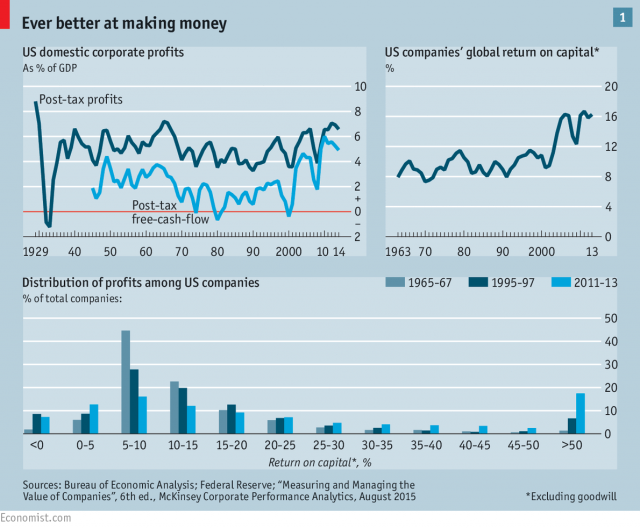


For wages to grow, people have to be paid more than they're worth as an economic unit. That's what unions are about. "More", as Samuel Gompers would answer when asked what he wanted.
This was a well understood concept in the 1950s, and was accepted by both management and labor in the major US manufacturing industries. The UAW - auto company contracts of that era explicitly tied wages to increased manufacturing productivity. It still is somewhat accepted in Germany, but is dead in the US.
Part of what killed wage growth was the demise of Communism. Communism was once a serious ideological threat to capitalism. From the 1920s to the early 1980s, there was real fear in the business community that communism might work. It might deliver a better life to workers. There was competition in ideology, and capitalism had to provide an increasing standard of living or risk countries going communist. Communism never did deliver a better standard of living, but the presence of a competing system which more or less worked kept capitalism honest.
With the demise of the USSR, and China moving away from its strict communist roots, the competition disappeared. Capitalism became a monopoly. Then it started acting like one. There was no longer any need to deliver a better life to workers.
That's how we got here.