The 3dfx timeline gives you an idea of how much the computer field has slowed down and consolidated. Voodoo was released in 1996, into a market with half a dozen competitors. Voodoo 2 in 1998, the same year as the first viable NVIDIA card (Riva TNT). NVIDIA released the GeForce 256 in 1999, cementing its dominance. 3dfx released its last card in 2000, just four years after its first. NVIDIA is now still dominant, 18 years after establishing dominance with the GeForce.
Think back on how much consumer computing changed from 1996 to 2000. Four years back from the present, in contrast, is the Haswell-based Macbook Pro and iPhone 5s (a perfectly fine setup today).
Most of the other companies are still there though. PowerVR still makes 3D chips, but only for the embedded market (e.g. Android phones). Matrox gave up on 3D and now only makes specialized cards for 8 and 16+ monitor displays (airports, kiosks). IIRC, even Trident switched to embedded graphics.
The thing that bothers me is that if you want a PCI-E card on a consumer system, you only have nVidia/AMD. Intel only does embedded now with none of their offerings on a card (like the only i740). There is no Ryzen 7 with an APU, so if you're building a small developer box, you have to buy a discrete graphics card and can't rely on embedded (unless you want to drop to the Ryzen 5, which was just released with an APU).
There are rumors that Intel might be getting back into this space. If anyone could try to compete with the big two, it's probably them.
I believe you might be thinking Intel hiring Raja Koduri this past November. It seems Raja Koduri will be heading up new products in the graphics arena, but that is at least two or three years into the future. https://www.pcper.com/reviews/Processors/Intel-Kaby-Lake-G-L...
Intel seems to have made or licensed a high speed, short distance, data bus that sits between the Intel CPU and the AMD GPU that are mounted side by side on a small board.
Would be hilarious btw if this showed up on desktops as a dual socket motherboard, with one socket for the CPU and another for the GPU. Likely with one massive cooler covering them both.
That design isn’t custom but appears to be using PowerVR licenses IP given the way some press releases were worded. I find it highly unlikely Apple
could design a market leading GPU compatible with their existing products in such a short time. Their CPU took a lot longer. My guess is the A11 is a tweak of the PVR and subsequent versions later will introduce a ground up redesign.
PVR owns a lot of TBDR patent IP since they mostly went it alone on tiled based deferred renderers when most of their competitors were IMRs. It looked like a smart decision as desktop GPUs were hitting a memory bandwidth constrAint until GDDR and ultra wide buses started being used and GPUs got better at early-z rejection.
But on mobile, TBDR works great since mobile has different power and heat constraints than desktop.
I find it highly unlikely Apple could design a market leading GPU compatible with their existing products in such a short time.
Nobody noticed, but apple started working back on their GPU all the way back on the iPhone 5s (with their A7 SoC)
It wasn't a complete custom design, but it wasn't an off the shelf powervr either. Until that point, apple always released the exact model of GPU they were using in their SoC, then suddenly their documentation starts referring to "the apple A7 GPU" and "the apple A8 GPU". Wikipeida does give a model number for the GPU, but if you trace it back you find a andandtech article going through the logic speculating it must be a powervr 6 series. And all roads lead back to that speculation.
For later SoCs, andandtech actually invent a new 6 core powervr variant, because powervr wasn't listing one yet die shots of the new iPad showed a 6 core GPU.
With the release of the iPhone 5s, apple also switched from the powervr supplied driver to their own one written in house.
It appears that apple incrementally swapped out parts of the powervr design until they arrived at the A11 SoC GPU which they declared as their own, with none of the original powervr parts remaining. Though the result appears to be very close to the original design. (I suspect powervr accidentally gave apple a perpetual patent license at some point before realizing what apple was up to)
They didn't redesign the GPU overnight, it was designed and released incrementally over many years under our very noses. Nobody noticed.
Funny thing is that my first 3D accelerator was a PowerVR, and unlike the 3Dfx solution it used the PCI bus to shuffle the finished frame to the video card for output.
In 1998 3dfx was incredibly dominant in the market. I don't think that after the release of Voodoo 2 many people would have bet on another company being the market leader. Riva TNT was ok, but it wasn't a breakthrough for Nvidia.
TNT was the first viable Voodoo 2 competitor, though it didn't quite catch up. The year after, NVIDIA released GeForce, which was indisputably better. 3dfx never recovered after that.
Yeah, I was a pretty serious PC gamer (Quake/Q2/Q3) back during the rise and fall of 3dfx. Pretty much everyone I knew went from software rendering to 3dfx-chipset cards but then jumped ship when the Riva TNT2 cards came out, primarily because they just produced much better visuals due to support for 32-bit color while the 3dfx offerings were all limited to 16-bit.
There was still a bit of a split in the market back then between those who went TNT2 (amazing, at the time, image quality) and those who went to the Voodoo3 (good raw speed, but limited to 16-bit color and thus noticeable banding artifacts)... 3dfx still held on to a bit of a niche there for a while longer, but then once the GeForce and GeForce 2 came out 3dfx was just dead in the water with nothing that could compete anywhere on the performance versus image quality axes.
Texture memory capacity, texture size limit (256x256!) and lack of s3tc/DXT1 compression were the real culprit. TNT shipped with 16MB, in TNT2 32MB came standard. Texture quality played the biggest role in perceived visual difference. Not to mention TNT performance went 1/2 down in 32bit mode, TNT2 fared only slightly better.
The year after the TNT was the TNT2 (which was a great chipset).
Geforce didn't come out until Oct 1999 and even then it was only one chipset. The rest of the product range came the following quarter (2000).
I skipped that generation and jumped to the Geforce 2 (this time first party rather than a 3rd party card with nvidia GPU), which was also an awesome card.
As for the fall of 3dfx, I dont think the rise in popularity of DirectX and OpenGL helped their case as that really levelled the playing field. After that, specifically targeting Voodoo cards felt more like a chore than an enhancement.
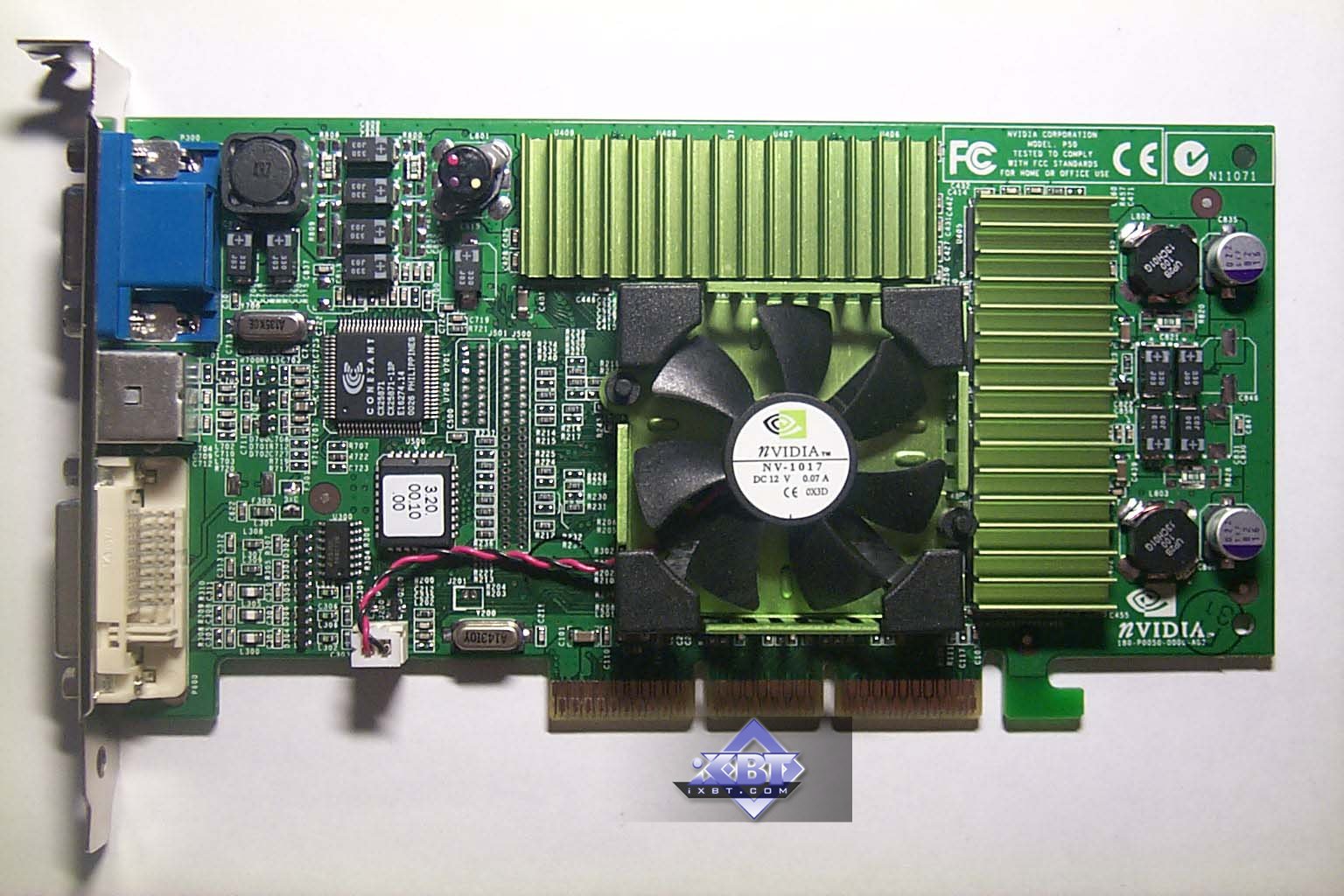
I had an NV-branded GF3, which was sold or given to developers since they had some issues with supplying enough chips to OEMs. Looked like this:
http://www.ixbt.com/video/images/leadtek-tdh/geforce3-ref-fr... (and judging by the URL name it was made by Leadtek).
AFAIK, Nvidia have never fabricated their own cards, but they do design the reference boards that most OEMs use as a basis for their own cards, and they did at one point release cards directly under the Nvidia brand (the cards were fabricated by Foxconn using Nvidia's designs).
Oh man, the Riva TNT was the 3D card I ever had, back when popular opinion said that hybrid 2D/3D cards would never be as good as a dedicated 3D card.
So amazing to get 30fps with fullscreen trilinear filtering. It really felt like the future... and then you jump back to the present and your graphics card is basically a renderfarm that you send geometry and shaders off to and it does the rest.
That's pretty much standard in every industry, though. Competition will kick underperformers out of the market and some amount of consolidation is inevitable. It's not Nvidia doesn't have any competition nowadays.
And even then they may have been a bit player if Microsoft had not flinched and thrown out their existing PocketPC platform to ship Phone 7.
Keep in mind that PocketPC was not just used for "consumer" phones, but also all kinds of hand held terminals in warehouses and such.
This was a market that Microsoft basically abandoned when they announced that Phone 7 and onwards would not be compatible with PocketPC software, even though they tried to extend a fig leaf by rebranding PocketPC 6.5 as Phone 6.5 (i think HP tried to sell a couple of PDAs with that).
Didn't take long before we saw alternatives out there, though these days i think they are mostly Android based.


Think back on how much consumer computing changed from 1996 to 2000. Four years back from the present, in contrast, is the Haswell-based Macbook Pro and iPhone 5s (a perfectly fine setup today).