I'm surprised that Cities: Skylines isn't listed as an inspiration because it's also based on individual agents moving around your city. Despite the name, Skylines is really a traffic management game more than anything else. Part of the fun of Skylines is just how cool your city looks. For all the emphasis on realism, I hope CityBound doesn't neglect appearances.
This looks really exciting! I just signed on as a Patron.
Appearances will be increasingly important to Citybound, I’m going for a flat shaded but super detailed look. Thanks for becoming a patron, much appreciated!
It's beautiful. Totally agree on the flat-shaded aesthetic. A nice stylized low-fi without giving into pixel-art.
I'm always suspicious about simulation-driven games because they can get lost in the wonkery of it in ways that don't actually provide gameplay to players - my understanding was that Master of Orion 3 was ruined by this kind of design. But it looks like your "simulation driven" thing is about the citizens, which is wonderful.
Your current vids are very rural. Are you planning on getting into transit and bike-lanes and the like, or is this primarily going to be about roadways?
Transit, pedestrians and later bikes will be the next features I want to work on regarding transportation, after I make all aspects of the simulation scale to larger-than-rural settings with car traffic.
If you do add those things, please don't give them magical benefits.
Transit should be outrageously expensive to add. (see the recent subway expansion in New York and in San Francisco) It should be outrageously expensive to operate.
Transit should shut down often for floods, strikes, the "wrong type of snow", "leaves on the tracks", crowds of people (good job San Francisco, LOL), maintenance, terrorist attacks, and many other random reasons.
Transit should increase crime.
Transit should go to the wrong places. You ask for it to be installed where it is needed, but instead it ends up a mile away because that was where it is possible to build.
Yeah, it's perfectly reasonable to set this game in a magical fantasy world where underground rail is an order of magnitude cheaper than the US. This fantasy world is commonly referred to as "France" (https://www.citylab.com/transportation/2018/01/why-its-so-ex...).
It's a spectrum. My goal is to "teach the right things" that you would need in a realistic setting and have the simulation try it's honest best to simulate everything in realistic scope, detail and behaviour, but I might cut some corners with bureaucracy that is involved in real-world city planning to not compromise on fun.
One of the truly awful things about SimCity was that transit was unrealistically beneficial. It was some sort of awful joke, the sort you might roll your eyes at and say "oh brother, this is idiotic". It felt like somebody was pushing a transit agenda hard.
Similarly, pollution was unreasonable. Coal power may be dirty, but SimCity made it absurd. There was also the nuclear plant explosions that pretty much never happen in the real world. Both the failure rate and the failure consequences were way above normal.
Not sure you know what “exact opposite” means, but I read that link expecting to see an argument that nuclear power plants blow up much more frequently in real life.
I thought "transit planner" would be a hint that I was referring to the first part of the parent's comment, that "somebody was pushing a transit agenda hard".
> Despite the name, Skylines is really a traffic management game more than anything else
The developer, Colossal Order, is also responsible for "Cities In Motion" and "Cities in Motion 2", both of which task the player with improving public transit systems. I haven't played either of those, but having played Skylines, I can only assume that the developer's prior games heavily influenced the game mechanics of this one.
There's an insane amount of mods available for Skylines too, and the ones that expand the traffic management mechanics are very enjoyable.
I mean, after spending more than a thousand hours fixing traffic problems, I even briefly thought about changing my career to become a transport planner. If some other mod/game gives me even more precision and options, I'd probably be spending all my free time in it.
Skylines is a mediocre city simulation game but a great traffic management/simulation game.
> I even briefly thought about changing my career to become a transport planner
I would think you would be highly disappointed with what you can actually accomplish considering bureaucracy/politics/budget and all that. In Cities you get to be dictator.
> Despite the name, Skylines is really a traffic management game more than anything else. Part of the fun of Skylines is just how cool your city looks.
Unfortunately, traffic management is the only part of the game that really holds up as a simulator.
Public services and pollution, in particular, are basically skeletons without any real depth to them, and they have considerably less depth than SC4. Cities: Skylines is mostly good as a) a traffic and transit simulator, and b) a sandbox game for using mods to create beautiful urban artwork. If you go to /r/CitiesSkylines or look at a number of YouTubers (I strongly recommend Infrastructurist), you'll see lots of gorgeous cities that were created by using mods like RICO, Move It!, and various forms of Anarchy (among several others) to plop down assets in ways that resemble real cities. An infinite money mod is, of course, a given. There's no real simulation going on here: you have a bunch of very talented, creative individuals using the game as a specialized canvas.
But let's talk a bit about just how public services and pollution are skeletons.
Public services are very simple: citizens want a service, and you plop down buildings that provide that service. What little depth they have comes from the traffic management sim: the service needs to be accessible, so either citizens need to be able to get to the buildings in a timely fashion, or the buildings need to be able to send their vehicles out to various parts of town in a timely fashion. If traffic flow gets bad enough that this fails to happen, citizens get upset. All you need to have effective public services is enough capacity + traffic flow for your citizens to make use of them.
There is no concept of range. If you put a school down in a city, children from all over the city will go there to get educated. If you have multiple schools, there is no correlation between where your kids live and where they go to school. Of course, there are mods that can help a little: you can easily find a mod that limits use of public services to the district they're planted in. But that's it.
Compare SimCity 4, on the other hand, where every building has a range, and each service has two funding sliders: one that controls effectiveness, and one that controls range (and you can override these sliders on a per-building basis, too). With range, you have to be careful to not let your buildings overlap too much, because then you're throwing away money. And you can overfund your services, but that's a hard choice: overfunding has diminishing returns and, more interestingly, can cause negative externalities. For example, overfunding your police can create a situation where police officers harass the community and thus make your citizens unhappy. No such complexity exists in Cities: Skylines. Nothing has externalities in Cities: Skylines. There's no disadvantage to throwing in more of everything. Well, except for water. I'll get to that later. And if you underfund your services in SC4, you have a chance to wind up with an actual, honest-to-goodness strike on your hands. And money often gets tight enough that you will periodically have to underfund something just to stay in the black, so you have to choose which service you can most afford a strike at. No strikes are in Cities: Skylines.
Education, too, is way too easy. In SimCity 4, developing an educated workforce that can support high-tech industry takes several generations of cultivating your citizenry. No such problem in Cities: Skylines, just throw down enough elementary schools, high schools, and universities, and you've got an educated workforce in no time! And you really want your workforce to be educated, too, because having an uneducated population means you're stuck with dirty industry, which sucks. The pollution is awful, and the jobs don't pay well, so your sims stay poor and live in slums.
Oh yeah, and there's basically no class stratification in Cities: Skylines. SC4 divides properties into low-wealth, medium-wealth, and high-wealth, which is determined by property values, with visually-distinct buildings at each position. This is a completely separate axis from building level, which mostly has to do with the size of your buildings, bounded by the density of your zoning (low density is levels 1-3, medium is 4-6, high is 7+). So slums look like slums, nice parts of town look nice, etc. Cities: Skylines just has building level. So in CS, your buildings will become bigger and nicer as you grow, but there's no such thing as "a poor neighborhood", "a middle-class neighborhood", or "a rich neighborhood", unlike in SC4.
Before I get to pollution, let's talk garbage. There are a number of garbage facilities in Cities: Skylines, including a recycling center introduced with the Green Cities expansion. The recycling center is just a strictly-better landfill. It does everything a landfill does, only more so. There is no reason to build landfills if you own Green Cities. In SimCity 4, on the other hand, they serve different purposes. In SC4, landfill zoning provides a place for your sims' trash to go, and a recycling center reduces the amount of trash your sims produce in the first place. Thus, you can't deal with garbage on just recycling centers alone. You still need landfills, but a recycling center will let you get away with zoning less landfill than you'd normally need. So you really want both recycling centers and landfills, just like in real life. But Colossal Order wanted people to buy Green Cities, so they made everything in that expansion completely overpowered and strictly better than what's in vanilla.
Pollution is easily-avoidable in Cities: Skylines to the point where it might as well not exist unless you screw up dramatically. Air pollution isn't even a thing at all. You can have all the dirty, smoggy factories you want, and your citizens won't care. Let's just say that, in SimCity 4, air pollution is a huge thing, and you'll be spending a good chunk of your game trying to mitigate it. What you do have in Cities: Skylines, though, is ground pollution. Dirty buildings pollute the ground, and if people live on polluted ground, they get sick and die. But ground pollution has a teeny-tiny radius, so it might as well not exist. Just don't build right next door to dirty industry or coal plants, and certainly don't bulldoze your dirty industry and coal plants and build residential where they used to be, and you're fine. I wish pollution was that simple in real life.
Water pollution is even more avoidable. You only have water pollution at all if you have a water pump downstream from a sewage outlet. This is trivially avoidable. It's one of the first things the tutorial hammers into you. Unless you're going out of your way to screw up, you won't have water pollution. But what if you do screw up? Well, if even the slightest bit of sewage gets in your water supply, your whole city undergoes a massive die-off. That's right, if you ever have nonzero water pollution, you might as well start a new city. Is there a way to mitigate it? Sure, build a water treatment plant! But the water treatment plant just lowers your water pollution, it doesn't take it all the way down to zero. And any nonzero amount of water pollution will kill your city, so you might as well just save your money. Oh, and this is literally the only thing a water treatment plant does, so unless you've screwed the pooch and killed your city, you will never have any reason to build one.
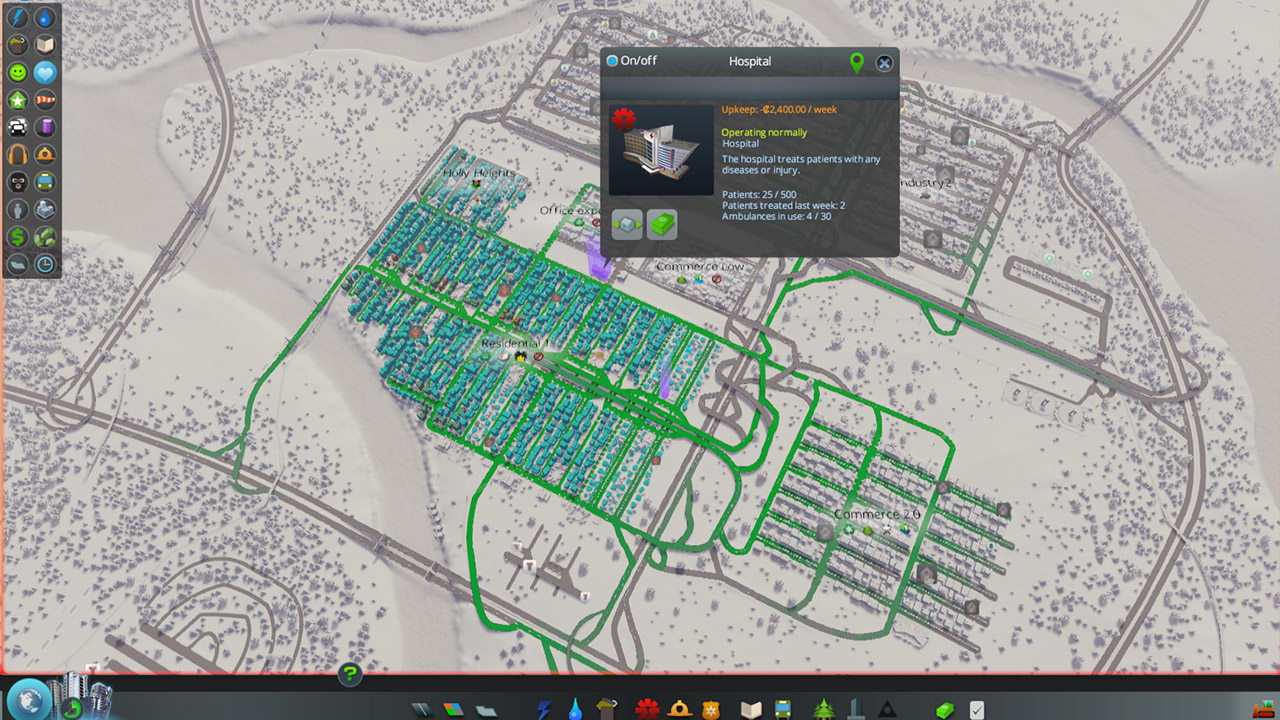
This image shows the range that the medical facilities have in the city. The purple buildings are hospitals/clinics, and the green shading on the roads indicates the reach that those buildings have. Not sure where you got the above fact, unless I am misunderstanding something.
From what I can tell looking around on Steam forums, this isn't the range of the service. There are two things going on:
People who live close enough to services get an additional happiness bonus for living close to the service on top of getting their needs fulfilled. The service still operates citywide, and people will still get all the benefits of having that service no matter where they live, but living close to one gets them an additional bonus.
There is also a traffic flow element here: people who live past a certain distance from the building have to deal with longer than expected travel times, so their ability to make full use of the service starts to degrade outside of the green. They're still covered by it, but it's not as efficient.
> People who live close enough to services get an additional happiness bonus for living close to the service on top of getting their needs fulfilled. The service still operates citywide...
I agree - and here is where things start getting indirectly complicated/irrealistic:
1) e.g. the ambulance or the garbage truck get deployed from the opposite part of the map and then they get into traffic and they needs ages until they reache the target location, which is when my citizen is already because of "natural" causes or was choked to death by garbage.
2) I honestly don't understand how living just next to a hospital should increase the property value. "Nearby", yes. "Next-to-it" no (noise & lights & people in weird situations targeting the hospital walking by all night long? Definitely not an area where I'd like to live, hehe...).
To 1, yes, that happens. Makes it impossible to have cities where not every area is connected by roads. It's also why it is so important in this game to not have traffic jams. There is a recent mod for this however: https://steamcommunity.com/sharedfiles/filedetails/?id=16808..., Most Effective Traffic Manager. It changes how the routing works and tries to combat exactly this. Though I could not just add it to my current rather large city, it dies with null pointer exceptions. It might work better now that it got some patches or when starting from scratch.
The "too close is bad" is done by noise pollution. I think hospitals do not emit noise in Skylines, but the cars going to and from do, and other buildings have that built in, especially monuments, malls and metro stations.
> the service needs to be accessible, so either citizens need to be able to get to the buildings in a timely fashion, or the buildings need to be able to send their vehicles out to various parts of town in a timely fashion. If traffic flow gets bad enough that this fails to happen, citizens get upset. All you need to have effective public services is enough capacity + traffic flow for your citizens to make use of them.
City Skylines does have one form of pollution you didn't mention: Noise pollution. People next to busy streets get sick and die from the noise.
Water pollution generally only happens when a player starts sucking out too much water from a river and reverses its flow.
I do agree that the mass dieoffs from a single drop of polluted water are probably too much. A significant production drop as people are under a boil water advisory at first might be better, and only becoming a major die off if you neglect to fix the problem. The water treatment plant could be more interesting if people were always dying at a low/modest rate from even "clean" river water until you built it.
Education in C:SL is actually more realistic then sc4. In sc4 the difference between different levels of schools is just that they boost the education level of sims of different ages. So a elementary school increases the education level of 20 and 30 year olds, but not sims in their 60s [1]. While in c:sl people need to actually go through the schooling system, and you can see the education level of each of them...
Also, is air pollution a huge problem in sc4? My experience is that you just put dirty industry in a faraway place, like you would do in c:sl. You can say that the air pollution generated by traffic in sc4 is simulated in c:sl as noise as well.
To be fair, Cities Skylines is very much a sandbox game. Outside of maybe 2 or 3 scenarios, nothing in it is very hard, or meant to challenge you a whole lot.
I don't build Water Treatment plants because I'm worried about losing, I build them because I don't like looking at the gunk in the water.
Same with a landfill vs recycling center. I build a dump when I feel that it suits the city (young city, or new rural area) Later as that place builds up I will relocate the dump outside of city limits, plop a recycling center in the dense part of town, and build an incinerator somewhere else.


I'm surprised that Cities: Skylines isn't listed as an inspiration because it's also based on individual agents moving around your city. Despite the name, Skylines is really a traffic management game more than anything else. Part of the fun of Skylines is just how cool your city looks. For all the emphasis on realism, I hope CityBound doesn't neglect appearances.
This looks really exciting! I just signed on as a Patron.