For those interested in the science and less in the fluff: this is notable not because it's "bigger" but because it's the first really good observation that fits with a "pair instability supernova", which is a well developed existing theory but has never been observed.
The basic idea (I'm not a professional here) is that the gamma rays produced in the stellar core provide the bulk of the pressure that holds up the outer star against collapse. But past a certain temperature, the energy of those gamma rays starts preferentially resulting in electron/positron pair production. And the effective pressure per energy of an e-/p+ pair is significantly lower than it is for photons. So the outer core layers start falling downward, picking up energy as they do, and getting hotter. And the still higher temperatures result in gamma production which is even more likely to result in pairs, so the pressure drops still further and the core contracts more, and you get a runaway reaction.
But the runaway is of temperature and not so much density, so what's left after the outer layers of the star all get blown away is a comparatively low density core of extremely hot plasma, which simply diffuses without recollapsing into a neutron star of black hole.
It will. But due to the way things work (and here I'm mostly ignorant of the actual physics) the likelihood of this happening (or really for it to scatter against anything else in the plasma) for a high energy lepton is much lower than for a photon of the same energy. So where the old, cooler photons were hitting things locally and providing pressure that was keeping the core from collapsing, the positrons are escaping farther out and allowing the core to collapse.
The range given by Plait in the article at the top for SN 2016 iet is 120-260 M_{sun}, and towards the lower end would be a pulsational pair instability supernova (PPISN) (the "pulsational", the first P of PPISN, part starts to fall off above 130 M_{sun} and vanishes around 150 M_{sun}).
If you're feeling ambitious you can digest Woolsey 2017 https://arxiv.org/abs/1608.08939v2 which is about pulsational pair instability supernovae (PPISNs) and which by coincidence I had on hand because I was reading about LIGO's 50-135 M_{sun} remnant mass gap[1].
The first couple paragraphs of Woolsey 2017 are a good basis for an answer to the question, "what happens to the positrons?", and the answer is that they and the electrons contribute to complicated nuclear fusion chains more centrally within the star.
The central regions in which these gammas are being produced are extremely dense, and maybe it is helpful to think of a piece of some oxygen or silicon nucleus being squeezed in between the e+e- pair such that electron capture "steals" the electron and its part of the gamma's momentum, and the daughter products include neutrinos (which tend to carry momentum right out of the star system, since practically everything in the area is transparent to neutrinos).
In effect, the momentum of a centrally-produced gamma ray radiation kicks inner parts of the star outwards, but when the gamma ray's momentum "condenses" into e+e- pairs, a good fraction of the momentum ends up trapped within denser nuclei, or converted into neutrinos.
The electric charge is very strong so any "excess" positrons will quickly find another electron to annihilate with -- and there are plenty in the star (say, in less-central regions) to meet. The positron will be "pulled" part way up, and prospective partners with the opposite charge will be "pulled" part way down. They're likely to meet somewhere away from the central region, especially if there is a significant positron excess centrally. An annihilation gamma produced much closer to the surface can only lift the surface matter with the gamma's momentum, doing nothing to lift much more next-to-central regions away from the most central regions. Moreover, since the e+e- annihilation gamma can go in any direction, it has a greater chance of pushing less-central regions towards the centre than a nuclear fusion gamma produced very centrally.
Finally, Plait's Bad Astronomy article at the top also links to Plait's earlier https://www.syfy.com/syfywire/the-star-that-blew-up-a-little... which tries to describe PISNs for the readers following the sentence, "What follows is still somewhat hypothetical, but astronomers are working on this problem, and many think this can explain this very odd class of exploding star …"
- --
[1] There's a lack of observational evidence for black holes in that mass range, and if PPISNs are commonplace that might be why they don't exist, as opposed to other possibilities such as massgap BHs exist but their near-regions don't radiate much compared to the background). In essence PPISNs and PISNs reliably throw away enough mass that ~ 55-133 M_{sun} SN remnants are prohibited, and we can only get compact objects in that massgap through mergers or the like. More here https://arxiv.org/abs/1709.08584 if you're very interested, and the two authors are worth an author-search as they are prolific in this area.
The electron half of a pair produced very centrally within a star is very likely to be captured very quickly into a nuclear reaction.
This can produce central regions of pair-producing-but-election-capturing fusion, and a substantial excess of positrons. There are plenty of electrons away from these central regions for these positrons to meet by mutual attraction (and positron-positron repulsion). When they meet they annihilate, producing a gamma which can go in any direction, and which most likely will quickly deposit its momentum mostly-elastically into a nearby nucleus.
Very centrally produced gammas push nuclei outwards from the centre of the star; and the less centrally the gammas are produced, the greater the chance that the nuclei are pushed in some other direction (including inwards).
The chances of collision are low enough that there are few enough of them to fail to offset the now-missing original radiation pressure, which then allows a gravitational collapse to begin and progress.
What do you mean? Taking a guess at answering that, electrons and positrons aren't electrically neutral: they are very very strongly attracted to one another, especially compared to
> gravitational collapse
so the probability of electron-positron annihilation immediately after pair production is in general extremely high! (In lab settings you need strong magnetic traps to avoid that.)
The "trick" in the star's core is to remove the electrons locally, or alternatively to convert the mostly-elastic photon-nucleus scattering with a much more inelastic photon-nucleus scattering.
I've described the former in sibling comments -- oxygen and silicon are present in these stellar cores and aggressively capture electrons. The positrons then are pulled outwards by electrons outside the core, and annihilate there. I omitted that an electron-positron annihilation produces two (or more) gammas rather than one, and that the photons can go in (different) arbitrary directions.
The latter is also an important contributor. The gammas in question are not even close to being in free space. They're in a region densely populated by high-atomic-number nuclei, and the Z^2 contribution in https://en.wikipedia.org/wiki/Quantum_mechanical_scattering_... dominates. If the region were all lighter nuclei (hydrogen, helium) the probability of pair production would be much lower.
Roughly speaking, in the absence of immediate electron capture by the nucleus the pair-producing gamma "hits", the momentum of the gamma is split three ways: into each of the electron and positron, and into the nucleus. Electron capture is in effect just an extreme inelastic collision.
In the no-electron-capture case, the heavy nucleus, having absorbed the "recoil" proportion of the gamma into its internal degrees of freedom, has several ways to get rid of that momentum, re-emission of one or more photons with lower energy than the gamma, or transmutation (which might produce neutrinos).
If the electron and positron pair immediately annihilate, they do so minus the "recoil" energy to start with; additionally they produce more than one gamma, and in arbitrary directions. Consequently, there is less momentum available for subsequent elastic collisions.
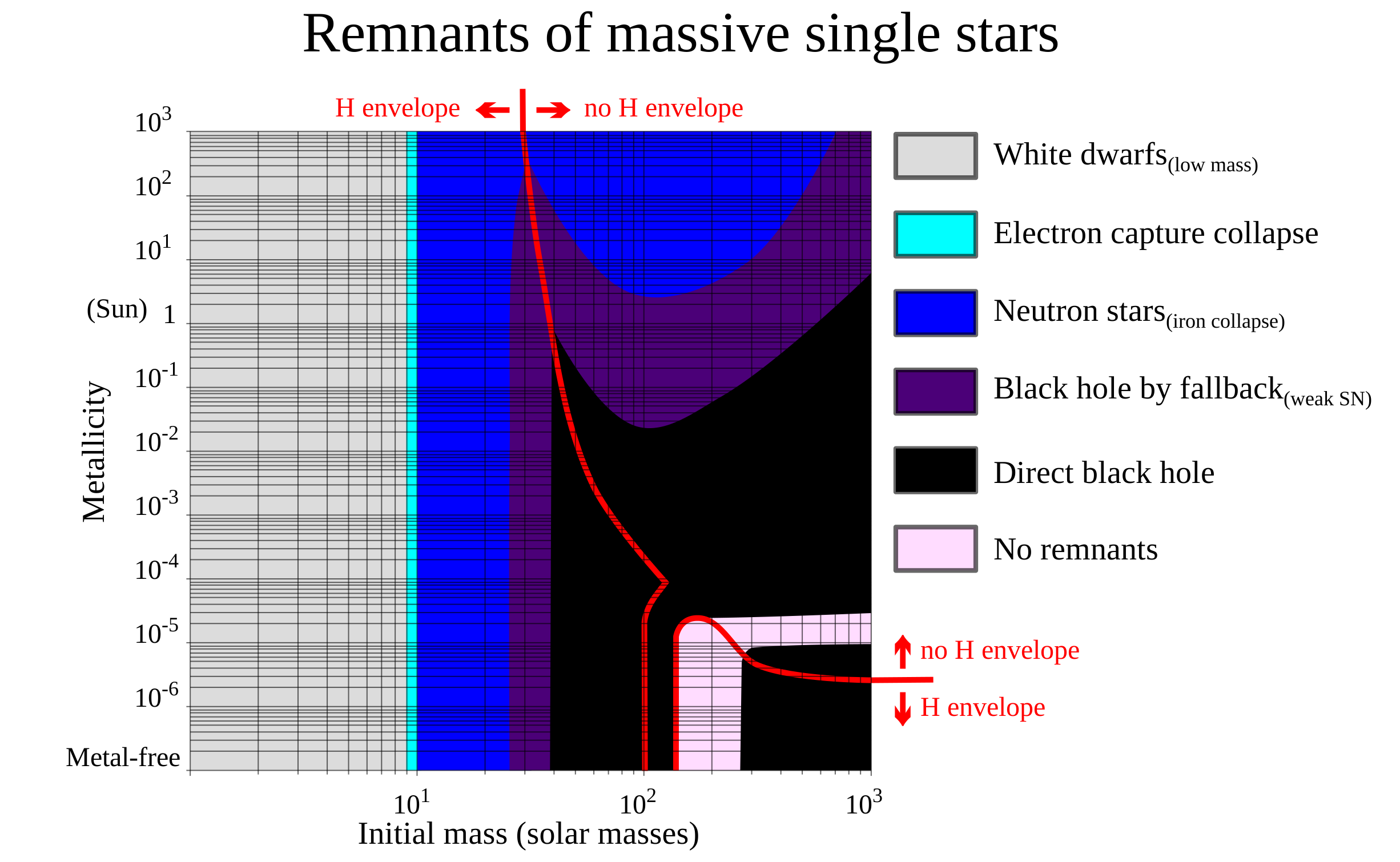
An interesting tidbit is that the region of stellar parameters where the explosion is so massive that it leaves behind no compact remnant borders directly on the region where stars can collapse into a black hole without a supernova, they just wink out of existence.
So that chart seems to imply it is unknown whether the Sun will end up with "electron capture collapse" or as a neutron star. That's news to me, because when I was younger, I had the impression that the accepted theory was it would become a white dwarf.
I think you're reading the exponent wrong. 10 times the mass of the sun where we generally get a neutron star; 9 times the mass of the sun is too light, so we get electron capture collapses; lighter still, and down to one times the mass of the sun (10^0 solar masses, the origin of the log-scale x axis) is where we get white dwarfs.
Even the direct black holes dont quietly wink out. Once an even horizon forms, anything outside in now in a forming accretion disk. As things contract they start spinning. Things get hot/loud/bright until that disk settles dow.
I guess on both sides they start out as star -> collapse, but one either side the collapse continues into a hole. Within those parameters the star will stop collapsing and go supernova and never collapse back. I guess that's what it means.
Yes, this most likely just means that different processes are responsible for the same outcome (i.e. becoming a blackhole), depending on the mass of the star.
Total tangent.. but there’s no innate reason to be totally boggled by huge (or incredibly tiny) numbers. I think getting all in a huff about them is an anti-pattern in science writing. I mean, we deal with gigabytes of data on machines with clock periods of nanoseconds every day.
What is cool is learning about new-to-you physical mechanisms.
It's faintly ridiculous to have all the over the top expressions of amazement about something a couple hundred times the size of the Sun. If you're the layperson this is aimed at, who doesn't have a clue about stellar physics, then why not imagine a star 1,000 or 1,000,000 times the mass?
Could have been a weapon's test gone wrong, like that recent Russian nuclear-powered cruise missile that blew up. A very amusing line of thought indeed.
>> It was pretty much at this point reading the journal paper that my brain wanted to leap out of my skull and run around in panicked circles screaming. I’ve run out of adjectives to describe an event like this.
Is it OK if I'm interested in science without acting as if I was watching a football game? Or do I lose my nerd cred for not expressing exuberant excitement with colourful language every time I hear how big the universe is, or how vast the cosmic scales, etc?
I don't remember Phil Plait being quite so breathless when he was blogging at, er, wherever he was before. (ScienceBlogs, RIP?) Is it a SyFy house style thing, perhaps?
Stuff like this just boggles my mind. Imagine if we could capture/store even a small fraction of that energy that was released in mere seconds. It could probably power Earth for millions of years. Sorry if my maths are off a bit.
The energies of even less exotic stars are insane. If we could capture 1 second worth of our sun's output then we could power earth for almost a million years.
The earth already does that, we just call it our ecosystem. It's why we have clean water, carrots, coal and, and the end the chain, the internet to talk about it.
We're actually getting a bit more than we'd like. If we could get the sun to turn it down a smidge for a few hundred years while we get the gas mix in our atmosphere right it would be most helpful.
No, we need more. The main barrier to achieving the dreams of science fiction is a lack of energy to accelerate human-scale amounts of material to high speeds (then slow them down later).
Not just that even more mundane stuff becomes much easier if you have more energy - clean water (desalination), trash (vaporize & collect fractions), raw materials (can trade energy for lower input concentration in ore), polution & greenhouse gases (capture back from th atmosphere and convert to something usable or inert).
All this becomes relatively easy if you have a lot of cheap power. And you would not get it just by power saving and eficiency improvements, only with research and building of new sources.
I'd add that we not only want, but need, space travel in order to maintain the species. Once our sun or planet dies we go with it, unless we're on a different one.
No, we need to use more of what we get. We don't use hardly any of what hits the earth. I believe I read that the Sun supplies 50X the amount of energy we consume (if of course we could capture it as energy).
You are off by a few orders of magnitude, the amount of sunlight hitting just new mexico (after taking into account the losses of converting it to electricity) is about 50x the energy we consume.
With current consumption only. But we will populate its every corner, waste every amount on food production and fantasize what if we could capture just ten seconds a year (and terraform Moon/Mars). Humanity is a virus that cannot stop eating, reproducing in mass amounts and converting their host into a stinky factory.
I really doubt that so called Type II civilizations with Dyson spheres are a paradise to live in. Really advanced creatures would simply reduce their demand and live in the same beautiful place instead, occasionally feeding surplus energy to their scientifical interests.
>Really advanced creatures would simply reduce their demand and live in the same beautiful place instead, occasionally feeding surplus energy to their scientifical interests.
Which works right until an asteroid strikes their planet, a gamma ray burst sterilizes their solar system or a more aggressive species eats them all. The universe is in no way nicer, calmer or more pleasant than the earth itself and look what the earth has produced.
Supply and demand would rapidly reduce this timeline even at incredible energy amounts. There is a virtually unlimited demand for energy. We'd build more energy intensive machines if the supply was so vast. Powering millions of large fans to break up a tornado or a hurricane would now be possible. We'd keep inventing power hungry ideas until balance was restored.
Theoretically we'd eventually cook the Earth with waste heat since energy is never lost so there is an upper limit for energy usage on the planet. Off Earth, not so much.
According to a number of physicists I've talked to, at our current rate of energy release this is already a concern. I've heard that we'll need to worry about this in the next 300-400 years.
If the brightness didn't go away, and that's unusual, why are people concluding it "annihilated itself"? I don't see why that would be the natural assumption. Maybe there is a black hole in the center and something about the dynamics is producing more radiation than usual from the stuff falling into it?
Supernovae resulting from an impact by a large object moving close to the speed of light. Was used/popularized in a series called "Three Body Problem" as a weapon (book premise is the "black forest theory", which is since every sentient civ is a potential existential threat advanced civs would genocide any aliens they detect, photoids being one of the exotic weapons to accomplish this).
Also see "The Fourth Profession" by Larry Niven. Aliens didn't annihilate everyone out of fear, but they would cause a nova when there was profit in doing so.


The basic idea (I'm not a professional here) is that the gamma rays produced in the stellar core provide the bulk of the pressure that holds up the outer star against collapse. But past a certain temperature, the energy of those gamma rays starts preferentially resulting in electron/positron pair production. And the effective pressure per energy of an e-/p+ pair is significantly lower than it is for photons. So the outer core layers start falling downward, picking up energy as they do, and getting hotter. And the still higher temperatures result in gamma production which is even more likely to result in pairs, so the pressure drops still further and the core contracts more, and you get a runaway reaction.
But the runaway is of temperature and not so much density, so what's left after the outer layers of the star all get blown away is a comparatively low density core of extremely hot plasma, which simply diffuses without recollapsing into a neutron star of black hole.