"The Grid" is a fascinating machine. If you're interested in it the full name is the GRiD Compass 1101. It used a display I've never seen on any laptop before, an electroluminescent monochrome one, really weird tech there. It's primarily used in static displays like car dashboards because it's very unlikely to "burn out" (not even sure it's possible). I've never seen them on dynamic displays before.
More fun facts, it was used in space, and perhaps even as the "nuclear football".
Once upon a time I had a 486 laptop with such a display. I kept it long beyond its prime because it was so superior to any other laptop display on the market.
Amusingly, the laptop featured a socketed 25 MHz 486 SX. I was able to swap it out for a 486 DX2, which added an FPU and an on-package clock doubler giving me a 50 MHz processor.
Considering monochrome wasn't really a limitation at the time, it makes quite a bit of sense as a display. It was certainly thinner than any CRT and so much lighter. I don't recall using one myself, how was the refresh rate on them if you do remember?
Its refresh was better than LCD laptop monitors of the time, which had horrible ghosting - remember windows had an option to give mouse cursors a tail because without that you’d be hopeless to find a moving mouse.
It did suffer especially from burn-in. Remnants of the WordPerfect status bar were permanently at the bottom of the screen.
Yeah, it reminded me of the gas-plasma monochrome displays that were common on "luggable" PCs in the late '80s (like this one: https://jshorney.incolor.com/p70.htm).
They were much lighter than a comparable size CRT, which was the display solution used on the original luggables from companies like Osborne and Compaq. But that was about the only good thing that could be said about them.
Saw one of the Grid machines at VCF West a few weeks ago. The screen was eye-catching; a vivid red with no perceptible flicker. Looked great (though monochrome) even by today’s standards.
Works on the same principle of passing a current through a substance to emit radiation, it's just the electroluminescent panels use a solid material, so I think they're able to be flatter.
I had one of these I got from someone who knew someone who knew someone in the Reagan administration.
If you pointed the screen at a TV set, the signal would go all screwy. Turn it the other way, and it was fine. That thing must have been shielded out the wazoo.
The display is plasma not EL. Same was used on many 80's era laptops and luggables like the Toshiba 3100. They can suffer burn in from static displays just like CRTs and modern plasma screens.
Everywhere says it's electroluminescent. I mentioned "burning out" instead of burning in. I know it's not the most technical term, but I mean LEDs failing in displays. In your speedometer for your car, either the whole display with fail (probably the circuit is broken) or the whole thing works, because it's one EL panel behind a translucent screen.
Also because of the nature of an ELD's components being static, (they radiate when a charge is applied, in a way very different to the phosphors that move around in CRT and plasma screens) I don't think it's possible for them to burn in.


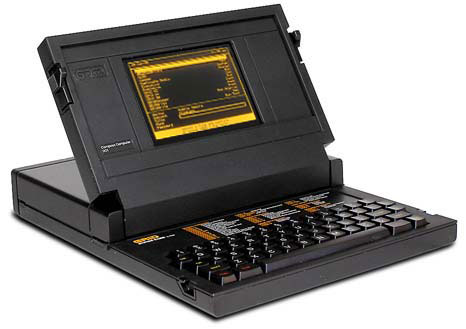
More fun facts, it was used in space, and perhaps even as the "nuclear football".