Concentrating geopolitical risk of TSMC operations makes Taiwan more important to the rest of the world. The US would naturally want to reduce this risk. In Taiwan-China conflict world chip production would take a huge hit or be in the danger of falling under Chinese rule.
If TSMC's leadership is patriotic, they should refuse this pressure as much as they can and ask more weapons for Taiwan instead.
The Taiwanese government owns 6% of TSMC, and all the leadership is based in Taiwan so I would imagine they'd prefer to not endanger their family and friends.
Cost is huge for the lower classes and maybe half the upper classes. They are sold on honor, but they fought for the profit of the ruling class, via conquest or be diverting fund to the military industrial complex.
What you describe is the effect of war, not its origin. Ironmongers get rich from war, but they probably don't make the conflict happen. How could Northrup Grumman force the invasion of Kuwait to improve F117 sales?
Ironmongers are also a much smaller - less important - share of the US economic pie than they used to be, back when US manufacturing was a much larger share of the economy. Now, granted, even with their lessened share of economy, they still of course carry outsized influence politically as proxy arms of the Pentagon.
As recently as the first Gulf War, Microsoft (for example) was a tiny speck compared to the military industrial complex. In five years or so, Microsoft's annual sales will be equal to about 25% of the annual US military budget (not meant to be apples to apples, it merely points out the massively increased scale of big tech vs eg 1990; Microsoft's sales for fiscal 1990 were... $1.18 billion).
To put it into tangible dollar terms:
Apple, by itself, generates approximately twice the annual operating profit of all US defense contractors combined.
Apple benefits from calm globalization, not war.
Big tech humiliates the military industrial complex on generating profits. And big tech is still expanding, whereas most major sectors are not. Which is to say, big tech money looks like it's going to double in size again in the next ten years (7% * 10 years).
AAPL + MSFT + GOOGL + FB + INTC + AMZN = ~$220-$230 billion in annual operating profit for 2020.
There are three trillion dollar corporations in there (Amazon is just shy of it; and FB will join them in that club within a few years). The rest of the world has one, which isn't really a corporation, in Aramco. It's $5.5 trillion in combined market cap. The Tokyo stock exchange is the third most valuable exchange by total market cap in the world, at about $5.5 to $5.7 trillion (the next two are US exchanges).
So digital giants have more lobbyist potential (in financial terms only, they cannot compete in massive 'job creation' in a districts all around the US, especially blue collar jobs) than the whole MIC, and the incentives to use it to counter lobbyist potential of warmongers. Why don't they use it for actual lobbying-for-global-piece?
The "Arab Spring" was just another power projection project, you only need to examine how many so-called NGOs that ran the social media campaigns were directly or indirectly funded by intelligence agencies.
But more to the point of the GP, to think that only the military industrial complex profits from American global dominance is incredibly naive. All the U.S. interventionism in South America for the last century (i.e. armed insurrection against democracies to install fascist dictatorships) was about opening markets and resources for exploitation by American (civil) corporations.
You have a good point about tech getting bigger. What worries me is that tech starting to profit more from war. Surveillance , GIS, AI, chips, robotics... are already a huge area and expanding. It is not a stretch to imagine a scenario like facebook signing a deal to provide intelligence, google or amazon providing infrastructure.
War is still highly profitable for oil companies (like Aramco) as long as they can get oil fields for cheap, set the price for oil and poor people (central banks) pay for the costs.
In the next 20 years both oil companies and central banks are getting distrupted, at the same time a brave new world is coming...
Eisenhower’s speech was precisely about the fact that, in conflicts before World War 2, existing manufacturers would temporarily make weapons, but that World War 2 left us with a “permanents armaments industry of vast proportions.” Literally his point is that it used to be ironmongers making weapons, but now it’s weapons manufacturers making weapons.
The MIC whispers in the ear of the movers and shakers of Washington to ensure conditions are good for business. General Eisenhower witnessed this happening. They are directly responsible for the last 100+ years of American military adventurism.
His speech was about the result of the Second World War:
> Until the latest of our world conflicts, the United States had no armaments industry. American makers of plowshares could, with time and as required, make swords as well. But now we can no longer risk emergency improvisation of national defense; we have been compelled to create a permanent armaments industry of vast proportions.
His point wasn’t about specific instances of armaments manufacturers influencing foreign policy, it was simply about the existence of a new and vast industry permanently dedicated to manufacturing armaments.
It seems like the catastrophic prospects that nuclear war presented played a part in preventing that sort of war - but such things are hard to know for sure.
> Most wars between nations are fought for something like honour:
This is not true. Wars are fought for wealth or to protect wealth ( perceived or not ). "Honor" ( like freedom, human rights, etc ) is the lie the elites employ to sell the war to the public and dupe the masses into sending their sons and daughters to the battlefield.
We didn't fight the korean war, vietnam war, iraq wars, etc for "honor". We fought it for wealth. Every single war we fought ( from the Revolutionary War to the wars today ) was about wealth.
The cost-benefit analysis of war is another thing altogether. It isn't an exact science and it's like playing a game of "what-if". In some wars, you can see clear winners who made out like bandits. I don't think anyone would claim the US didn't come out the big winner of ww2. There are clearly some wars where it was a complete waste of lives ( ww1 ) since no side really won and the only winners were bankers and war profiteers. Most other wars, who knows. The cost-benefit analysis comes down to your own biases and how you perceive a non-military solution would have worked out.
If wars were truly fought for honor, then we'd have a lot more wars and a lot more nukings. Honor is the fake thin veneer of war. Scratch it and you'll find the true cause of wealth - greed.
There are not a lot of wars that have turned out to be "just" in retrospect; the American entry into WW2 as a defensive war is one of the bigger exceptions. Pretty much all of the wars of choice after that have been disasters.
Wouldn't it also be an incentive for war if a country is a) mostly independent because it produces a lot of technology domestically b) the next-in-line for supplying the tech to the world if the current main supplier disappears?
No, my assumption is that a war would leave Taiwan scorched and useless to anyone.
"a) mostly independent because it produces a lot of technology domestically" would ensure that China doesn't suffer from the lack of availability due to this destruction, and "b) the next-in-line for supplying the tech to the world if the current main supplier disappears" would ensure China profits.
That assumes these two assumptions are actually true.
I've heard a rumour too that there's a safe in each of their fabs containing enough explosives and instructions on how to scuttle the fab in case of invasion.
This would not surprise me, especially considering just how little you would need to catastrophically disable one of these factories. That said, I don't think this is a very practicable angle to worry about, since it's not just the factory you need to make the products. It's also the people, experience, and massive logistical octopus the factory is hooked into that makes it able to produce these incredibly valuable products. One minor deviation in a supply chain (i.e. a vendor switch) can mean millions of dollars in scrapped wafers. Just having the factory and its tools doesn't mean anything for an invader. It would simply become the most expensive waste of space on the planet.
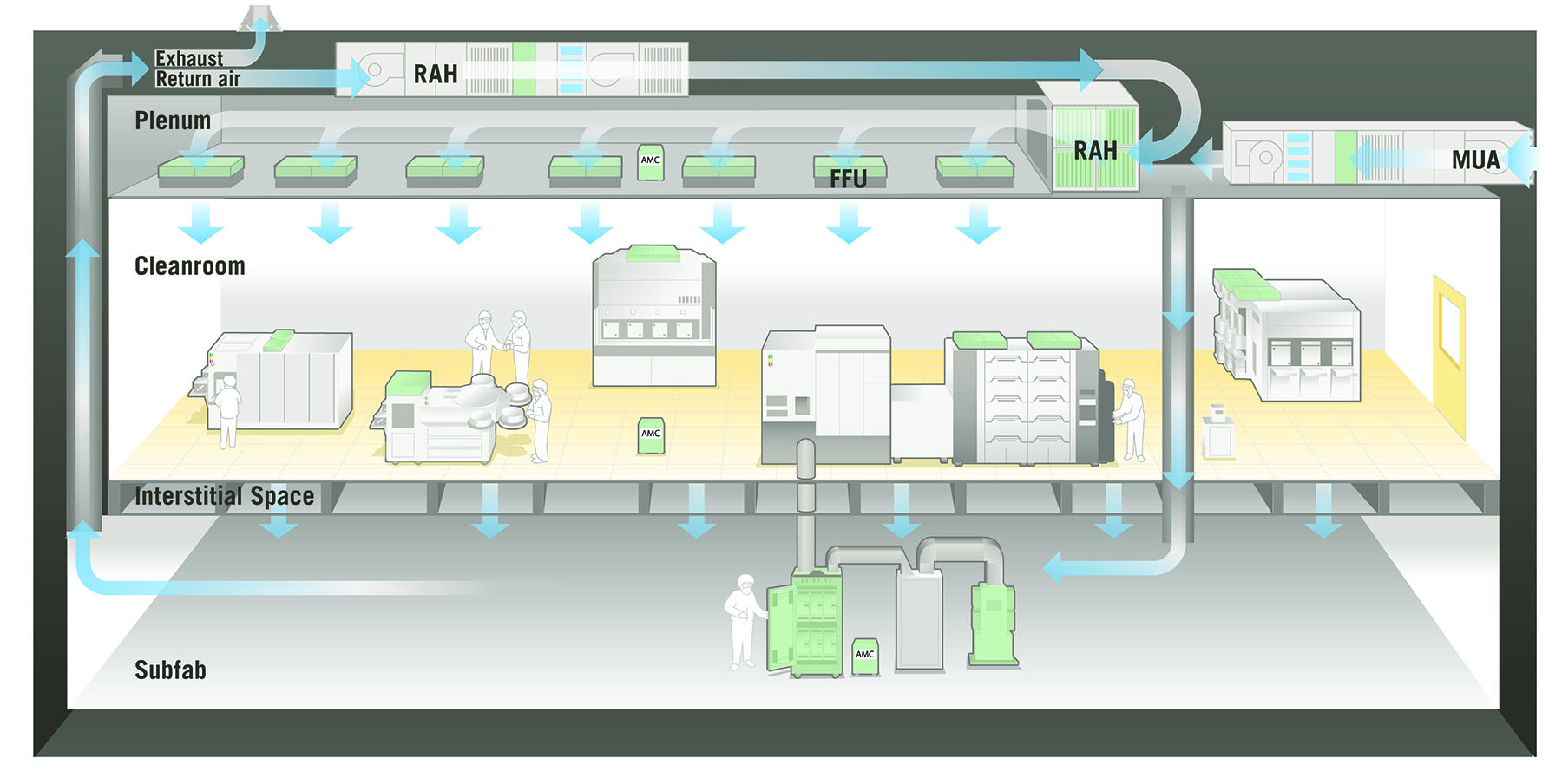
Not much actually (I've worked in a fab), the entire floor is porous to allow air through it and fab HVAC systems attempt to create laminar flow from top to bottom [1].
That is seriously cool. Does that reduce the need for protective equipment to keep dander and dust from getting everywhere or is this strictly in addition? My sense of how destructive dust can be in these facilities may be inflated. I'd heard that re-establishing a clean room can be a huge PITA and the first thing I could think of was powders getting in there.
If you're ordering your people to destroy equipment, you could turn off the air handlers first, right? You're not gonna be in there long enough for the CO2 to build up to harmful levels. Unfortunately I don't recognize most of those acronyms. Are they dealing with fumes as well?
No, its in addition. There are micro-clean environments inside the tools themselves. The wafer chamber is a couple of orders of magnitude clean. The plastic box that carries 15-20 wafers has to be specially made for cleanliness, each piece costing thousands of dollars. Entegris makes these boxes too [1].
It honestly depends on where in the fab. One of the most dangerous things from a chemical perspective would be copper in the non-copper part of the factory. If you set off something jacketed with copper right in the middle of the photolithography tool area, it would probably be game over for quite some time.
Given we're in a hypothetical about 'how would you scuttle your own fab', and that I'm verbalizing the implicit "without hurting any employees", I'd guess that one or several team leads in charge of either automation design or maintenance could think of a dozen nightmare scenarios or even personal anecdotes of proverbial wires getting crossed and causing mayhem. If the solvent got into this line, or the effluent into this one, or the wrong voltage here, or the part installed backward here (because in The Expanse they don't have keyed sockets to prevent an employee from installing high current equipment backward, apparently... but I digress).
We tend to be limited in our creativity, though. You mentioned a pretty violent way to distribute copper, isn't powdered copper a common ingredient in fireworks? You just need to get the copper airborne, unattended (copper poisoning I hear is pretty awful), not make a big boom. You would have absolutely no cause to have that material anywhere near let alone inside of a fab. But if a hostile takeover at gunpoint is actually a scenario you're concerned about instead of a bunch of randos bullshitting on the Internet? Wouldn't be hard to prepare some boxes and a laminated instruction sheet to put in a safe somewhere. In Case of Armed Invasion, Read Instructions.
That would be far too dangerous as this makes future construction work on a building extremely risky. I don't believe that for a second. I would not be surprised of there's a plan for the sabotage of infrastructure or valuable facilities in general.
In a similar vein, German roads and bridges had shafts in them for explosive charges. The plan was to blow them up in case of a Warsaw Pact invasion to slow any enemy advance.
Be careful for what you wish for. Taiwan’s formal name is Republic of China, the older generations does not exactly share the younger generations wish of independence. In fact, they are often patriotic .. to China.
I think you might need to interpret "China" in the grandparent to this post as literally the land and people, instead of the more common meaning of the current government.
Taiwan's official view, as I understand it, is that they are the rightful government of the land and those people, and that the people currently reigning are illegitimate.
Look at the Straits Communiques to understand the KMT position. The DPP which won the election is far more likely to declare independence and ignore the history entirely.
Yes but the election prior to that argues against you as well. The reason for the most recent shift was because of Hong Kong protests and mainland action there. Prior to that there was a massive shift in favor of stronger relations with Mainland China.
It has never had a pro-PRC stance. That's a gross misrepresentation of the KMT view. At best, the KMT is a pro-status-quo party that simply thinks it's bad for business to start WW3 over the Chine issue.
Keep in mind there were 5 million votes for the opposition. Where does the leadership of TSMC fall under? We won’t know, are they more likely to support independence and change than young people in college? We can only make educated guesses.
The election doesn't tell you much. The young voters continue to prefer independence, while the shrinking older population prefers eventual unification with China. As more young people become eligible to vote, the independence crowd simply gets more votes.
KMT = economy party, they talk about "eventual reunification" in public statements to appease PRC so that cross-strait relations can remain good, which they think is crucial for the economy (since PRC is Taiwan's biggest trading partner). Pretty much nobody actually cares about reunification in and of itself, and KMT's current stance is that it won't happen until PRC becomes a democracy.
DPP = in addition to defying PRC's bullying about Taiwan government's statements regarding independence, DPP believes it is crucial to expand trade with other countries to reduce economic reliance on PRC.
So I would say there isn't really a huge generational divide regarding actually supporting re-unification, but certainly younger generation may not be as concerned about the potential economic ramifications of defying PRC.
It's not that the KMT wants to appease the PRC. Of course the KMT wishes for eventual reunification: they were kicked out of the rest of China by the communists but that does not mean that they should give up hope off regime change on the mainland.
They are not patriotic to the mainland government. There are few people in Taiwan that want reunification. Both greens and blues want to maintain autonomy, it's just the level to which they want it that differs.
Patriotic to "China," yes, but those in ROC who believe in "one China" in general don't support the PRC. There is some talk of reunification but even among the pan-Blue, it is generally assumed that reunification would only be possible if the communist party in PRC collapsed.
Even older generations do not support reunification, at least in any specific sense, if I understand correctly.
It's more complex - essentially the people in Taiwan who's politics descend from the nationalists who escaped ahead of Mao's and took over the country are different from those who's politics descend from Japanese invasion and occupation from 1895-1945, ~1 week of independence, followed by occupation by those self same nationalists. They literally speak different languages.
The weird thing is that the Nationalists, the arch-anti-communists who believe they still rule one China are the ones who have been cosying up to the mainland over the past decade or so, making big bucks doing so - they're the ones who are against Taiwan as an independent country ....
The kids? they love j-pop/k-pop are much more citizens of a wider Asia rather than China.
So the people who have won this latest election by a landslide aren't the descendants of the Nationalists who believe they rule China, but they do believe in a Taiwan in a wider Asia, what's happening in Hong Kong scares the shit out of them.
IMHO we should happily recognize "Taiwan", but not the defunct "RoC"
What Washington should be doing is investing in creating a US-based top-notch semiconductor foundry business. And that's something that takes 20+ years.
> What Washington should be doing is investing in creating a US-based top-notch semiconductor foundry business. And that's something that takes 20+ years.
That would require leadership and vision. Unfortunately, too many American politicians would prefer to use any money available for that to instead cut taxes yet again.
Also (correct me if I'm wrong), but doesn't Intel keep its manufacturing dedicated to its own use? So it might not be available for custom military-use chips.
I agree with your statement up until you point your finger at tax cuts. Tax Revenues are at an all-time high BECAUSE of the tax cuts. Look it up before making erroneous statements.
There's Intel today but, also, presumably this could be done with GloFo? They were in the midst of research into 7nm processes but stopped due to competition. Feels like investment there could work faster than 20+ yrs.
And ON Semiconductor bought Global Foundries' Fab 10 (formerly IBM) in East Fishkill.
Sematech was the last US government effort to improve US competitiveness in semiconductors. It's still around but isn't a US government initiative any longer.
A modern chip design-to-production pipeline takes roughly five years, 2 years if you crunch it and dot try anything fancy.
And yes moving from TSMC/GoFo production nodes to Intel would require significant redesign.
"Random" has some connotations that probably aren't helpful.
He's saying you can't make arbitrary chips at the Intel fabs. So you could end up with a proverbial car with no wheels. Looks cool but it ain't going anywhere.
I just meant if I had a design I wanted to make could I make it with Intel in the same way I could with a TSMC partner like Broadcom. My previous experience is that you could, we had them come deliver us a presentation some years ago. Their offering was no good at the time as they didn't have some of the IP macros available in the time frame we needed. So I find the parent comment confusing, unless things have changed.
Trying to be careful what I wish for (and probably failing), at this point electronics are such an integral part of Defense that some of the money spent on aerospace really should be diverted to insuring domestic capacity for electronics and computers.
But as several other people pointed out, and several political luminaries from the past have also pointed out, a global supply chain reduces the threat of war. Either goods cross borders or soldiers do.
Absolutely. NSA has its own fab to guarantee security and ensure secrecy. No reason why we can’t have a corporation that pushes semiconductor tech forward.
Apple's A chips were, once upon a time, manufactured by Samsung in Austin, Texas until 14nm in 2015. Tim Apple switched to TSMC in Taiwan shortly after defending Apple's outsourcing practices in a rare national TV appearance, boldly claiming that "the engines of iPads and iPhones are made in US."
Tesla's chips are made in Samsung's Austin, Texas plant.
Well, there's the American fab we've been looking for! Samsung isn't too far behind TSMC, is it? Even if the Austin plant were a generation or two behind their Korean plants, it shouldn't be too difficult to bring it up to date -- especially if the investment will be rewarded by lucrative defense contracts. Besides, Samsung already builds a lot of military-grade stuff for the Korean government, so it's not like they lack the experience.
This sounds much easier than telling TSMC to build a whole new fab on American soil.
Well, the key thing is to get everyone to use the US plant, but nobody wants to use potential competitor's foundry, who recently announced that they plan to spend $100+B to challenge other logic chip makers. A few minuscule defense contracts aren't probably worth what they have to invest in -- Samsung for instance has already spent $15B in their Austin plant.
I believe Apple use TSMC, whilst Tesla use Samsung for their customs. So, outsourcing. I haven't heard of either going into the silicon business recently.
DoD's having a crisis with its trusted Foundry Program [1][2].
Originally, IBM's East-Fishkill plant was the largest trusted-foundry of near latest generations (14nm, 22nm) but that was sold off to Global-Foundries, which then sold it off to ON Semiconductor. Now it needs someone to fab the latest generation with a full chain-of-trust.
ON is at least a US owned company. Should make it easier to maintain the trusted foundry there, as they have several other sites which are accredited. According to their marketing material, they are licensing the GF/IBM 45nm/65nm nodes.
security risks aside, andy grove of intel publicly regretted offshoring semiconductor manufacturing because of his suspicions about generational shifts in innovation and expertise
I've tried to read econ papers on colocation of innovation and manufacturing -- they're mostly long-winded and unconvincing but the concept is compelling
Dan Wang explores this idea in 'How Technology Grows' [0]. To summarize, he asserts that the main downside of offshoring is the loss of process knowledge (the tacit knowledge that is learned by doing and transmitted through culture).
The Samsung LSI/flash lines in ATX are not a leading process node in terms of all foundries (i.e. TSMC), but last I heard they were pretty close to the bleeding edge of what Samsung is capable of in their Korean factories. The ATX lines were always intended to be exact copies of their Korean counterparts, but this may have deviated in recent years (I have been out of the loop for ~7 years now on their internals).
Some of the major reasons behind Samsung building that factory in Austin were to satisfy Apple and to also leverage the more "open" innovation attitudes of the average American worker.
According to Samsung's own account, their first fabrication plant in Austin, Texas opened in 1997, followed by major upgrades/expansion in 2007 and 2017.
> I've tried to read econ papers on colocation of innovation and manufacturing -- they're mostly long-winded and unconvincing but the concept is compelling
aside from the basic claim that large factories are doing some amount of R&D on-site, this read like nonsense to me. Could be my lack of depth in industrial organization / economics.
maybe also search 'industrial clustering' or 'innovation clusters'
Couldn't this have the opposite effect from what is intended? If all the US military TSMC chips come from a separate facility from those for Huawei, etc... then there's only one, big, target with minimal collateral damage.
No. If you're already at the point of China bombing fab plants in the US, you're at absolute war and many millions of people will die. The US would respond very badly, quite overly irrationally to an extreme to having its mainland bombed. Having those fabs in eg Taiwan and of mixed use (US & China both deriving supply from them) would be pointless under that conflict scenario anyway; all it would do is keep China from bombing them - maybe - and instead they'd seize them physically and shut off US supply while trying to keep their own supply going (the US can't stop China from taking Taiwan; if they move on Taiwan, they're getting anything left standing, including fabs). There's zero upside to keeping them mixed with US / Huawei if there's a conflict.
Sure, I think it's quite technically obvious when you look at any aspect of the matter. Taiwan is five feet from mainland China and they have a massive military that is increasingly quite advanced technologically (clearly the overall #2 military in the world in both capability and technology at this point; Russia is superior to China in a few categories, but not overall; China is rapidly rising, Russia's military is rusting) and they have an increasingly potent navy. They can stand off US carriers effectively and are building multiple carriers of their own. They can rapidly, massively resupply locally, whereas the US would have the British Empire problem of trying to supply a conflict very far away (and facing non-stop Chinese harassment & losses in attempting to resupply into Asia). US bombing capability is far too limited in volume now versus a target as massive as modern China's manufacturing and military (we can't take it down effectively or fast enough; and we couldn't easily consistently penetrate their territory air defenses anyway; Russia would very happily feed them volumes of S missile systems, which would severely restrict US bombing efforts). US military resupply is wildly expensive, Chinese military resupply is not (specifically on such a local/regional basis). My god the resupply capabilities of a full war footing modern China in the local region - just get the fuck out of the way of that. Picture WW2 scale US manufacturing arms output capability and then double it.
What is the US going to do, lose a couple hundred thousand soldiers and a large number of naval ships trying to save Taiwan, which is an impossible task long-term. No chance the American public goes for that unless the mainland US is at risk or unless China makes the mistake of killing a large number of US soldiers in eg South Korea or Japan. Taiwan is an ally, it isn't necessary for US national well-being. If China gets Taiwan, and the US keeps its manufacturing-import relationship with China/Taiwan for its domestic economy benefit, the US public will have little appetite for an actual war with China. Where's the US public self-interest otherwise?
Do you kill everyone in China, alternatively (not plausible, as that's all out nuclear warfare between the two nations)? Because that's the only way to permanently stop them from taking Taiwan if they want it. They have an authoritarian system, truly epic scale manufacturing capabilities of all sorts, a rapidly advancing military, and 1.4 billion people to throw at problems (with only minimum regard for killing large numbers of them if it's regarded as absolutely necessary for national goals; China will tolerate losses far better than the US, authoritarian systems have demonstrated that repeatedly in the prior century).
Any invasion plans would require a ton of perpetration that would be seen months before.
The US Military is a logistic machine. No President would sit by and watch the preparations and do nothing. The death of a US carrier group in defense would ensure that the US would not backdown. Think of the US after Pearl Harbor. It would end with nukes and the US would “win” for some definition of the word win at that point. The Russians would op out hoping to come out the untouched as the US and a China destroy themselves. Because of this a well reasoned response risk wise would be for the US just to go nuclear day one and decapitate China before they saw it coming. That’s far more likely.
This has been proved with Syria and Russia. The U.S. didn't try to stop or go to war with Russia for losing Syria to them, they accepted the loss of Russia "keeping" Syria and moved on.
U.S. best weapon today is economic sanctions, but is not too effective against China.
Actually I think it's the reverse; it is quite effective against China.
China needs huge amount of USD for supporting its internal needs for food, resources, etc. That's why Hong Kong is so important to China as she is the only city in China which can raise USD funds via the stock market.
A 'still ok' economy is the only thing to keep the legitimacy for the current authoritarian regime. If the economy turns bad, people will start challenging the regime internally.
I thought the deal about the F35 and other fighter planes was that when the various countries bought this hardware they got to build a part of it. Really as a way to soften or justify the absurd cost of these things,
For example here in Denmark, the Danish company Terma which is specialised in radar technology produces a number of components for the F35:
I'm curious about the politics here. I get making the chips in the US, but if security is the concern they should no be made by a company based in Taiwan regardless of where the fab is.
Why is Taiwan specifically a threat? They're a long-term ally and their voters recently gave a new mandate to anti-China leaders in an election. If the US is worried about threats from Chinese electronics companies like Huawei it doesn't make any sense to alienate Taiwan.
In addition to the other points, it seems like it would be much easier for the Chinese to infiltrate Taiwanese industry with spies/saboteurs since they share cultures.
Blackmail of key individuals is probably easier too since Taiwanese are more likely to have family members on the mainland and/or Hong Kong.
Not so much specifically as in politics alliances change fast so you have to consider even your friends as a potential threat. After WWII it took only a few years for Japan to go to friend - there was no way to predict that (as opposed to isolationists who want nothing to do with us)
So that there is a “chain of custody “ from plan to production completely within the US. Presumably the people working in such would be reachable by US law, if not closely aligned with their own country’s interests.
If the fab is in the US, we can take over the plant and use the existing workers who as Americans are loyal to the US over the company. Of course we have to kick out foreign company leadership, but there are plenty of leaders who can run a plant with the same processes for a few years while learning what is really needed. Odds are there will be some local leaders who can step up. The plant might fall behind the latest processes but it will be good for what it does for a while - long enough to finish the war
Would the location of the factory really make much difference? If TSMC was to buckle under China pressure, it could probably find a way to interfere with or distribute secrets from the US military chips regardless of the physical location.
TSMC is "in China" it's just that ROC fabs are a few process nodes ahead of anything in the PRC.
Various US military and government orgs prefer to buy chips entirely sourced within the US, this isn't as much about pointing fingers at China, but it is presumably harder to suborn domestic workers than foreign workers.
Personally, my take on things is that the major world powers should use silicon entirely manufactured and assembled within their borders for critical and military/government hardware. It is too damn hard to verify chips after they are manufactured, because potential backdoors and vulnerabilities are too small to see these days. It is always an arms race between attackers and security, and whichever side is "winning" in a particular domain will shift back and forth, and the cost-effective tradeoffs will shift in position. Same thing happens in physical warfare over the course of history.
The argument that PRC "could probably find a way to interfere" is not germane, because perfect security was never on the table in the first place. We are just comparing different relative levels of security on a probabilistic basis comparing cost of attack and cost of defense.
Military prefers locally sources parts because if war breaks out you need absolute certainly you can get the critical parts you need to build whatever weapons you don't have. For short war this isn't a big deal because you are stuck with whatever you have one hand. For a longer war you need to buy more weapons - and that means you need a source you can buy them from. Friends and enemies change all the time, so the only way to be 100% sure is to produce your own parts in your country.
So, at first we encouraged military companies mergers to save our money (back from 1980s?) and left only with a few monopolies, then suddenly there is only one company that can make our military chips? What a surprise! And now we have to pay premium to have them made on our soil? Same situation with non-military monopolies and near-monopolies.
It was the 90s, and the only major defense contractor that had large fabs for digital chips was TI. The consolidation had little effect on where the chips are made.
Most chips don't need the latest silicon technology, mostly that's just for high end CPUs and memory - "fast enough" allows one to start to optimize for cheaper
Politics aside that is the huge problem of having a monopoly in that industry. I really hope we will have more contract chip manufacturers at some point in the future.
From a purely economic viewpoint, fabs these days have such high levels of automation that locating them in Asia doesn't carry the cost benefits it used to


Concentrating geopolitical risk of TSMC operations makes Taiwan more important to the rest of the world. The US would naturally want to reduce this risk. In Taiwan-China conflict world chip production would take a huge hit or be in the danger of falling under Chinese rule.
If TSMC's leadership is patriotic, they should refuse this pressure as much as they can and ask more weapons for Taiwan instead.