On one hand, esr has a point. There is a credible argument that cancel culture has gone too far, and that expressing disagreement itself is now becoming dangerous as those with whom you disagree will take the opportunity to play victim and attempt to defame you simply for disagreeing. Identity politics along these lines have lately become unproductive and distracting. I generally don’t participate in groups that permit that sort of thing. There’s a real problem afoot.
On the other hand, esr is a real jerk. Real jerks in f/oss are also a real problem. f/oss groups should ABSOLUTELY eject bullies: not for wrongthink, but for bullying. We must be kind.
I think the solution is to continue to repeat his warning message, but also to eject him and any other bullies like him. (Including those who bully with the extreme-PC victimization hammer.)
One can fight excessive-SJWing and remain kind and considerate to others whilst doing so.
I don't mean to dispute that ESR may be a jerk, but I'd ask you to consider what his position is:
> It's less bad that people sometimes got their feelings hurt than it is to institutionalize a means by which dissenting opinions are crushed under the rubric of “not nice”.
His point, as I take it, is that a "cancel culture" is antithetical to an open culture. I agree. Excluding someone due to tone, without warning or clear explanation of the violation, especially when it appears the content is a contested opinion, is bigoted censorship.
To steal the Paine quote ESR himself used, "He that would make his own liberty secure, must guard even his enemy from oppression; for if he violates this duty, he establishes a precedent that will reach to himself."
The liberty to use strong rhetoric[0] in defense of ideas is what I see under attack by banning ESR from these discussions.
[0]: To my reading, the most inflammatory remarks he said on the mailing list are:
> With whatever moral authority I still have here, I say to all advocates of soi-disant "ethical" licensing not just "No" but "To hell with you and the horse you rode in on."
in the opening email for that thread and in his penultimate email:
> I am not fooled. You are mounting an ideological attack on our core principles of liberty and nondiscrimination. You will not succeed while I retain any ability to oppose this.
Compared to a typical rant from Torvalds this is pretty tame debate-speak.
> a "cancel culture" is antithetical to an open culture. I agree. Excluding someone due to tone, without warning or clear explanation of the violation, especially when it appears the content is a contested opinion, is bigoted censorship.
Ever hear the expression "Your right to your fist only extends as far as my face?"
In order to express ideas openly, even firmly and directly, one does not need to be explicitly RUDE to others, and apply personal insults and attacks.
For people who seem to be deeply intellectual, ESR and Linus (though less these days) have an apalling inability to differentiate between "This is a stupid idea" and "You are a stupid person".
They seem to revel in additional personal attacks on other people rather than engaging in a free marketplace of open ideas, and their behaviour has been unchecked for decades because they are brilliant and their contributions are meaningful.
It turns out, history is full of examples of that.
It also turns out that you don't HAVE to be a jerk, and you can express your strong beliefs in an idea without calling someone a looneytune.
> Ever hear the expression "Your right to your fist only extends as far as my face?"
Equating physical violence with someone who called another a "looneytune" is completely unreasonable as they are NOT the same thing. The uncomfortable truth is, the freedom of expression guarantees the right of someone else to say something people disagree with, hurt your feelings, offend, or even make others angry.
Also, who gets to decide when someone is being a jerk? In this case, it's a group of people who are comfortable deleting almost all evidence of Eric's supposedly offensive remarks, thereby ensuring that no one can even debate the subject reasonably. That alone, would keep me from jumping to their defense even if I agreed with their actions.
And drawing an impassable wall between physical violence and verbal abuse is also completely unreasonable.
The world is full of roided up assholes who would scream at someone in the face, have their victim "push them away", only to proceed to punch them back because once you cross the line into physicality a shove is the same as a punch in the face.
It's bullshit.
Obviously being "a jerk" to someone is not the same as physically hitting someone.
But in the context of a workplace, an online forum, or a community contributing to an open source project, the choice isn't between punching someone or yelling at them.
The choice is between civility and not. Between being an asshole for no reason and not. People like Linus Torvalds and ESR have significant trust in their technical leadership. If they don't like an idea they can just say "that is a bad idea. here is why". Their position is not strengthened by screaming insults at the other side. All it does is make them look childish and make people not want to contribute their time and energy to the cause.
The roided up monster antagonises, waiting for the slightest excuse to explode in violence.
A slightly sneakier version of the same monster would antagonise more non-physically and perpetually.
There's slippery slopes and giving inches; there are deleterious attractors all human interaction ecosystems can fall into through a tragedy of the commons (see meditations on moloch by slatestarcodex). How do you prevent this, or even start to stand against it? Schelling points.
The guy shouting on the corner is reliable. He's obvious and slightly unpleasant. But he's a lesser evil than the creeping decay that girdles you and smothers you while whispering honey into your ear.
> In order to express ideas openly, even firmly and directly, one does not need to be explicitly RUDE to others, and apply personal insults and attacks.
The issue is that "rude" is up to whoever feels treated rudely. If you tell someone they are wrong in no uncertain words, they might consider you rude. If you sugarcoat it, you're a) lying, b) doing the community a disservice by not opposing something that you consider wrong.
> For people who seem to be deeply intellectual, ESR and Linus (though less these days) have an apalling inability to differentiate between "This is a stupid idea" and "You are a stupid person".
Funny, it always struck me that it's people who are deeply emotional who have a problem with it. If you're emotional, you will feel personally attacked and aren't able to put that aside and deal with the issue at hand. If you're intellectual, you will notice the insult, but it will not dominate your take-away, and you will easily be able to address it if you think it's necessary (hint: it's not) and move on to the content. If you're playful, you might just add something similar in your response. If you just want to lighten the mood, you'll make a joke. And then you move on and address the issue they were talking about, because there's usually an issue in there, they aren't just saying "no, you're dumb" just because, they are saying "no, you're dumb, because you're doing xyz".
> They seem to revel in additional personal attacks on other people rather than engaging in a free marketplace of open ideas, and their behaviour has been unchecked for decades because they are brilliant and their contributions are meaningful.
I believe you're putting way too much weight on the insults here. I don't think that Linus sits there and laughs all day because he "owned some noob". More likely, he fires of an email and moves on with his life, the insult not being something that brings him a lot of pleasure, but just a part of his communication style. Not a sadist that wants to see other people experience pain and emberrassement but somebody who has little concern for the feelings of the recipients of his outbursts, either because he himself doesn't mind being called an asshat or because he believes that the stakes are too high to hold back.
> It also turns out that you don't HAVE to be a jerk
I agree if what you're trying to say is "there are highly-productive people that are not jerks". I strongly disagree if you're trying to say "you can choose whether you are a jerk or not, and you don't have to choose being a jerk".
> Ever hear the expression "Your right to your fist only extends as far as my face?"
I have. A "community guideline" or social disapproval of threatening violence may disallow those sorts of expressions, but they're quite common in certain communities (sports, games, etc - may be known as "trash talking").
> In order to express ideas openly, even firmly and directly, one does not need to be explicitly RUDE to others, and apply personal insults and attacks.
I agree. What one person interprets or intends as "explicitly RUDE" may be interpreted or intended differently by another individual, though, so an open community should assume good faith, correct the socially-determined, arbitrary language violation, and try to focus on the content of the message rather than delivery mechanism.
If you'd like to share examples of what makes you believe ESR[0] is unable to differentiate between a stupid idea and a stupid person, I'd be happy to examine them with you. I myself used Linus as an example of someone who can be famously insulting[1], yet I'm unaware of him actually permanently banning people from submitting new patches to the Linux kernel because he flipped out in a code review.
Indeed, as I think everyone can agree they've been polemic regardless of how you agree with them, the fact that they've engaged with the public at large seems contrary to your statement that they revel in personal attacks rather than engaging a free marketplace of ideas: They share an unambiguous position and offer defense of their ideas against all comers. I suspect most of this defense is done today by the organizations and the legacy they've created rather than them personally, which is why it's more noteworthy when they feel the need to make such strong statements.
> turns out that you don't HAVE to be a jerk, and you can express your strong beliefs in an idea without calling someone a looneytune.
You don't "HAVE" to be a jerk, but you may. I will listen to the content of your words rather than the appearance of your statement, and I believe ESR is aggressively asserting his position the Open Source Initiative should do the same.
I find it interesting you used "looneytune", because I don't see any message from ESR in the month of February using that word.[2][3] Quoting Russell McOrmond later in the thread[4] that does use the word "loonytoon", "ESR tried to post a message where he named and shamed some individuals and activities which he considers to be seriously problematic not only in society as a whole, but software communities as well. The moderators rejected his email to this list. Some might even suggest he is being de-platformed by being blocked from expressing personal political views. I'm not suggesting this, as I'm advocating strongly that those who wish to use software and software licenses to discriminate be invited (strongly if required) to go elsewhere than the OSI mailing lists."
[0]: Or Linus, I suppose, though that's less relevant to the specific topic
Torvalds has been exceptionally tame by comparison as of late. He's adopted a formal CoC, admitted he is often a real jerk, and is seeking professional counselling. You know, he is acting like an adult in this entire thing.
> Real jerks in f/oss are also a real problem. f/oss groups should ABSOLUTELY eject bullies: not for wrongthink, but for bullying. We must be kind.
So, is it illegitimate, then, to have a FOSS project with an intentional/cultivated "culture of abuse", where the idea is that nobody is kind to anybody and that's how everybody likes it? Sort of a... "BSDM but we build something along the way" thing? (For example, picture "Twitch Plays Pokemon" but, rather than a game, the peanut gallery is "playing" an IDE.)
I mean, it's not like every FOSS project needs to be treated as a serious attempt at being productive above all else, right? Fundamentally, for a lot of people, FOSS is a hobby of theirs, and if some people want to do whips-and-chains FOSS as a hobby, I don't see why anyone needs to butt in between them doing so.
Which gets to a deeper point: does FOSS imply open membership? It doesn't obviously in the case where it's a one-author library; but beyond that, things seem sort of fuzzy right now. You'd think it could be made clear which projects are "for joining", and which projects are more in the vein of "you can certainly fork it, but our own version will stay exactly what we, the static set of existing maintainers, want, and nothing else." Where in the latter case, the culture of the project doesn't really matter to anyone but the existing static set of maintainers, because it's not like anyone else is going to be exposed to it but them.
So, is it illegitimate, then, to have a FOSS project with an intentional/cultivated "culture of abuse", where the idea is that nobody is kind to anybody and that's how everybody likes it?
The thing about this hypothetical is that it's wildly different from what Linus Torvald mailing list abuse winds up being. The approach is "we have a culture of anything goes, not because anyone likes abuse, but it's best way to get things done, and because most competent people do things that way, starting with Linus himself, who's clearly ultra-competent".
Essentially, while there might be some similarities to each, the abuse in open source culture is far more similar to cult abuse than BDSM activity. In cult-style abuse a person entering a project would confronted by escalating abuse and they either flee or accept and begin to normalize it whereas in BDSM, a person is given a description of what they're getting into from the start (though shading towards other "styles" is a hazard here too, of course).
Thing is there are a spectrum of approaches on the Internet but with the Internet no longer young, it's understandable people are concerned about where various styles end up. I have a friend who frequents 4Chan and says they get a lot out of the anything goes styles - "you just have to be willing to accept being called a fag and not taking any of it seriously". The problem is it's known that a substantiale-enough-to-dangerous group of people take the abuse as exactly that point and rather than seeing at restricting it naming calling in forums, live stream mass murder (say, they guy in Australia). This takes people a little aback.
BDSM irl has a lot of controls to prevent people from taking it "seriously", the point isn't to have some who want to torture in a no-limits fashion. If you could have some equivalent way to filter out people who can't separate play from reality, that would be great but I haven't the more abusive nooks of the Internet being very good at that.
Linux might be where many people's minds go by default in this comparison, but it's not the example I meant to conjure here.
I'm talking more about, for example, the FOSS communities around game-console homebrew tooling, where any given project is usually an outgrowth of some private Discord somewhere—some pre-existing group of friends—and so everyone on the project calls one-another names in the [public] GitHub issues; often actively trolls one-another with counter-productive PRs or issue-filings; sometimes creates new projects from scratch to replace/obsolete someone else's project just because A disagrees with B about some minor non-software-related thing, e.g. taste in music, and so "can't respect them or their software"; etc.
These people are clearly playing around as they make this software—and often producing the software rather sub-optimally in the process—but the goal of most of these project communities is clearly to have fun with the process of making software, not to end up with useful software.
And now, back to the question: are these projects, and their processes, to be considered societally acceptable? Or are they "canceled?" Would adding a Code-of-Conduct stating clearly what they're doing in the project even help? (IMHO it doesn't seem like it'd make much of a difference; it's not like these projects get outside contribution anyways.)
The thing with semi-abusive, semi-fun-loving group of friends and the perhaps multitude of kind of ambiguously abusive relationships one might notice small circles of people, is that these seldom scale to millions of people nor do they scale to long periods of time.
My guess is something like this: Once the project becomes big/useful enough and normal people are now using and relying on it, then they can start ousting the eccentrics/untolerables because at a large enough population, normal people just naturally outnumber them.
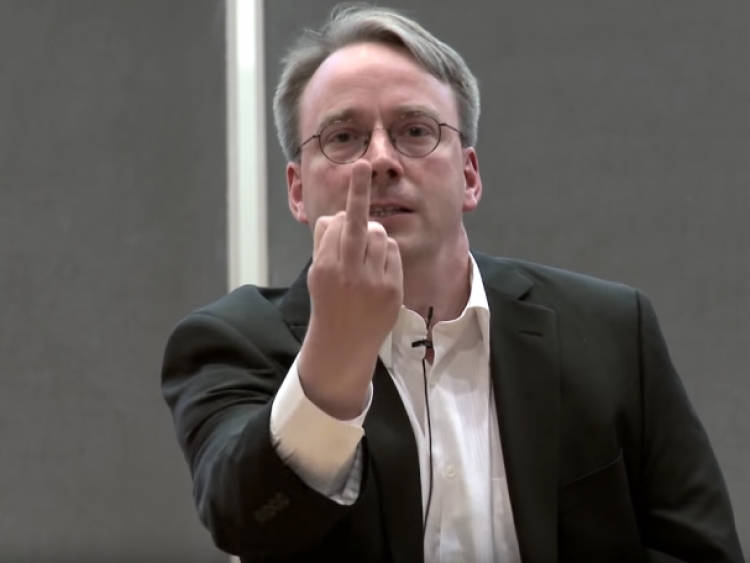
Disclaimer: Image is just an example to express an idea/concept. I do not endorse whatever is in the image and my post does not represent my employer, Unemployed Inc.
Any individual or group can do whatever they want in the OSS world, nobody is stopping anyone from being a jerk except those communities that voluntarily self-govern in such a fashion that excludes jerks. Where's the problem?
I've seen a few cases now where a FOSS project community—one that is nominally open to new members, but is in practice a closed and static group of close-knit friends—starts off all perfectly happy with a sort of raunchy/abusive internal demeanor; but then someone comes to them with a suggestion of some Code of Conduct or other standard of decorum; and then everyone suddenly decides that it's a good idea, not because they personally want to change how they interact, or even to see others interact differently with them, but because they don't want to be the one caught arguing against the CoC if it turns out that everyone else wants it.
That's still a voluntary choice made by those individuals. If the group doesn't want to follow the suggestion of an outsider they don't have to do that.
Well, yes; my point was that there's certain societal expectations "out in the environment" that cause groups to do dumb things; and the way to fix the problem created by that is to change the societal expectations.
Society is very diverse, it's not that realistic to change society such that you stamp out the ideas you disagree with, it's much more feasible and effective to use the power you have within your own community to stand up to ideas you disagree with.
I mean, the whole point of the Abilene paradox is that it's something that happens when everyone's level of regret they'd have from doing the thing doesn't exceed their level of regret from social approbation if it turns out everyone else did want to do the thing and they had to be the one to argue against it. So in the end everyone loses a little utility—rather than everyone expecting to lose a lot of utility (in the form of personal social capital), and then actually losing nothing-at-all when it turns out nobody's on the other side of the argument.
If you want to stand up for a lack of decorum in your community, there's nothing stopping you; but the behavioral economics just don't work out in favor of anyone following after your example, and do in fact work out in favor of the rest of the group tearing down the presumed-social-more-violator to protect themselves from being associated with you. (Again, even in cases where everyone turns out to secretly agree with you!)
People will have opinions about things, it's not feasible to eliminate the possibility of exposure to ideas you disagree with. If the Abilene paradox is so crippling that it precludes the possibility of expressing your own opinions within your own community then what hope is there to "change societal expectations"?
Groups that don't have a code of conduct (which in my experience increases rather than reduces the amount of jerkdom) get pressurised to add one. Conferences that don't have one attract twitter harassment campaigns. It's not really a free choice.
"The law" is ultimately just a particular form of social pressure, there's nothing magic about it. If someone is forced into bankruptcy because a twitter campaign got them fired, that's practically the same consequence as being forced into bankruptcy because a court imposed a large fine.
> "The law" is ultimately just a particular form of social pressure, there's nothing magic about it.
This is wrong. The "magic" (i.e. the thing that distinguishes it from social pressure) is threat of violence or imprisonment from the state if you don't comply with the law.
> If someone is forced into bankruptcy because a twitter campaign got them fired, that's practically the same consequence
No it isn't. You are employed at-will by your employer, they are free to fire you if they decide they want to do that, but they don't have to. If the business makes the decision to fire you based on public pressure that's their right unless you're making an argument for stricter labor laws (I suspect you aren't).
> This is wrong. The "magic" (i.e. the thing that distinguishes it from social pressure) is threat of violence or imprisonment from the state if you don't comply with the law.
Again, though, any violence is ultimately going to be carried out by humans for social reasons. While these online outrage mobs are, as yet, nowhere near as powerful as governments, they're already making credible threats of violence, so that's not the clear bright line you seem to think it is.
> No it isn't. You are employed at-will by your employer, they are free to fire you if they decide they want to do that, but they don't have to. If the business makes the decision to fire you based on public pressure that's their right unless you're making an argument for stricter labor laws (I suspect you aren't).
I am, among other things; at-will employment has always seemed unreasonable to me, as proven by the very existence of protected classes. It's popular to say "asshole isn't a protected class", but as far as I can see the whole rationale for protected classes applies just as strongly to those who have said legal but unpopular things.
> any violence is ultimately going to be carried out by humans for social reason
Every interaction with another human falls under the label of "social", the word ceases to mean anything when used to describe everything, abusing that rhetorical ambiguity to equate tweets on the internet with civil order enforced by armed agents of the state is absurd.
> While these online outrage mobs are, as yet, nowhere near as powerful as governments
Correct, not even close, and never will be in any conceivable future. The idea that a twitter mob could somehow ever be comparable in power to a government demonstrates a serious disconnection from reality and the power that governments exercise over their people all around the world and all through the annals of history.
> I am, among other things; at-will employment has always seemed unreasonable to me,
So what are you proposing?
> It's popular to say "asshole isn't a protected class", but as far as I can see the whole rationale for protected classes applies just as strongly to those who have said legal but unpopular things.
An asshole is not a "class" of people, it's a behavioral disposition. Nobody needs to be an asshole. The social advantages of being an asshole come with the consequences of people not wanting to interact with you.
> Correct, not even close, and never will be in any conceivable future. The idea that a twitter mob could somehow ever be comparable in power to a government demonstrates a serious disconnection from reality and the power that governments exercise over their people all around the world and all through the annals of history.
That's a trick of definitions: when an organisation acquires particular kinds of power we call it a "government", regardless of how it's structured or operates. Historically it's completely normal for states to be taken over by religious groups, by social movements, by corporations, by criminal gangs. And in most of history there has been very little respect for freedom of speech, for the right to say unpopular things and not suffer devastating personal consequences, for the idea that there's such a thing as a loyal opposition, or an honest mistake. If we believe that's important - and I do - then it's not enough to just protect speech from governments. Maybe 200 years ago only governments and major religions wielded enough power to ruin lives, and so constitutional protections and strict laws on freedom of religion were enough. But in these days of megacorps and large social movements that's no longer true.
> So what are you proposing?
That firings should be required to be for cause, and there should be reasonable protections even for fired workers in terms of notice periods, payments and the like - similar to the way it works in France (or most developed countries really). That really vital things (in particular, healthcare) should be done by a provider that's obliged to serve everyone rather than a private company that's permitted to arbitrarily withdraw coverage.
> An asshole is not a "class" of people, it's a behavioral disposition.
Or it's anyone you don't like. In any case, the rationale for protected classes isn't about the fact that they're classes, it's about the risk of suffering coordinated action from others - which nowadays applies to people who've said unpopular things too.
> Nobody needs to be an asshole.
Nobody needs to be a particular religion, but that's still a protected class.
It's absolutely legitimate to have a F/OSS-licensed project with such a culture. But it shouldn't count as part of the F/OSS movement(s), any more than an MIT-licensed website about how you need to pay SCO for Linux licenses would be part of the movement.
> But it shouldn't count as part of the F/OSS movement
Why not? If the end result is a high quality piece of open source software, why do I need to care about the politics or behavior of the developers?
The only reason I can think of would be from a risk-assessment standpoint, i.e. is another censorious asshole going to waltz on in and damage the team that produces this product so that it dies and becomes orphaned.
Why anyone would want to contribute to a project they don't like the developers of is beyond me; either fork it or go do something else. It's not a requirement. This is not your livelihood, for the most part. Just walk away.
Maybe if censorious assholes could just step the fuck off, and let people be, this would be less of a problem. As far as I can see, they've caused far more problems and far more discontent than anyone posting aggressively has ever done.
You don't have to care, and I am not saying you should.
I'm saying it doesn't count as part of the F/OSS movement. Whether you want to contribute, not contribute, etc. is your own choice and doesn't need to be correlated in any way.
> But it shouldn't count as part of the F/OSS movement(s)
Why not? Who gets to determine what counts as being part of the movement? I thought that, broadly speaking, the movement was about the method of producing and licensing software. If a certain group produces F/OSS software, but is internally abhorrent, they're still part of the F/OSS movement.
The comparison to BDSM is incorrect. BDSM is about "abuse" that one enjoys due to established parameters. I don't think anyone at the receiving end of abuse within F/OSS enjoys the abuse and seeks it out. That's why the codes of conduct exist, to... bring F/OSS in line with the expected ethical standards of scenes such as BDSM, so to speak.
Certainly. I wouldn't expect a big, open-membership FOSS project to "get away with" being abusive in a non-consensual way. That isn't what BDSM is—which I had hoped was carrying some of the weight in explaining what exactly I meant here, by making you picture what an actually-analogous-to-BSDM software community would be like.
But my question still stands. Let me be more precise with it. Is Code-of-Conduct-space actually wide in practice, or is it narrow? Is there really only one societally-acceptable way to run an open-membership out-in-public software project, with the differences coming down only to the fine details; or is it actually possible to do something very different, e.g. having a CoC containing "We like to call each-other names here. Only join if you're into that."?
Would a project that claims different limits than the ones of wider society, be tenable? Or would it, and every other project attempting such a thing, be boycotted, simply for its members being weird and liking things people don't normally like (and therefore making it squicky to contribute to the software if you don't like what they're doing, which must therefore be a moral failing on their part)?
What does "feminist" mean in this context? Many of the people who claim to be radically feminist on places like Twitter, etc. are in practice quite hostile to the bulk of female engineers and developers, especially to those who aren't very vocally aligned with their political stance. It's not real feminism, it's just extreme hypocrisy and pushing fringe politics.
Did I say they did? The GP poster just made a unilateral assertion, and I was trying to point out a case where the assertion is false. That case doesn't apply here; but nor should you implicitly accept the GP's conclusion (that ESR should be kicked out of this community), since one of the premises used in their argument (that all FOSS "must be kind") isn't true-as-stated.
When you want to do something as serious as exiling someone from cyberspace, you need a high standard of rigor in your arguments; and you need to be wary of thinking you can "read through" rhetoric to "what they clearly meant", without having false claims made for rhetorical purpose still affecting your judgement.
I invite the GP to restate their argument with more precision, and see if it still sounds compelling.
> So, is it illegitimate, then, to have a FOSS project with an intentional/cultivated "culture of abuse", where the idea is that nobody is kind to anybody and that's how everybody likes it? Sort of a... "BSDM but we build something along the way" thing?
It's nonviable for anything beyond a small hobby project, for the simple reason that such a culture would make it essentially impossible for anyone to participate in the project as a representative of their employer.
There are a lot of projects that are factored into small pieces with separate maintainership, where the project as a whole—or its "core"—might be corporate-sponsored; yet individual parts/plugins/connectors—including fairly-critical ones!—might turn out to be one person's hobby-project.
How many maintainers do you think the average Kafka connector has? The average Postgres extension? The average Redis or Nginx module? Etc.
These ecosystem components move the project-as-a-whole forward, and yet they don't necessarily need to be as "corporate" as the project-as-a-whole does to accomplish that. Even though, in the end, a corporation might use one of them, it won't really matter as long as nobody sees them doing so. (If they ever need to patch the un-corporate extension, though, they'll probably fork the thing and flense out all references to the original. I've seen that happen a lot, and done it a few times myself.)
> would make it essentially impossible for anyone to participate in the project as a representative of their employer.
Freedom to fork is a thing. Start a CoC-friendly fork of the project, for the benefit of those who require this as a condition of participation; but stipulate that both forks will freely share code between one another. (Meaning, no PNG-like clause whatsoever. This ensures that the choice between the "nice, CoC" and "sticks and stones" project leadership styles is kept free and open, with nobody being forced into one choice or the other. This of course is a compelling reason to actively reinforce the status quo of Persona-Non-Grata clauses in a copyright license being regarded as incompatible with the OSD or any other definition of FLOSS.)
> where the idea is that nobody is kind to anybody and that's how everybody likes it?
Crocker's Rules[0] as CODE_OF_CONDUCT? That's an interesting idea indeed. Especially if you want to actively preempt entryism by the usual faction of CoC-pushers.
> Note that Crocker's Rules does not mean you can insult people; it means that other people don't have to worry about whether they are insulting you.
People deciding to subject themselves to this does not allow them to be abusive towards others, nor would it be stretch to argue that for a project to be "open", there ought to not be a culture of actively being inconsiderate.
Whether FOSS implies open membership is a matter of semantics. FOSS can refer to the development model (bazaar vs cathedral), the community, attitudes ("patches welcome" as a way of saying "well do it yourself then", meant sarcastically as "patches welcome" is repeating the implicit), or ideological stance (blah blah freedom).
So I don't think "does FOSS imply open membership" even has an answer.
Maaybe, but you'd have to follow the "safe, sane and consensual" rules. Explain in advance that that's what you're doing. Ensure that everyone is on board. And not do it in public, because the public aren't consenting.
And if it rose to public prominence while remaining a men only club, that would probably cease to be OK.
(It remains unclear to me what the long term psychological effects of participating in a community where "nobody is kind to anybody" are, and what kind of trauma they are replicating)
> Explain in advance that that's what you're doing. Ensure that everyone is on board.
This assumes that people choose their way into this state. What if "software as performative BSDM" is the state of nature, that people are in unless they decide otherwise? (A bold claim, I know, but I can think of some good examples, and I bet you can too.)
> And if it rose to public prominence while remaining a men only club, that would probably cease to be OK.
What defines prominence? There are a lot of FOSS projects that are critically relied-upon by thousands of downstream projects, which nevertheless only have one contributor—and not even because that contributor doesn't accept PRs, but rather just because nobody else has ever thought to help them.
And then there are the tiny projects everyone ends up using because they're transitive dependencies of one thing or another. This comes up a lot in the Node.js ecosystem.
And then there are literal art-projects that people end up relying upon for some strange reason. _why's libraries were this kind of thing: open-source in a sense, but not for the sake of improving them qua software, but rather instead to improve them qua the original artistic vision, if you understood and shared it; and otherwise only open to view and learn from.
> but you'd have to follow the "safe, sane and consensual" rules.
Those rules are entirely arbitrary and were made up as part of this new Code of Conduct bullshit. They didn't used to exist and plenty of productive developers contributed plenty of useful code. You're arguing the rules matter from within the context of the rules; that's begging the question.
> long term psychological effects of participating in a community where "nobody is kind to anybody" are
99% of people toughen up and move on with their lives and learn to not be so serious.
1% of people don't manage to do this. Some subset of that 1% get mad about it, and now they're using this as a hammer against massive numbers of normal, volunteer developers who just wanted to happily code without having to acquiesce to a particular brand of American progressivist moral licensing.
99% of people don't participate in open source, and much of the behavior we're talking about wouldn't be tolerated at any Western employer (except among the most senior untouchables).
I don't think that bolsters your argument. Having been around at its beginnings, FOSS itself wouldn't have been tolerated at any Western employer at that time. Consider that it was the rebels who didn't care about conforming or what was good for business/PR that made FOSS what it is today.
In the beginning there was no "FOSS" only Free Software. Only after the invention of Open Source as a more business compatible and less radical version FOSS came to life.
I doubt OSI has stated a "culture of abuse" as their goal, their CoC even indicates the opposite.
If someone and his three friends want to be politically incorrect, great, let them.
If they open up their little club to the world at large, without any indication that their club is "special", then I guess the world is right to assume some standards of behaviour.
Why does opening up your rude little club imply anything of the sort? Why would you join a club that you don't enjoy the discourse within? I don't understand how people can't see that participation in all of this is 100% voluntary. This isn't like inclusion and diversity efforts in corporate enterprise, this is a different beast, and over-corporatizing it defeats the reasons why many people moved to working in / on open source stuff to start with.
> Why would you join a club that you don't enjoy the discourse within? I don't understand how people can't see that participation in all of this is 100% voluntary.
The topic under discussion is the OSI's policies and the application thereof. It seems pretty evident to me that the OSI sees that first part (people not enjoying the way they're spoken to or about) as the potential problem: they want people to voluntarily participate in a group, and feel like others in that group can be expected to treat them with dignity and respect even if they disagree.
Furthermore, to your "100% voluntary" part: OSI just revoked their voluntary association with ESR. It cuts both ways.
I don't think it's unreasonable for a large group that is open to the public to publish some pretty standard "don't be a rude and inconsiderate jerk" rules, and to enforce them. As you've pointed out, they can always go fork if they don't like it. Maybe ESR can go start the 'R(ude)OSI' if he thinks that's a productive use of his time, but I don't think most people in general want to have to deal with having textual abuse hurled at them just to participate.
Who knows, maybe I'm wrong and such an effort would be successful! I encourage someone who believes that to try; I'm not against the words, I'm against being rude to people who wish to come and contribute who are shunned or discouraged or driven away as a result of it. Many hands make light work. I'd like to see free software take over the world, and I truly believe that it won't be able to do that if many/most groups creating and promoting it give first-timers a terrible negative experience, which has been the status quo since I was a child.
I tend to favor the rude crowd on principle, but I agree with the logic supporting OSI. More than just "a large group", they're a corporate brand (and one of the most important ones in the open-source world) and as a brand they have to think about their image. ESR doesn't fit their image. OSI wants to present a softer image. That's their prerogative (and I agree, probably important for the open source community to grow with new people who mostly start young and stupid - that's a good thing).
That said, there is probably space for a ROSI: a group with similar benefits to OSI but which prioritizes software over feelings. Being tactful, even for those who can and want to, costs time and energy. Dispensing with that saves time.
I don't see any reason you can't have an open source project which enforces a strong code of conduct, creates a "safe space" for members sensitive to various things, which doesn't tolerate rudeness, jerks, bullies, etc. Or one with a "show me the code, stick and stones" ethos.
I also don't think that has to be every open source project. Put another way Tumblr and 4chan can exist on the same internet and we can complain about both.
I think what perturbs me is this sense that the people who actually contribute to f/oss are less and less in control and I think this is largely what Raymond was talking about. "Code of conducts" inherently drive power away from the contributors to some sort of moderator enforcing the CoC. More and more I see this almost stereotypical situation of somebody who doesn't contribute to a project demanding adherence to some progressive shibboleth, saying that the project and themselves and people they know have been victimised by violence due to said lack of adherence. Which comes off as mutinous.
You're still centralizing a power. It would probably be better to have some rule that's based on quorum and consensus than specifically elected people. E.g. at least some percentage (say 60%) of active contributors must weigh in and some percentage of those (perhaps a simple majority) must agree that a violation took place.
Granted, that's still open to abuse if the quorum requirements are small enough (how small would depend on the quantity of abusers), but I feel it's more in spirit than centralizing the power into a sub-group.
I will further grant that it's likely that, in any group, only a subset will care enough about these things to police them, so the point may be moot.
Debian does that (indirectly, as in the DPL is elected and the buck stops with them), and people still complain and disagree about CoC-related decisions.
I doubt there has ever been any serious democratic process in which some participants didn't complain. That seems to be the nature of the beast; if you want to suppress complainers you leave democracy behind and enter into the realm of authoritarianism.
The maintainers aren't likely to do that though, for a multitude of reasons. Why not let the CoC-people fork it and see how much better they can do it? Why would we need to oust the maintainers to see whether they are better at maintaining the project they built than some random person from Twitter that decided this is the project they're going to inject themselves into today?
> On the other hand, esr is a real jerk. Real jerks in f/oss are also a real problem. f/oss groups should ABSOLUTELY eject bullies: not for wrongthink, but for bullying. We must be kind.
I disagree with this argument as it is stated, because it is much too broad.
If you had limited it to saying that you will eject bullies from f/oss groups that you have control over, and will refuse to participate in f/oss groups that have bullies in them, that would be fine. But you don't get to tell every single person who does f/oss what kinds of people they should be willing to work with. That kind of "I presume to tell everyone else what they should do" mentality is exactly what is wrong with the "cancel culture" that you rightly condemn.
I also disagree with the particular opinion you have stated regarding esr, as you stated it, because again it is much too broad, and indeed goes in the wrong direction if anything. I have worked with esr on a small part of one of his f/oss projects (porting reposurgeon to Python 3, and then co-authoring a HOWTO explaining the methods we used), and I did not find him to be a jerk at all in that context. He was focused on solving the problem and writing good code, and was extremely helpful and productive in his communications. I think you will find plenty of other people who have worked with him on actual coding who have had similar experiences. So if he does exhibit jerkitude, I think it's in contexts that do not involve getting actual f/oss work done. I think that makes a big difference.
I also think people who view his sometimes forceful method of expressing himself as jerkitude are failing to understand his reasons for taking such a tone when he does, and which he has on his own blog with regard to the OSI affair. The game he sees being played with OSI is not an isolated incident: the general MO of playing on people's innate sense of fairness to get control of an organization under the guise of "we must be kind", and then completely subverting that organization's original purpose, has been a staple of the Left for centuries, if not longer. It's the same game that was played at universities across the US in the 1960s. People who are aware of that historical background are understandably greatly concerned to see it happening again.
> There is a difference between "should" (which is clearly an opinion) and "must" (which implies some level of force to back it up).
"Should" can turn into "must" very quickly when the "force to back it up" is obtained. So the time to object is at the "should" stage. If you wait until the "must" stage, it's too late. (Note that "cancel culture", when it reaches the "must" stage, which is exactly what it's trying to do with FOSS projects, does not tolerate dissenting opinions.)
> Real jerks in f/oss are also a real problem. f/oss groups should ABSOLUTELY eject bullies: not for wrongthink, but for bullying. We must be kind.
I'm more goal oriented, it's about getting to the destination, not the adventures we find along the way. If somebody is curing cancer but has a habit of calling everyone an asshole and is a prick in general ... let him. He's curing cancer, don't mess with that.
The same goes for software imho. If you can deliver great software AND always be kind and all that, great. If you have to choose, I'm always choosing the great software. I do agree though that you don't need to make those your public representatives. Insulate them with a layer of people that are more diplomatic.
Also, I believe a lot of this is because it's online, and even people that have been online for decades don't always realize how wildly different other people's backgrounds are and how they might misunderstand something/how their communication style might trigger some traumas.
The fact that the "be kind, be considerate" route gets abused by power grabbing people also doesn't help, because every honest appeal to kindness is hard to tell apart from the beginning of an unfriendly take-over.
I'm not exactly sure where you draw the difference. Minority opinions are sometimes helpful in creating products that work for everyone (my favorite example here being a hand dryer that did not recognize black skin). It can be useful to amplify such voices. If you want to call that "SJWism", fine.
But this is literally just a call for civility, recognizing that many people may not want to subject themselves to this kind of toxic atmosphere. You can ALWAYS voice your concerns in a productive manner in the "meritocratic" ideal.
Added to this, note that the attack surface for such toxic behavior might be much bigger if you're a minority group. Let's take the assumption that women need every fucking thing explained to them - which is quite alive and really fucking annoying. I don't think that's banworthy, but certainly noteworthy and, if you wanna continue to talk down to your peers, maybe you need a break from the mailing list after all.
> But this is literally just a call for civility, recognizing that many people may not want to subject themselves to this kind of toxic atmosphere
The problem here is that "toxic" is something that gets to be defined by those who would use it as a hammer against everyone else. What one person considers to simply be a spirited conversation may seem as a deafeningly aggressive argument to someone else; but such is life!
The free market dictates that products will survive on their merits, and this is triply true when the product itself costs nothing - people use what works. If a particular development style ends up resulting in more contributors and better code, so be it; but there's no guarantee of that whatsoever. Some of the best code in the world has been written by megalomaniacs who would never pass a CoC sniff test.
> Added to this, note that the attack surface for such toxic behavior might be much bigger if you're a minority group.
Maybe, but there's only one group you're allowed to attack in every modern newspaper, and are not allowed to acknowledge positively in any political campaign.
> The free market dictates that products will survive on their merits
Huh? That's certainly not what the free market dictates at all. There's no sense of "merit" imbued anywhere inside anything in the free market. There are assumptions behind the shapes of the supply and demand functions (namely convexity) and a belief in price signaling information. That's all.
> Maybe, but there's only one group you're allowed to attack in every modern newspaper, and are not allowed to acknowledge positively in any political campaign.
Oh, I'm not the only one to notice the rampant transphobia in UK media and the labour party, nice.
The Labour party is having a leadership election in which Rebecca Long Bailey is an outspoken proponent of trans rights and issues. The statement you're trying (and failing) to disprove said "are not allowed to acknowledge positively in any political campaign" but she's clearly both allowed to positively acknowledge trans rights in a political campaign and is actually doing so. Thus your attempted counter-example is wrong, and I think you knew that.
As for straight white men, I'm trying to remember the last time the leader of a political party or writer of a newspaper column went to bat for those people's rights. Can't actually recall one.
You haven't proved anything other than the fact that you know exactly what I meant, and are using tactical nihilism to pretend that a tiny fraction of the population not having their every whim catered to is an issue the rest of us should care about.
> You can ALWAYS voice your concerns in a productive manner in the "meritocratic" ideal.
You, and perhaps most people believe that, but there's a vocal minority who considers even the concept of meritocracy as an aspirational ideal to be offensive. cf. Github having to throw out their dumb pompous rug: https://readwrite.com/2014/01/24/github-meritocracy-rug/



On one hand, esr has a point. There is a credible argument that cancel culture has gone too far, and that expressing disagreement itself is now becoming dangerous as those with whom you disagree will take the opportunity to play victim and attempt to defame you simply for disagreeing. Identity politics along these lines have lately become unproductive and distracting. I generally don’t participate in groups that permit that sort of thing. There’s a real problem afoot.
On the other hand, esr is a real jerk. Real jerks in f/oss are also a real problem. f/oss groups should ABSOLUTELY eject bullies: not for wrongthink, but for bullying. We must be kind.
I think the solution is to continue to repeat his warning message, but also to eject him and any other bullies like him. (Including those who bully with the extreme-PC victimization hammer.)
One can fight excessive-SJWing and remain kind and considerate to others whilst doing so.