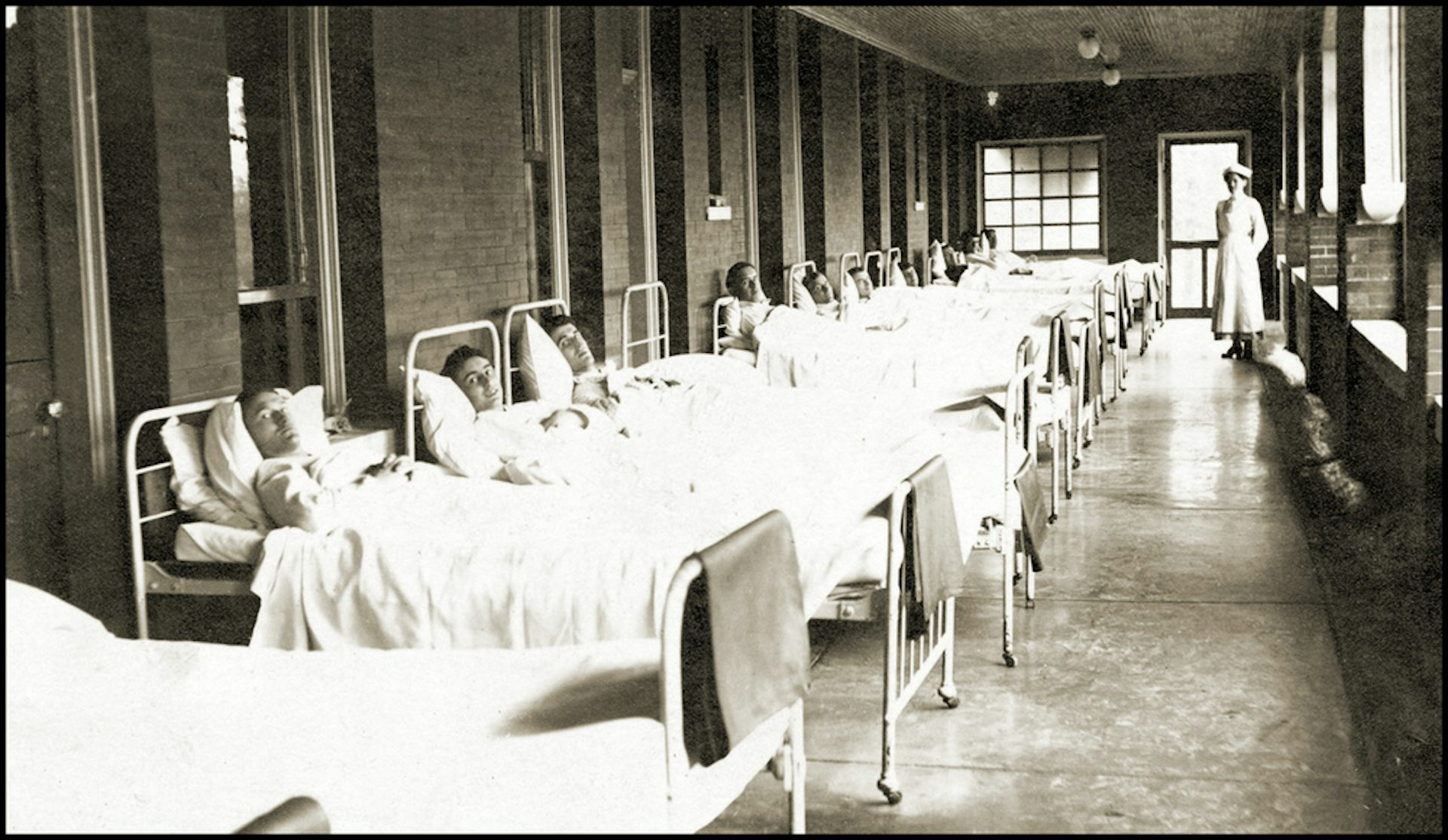
Actually I was thinking more about scale than about absolute impossibility: simple things like emergency hospital beds and the like, a modern city could still make them at artisanal scale, but not in volume like they could back then. All those amazing efficiency gains we have from flatpacks, automation and specialisation come at the cost of reduced flexibility.
There is still plenty of ability though. I have a table saw in my garage, If I'm needed to stop my computer job I can make a couple jigs and turn out bed rails, someone else in my town can turn out legs, (repeat for a lot of other parts), then the whole kit gets sent to other people with just a screwdriver.
Not for long. You could probably sustain that for a 3-5 weeks. I live in an area of upstate NY where this would be possible in 1918.
Today, no sawmills, no regional tool and supply manufacturers, no regional raw materials. Iron ore from the lake Champlain area could be smelted in the Albany area and made into nails in many places.
Today, you’re 100% dependent on diesel and open roads to Newark, the I-81 corridor and rail traffic from the west for food. 75% of the regional produce producers of gone. Most (50-70%) of whatever is left of dairy production will be driven into bankruptcy this year.
There is plenty of transport, and plenty of diesel fuel. Thus my city doesn't need to be self sufficient. I'd expect my beds to be exported to other nearby cities, while they work on making ventilator parts.
I'm not sure if it is needed though: there is probably more than enough lumber in the local lumber yards currently intended for local construction projects but when nobody is building/remodeling...
Actually I live in a manufacturing city so I'd expect we would be making ventilator parts, since I don't have machining experience I'd be repurposed to packing the parts into boxes. Any city has enough tablesaws to build beds, not every city has as many people who know how to run a lathe as mine.
There is implied failure of services in Spookies response. Already here in vegas, my step dad works at a bread factory as supervisor, they are seeing an increase of demand. He's had to go in several times late at night to relieve someone who was on a longer shift. He says if they lose one person they will start falling behind.
The short term consumables or raw resources are the ones that matter the most. If people stop going to work to make bread or toilet paper or refine oil it's going to put a strain on a lot of things. The oil and chemical industries are really going to be important for producing medical items like gloves, sanitizer, cleaning agents, plastic ventilators, sanitary plastic containers for equipment and needles, etc. Not to mention the effects of lower oil production and the strain and cost on shipping those things back and forth to their respective factories.
But it will have to be pretty bad before we have to worry about that I think.
A lot of that can be attributed to the bullwhip effect. It is the effect that even small demand fluctuations down stream, e.g. consumers, in a supply chain can have on parties, and availability, up stream, e.g. manufacturers, suppliers, whole sellers and so on.
One of the reasons why panic, and the resulting changes in consumer demand for certain products, is so dangerous. Not because stores are running out of toilet paper, but because of the mid term effects this has on availability of all kinds of things. This effect is impossible to predict upfront.
So, yet another reason to stay calm and avoid this kind of stress on supply chains providing goods of daily need.
This is, in my opinion, a common misconception about modern day supply chains. JIT is mostly used for the last delivery step, component deliveries for automotive final assembly lines are the best example for this. And even there is a certain buffer, a well planned and monitored one.
All other steps involve buffer stocks and inventories. This inventory is sitting local warehouses for example. Or just dead weight in the various locations. More often than not, this is due to inefficiencies.
That beingsaid, JIT is simply to hard to implement to use it for anything else then the most important parts. and even there only for the very last step, everything else smply has to many variables for JIT to work.
The best example are automotive supply chains that kept running all the time through February.
And stuff like groceries are not run JIT, with the exception of the replenishment of shelves and local stores from a regional warehouse. And that is not true JIT.
How were hospital beds made in 1918? Basically by hand ("artisanal"), but with lots and lots of very cheap labour. Those conditions still exist, since training someone to cut and bend metal tubes, drill holes and screw them together is not hard.
This effeciency doesn't simply go away, so. In the worst case scenarios we are discussing here, the relevant products are only asmall portion of global trade and supply chains. You could, for example, completely ignore Apple's operations under this scenario.
These critical porducts, and the coresponding manufacturing base, will be part of the critical infrastructure to be kept running. Automation is a huge benefit for this, as these operations can be run with a very limited number of people. Distribution and transportation is the same, it can be kept up for the essentials with a very limited amount of people. Even internationally, container ships continued to sail from Chinese ports. Granted, sometimes they sailed empty, but that was due to the shut-down of Chinese manufacturing.
In a true worst case scenario, dedicated ports will be kept running. again wth close to no people involved.
Administration for all this can be done to a huge part from home. Feet on the ground are by no means as important anyore as they used to be.
a situation like this should be avoided at all cost so. Hence the measures currently being taken.