So if I'm understanding correctly, your theory is that MS will be expecting Windows servers with DirectX and WSL to be the targets for ML production workloads? Instead of Linux servers in Azure...
Wouldn't developers just write native Windows ML apps then?
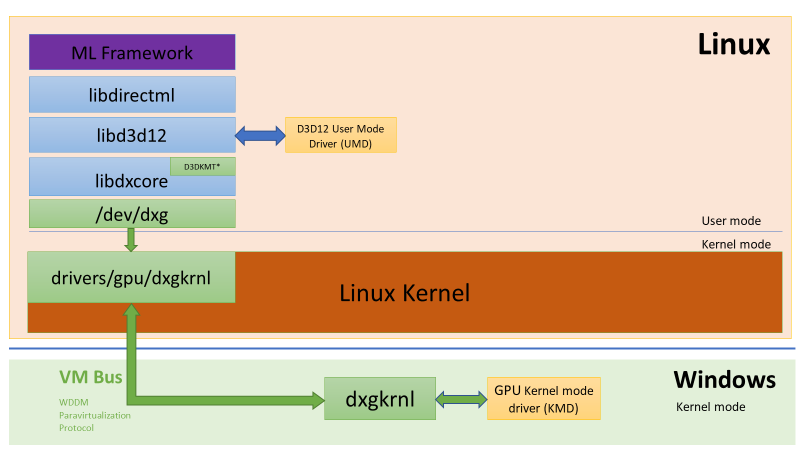
This isn't true, you''re supposed to use proprietary DirectX libs that interface with a virtual DirectX device, as shown in this architecture diagram provided by Microsoft:
You're supposed to use APIs provided by mesa (OpenGL, OpenCL) or TensorFlow and similar ML Frameworks which then talk to D3D12 or DirectML as seen on linked diagrams.
It makes zero sense to consume D3D12 and DirectML under WSL directly from user applications since that prevents your app from being deployed on the real linux. There also won't be any SDK or headers released by Microsoft so you'll have to manually load functions from .so.
Not everyone will be using the popular ML frameworks that will likely try to smooth out cross platform differences. OpenGL & OpenCL is still available, that doesn't negate the fact that Microsoft's proprietary DirectX extension is exposed directly.
> It makes zero sense to consume D3D12 and DirectML under WSL directly from user applications since that prevents your app from being deployed on the real linux.
That's the whole point, people will do it because it's convenient, and Microsoft is counting on the fact that it prevents your app from being deployed on "real Linux". DirectX is already quite a popular API on a popular OS and actually pretty good on technical merit alone. It may very well be a sensible trade-off for a project or developer to move to DirectX, but it will be a loss for the Linux ecosystem.
> There also won't be any SDK or headers released by Microsoft so you'll have to manually load functions from .so.
The .so files are compiled from the same source code, the article doesn't go into a lot of detail but I suspect existing DirectX tooling will be updated for Linux targets. Either way, normal developers will have access to the same tooling and documentation as the developers for TensorFlow and similar ML frameworks you already claimed will talk to D3D12 or DirectML (unless you're claiming that Microsoft will give special tools to the open source TensorFlow project or something).