>The Dr. Seuss books were banned not just by eBay but also by their publisher
I don't see the problem here. The copyright owner's no longer wish to distribute certain items in their intellectual property collection? So? I don't see people concerned that Disney isn't pulling "Song of the South" out of their vault, or isn't streaming it on Disney+.
What's the alternative you want? The government to FORCE artists to publish? FORCE Ebay to list these particular Dr. Seuss books? What the hell?? Isn't that worse?
Disney is a great example. It's a huge copyright owners which owns the rights to numerous important cultural works. They can, very effectively, decide what ideas the American public will have access to.
Yes, this is all legal. However, legally, the commissars of the Soviet Union also had the right and the power to ban ideas, books, works of art, and every form of expression.
The problem is the result: a small elite group of cultural commissars controlling the flow of ideas, and shutting undesirable ideas out of the public discourse and the public mind.
That is how totalitarian regimes are created and maintained.
Incidentally, the "government force" in copyright protection is the protection of copyright. That was done for the explicit purpose of fostering the publication of works, since the American lawmakers could never imagine that there will come a time in which huge corporations will ban books on political grounds.
All the government has to do is to stop enforcing copyright protection for copyright-owners who no longer publish the copyrighted works. Guaranteed other publishers will pick up these Dr. Seuss books, since he is by far the most popular children's books author of our time.
As things stand, bid these books adieu. Your children will not be able to read them.
This is not how totalitarian regimes are created at all. Commissars in the USSR having the power to ban books meant repercussions from the state for reading or distributing those books, and was a clear signal that similar works would meet a similar fate.
The publisher deciding to no longer sell some part of their work is entirely different. It makes no difference to your ability to enjoy a copy you own or to sell it to someone else. Nor does it affect your ability to create a similar illustrated children's book including whatever stereotypes you desire. No one is 'banning' you from doing this, although it might diminish their opinion of you.
This is not how totalitarian regimes were created in the past.
Once expressions of ideas are effectively banned, you are in a totalitarian, oppressive regime. It doesn't matter whether that banning was done by the state or by huge monopolistic corporations: the end result is the same.
Also, in this case, while corporations are leading the way, we also see increasingly loud calls for our government to step in and criminalize some forms of speech, for example those deemed "hate speech": https://www.nytimes.com/2020/10/13/magazine/free-speech.html
This is really a two-pronged attack on free speech and the free exchange of ideas: in the private sphere, individuals and companies move to effectively ban certain expressions, such as the publication of "objectionable" books. In the public sphere, there are moves to criminalize "objectionable" expressions.
The actions in each sphere reciprocally support each other, and normalize the idea that the free exchange of ideas must be policed and restricted.
It's a poor decision on the company's part, and we are criticizing the decision. No one (reasonable) is asking the government to regulate this. We're merely criticizing the decisions of two private companies, and the social movements which pressured them to do so.
It was public criticism, or the fear of public criticism that led them to make this decision in the first place, so this seems like a perfectly fine line of argument to make. (ie, that this was a poor decision on their part.)
Can you expand on how not continuing to distribute materials with racial representations from a time when skin color determined humanity / slavery is a poor decision?
I do not like to see what I am seeing in this HN thread. I think that not propagating offensive, dehumanizing views publicly seems perfectly wise.
Caricature and racism are not identical. I think that would be my primary counterpoint. Just because it's fallen out of fashion to draw people in such caricatured ways, does not necessarily mean that there was any negative or racist intent by the artist. I think this matters quite a bit. Dr. Seuss is not evil because he could not predict where the moral zeitgeist would lead us.
People who actually supported slavery, or Jim Crow, I would say are in fact evil, regardless of whether those views were acceptable in some circles.
You really must pay attention to intent, and this is a major failing of the modern edge of these progressive movements. If suddenly, some phrase quickly falls out of fashion, an I use the old antiquated phrase, it must matter whether I actually had any racist intent. Just the fact that I haven't kept up with the newest moral outrage is not enough on its own.
Ok, sure, this is a fair point in general, but how is it exactly applicable here?
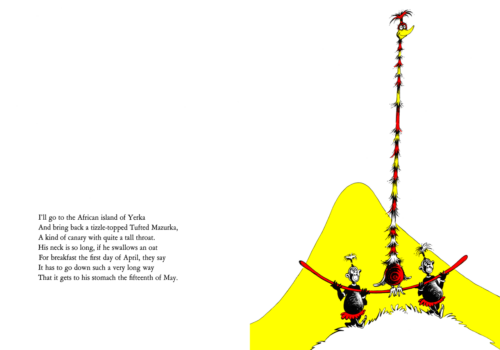
Let's take the example of "If I Ran the Zoo", since it's one of the only images [0][1] I can find.
The synopsis of the book seems to be a child daydreaming about the animals he would keep at his zoo. Whether or not the "Africans" in this book are one of those animals is not clear to me, but this is a representation of African / Black people as literal monkeys.
How you can try to imply that representing black people as monkeys is not racism, given the hundreds of years of insults in that vein, pseudoscience from slave owners and sympathizers suggesting the same, and indeed all the folk with the moral failings of the time that you suggest who would hold and perpetuate this viewpoint?
> Dr Suess is not evil because he could not predict where the moral zeitgeist would lead us
I completely fail to see how you can infer that a publisher not generating additional copies of prose that has found itself in a morally compromised position implies that Dr Suess is evil, or that anyone thinks that.
Indeed, I believe Dr Suess to have published 60 or more books in his career, so merely 10% of his career publications have been selected to cease being replicated further because they partook and perpetuated the darker side of a slaver society's worldview. This is not saying the man was evil or that his works were nefarious, it is saying that science and society have moved us beyond those viewpoints and propagating them further does us no good.
Indeed, I'm not even sure how this is being portrayed as "canceling" or any such thing. A publisher with control over the book rights stopped producing the book rights. Your entire rant is predicated around this being a retaliatory act for perceived evils, but that's incredibly lacking in nuance.
Children develop their worldview thru the mediums of information they interact with, and to for a publisher to refine its selection to prevent children growing up with unconscious cognitive biases that are dated, far outside, and even contrary to mainstream societal views of our time is just a complete non-issue.
>Let's take the example of "If I Ran the Zoo", since it's one of the only images [0][1] I can find.
I was originally going to issue a rebuttal based on my reading of "If I Ran the Zoo." But, it occurs to me that you can't really be very offended if you haven't even read the story. What's there to be offended by? You don't even know the context of the image which offends you.
>I completely fail to see how you can infer that a publisher not generating additional copies of prose that has found itself in a morally compromised position implies that Dr Suess is evil, or that anyone thinks that.
Although I still disagree with the publisher's decision, I take your point here.
>because they partook and perpetuated the darker side of a slaver society's worldview
What exactly is a "slaver society?" Dr. Seuss was born in 1904, after slavery was abolished. I doubt he was much of a "slaver," as in "someone who literally obtains slaves."
>Children develop their worldview thru the mediums of information they interact with,
Yes, precisely, and I don't believe it's appropriate that children learn to fear and ban ideas which they find distasteful.
> You don't even know the context of the image which offends you
Excuse me? Those monkeys in that picture are representing African humans. I know perfectly well what I've just seen, because I read the article I linked. Perhaps you have failed to do so?
> What exactly is a "slaver society"? Dr. Seuss was born in 1904
Ok, and the Tulsa Race Massacre was in 1921. State-backed murder of black people for the crime of being successful. The south was clearly deeply unhappy about their loss of slaves and backed a set of increasingly "plausibly deniable" laws over time that were designed to segregate, undermine, and condemn to failure Black people in the USA.
If you really think "slaver society" is an overkill to describe an entire region of the USA with extremely racist ideals towards people they consider slaves, let's instead say "because they partook and perpetuated the darker side of a society that wishes they were still slavers". I'm so sorry I was slightly pedantic for you
> I don't believe it's appropriate that children learn to fear and ban ideas which they find distasteful
What kind of horseshit disingenuous representation of the situation is that? These Fox News - not legally a news corporation btw - talking points are so stupid. Once again, just like the "USSR book banning" fear mongering analogy above, you are acting as someone who pretends that a private business ceasing publication of books with societally repulsive views is somehow analogous to "banning ideas".
I hope children grow up and learn that condemning and removing from modern discourse historical or traditional views that no longer match up with the ethical framework of society is the only way we can continue to increase human rights in the face of governments and billionaires increasingly concerned with removing those.
Your framing doesn't follow from your logic in any way, and you don't play with pedantry particularly impressively.
We should probably tone down the temperature here. I don't think we're getting anywhere productive, and it's not looking like we're going to see eye to eye.
For the record, I don't watch Fox news, and I dislike it quite a bit.
I agree, I do not see eye-to-eye with those who, never having commented on how a book publisher manages their inventory and resource allocations, decide that a private corporation ceasing publication of select books with racial epithets they consider dehumanizing is analogous to "banning" of the material in any way.
Indeed, the fact that the first time you've ever hopped into a conversation around book publishing is to decry the fact that a publisher isn't generating more pictures of Africans represented as monkeys distances us even further.
Finally, the fact that you don't think "slaver society viewpoints" persisted in a society that murdered an entire city block of Black people merely for being Black people really hammers home how ignorant you are.
If you do not like Fox News, you should question why you are parroting their ridiculous mischaracterizations of a private corporation's normal business actions.
You and a large number of people feel those views repugnant. That said, there are likely certain views you have, that you feel you should have the right to express freely that a large group of people feel are equally repugnant and offensive. Freedom of speech provides a natural check and balance by letting the best ideas thrive via an open market of ideas, not a large un-elected ministry acceptability. History shows that wielding the weapon of censorship tends to have a boomerang effect long term and can have other consequence, such as radicalizing people.
On a personal note, when I see groups banning ideas and views I automatically discredit the group and ideas behind the banning. The reason is that if a view truly has merit it should be able to stand up to healthy debate on it's own merits.
> Freedom of speech provides a natural check and balance by letting the best ideas thrive via an open market of ideas, not a large un-elected ministry acceptability.
I agree with what you wrote here, but if you believe this I'm confused why you would take issue with what happened here. This is exactly what has played out. These books were created and published in an open market. Remember, in free markets there is the possibility of failure. That's what you're seeing right here. The publisher of these ideas have determined that they have failed in the market.
So what's the problem? No "large un-elected ministry acceptability" caused this to happen. It was the marketplace that rejected these ideas, and the publisher didn't want to bear the cost of continued publication, which they are free to do. Everyone involved exercised their individual freedoms in the marketplace. The system is working as intended. Where is the failure?
"These books were created and published in an open market." Sorry, but this is utterly false. The extraordinarily extended periods of copyright-terms enforced by the government make this the very opposite of the open market.
The marketplace hasn't rejected these ideas. The holders of the copyright - a law enforced by the government - have rejected these ideas and no one can oppose them. Because of copyright, no other publisher can publish these books in the marketplace. Ergo - no free market and an effective ban on the books.
You are confusing the particular expression of an idea with the idea itself. There are an infinite number of ways to express the ideas contained within the books that Dr. Seuss Enterprises decided not to publish. The expression of those ideas has not been banned at all, by anyone. Not eBay, not Amazon, not Dr. Seuss Enterprises, not even the government.
Dr. Seuss Enterprises has decided to stop publication of their particular expression of these ideas because the ideas themselves are not popular enough to financially justify their continued publication. That's the method by which the whole system works. Ideas flourish in the marketplace when people support them. When people support an idea, it achieves financial success for those that express it. People who express unpopular ideas difficult to find financial success due to a lack of a support base.
How else do you imagine the marketplace of ideas works, and what exactly do you think happens to ideas that are rejected by the marketplace?
Please don't change the goalposts to "general ideas". The works of Dr Seuss can NO longer be published by other actors without violating the terms of copyright and inviting the full force of law and government and punishment on those who would attempt to do so. Besides, ideas can only be expressed through mediums and when those mediums are banned, so is the expression of ideas.
There is no flourishing of the market place here - it has been implicitly denied. If there were no copyright - you can be bet your years salary that there would be folks willing to publish these books for the audience that wishes to read them.
Remove the copyright - make it a true free market and THEN let's see if your argument that the ideas themselves are not popular enough holds true. Besides your statement of financial justification is utterly false. Dr Seuss tops the list of top 10 children's books.
No, its fascist ultra-left ideology that is responsible for these implicit bans. Some folks want to dictate what other should read - capitalism doesn't even come into the picture.
Woooah hang on. Don’t blame the left for the problems of copyright. As a Marxist, I am on board 100% with you that copyright as an idea should be removed from our daily lives. Copyright has no place in leftist ideology, so I have no idea how you are making the connection. As I’ve stated many times we live in a capitalist society, and it’s under the rules of capitalism, at the desire of capitalists, that copyright exists. Capitalism absolutely comes into the picture because capitalism is the system under which all of this is happening. We don’t live in a socialist system so how are you blaming leftist ideology?
And I’m not trying to move any goalposts. In several conversations here I’ve been assured that the actual problem is not the discontinuation of these specific books, but the larger picture wherein under some slippery slope argument the general ideas could be eventually banned outright. But apologies if this is not your position and you take issue with the ability of these companies to control their own IP. I would agree with you there.
But at the same time I also recognize that copyright is built into our Constitution and it’s not going anywhere anytime soon. So under that framework, I don’t see anything wrong with what Dr. Seuss Enterprises did. Copyright gives them freedom over the creative works they own. The freedom to distribute and the freedom not to distribute. Without the freedom to not distribute works, the decision to publish any works becomes risky for the author, because it cannot be undone, ever. This is going to have the necessary effect of reducing the number of ideas that are expressed, as riskier ideas cannot be retracted by their authors. After all, this is the general idea behind the concept of copyright and underpins the entire marketplace of ideas.
I have no doubt that if copyright were abolished, others would pick up the unpublished works and attempt to distribute them. But this comes at a cost of time and money. What if they don’t sell enough copies to recoup the effort, and they go out of business, thereby halting publication? What if seeing this failure, no one else takes up the mantle of publishing these books? We are in the exact same situation. Would you say they are banned? Of course not, they have just failed financially, which is what happens all the time to books, and what happened in this case.
Dr. Seuss Enterprises surmised that the continued publication of these books would hurt them financially. As your link indicates, they publish a number of very popular books, but notably none of the books in your link are being discontinued. We already know the ideas aren’t very popular because they don’t sell well as it is. If they were popular, they would be on your list.
Anyway, tldr; don’t blame leftist ideology for the perceived failure of a system of, by, and for capitalists.
> That said, there are likely certain views you have, that you feel you should have the right to express freely that a large group of people feel are equally repugnant and offensive
I highly doubt this. I do not dehumanize others nor believe that likening enslaved races to monkeys is in any way appropriate. Besides, you are discussing free speech here - Dr Seuss in no way had his free speech curtailed. He is dead.
> Freedom of speech provides a natural check and balance by letting the best ideas thrive via an open market of ideas
This is a meaningless feel-goodism.
Freedom of speech protects citizens against government retaliation or censorship for most categories of speech, notably carving out exceptions for calls to violence / treason etc.. Freedom of speech basically means you can say whatever the hell you want if it's not too overtly tearing at the fabric of society.
Freedom of speech is not freedom from consequence; I can say 2+2 = 5 but that doesn't make it smart. People will call me an idiot, and they have that right.
Freedom of speech doesn't protect authors from not "eternally having their works published by their copyright holders even after the author's lifetime has ended", and that is literally the only thing I can see you arguing for here. A publisher who owns the rights to these books has stopped generating more copies of them. What is wrong with that?
> On a personal note, when I see groups banning ideas and views I automatically discredit the group and ideas behind the banning
So, when you see Dr Seuss' publisher stop generating additional copies of books they believe further ideas and sentiments they wish to have no part of - surely, they are free to do this - you are automatically discrediting what group for this banning, exactly?
This newfound moral outrage is hilarious. President Obama praised and recommended Dr. Seuss books in an official press release as recently as 2015, his last year as president. Now they are suddenly "outrageous and unacceptable".
One of the books they banned, "And to Think That I Saw It on Mulberry Street", was Dr. Seuss's breakthrough work, and certainly not "obscure". Another, "If I Ran the Zoo", is widely considered among his best.
thats just revisionism, i dont remember either of them, and ive never seen anyone reference them until these past few days. after the controversy is over, nobody will miss them
How are you acting as if a publisher ceasing to generate material that it wishes to ethically distance itself from, executed as a perfectly legal maneuver by a private corporation, is in any way analogous to the USSR's centralized government banning books?
I'm sure some people will miss these books, but for those people they can go ahead and find a collector's copy on a marketplace, use a library which has them, find some other private holder, or use the internet to enjoy them in whatever capacity. This is because these books are not banned by a centralized government, but instead have been selected to cease publication by a private corporation.
They were important to dr seuss as a person and his development as an author, but culturally theyve been eclipsed by his more famous work.
These books arent gone, you can still find them and they are documented for historical purposes, but as a society we have decided that there is no need for them as childrens books. Nobody cares about the hundreds of books that go out of print every year
You are not arguing honestly here. You are just defending this decision by any means you have, honest or dishonest.
The books will be preserved, much like banned books in the Soviet unions typically were preserved, in some government archive.
The millions of readers of our generation, who had access to these books because they were offered for sale, will no longer have access to them.
My parents read these books to me. I will not be able to read them to my children.
"Nobody will miss them" is an incredibly false and irrelevant argument. Nobody "missed" all the books in the Soviet union that were blocked by the commissars and never published. How is that a valid justification for this happening in the US now?
You are justifying book banning, pure and simple, and you are using any available argument, and many dishonest ones, to do it. Ultimately, you yourself don't understand why you do this. You just follow the cancel mob.
I am a member of a minority that is supposed to be offended by these books. I am not. I would bet anything that you were not personally offended if you ever read them, too.
But the Cancel Mob has mobilized and you are mindlessly following, because it is the convenient choice, the easy choice, the SAFE choice.
You’ve devolved completely into Fox News - which is legally not news btw - talking points, and you’ll say others are arguing dishonestly?
This decision - to cease publishing select Dr Seuss books - was taken, with no external pressures, by the private corporation and legal owner of these books.
There is no “Cancel Mob” mobilizing here, except perhaps the right wing one that is acting as if a business is not free to remove some part of their inventory on a whim.
Your analogies to the USSR banning books is completely inappropriate as the USSR was a centralized government banning books. A private corporation is certainly not compelled to produce or sell any product they do not wish to continue to sell, and the books remain legal to possess, sell, or trade because no rights have been infringed by the US government nor any legal actions or pressures issued on this topic.
Whoa. I just bought a new copy of Mulberry Street a couple of years ago. It was on some end cap display at Barnes and Noble. I have read it to my daughter a dozen times. I hadn’t actually looked at the list of Dr. Seuss books, and assumed they were obscure like people said, but Mulberry Street definitely isn’t obscure.
if you associate Black people with literal monkeys you are the one that is racist.
All the book is explicitly saying is that it would be a good idea to hire a person of African origin to work at the zoo.
This have some logic to it in a child mind because they could assume they would know best how to take care of those animals.
It's obviously a caricature but nowhere does it say African people are animals or monkey. This is all originating from your own racism.
> If you associate Black people with literal monkeys you are the one that is racist
Man, isn't it just fantastic how easily you make my point for me. This is also the viewpoint that Dr Seuss' publishers imagined the public at large would hold, so accordingly they have ceased to publish a book that represents "Africans" with this picture:
Edit: I am unable to respond directly. The Africans are the monkeys holding the rod in that picture, that is the entire point of this whole "ceasing publication" business
The monkeys in that picture were the picture representation of the "Africans" in that book.
Your ridiculous deflection is saddening. You yourself stated the criteria the publisher made their decision under, and now you will act like you have not said it
Edit: the very image you linked shows "the African island of Yerka", where they're retrieving the bird from, and you expect me to believe you can't see the implication that the monkeys in skirts holding the shaped bar the bird resides on are the African residents of that island?
Did you read the book? I just did and did not find the page where it refer to an African Man. I might be wrong or it already got modified in recent copy of the book.
Song of the South is a good movie especially for its time (Black representation in film) that Disney destroyed because of its aversion to controversy. Since actual Black people are unpopular in racist America, honest portrayals of Black people are considered offensive, effectively removing Black people and characters from mainstream culture unless they "act white".
Slavery is terrible, and since black people were enslaved, literature about Black American's lives from before 1865 is not acceptable. This is bad.


I don't see the problem here. The copyright owner's no longer wish to distribute certain items in their intellectual property collection? So? I don't see people concerned that Disney isn't pulling "Song of the South" out of their vault, or isn't streaming it on Disney+.
What's the alternative you want? The government to FORCE artists to publish? FORCE Ebay to list these particular Dr. Seuss books? What the hell?? Isn't that worse?