Kind of disappointing that the thiel fellowship has finally descended into "fund kids who already have businesses". It was more interesting when it was "fund kids who have <generic> potential", but also I did watch the fellowship struggle to match fundable ideas with money (that is actually hard and takes effort, reputational risk, followthrough, discipline, that I think only one person I knew in the org had - and she left a while back, and probably investments in real leadership training and real mentorship that they weren't willing to do) much less know what to do with smart kids that had good ideas that weren't fundable/profitable.
I can't speak for Silicon Valley, nor for the majority of HN, but my (obviously biased) sample of approximately 20 HN-reading friends are all massive Thiel fans. Myself included.
So perhaps there are more of us than you think, we're just not keen to speak up in the comments section because it just invites a flame war?
If your 20 friends are all "massive fans" of a given person, I agree, that's a pretty solid indicator of significant bias. Well, maybe not if that person were the Dalai Lama or something like that, but Thiel is not the Dalai Lama. (Even a regular llama would be strong competition.) I should add that the same would very much apply if all your 20 friends felt the opposite way - that would be closer to the norm, but still implausibly unanimous.
Your comment didn’t challenge anything about my approval of Thiel. In fact, your comment didn’t add anything substantive whatsoever apart from a tone of disapproval - hence my question about starting flame wars.
Usefully, your comment has demonstrated the exact phenomenon I was referring to.
>So perhaps there are more of us than you think, we're just not keen to speak up in the comments section
May be. But I certainly know he is extremely unpopular on twitter, HN along with pretty much all mainstream media. You just have to look at some of the comments in this thread ( some of them are filtered as dead )
To the point I think it is extremely courageous to admit you are a big fan of him.
I dont want flame wars. But I certainly want balance of opinions. Whenever something is extremely one-sided I tends to get wary. But then I also understand why replying may start a flamewar. Discussion is hard.
I don't hate Peter Thiel but I feel compelled as an American to say I believe that we should find ways to improve our democratic system, not get rid of it. Thiel seems to believe democracy doesn't work and presumably technocrats such as himself would be better running things. Perish the thought.
A rapidly growing opinion on HN that's approaching majority status is that tech titans should be able to tightly control what information people see in order to control their votes because otherwise they will vote incorrectly. This might not be your view, but it is incredibly common here and in the tech sector. Guess it's still technically a democracy if everyone votes after having their information highly curated by the tech industry but it certainly isn't one spiritually.
It’s a speech issue and the ability for private companies to exercise their own moderation is the free speech position.
A government forcing private companies to implement policies around speech is a violation of their speech.
My take on this is more nuanced and I think private companies wielding speech restriction is high risk, but people saying the government should step in are wrong imo.
Another aspect is that companies like Twitter or Meta have legal exposure in various jurisdictions around the world. The libel laws in the UK are different than that those in the US, etc... They're responsibility for what is on their sites is an ongoing question. They have to have the ability to moderate their sites to comply with local laws, or they have to be excused from liability.
> should be able to tightly control what information people see
You don't say what you mean by this so I don't know how to respond. Some say the tech companies lean left, some say they lean right, but HN is not the place to discuss politics. I will say most of the posts and comments I see are aligned with the hacker's ethos of opposing censorship. Banning Rep. Greene for vaccine misinformation or former President Trump for inciting violence is not censorship.
I think you might be ascribing too much nuance into such a broad indicator as an upvote. Might it be an interest in where big chunks of VC cash are being thrown, rather than a popularity poll of the man behind it?
> Does Peter Thiel still does VC? I thought he left YC and Silicon Valley.
They've recently legalized doing venture capital in Los Angeles, New York, Seattle, Boston and dozens of other cities (including those outside of the US too).
When I see someone funding a 40 year old and providing indemnification, I'll believe that they have a hope of doing anything in the biomedical space.
Biomedical is NOT stuck for innovation or execution. It is stuck on indemnifcation.
For example, one doctor developed an asthma sensor for his daughter that would automatically let the school nurse know, let him know, and call 911 for an ambulance if the attack was bad enough. It works really well. Nobody will touch it with a 10 foot pole because when it doesn't work and somebody's child dies, there is an inevitable lawsuit incoming.
This is where biomedical is stuck--not engineering.
Well, yeah. If the purpose of your biomedical device is to measure x or y or z so the patient can make a certain decision, you need to be able to prove that your device can provide accurate enough data for the patient to make that decision.
If the purpose of your device is to provide alerts, you need to prove that it your device actually alerts the patient at the right time. To do this you need accurate continuous measurements, and a proven system that alerts the user based on that data. This is extremely difficult.
I work for Dexcom, the only company that makes an FDA approved glucose monitor that can both fire alerts, and is approved for use by children under 12. We started with a very small team and it took a solid decade before we got FDA approval, but FDA approval is basically the highest bar for a medical device. So much so that many nations automatically greenlight any device with FDA approval.
If you've built something, and you can't prove with documentation that the specific device you're selling a customer will work exactly as advertised, before they take it out of the box, you can always sell your probably-works device to another nation (or nations) first until you get your ducks in a row for the FDA.
True. But in the case I cited (the doctor was actually asking our company to do the backend transport for the device), the device works. It will bring quality of life improvements.
However, as you well know, nothing is ever 100%. Even if the detector was 100% (and nothing ever will be), the network carrying those alerts is most certainly not 100% (all the cellular carriers in the US have specific language barring medical usage because they know they're terrible). And when, not if, some notification doesn't go through you're on the receiving end of a lawsuit.
So, the problem is that if the device doesn't obviously make enough profit to cover the legal settlement cost from the case where it fails, it's dead in the water. Indemnification tips that balance a bit to allow devices that might be a net win but it will be difficult to prove that a priori.
It's such a problem that I have a black-humor question to everybody who thinks they want to do a biotechnology device: "That's a great idea! So, how many people are you allowed to kill?" If they get over the shock of the question, I start doing back of the envelope calculations for how many people the device will kill. If they're still with me after that, we can have a real discussion about whether their device might be feasible.
Come on...before you post complaints about how someone else is literally giving away millions of dollars to the wrong promising young people, maybe actually read the list of projects?
"Zeno Power is developing small-scale nuclear power systems to provide clean and resilient power in austere environments." He's literally funding clean energy.
And even if this year's list didn't have that in the list, let's celebrate someone doing good instead of lobbing stones from the sidelines about how they didn't do it the exact way we would have.
If there were things on there about climate or carbon capture people would find something else to hate about it. It's not enough. It won't work. And so on...
That's extremely glass half-empty of you. There's a surprising number of companies in this list that are about sustainable production. And Zeno Power is developing clean (nuclear) energy.
Not really. It is certainly an issue which progressives put more weight on. And there is a disagreement on the solutions too: progressives are generally apprehensive about nuclear. [1]
You can personally attack me with any one of the "certain" labels in the arsenal. But you can also choose to argue in good faith.
> And there is a disagreement on the solutions too: progressives are generally apprehensive about nuclear.
Yeah, this is one of the things I really hate about my side of the aisle. It's stupid, unscientific, and just plain uninformed. Nuclear energy is one of our best, most actually viable ways out of this mess. (File with: GMO crops, 'chemicals', etc.)
Ah, I hadn't realised that. I'm really glad to hear that. Obviously I hope PV and other green energy sources will take off, but in the interim nuclear is by far the best established and working green source of energy.
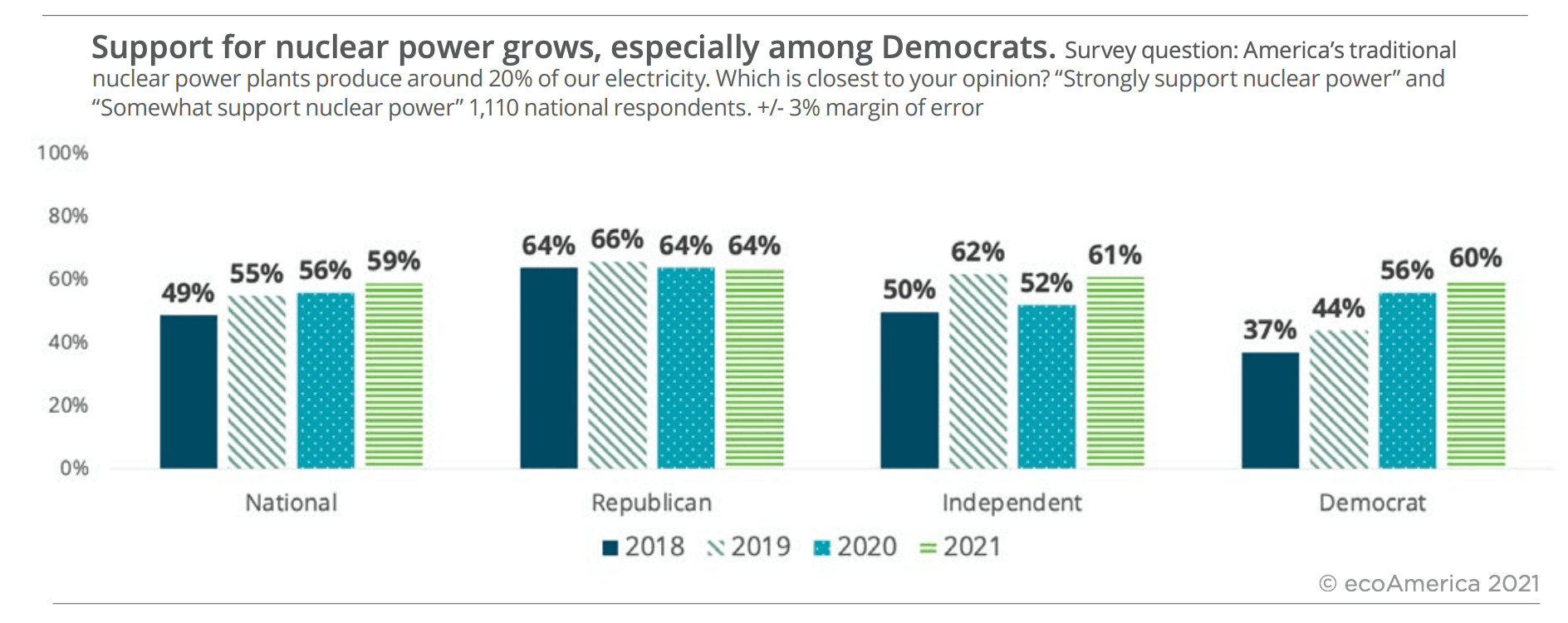
That was interesting. Surveys are not that reliable though, and the outcome depends on how the question is being asked.
I found this 2020 survey by Pew Research which I think paints a more realistic picture [1]. It has a larger sample size [2], and IMO it asks a more objective/specific question.
Among "Conservative Republicans", 59% responded that they support expanding nuclear power plants, in contrast with 35% of "Liberal Democrats". Interestingly, for "Mod/lib Republicans", that number is also below 50%.
You might have a point though. My personal observation is that there has been a slight shift among the progressives, but not as much as the graph by ecoAmerica suggests.
This survey is still a year and 7 months old now. In my personal observation is that most of the folks I know here in NYC who identify as a Democrat, Progressive, etc are in favor of nuclear power.
Please note that you are conflating two different things.
This piece is on the fellowship, and the article says: “To date, companies created by Thiel Fellows are together valued at more than $46.8 billion, excluding Ethereum which is valued at $450 billion.”
I didn't know there was so readily a list of places I'd never want to work. Gonna bookmark this site to make sure I never do business with any of them. The most depressing part is how young they all are; which is of course, because they're easier to manipulate lacking real world experience.
This kind of comment doesn't help, even in the case that you're right.
Edit: you've unfortunately been doing this repeatedly. We ban that sort of account, so please stop. We've already had to ask you more than once about this.
Do you even know what the Thiel Fellowships are? Whatever you think of his politics, he literally gives away money to promising young people to help them realize their dreams...in exchange for no equity. Are you really saying that, because you dislike Thiel, you'd never do business with anyone who accepted free money from him?
I fail to see the relevance of your own post as well, and frankly, I don’t see why I’d have to explain myself to you or anyone else, just as I don’t expect any from you.
The point of my post is that there is nothing particularly significant about claiming that you would refuse to take money from someone who is never going to offer it to you to begin with. It's a completely worthless and trivial statement that comes across as posturing.
I mean, it's called a hypothetical. They're pretty common. They can even be used as thought experiments to bring out interesting aspects of moral questions.
If the person bringing up the hypothetical were remotely as talented as the people on this list and then made a claim that they'd refuse a free $100,000 in order to advance their interests, that would be a worthwhile discussion. Then we can expand on their point of view, what tradeoffs they make, what actual resources or funding they made use of as well as the kind of diligence they performed when accepting money...
In the absence of those qualifications, some random person saying they'd refuse 100k knowing full they're not in a position to have it offered to them is nothing more than a cheap claim and does nothing but demean the talent and judgement of those who choose to accept it.
I don't see what that has to do with anything. They are equally qualified to discuss the moral aspects of the question, which is what they are discussing. This feels like a lame attempt to shame the other commenter out of a point you couldn't answer - and on the basis of a standard you wouldn't pass yourself either.
No they are not equally qualified to discuss the moral aspect of it because they have nothing at risk. It's very easy to make cheap moral claims when there is nothing at stake. What's interesting is the kind of moral decisions and tradeoffs an individual makes when there is something at stake.
The fact that this person is not in a position to stake anything makes their claim entirely vacuous and superficial. First go off and start a company working on nuclear energy or electric airplanes, get to a point in your life where someone cares to offer you $100k for nothing in return, then feel free to talk about the tradeoffs and difficult balancing act that leads you to refuse it. That can be an interesting discussion...
Some nobody just chiming in with nothing other than a claim that they'd refuse to take money that they're in no position to even be offered is cheap posturing.
OK, this is now closer to approaching a cogent counter-argument. So why exactly is it that having something at stake would lead someone to answer that question differently?
And why do you think human beings can't think hypothetically about the condition of having something at stake, the same way we can think hypothetically about most everything else?
Tens of thousands of FAMANGA employees get $100K+ per year above and beyond a great income, which they can use for whatever they care about. A $100K fellowship gift isn't so different.
Yeah, I don't think I've seen such an incoherent attempt to ban someone from having an opinion. It's on a level with saying you can't disapprove of Harold Shipman until you've got a medical degree.
Presumably we all have to spend the rest of our lives running around getting various professional qualifications and careers, just so that we can have opinions on utterly generic moral questions which happen to be faced by someone with that degree.
Indeed - apparently my Trump bashing was "unqualified", so I now have to go and run for President, get elected, be President for 4 years, and then I can start bashing him.
There are some other things on that todo list ('rape first wife', 'cheat on pregnant third wife with pornstar', 'publicly blame your failed business on a dead man before his funeral had even taken place', 'send deranged tweets to Kim Jong Un while on cough medicine and alprazolam') but you'll get to them ;)
But nah, seriously, I don't know how some people can say such absolutely witless stuff, and still see fit to click 'send'. I think they are just nonplussed that not everyone else has the same Ubermensch ethic as they do, where anyone sufficiently rich or accomplished is exempted from the moral requirements incumbent on normal human beings.
They worship them, to put it simply - the rich and powerful - and they don't understand & can't process that not everyone else does.
I'm not a Facebook user, mostly because of the vast and repeated privacy violations they've committed in the past (not to mention their monopoly behaviors and political influencing, etc.) - but because I don't run/own/fund any similar monopolistic entity, I'm essentially forbidden from even talking about it??
Another is ClearView AI (oh look, another Thiel-funded thing!) - I oppose the existence of that company based on their entire business model being the abuse of people's information without consent, and how they expect you to cancel yourself to prevent being abused by them [1]. But according to some people [2], anyone that hasn't been abusing people's privacy cannot have an opinion on ClearView AI's actions [3], until you actually do so yourself [4], otherwise you're just "posturing" [4][5].
Yeah, great logic!
> They worship them, to put it simply - the rich and powerful - and they don't understand & can't process that not everyone else does.
What's worse are the ones that go out of their way to justify or even apologize their behavior (not unlike those part of a certain political cult right now).
Yeah, it's an absurd claim. And of course it never applies to their own hagiographic opinions of these people and these companies - it only invalidates critics. Handy! Who wants to be the one to tell the Holocaust historians?
And yeah, ClearView is absolutely typical. I'm not going to genuflect to some seasteading-obsessed professed libertarian whose entire business career, practically, has been in the realm of surveillance companies targeted at the bloated and despotic American state. Not even if you wrap it in some cod-philosophy blog post that namedrops Bayesian probability and game theory and Taleb.
Lots of people in society today believe everything is politics, and if you do not agree with a person 100% on every political issue then you must refuse to all interactions with them, you must never associate with them, you must never partner with them in area's where you may align, and above all else you must never take money from them...
it is sad existence for these people, one of mono-culture, and cult like adherence to a single political dogma
A) On what basis do you claim that all public companies are not ethical? (You said "any", but by definition that means "all".)
B) By that logic, isn't all money tainted? And everyone of us? And every thing?
This is the starting point of every person's decisions regarding being ethical.
How far back do you need to "follow the money" before you consider it "ethical"?
That is up to every person. Theil has actively engaged in dubious ethics, I won't belabor them again. With him it is one hop to "dubious", compared to other organizations where you have to make several graph node hops to get to something dubius. This is a personal choice and everyone has to do their own research if they care about it.
I’m not claiming that all public companies are unethical. I’m claiming that all public companies have some unethical investors. That is, the operations of the company directly benefit some unethical actors. This has nothing to do with “money being tainted” in general.
Just to be clear, this is what you said that I was responding to:
> I think the concern is that they are taking money from someone with highly debatable/questionable ethics.
Some investors in almost all public companies have highly debatable ethics.
But that is why I said it is up to the individual. Some people could care less, other people at least want to know if the board is ethical.
I would put in the effort to know if any shady people were on the board of the company I'm taking money from. And if new information came to light after the fact, I would cease taking money.
You can't know everything about everything, and not even attempting to be ethical because you don't have all the information without doing any research is, IMHO, cowardly. It's the "if we can't fix this one big thing why bother doing any of these other things" fallacy. But that's just me and my ilk.
It's easy to make fun of someone trying to be ethical or who cares, because you can't know everything. That's what trolls do for fun. But I think it takes courage to try to stand for something you believe in. Again, that's just me and my ilk.
They're young (and some live in foreign countries) and in any case probably have no idea what Thiel is really about. I say give them a chance to repent and rehabilitate.
I'd definitely not want to work for a company that takes Thiel's money or has any of his acolytes or close associates on board, though.
> They're young (and some live in foreign countries)
I don't think it's fair to assume that startup founders who have applied to a Thiel Fellowship did so because of ignorance (or because they are young or "foreign").
This is an amazing opportunity for many people and highly competitive. I even see an upside to companies automatically being able to filter their hiring for people that don't get hung up on this. If someone won't work for a company because a particular VC funded it, I can imagine there a much higher probability of that person causing trouble wherever they end up
I don't think it's fair to assume that startup founders who have applied to a Thiel Fellowship did so because of ignorance (or because they are young or "foreign").
My assumption is they obviously know he's a "titan of industry" and that's obviously why they applied for the fellowship. They may not know or care about his politics, and (yes, partially due to the fact that the bulk of these events transpired when they were much younger) may not be aware of some of his more loathsome antics.
I'm not condemning these people, or saying they're stupid. If anything I'm trying to give them the benefit of the doubt, here.
If someone won't work for a company because a particular VC funded it, I can imagine there a much higher probability of that person causing trouble wherever they end up.
It's called ethical backbone. It is perfectly acceptable to not want to work for companies that are engaged in any manner of unethical practices. Or for people who are basically unethical and/or toxic. Or for companies they fund.
If this kind of stance falls under the rubric of "causing trouble" then well, that's the world you chose to live in.