Edited comment: originally linked to the wrong satellite imagery (from a separate eruption several hours ago). The discussion in this link is still informative, but not current:
For anyone wanting to see the same shockwave as is linked here in video form, a BBC article[0] has a it embedded. The Himawari viewer works well for stills but makes the effect over time a bit harder to appreciate.
Yeah I just browse with a profile that deletes all cookies and history when I close the browser. Then just accept or dismiss all those stupid cookie consent popups.
More like "they had, but decided to remove". Firefox on Android used to support any extensions, but they cut that down. You can still get the functionality in browsers like Icecatmobile, though.
I'm curious as to what you see (I'm in the UK so there are very strict legal requirements that the BBC don't show ads so my page will be different to yours) for me the cookie prompt is at the top and pushes the content down a little but I can ignore it and see everything. That meets gdpr requirements as I can still do what I want and unless I tick OK nothing should be set.
This is FANTASTIC! Thank you so much for sharing these links. Kids loved this, as we had just learned about similar volcanic eruptions through a recent Nat Geo magazine.
> There were no immediate reports of injuries or the extent of the damage because all internet connectivity with Tonga was lost at about 6:40 p.m. local time — about 10 minutes after problems began, said Doug Madory, director of internet analysis for the network intelligence firm Kentik.
> Tonga gets its internet via an undersea cable from Suva, Fiji, which presumably was damaged. The company that manages that connection, Southern Cross Cable Network, could not immediately be reached for comment.
There are social media posts of the tsunami though which I believe are from Tonga. So folks at the shoreline were presumably fine enough to record and post video somehow.
>I’d be worried about anyone on an airplane near there, but I guess it’s not a highly trafficked route.
I was curious whether Fua'amotu International Airport is a stop on flights going elsewhere but I wasn't able to come up with a good search. It sounds like it could be:
"The air field was constructed by Seabees of the 1st Construction Battalion with assistance and labor of the U. S. Army 147th Infantry Regiment. It was intended as a World War II heavy bomber field, and had three coral-surfaced runways. In the late 1970s, it was expanded to permit jet aircraft to use the runways. Fuaʻamotu is now suitable for up to Boeing 767 size aircraft, but remains closed to larger jets (e.g. Boeing 747s)."
Today's aircraft can easily handle transpacific flights, and Tonga is in the Southern Hemisphere close to the equator so even Southern Hemisphere flights would likely avoid it.
It's basically just Australia and New Zealand to Hawaii and North America, and Pacific Islands east of Tonga. As well as any inter-Oceanic flights that happen to pass it.
I wonder how these social media posts were being uploaded due to a loss of internet connectivity. Satellite internet, or has internet been restored already?
Last time the undersea fibre optic cables (international and local) were broken (2019-2020) [0] a Kacific [1] K-band satellite emergency link was installed for and by the Tonga ISP EziNet [2] and others.
(the 2019 break was caused by a Turkish oil tanker prematurely dropping anchor in a restricted zone [3])
"DS Venture Ltd (DSV) was the owner of the Duzgit Venture. On 20 January 2019, as the vessel approached the Port of Nuku'alofa, its starboard anchor and chain were prematurely released from their housing. As the anchor and chain were winched back in, they caught and damaged a cable. The cable was one of two undersea communications cables owned by Tonga Cable Ltd (TCL) connecting Nuku'alofa, Ha'apai, and Vava'u with Fiji. As a result of damage to the cable, Tonga was without cable telecommunications for almost three weeks. "
Here's alternate versions with 24-hour long windows (not ideal), because I haven't figured out how to link timestamps in the URL parameters of satellite loops, so they are shifting forwards in time. (I'm sure someone else will figure out a better solution: I've given up).
FYI there is a tsunami advisory for the entire west coast at this point: https://tsunami.gov/ (specifically at [1], but tsunami.gov will contain the latest).
Expected arrival times in California (Pacific Time):
     * California
    Fort Bragg       0735  PST Jan 15
    Monterey         0735  PST Jan 15
    Port San Luis    0740  PST Jan 15
    Santa Barbara    0745  PST Jan 15
    La Jolla         0750  PST Jan 15
    Los Angeles Harb 0750  PST Jan 15
    Newport Beach    0755  PST Jan 15
    Oceanside        0755  PST Jan 15
    Crescent City    0800  PST Jan 15
    San Francisco    0810  PST Jan 15
The parking lot at Santa Cruz (California) Harbor flooded and there was some minor damage, though a lot less than from the 2011 tsunami from the Japanese earthquake. It was only about a 30 to 50 cm surge (one to 1.5 feet) but happened at high tide.
Did they know this was coming? Or how did they manage to have the satellite centred over the volcano at the right moment?
Edit: Found the answer, this was the second or third eruption from this volcano. So yeah they where already monitoring it. Amazing how they can manoeuvre these camera satellites now.
This looks to be zoomed way closer than your link, you can see small waves on the ocean etc. I did not think you could film the whole face of the earth at that resolution?
Edit: Or are those small waves actually large clouds?
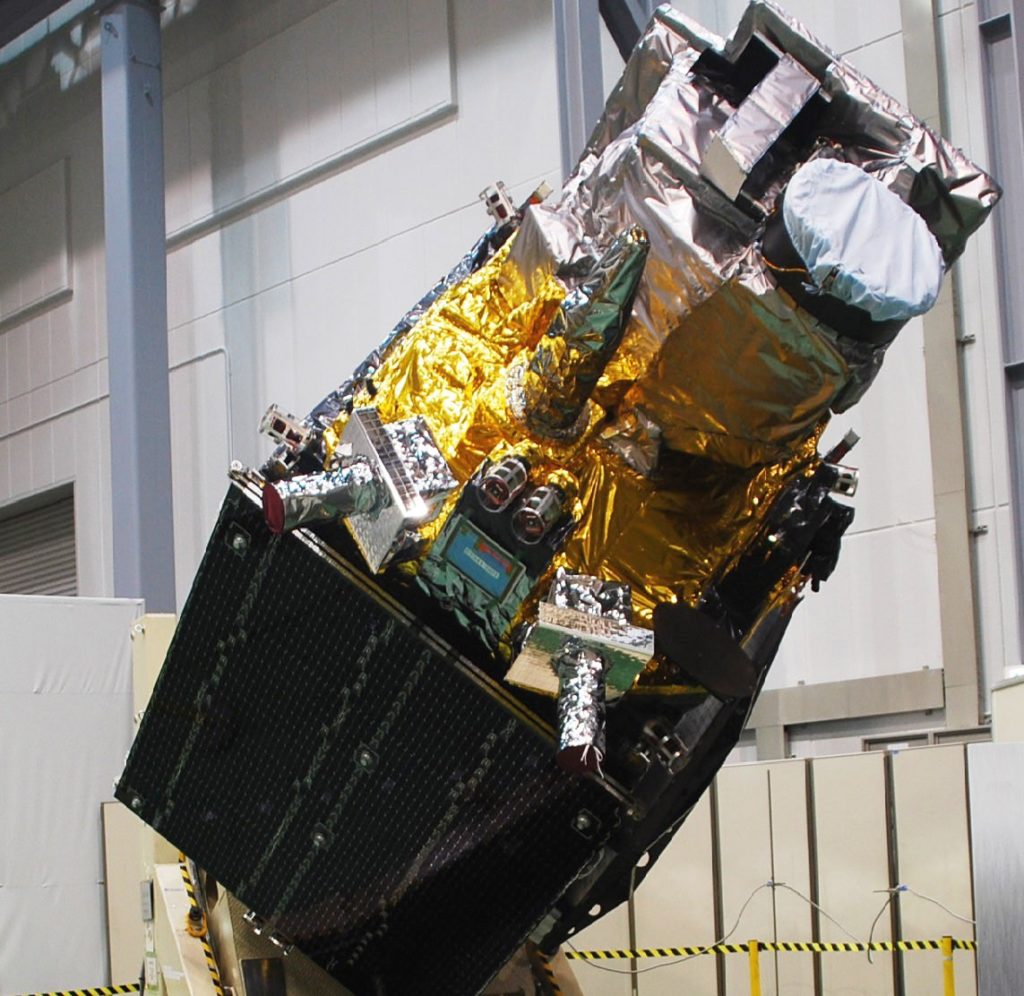
The two GOES satellites use the ABI (advanced baseline imager) to image a large portion of the total planet at a spatial resolution of around 1km. The GOES ABI design is influential on the broader world of weather satellites and many weather satellites operated by other countries (e.g. Japan's Himawari) use derived or similar imagers. GOES and Himawari are the premier weather imaging satellites of the US-allied world, collectively the two systems image a very large percentage of the total planet surface except extreme latitudes. Data from GOES and Himawari are fused to produce the global satellite images provided by e.g. NWS.
The US Stormwatch image does seem to be cropped from Himawari. The size here may be deceptive, the spatial resolution is not as high as it looks because this cloud is so large.
Although the GOES ABI (and related Himawari AHI) are static designs that image the full planet from a fixed position (i.e. there is no aiming or steering as is sometimes the case in other remote sensing satellites), they do deal with practical limitations related to readout and downlink capacity. As a result they typically produce a full-disk image every 5 minutes but both are capable of producing more frequent images of selected regions (areas of interest) on command. This capability is mostly used for maintenance purposes (e.g. registration calibration) rather than for weather observations.
Incidentally NOAA is preparing to launch a new GOES satellite, GOES-T which will become GOES-18, in somewhat over a month. It is the same basic generation as GOES-16 and GOES-17 currently in primary use, including the same basic ABI, but has a minor "bugfix" to the ABI design that will avoid a problem GOES-16 and GOES-17 have that requires them to go into a reduced readout rate mode some of the time for thermal management reasons.
My basic meteorology knowledge is somewhat limited but I believe what appear to be waves are cirrus clouds. This is somewhat confirmed by their significantly increased prominence along the shockwave front, as large shockwaves in the atmosphere cause some additional formation of condensation clouds due to the increased pressure, and these tend to be cirrus up at high altitude (the condensation immediately freezes into small crystals).
look like clouds to me but i'm not an expert in satellite imagery. the shockwave implies > the speed of sound so more of an explosion than eruption right?
Many eruptions are explosive[1], like Mount St. Helens in 1980. Here's a small explosive eruption where you can see the shockwave and eventually hear it when it hits the ship the cameraperson is on: https://www.youtube.com/watch?v=BUREX8aFbMs
I remember seeing on a TV program about an eruption where some people were monitoring a volcano from some miles away at an airport where they thought it was probably safe.
And the comment was made that if the pyroclastic flow reached them, the first they would know about it, at night, was when the runway lights vanished.
The satellite wasn't maneuvered, and it was not specifically monitoring this location. It is a weather satellite that looks at half the planet at a time. This is just a crop of a much wider field of view.
Satellites in general aren’t maneuverable. The camera angle can be changed to point at, and capture, a region of interest when the satellite passes over it, but the satellite’s orbit is determined on insertion and doesn’t change on demand.
Satellites can be moved, for example to avoid a collision with another satellite or debris, or to semi-permanently change the orbit. They have some sort of propulsion to allow this, and also counter atmospheric drag etc.
However, the lifetime of the satellite is generally limited by the amount of propellant (or whatever), after it's run out the satellite is useless. So it's not done on a whim.
They have a very limited amount of hydrazine, used for small course corrections for drag compensation and debris avoidance. It's not used, nor can be used, to "change orbit" in the sense of redirecting the satellite to look at some specific location on demand, outside of the satellite's original orbit.
Parent post is correct. Raising and lowering the orbit is a matter of burning a reasonable amount of rather limited fuel. But making a left hand turn at 17.5 km/h is incredibly energy intensive.
Look at the SpaceX launch of DART. They needed a whole rocket to lift a tiny payload due to needing to turn roughly 45 degrees
GEO satellites never move. Only times they are moved out of its longitude is when they are decommissioned or relocated when absolutely necessary, which by the way takes months.
> ... when the satellite passes over it ...
GEO satellites don't "pass over" anything by definition. They permanently float in the air 35786km above a designated spot along equator(complicated). So GP is clearly not talking about GEO satellites.
This is from two indoor BMP280 sensors on Home Assistant that are about 5300 miles from Tonga. (They are a floor apart from each other)
It's amazing what extremely cheap sensors can currently measure, though 1883 technology was sufficient to measure the pressure wave from Krakatoa circling the globe multiple times.
> Whoa that second link.. that guy is so lucky this didn't turn into a full blown tsunami.
That is what a full blown tsunami looks like, based on watching many YouTube videos on the subject.
Bear in mind this is only a minute of footage. If the water keeps coming in like that for an hour it will eventually reach the person shooting this video.
The scary thing about tsunamis is that they look fairly innocent in the beginning. And five minutes later there’s ten feet of water moving very fast with houses and cars in it.
Here’s a good example of how it can go from looking harmless to terrifying in 25 minutes: https://youtu.be/P8qFi74k2UE
That's a sobering video. It doesn't look like much... at first. The power and violence of the water really has to be seen to be appreciated.
Edited to add:
On March 11, 2011, large parts of the city were destroyed by the tsunami which followed the Tōhoku earthquake. The island of Ōshima and its 3,000 residents, included in the city limits, was isolated by the tsunami which damaged the ferry connections.[7] After the tsunami, spilled fuel from the town's fishing fleet caught fire and burned for four days.[8] As of 22 April 2011, the city had confirmed 837 deaths with 1,196 missing.[9]
Wow. Watching the people's attitude change, from puttering around in slippers joking about the first quaint little trickle, to full judgement day, within twenty minutes.
Wow! Someone else already mentioned it, but this so "interestingly unusual" to "apocalyptic" in twenty minutes it's hard to fathom. Thanks for sharing the link I personally had no idea!
The term 'tidal wave' has been deprecated for some time, as they are not gravity-driven, but it does capture how the wave does not just break on the shoreline like an ocean roller, it keeps on coming.
This is a real tsunami, just not really really big, they are partially protected by a reef. It's not a slow eruption (check out the shockwave in one of the videos, heard in New Zealand). There was a smaller bang yesterday.
Some of these communities have nothing but a coast!
It's probably in a Jared Diamond book somewhere about shifting expectations depending on where you grow up, some people can't imagine that people live in a place where you can't hear the sea, because they only knew that.
Also, for those that have some high areas, chances are the high areas are a volcano. If it is, it likely is an active volcano, as this region is on the ring of fire (https://en.wikipedia.org/wiki/Ring_of_Fire)
Here in Vanuatu we could also hear it. On facebook people from all the islands are talking about it and were trying to figure out if it was one of our own island volcanoes that erupted.
Does anyone with knowledge about volcanoes have context on how big this is? Clearly not small, but is this a once-in-a-decade or a once-in-a-lifetime size explosion? Are there any well-known eruptions to compare it to (e.g. Mount St. Helens)?
Not a volcanologist here but I've always loved volcanoes.
It's probably gonna depend on how long it keeps erupting. Volcanic eruptions are rated (VEI index) on volume of material ejected, but each level has 10x more material than the previous.
If this were a volcano on land... I'd guess we are at a 4 or so. As this is a volcano that just barely breached the surface and thus interacts with water alot... maybe a 3? Volcanoes like this create really violent explosions (like the ones heard yesterday), but that doesn't necessarily require more material.
As said though, it'll be hard to tell without knowing how long the eruption went on and seeing the state of the island.
Man. This has got to count as the largest explosion on earth within any of our lifetimes. Anyone got a figure on how much pulverized rock would have been displaced into the atmosphere had this taken place on dry land? How long a nuclear winter we'd be in for? Or how this compares to Krakatoa? From the imagery it seems orders of magnitude larger as a single explosion than all the nuclear weapons we ever detonated combined. That shock wave goes over Tonga within the first couple frames.
It still remains to be seen exactly how big it is. My feel is it’s slightly smaller than Mount Pinatubo in 1991 (in my lifetime) which significantly reduced global temperatures for a bit. Folks have suggested maybe 0.1 to 0.5C (0.2 to 1 degree F) temporary temperature reduction.
because of course they do. it's like punctuation for "them". imagine a line graph as you are reading that comment. it starts high, but then starts to fail off quickly as you get to the second word picks up speed of its drop as you carry on. then, just to clean up everything, bro just plumments the graph to nil
Probably not. Way to small for that, and even the early large eruptions only affect the atmosphere noticably for a year or two (unless it's a really really really crazy large eruption that makes Tambora look like tiny)
They won't slow it, but pause effects for a short while. The CO2 would still be there afterwards and all the while increasing, the oceans will still be acidifying, etc.
The next years after would still be as bad as predicted
It's kind of a compliment. "Hot take" is becoming common parlance, but a hot take as defined by Blind Boy Boathouse would be a connection you notice between two seemingly unrelated things, and then dive into to arrive at a smashing observation about, where you link those things by obsessively researching the connections between them, to reveal a hot take on events that no one has quite heard of, or had the same take on before.
I've heard advertisements on the radio recently for financial and sports programs and web sites where they promise "No hot takes — only real information."
Yeah, I think "hot take" [1] is the analytic analogue to expressions like "by the seat of the pants," [2] meaning something like: A rushed, likely emotional, reaction to something with no or minimal follow-up research or analysis.
Not precisely. What makes a "take" hot is its provocative or controversial nature. It's not quite flamebait -- that implies more of a deliberate attempt to sow discord -- but it's along the same lines.
What length of time are these satellite videos taken? I think it might make the explosion look larger than it really is. What we are seeing is the billowing flat top of the debris cloud.
My watch was able to pick up the pressure wave in Switzerland, on the other side of the earth. It's the little spike around 25% from the left. I wouldn't have believed it but the magnitude, timing and shape line up with what others have reported from stationary barometers on twitter.
I saw a thread on Twitter regarding the expected pressure spike that should be happening shortly in Southern Algeria as the pressure waves converge from opposite directions at the antipode of the volcano. Thought that was pretty interesting.
Is there any website tracking how long the sound would take to reach various locations? I’m guessing I might be able to hear a gentle rumble in SF
Edit: some Googling tells me it's about 5300 miles from SF to this volcano. At 767mph, that's 6 hours and 54 minutes. The volcano erupted at 8:26pm Pacific, meaning at around 3:20am Pacific time the sound should reach SF.
I live in the Yukon Territory, Canada... Not 100% sure this explosion is what woke me this morning but:
I woke up at 7:15 AM MST to what I though was a freight truck loading boxes at the business next door. Rumbling, thudding noises. Very faint. Promptly ignored it and tried to go back to sleep, a few moments later my sister 100 KM outside of my location on a off-grind property texted me asking if I could hear thunder/fireworks like noises outside. Noise probably lasted 10-15 minutes.
I did some napkin math for speed of sound and it gets close.
It was heard in NZ, some as south as Christchurch claiming to have heard it. In in Christchurch and didn't hear it but did see changes in air pressure was the sound waves went through.
>“We continue to try and contact the Tonga network operations centre but at this stage remain unable to do so, even via satellite phone. While we understand Tonga also has satellite links, we don’t know whether the satellite ground equipment has been affected.”
The ground link between Fiji and Tonga was broken. Even satellite links are down due the ash cloud. That's why there's no telemetry from anything at all. Hard to imagine but we have no link to Tonga.
Really, unbelievably cool satellite images. I don't know much about satellite imagery, is Himawari-8 always pointed to that area in the Pacific, or did we expect it to explode and was purposefully pointed towards the island?
Here's what I honestly worry about: queue the conspiracies, "New islands don't just explode like that! That's the Fauci-Gates COVID-5G nuclear testing site sheeple!"
It's in a geostationary orbit at 140.7 degrees east, roughly in line with the east coast of Japan, and about 35 degrees west of the volcano, so it always has the volcano in view. It has an imaging sensor which continuously scans the whole visible disc of the earth, taking ten minutes to do so [1]. So, you get pictures of anything that happens, anywhere!
Yes, Himawari-8 is a geostationary satellite over longitude 140deg east and always pointed there.
The Wikipedia article contains images of the full disk of Earth that it is observing. Since it is geostationary, the view does not change.
Along southern Alaska, the shockwaves were audible a few hours ago. I slept through it, but my feed has people complaining of having been woken up. Our local subreddits have posts from people being confused about potential thunder or military exercises. It is incredible to think of the energy involved in these events.
Around 4-5 AM AKST going off what I see others have been saying, sorry I don't know precise timestamps. One of the posts in /r/alaska was at 4:50 AM. One in /r/anchorage was at 4:39 AM.
Edit: Alaska Volcano Observatory just posted this graph of the pressure wave here
* Boat operators,
* Where time and conditions permit, move your boat out to
sea to a depth of at least 180 feet.
     * If at sea avoid entering shallow water, harbors,
       marinas, bays, and inlets to avoid floating and
       submerged debris and strong currents.

 * Do not go to the shore to observe the tsunami.

 * Do not return to the coast until local emergency officials
   indicate it is safe to do so.
This doesn’t seem to be specifically about house boats. Might be worth contacting your local emergency officials (whoever they may be).
When a Tsunami Advisory is posted, tsunami conditions in or near the water are expected. Under an advisory, strong ocean currents and/or waves with the potential to cause coastal damage are expected.
The public should stay out of the water and away from beaches and coastlines."
> A tsunami advisory is in effect Saturday morning for the West Coast, including coastal California and parts of the San Francisco Bay Area, after a large underwater volcanic eruption near the Tonga Islands Friday night.
The National Weather Service said peak waves of one to two feet are possible from the event.
I could hear these large thuds all the way from the top of the south island, NZ, in the hills and at around the same time others were reporting it. Definitely heard like 20+ of these sounds, just assumed it was some anti-pest thing going off at random intervals but it was pine forest so doubt it was that.
I think you have a point there, but it could sound less condescending. It is really putting off. I personally don't think it leads to anything constrictive, only makes people feel worse about themselves.
Maybe, but to be honest, that was the re-edited dialed back version. The original post I replied was way to trollish/consipiracy pushing. "question no one else will ask" is just obvious attempt at a dog whistle, but instead grabbed the football ref whistle.
Volcanic eruptions have climatic effects on short timescales--think a few years of maybe ~0.5°C cooling (this is going by Pinatubo's eruption ~30 years ago).
Much smaller than Krakatoa so far. We'll have to see where it comes out on the VEI scale though. Krakatoa was really big, so I think it's pretty unlikely we will get close to that on this one.
The Tsunami they are guessing probably came from an earthquake or underwater landslide caused by the eruption, but the eruption doesn't really need to be huge to cause those. It'll be interesting to see once the eruption stops (if it's a landslide, you can usually see a crescent shaped formation on the volcano, although it may be underwater).
"The third explosion has been reported as the loudest sound heard in historic times. The loudness of the blast heard 160 km (100 mi) from the volcano has been calculated to have been 180 dB. Each explosion was accompanied by tsunamis estimated to have been over 30 metres (98 feet) high in places. ...The energy released from the explosion has been estimated to be equal to about 200 megatonnes of TNT, roughly four times as powerful as the Tsar Bomba"
In some alternate universe 1984's "The Terminator" is a movie with a similar plot to "Pitch Black" in our universe (yes I know it's an eclipse in "Pitch Black").
That seems unlikely, since the magnitude was only 4.0. The relation between magnitude and actual impact is complex, but big ones tend to be 6+ and really big ones 8 or even 9.
The current magnitude estimate from the USGS is 5.8, with the caveat that, "...this event is calculated using techniques calibrated for earthquakes. The current magnitude is only a preliminary estimate for this volcanic event." [1]
What is the magnitude scale for volcanoes vs earthquakes? The tsnumai.gov site says this is magnitude 1.0 but without units or type. So I wonder if it's a tsunami potential specific scale?




https://www.star.nesdis.noaa.gov/goes/sector_band.php?sat=G1... (GOES-West)
https://www.star.nesdis.noaa.gov/goes/sector.php?sat=G17&sec...
https://rammb.cira.colostate.edu/ramsdis/online/loop.asp?dat... (Himawari-8)
https://rammb.cira.colostate.edu/ramsdis/online/himawari-8.a...
Edited comment: originally linked to the wrong satellite imagery (from a separate eruption several hours ago). The discussion in this link is still informative, but not current:
https://www.nesdis.noaa.gov/news/hunga-tonga-hunga-haapai-er...