See: https://scholarship.law.stjohns.edu/cgi/viewcontent.cgi?arti.... Go back and compare judicial decisions from the 1940s to 1970s to ones today. The ones today are much more grounded in statutory text, constitutional history, etc., and less reliant on policy arguments, notions of justice and fairness, etc.
Even “liberal” legal decisions are far more conservative today than they were in the 1970s. Compare Roe and Obergefell (both written by socially liberal Republicans). Roe has lots of high minded hand waving about rights and dignity and whatnot. Obergefell meanwhile starts from deeply rooted traditions and spends a tremendous amount of ink making the case that gay marriage is sufficiently like traditional marriage that it should be covered by the same constitutional protection.
This became starkly apparent when Roe was overturned. By that point, the ground had shifted so much that even liberals had a hard time defending Roe on the merits. They had instead retreated to stare decisis. Because even a lot of liberal lawyers today have a hard time swallowing the idea that judges should be in the business of inventing new rights to implement their vision of what’s just.
That says very little about the legal progression as a whole and a lot about the nearly-statically-insignificant, structurally-supreme sample of nine judges with life appointments generated via an extremely political process.
Yes, there are a lot of textualists on the Supreme Court right now (thanks to a concerted political effort to put them there). That doesn't imply they represent the "intellectual horsepower" of the legal profession as a whole. They might represent the political savviness and luck of the GOP, to have managed to appoint so many from a minority-populace-support footing by maximally gaming the non-representative quirks of the US political system. But I wouldn't classify political savvy as legal "intellectual horsepower;" the ABA doesn't rate voters.
The article isn’t just talking about the Supreme Court. Yes that’s where this has had the most prominent effect, but the influence of textualism (and concrete legal analysis in general) has filtered down throughout the courts and even those bastions of liberalism, law schools.
To be sure, the overwhelming majority of lawyers are liberal, and indeed the majority of very smart lawyers are liberal. But legal conservatism punches way above its weight in shaping the turf everyone is playing on.
Yes, because it is popular among GOP politicians (since it supports interpretations of the law that are positively archaic by modern standards... In some cases, ignoring decades of jurisprudence is the only way to get the outcome they want short of controlling enough of Congress to pass laws, which they find harder to do year over year as the demographics of America shift) and through their efforts we've got a few true believers on the Supreme Court and several in the lower courts now.
That doesn't imply it's good law that well-trained lawyers believe is correct. If anything, the prevalence of lawyers who aren't on board with it indicates the contrary. But the federal legal system itself is not a democracy, and when we change a handful of key operators in the courts, the timbre of the law can change quickly.
As the article observes, the conservative legal movement has had a tremendous influence on law schools as well. It has moved the entire landscape to the right. When Justice Kagan said “we are all textualists now,” she was hitting upon a real thing. Across the board, the legal profession today has a greater belief that judges should be interpreting the laws, not making new law out of abstract notions of justice and fairness. Among the latest generation of lawyers and judges, there are just way fewer people who have the expansive view of the role of judges that the profession had in the 1960s and 1970s.
You’re incorrect about both democracy and demographics. The legal profession is dominated by the ideology of a white liberal minority. Not only are there few conservatives, but the conservative views prevalent among Black, Hispanic, and Asian people are also absent. (This is a common mistake where people confuse minorities voting democrat for being liberal. Most democrats are not liberal, and “changing demographics” hasn’t affected that because most minorities aren’t liberal either.)
Modern liberal legal thought arose in the 1950s and 1960s to allow that ideological minority to change society in ways they couldn’t achieve at the ballot box. For example, both Republican and democrat lawyers and judges are much more secular than voters in their respective parties. Thus, the Supreme Court banned school prayer more than 70 years ago, but even as of 2012 a strong majority of Americans opposed that decision: https://www.pewresearch.org/fact-tank/2013/06/13/south-carol....
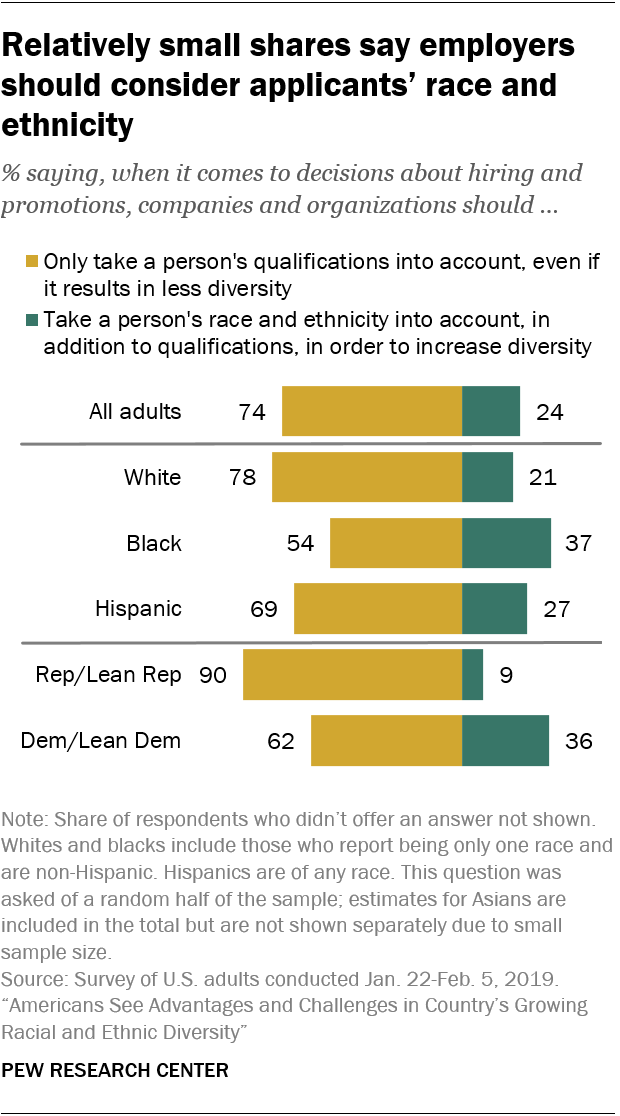
Another example is racial preferences in education and hiring. It’s the pet project of white liberals and their allies. The majority of non-white Americans, including Black people, oppose express racial preferences for both college admissions and hiring. (E.g. https://www.pewresearch.org/social-trends/wp-content/uploads...)


Even “liberal” legal decisions are far more conservative today than they were in the 1970s. Compare Roe and Obergefell (both written by socially liberal Republicans). Roe has lots of high minded hand waving about rights and dignity and whatnot. Obergefell meanwhile starts from deeply rooted traditions and spends a tremendous amount of ink making the case that gay marriage is sufficiently like traditional marriage that it should be covered by the same constitutional protection.
This became starkly apparent when Roe was overturned. By that point, the ground had shifted so much that even liberals had a hard time defending Roe on the merits. They had instead retreated to stare decisis. Because even a lot of liberal lawyers today have a hard time swallowing the idea that judges should be in the business of inventing new rights to implement their vision of what’s just.