> To optimize this ratio in practice, we used the multi-pixel sensor of an electron multiplying charge-coupled device (EMCCD) camera as our idler detector (Fig. 1a). As the EMCCD can detect multiple photons simultaneously, it allowed us to identify and reject, that is, post-select, all events other than those where a single-photon pair was generated with a higher efficiency than with more traditional single-photon avalanche diodes (SPAD)
How is it possible to both detect a photon and then allow it to travel to the human eye? Wouldn't detection require absorption of the photon?
There is a process called spontaneous parametric downconversion (SPDC), where if you shine laser of frequency f at a crystal, it will with small probability p emit two photons of frequency f/2 (energy conservation in play here).
If done correctly, the outgoing laser light and the two photons all travel in different directions and so can be separated and further directed using mirrors or optical fiber cables.
Because the process is non-deterministic, what we usually do is direct one of the photon beams towards a "heralding" [1] detector, while the other is directed towards the optical setup where we need a single photon [2]. If at a given moment a photon pair is produced, then the heralding detector will click; which tells us that is also a photon currently in our optical setup.
Finally, there is a ~p^2 probability that two photon-pairs will be produced at the same time by this process (and p^3 etc). To eliminate this possibility, in this experiment their heralding detector can detect how many photons landed on it any given moment. So if they see 2 or more photons in their heralding detector, then they discard this run, because now there are multiple photons heading towards the human eye.
[1] Herald as in the guy who announced that the King was approaching.
"SPDC is a quantum optical technique in which correlated pairs of photons (called signal and idler) are produced probabilistically from a higher energetic pump photon in a non-linear crystal following energy and momentum conservation16,17 (Fig. 1a). By detecting one of the photons (idler) and sending the other (signal) to the observer’s eye..."
I suppose conservation of momentum allows them to guarantee pairs, in which case a photon in one direction guarantees a photon in the opposite direction.
> How is it possible to both detect a photon and then allow it to travel to the human eye?
Leonard Susskind explained it like this in one of his lectures (they are on YouTube, he's an excellent explainer):
From the moment the photon is emitted, to the moment it's detected, the photon exists in entanglement with all the intermediary things it "touched". Only at the final location it's "absorbed" (with a probability). At the intermediary locations the probability ended on the low side so it passed through.
Interesting study, though if you look at the results 'significantly above chance' looks to be 0.60 +/- .05, which is indeed better than 0.50 but not what anyone could call reliable detection.
I wonder if trained owls could detect single photons, or if their night vision is based on just having much larger lenses that collect more light?
It seems that all rods in retinas are activated by single-photon-absorption, it's just about how many have to be activated to generate a neural signal.
Owl eyes have really cool adaptations (see https://abcbirds.org/blog/owl-eyes/). If we can somewhat detect single photons, it seems very likely owls could do it much more repeatably.
It wasn’t clear to me whether that 0.60 accounted for the fact (mentioned in the overview) that only 10% of photons reaching the eye actually make it through.
It definitely is. The retina "measures" photon positions, which is why you see images. Observation is just interaction, no need to consider whether A can observe B. If they interact, some kind of observation takes place.
When you look at the flickering pattern a laser pointer makes on a rough surface, that flickering pattern is similar in nature to the double slit interference, and you are seeing it with your eyes.
Don't forget that the interference pattern is a statistical one, you need to average over a number of photons to "see" it emerge.
Yep! Any interaction counts. If something interacts with a photon, and that interaction can only happen if it goes through one of the two slits (i.e., it tells you "which way" the photon went), then the interference pattern will disappear.
What escapes my understanding with the whole "interaction is observation" thing is that I don't get how anything could ever not be interacting with a whole lot of other stuff. Gravity and EM fields are everywhere. Even if photons are somehow immune to that (which, they're not, because gravity can re-direct photons) it's my understanding that we can see the same interference patterns with particle streams of ordinary matter, and I can't for the life of me figure out how those could ever not be interacting with basically everything remotely nearby, including the entire test apparatus.
And now you understand why "quantum gravity" is such a big question in physics right now! We don't understand it all. I actually don't know anything about how EM fields affect superposition, perhaps someone else can chime in.
Yup, everything interacts with everything close by all the time.
The important thing is by how much, and what sort of interference patterns can this produce.
As it turns out, interference is quite hard to produce randomly because two fields only produce wavering patterns when their frequency and other parameters are almost equal.
So yes, the ball you just threw to your friend is actually spread out over a whole region, that spread is about 10^-34 m so it impact is not visible at all.
The short answer (as I understand it) is that decoherence is not binary. The gravitational field may be able to partially resolve the position, for example, and so you only get slight reduction in interference.
On a related note, you can hear sounds that displace your eardrums on the order of an atomic diameter. At least that is something I heard years ago, a quick search turned up this StackExchange question [1] so there may be some truth to this, I did however not read the answers too carefully. They actually seems to suggest that the threshold is even quite a bit smaller which makes me somewhat cautious of the claim, but then again you are essentially integrating over really many atoms in your eardrum getting displaced together.
>> sounds that displace your eardrums on the order of an atomic diameter.
That isn't all that surprising really. This isn't one atom moving a tiny bit. It is billions and billions of atoms all shifting back and forth together.
It's not that it takes billions+ of atoms in order to effect a motion at all, it's that the amount of motion here, _of the sensor_, is just an atomic diameter. If it takes billions of atoms to move the sensor, the sensor itself is comprised of trillions+ (I'd guess, decillions+) of atoms.
That we can "hear" the movement of just a single atomic diameter in distance of such a relatively massive structure doesn't seem amazing? I'm even more amazed that with such sensitivity, we aren't inundated with the noise from that, and can still hear normal volume sounds, whose movement must be absolutely massive compared to a single atomic diameter. I guess that effect is similar to the eye's. We cannot see a single photon in the presence of daylight. That only works in a darkened (pitch black in this case) room.
This fun fact gets even more fun when you consider that a human radiates a nonzero amount of visible light via blackbody radiation - on the order of a photon/minute - which means that in theory, with some luck, in an otherwise cold and completely dark room, two humans might be able to notice each other through vision alone.
A bit more than just “some” luck needed for one of those photons to be emitted straight into the other person’s pupil!
The angular diameter of a human pupil (~5 mm) at a distance of ~2 m is about 0.2 degrees, taking the small angle approximation. So the area of the pupil is maybe 0.04 square degrees, or around one millionth of a full solid angle (~41,000 square degrees).
Assuming a spherical isotropically radiating human, the probability of hitting a pupil from any distance is thus pretty unlikely.
We probably need to get more precise for a real answer.
The number I’m getting is about 2 photons/minute per steradian; a steradian has solid area 1m^2 at 1m away. With fully dilated pupils (8mmish) you get an area of pi x 2 x r^2 = 50mm^2, which gives us a rate of about .15 photons/day.
So… Maybe. If you’re very lucky. It’d be interesting to do the same math for a room temp object to see if you’re above the noise floor at all or if this is completely impossible, but I should go do my actual job instead of letting myself get nerdsniped by this.
No, this will not help. Thermodynamic law forbids this.
Otherwise one can create a machine concentrating all the thermal radiation of one black object at temperature T1, onto another perfectly white object also at T1 with a tiny black hole, heat up the second and then violate the second law of thermodynamics.
I'm thinking back to the movie Real Genius during one of the montage scenes where they're cramming for finals in a common area when one student just stands up from his material and starts screaming in madness before fleeing. Everyone else, just behaves as if this is normal as someone takes the now vacant place at the table.
That guy screaming in madness? That's me after just thinking of doing the math without even grabbing a pencil.
So you can probably fit three to five one-bounce reflections in your field of view. Then there’s the “infinite” number of higher-order reflections, but given that the probability for a photon to be absorbed rather than reflected is maybe 5% every time it hits a mirror, the additional reflections don’t really contribute that much beyond maybe 20 bounces. So I guess the odds could improve to something like 1/10,000 as a really rough guesstimate.
Definitely. 20 years ago when homes were not littered with LEDs all over, I would wake in the night to total blackness.
I could still find my way around the house just able to see based on what is I suppose a noise floor of ambient temperature.
Go into the kitchen & behold the stove top emitting 'bright' white light, from I suppose a temperature of around 30degC /90F.
Obviously everything is a blackbody, but those photons surely can't be 'single' visible ones.
Gosh. I used to have pretty good night vision and recognise what you mean about "see based on the noise floor" - but I never had an experience like seeing the stovetop heat. Remarkable. I wonder how much variation there is between people? Unfortunately mine's faded with age so I don't think it's worth my trying to see if I can see that myself now...
I’ve been aware of this fact as Feynman points it out in the course of the lectures, but find it totally nuts — there is some sense of scale I’m missing.
Matter consists of discrete chunks, atoms, but these chunks are so infinitesimal and numerous that there is no question of seeing them and any effect involving a handful of them is far, far below the human scale.
Light also comes in chunks, and the number of these chunks should be comparable to number of atoms since, e.g every single atomic transition generates a photon. Actually they should be far more numerous as they are massless and easily created, destroyed.
Yet, somehow, they are not far below the human scale of detection — as few as 5 (!) results in a perceivable flash.
What am I missing here? (Obviously this boils down to a numeric estimation and the numbers are what they are — my question is why do the numbers wind up even remotely in the human ballpark.)
Another piece of this puzzle is that in a lot of cases, chemical reactions have an exponential sensitivity to energy levels.
The visible light spectrum corresponds to photons with energies of roughly 1.6 to 3.4 electron volts. That's a non-trivial amount of energy, enough to break the weaker bonds in many kinds of molecules.
In comparison, our environment is awash in huge numbers of thermal infrared photons, with energies on the order of 0.025 eV. But each of these photons has much less than 1/100th the effectiveness when it comes to interacting with atomic bonds.
As for the photopigments themselves, you can think of them kind of like atomic-scale mousetraps. Once a photosensitive molecule has been put into a highly energetic state, it only takes a tiny stimulus to make it release that energy, eventually leading to a much larger nerve impulse. Biological photosensors have been optimized by evolution to take advantage of this effect.
The visible photons have enough energy above the room temperature noise, that each one can be detected and amplified. Even when that energy is minuscule, it is sufficient to affect a molecule of pigment enough to cause cascade of amplifying reactions leading to detection.
I think we almost agree, but I want to clarify that visible photons and room temperature photons have a very different energy and frequency, and the molecules that detect them in the eye are very sensitive to frequency. So you see the "visible" photons that have a frequency in the correct range, but don't see the other photons.
I guess you can see a few visible photons even if the background has a lot of ultraviolet photons that have more energy and frequency. (It may hurt your eyes. Don't try it at home.)
Maybe seeing in the dark is simply so valuable that evolution has created extremely light-sensitive eyes for many species?
If there was a molecule whose detection in tiny amounts would give a species a competitive edge, we might have noses capable of detecting 5-molecule amounts of this substance.
Unless there's something else involved, most other animals that have good night vision is simply because they have bigger eyes that collect more photons. A single photon test would be the same with those animals eyes versus our own. I think the bigger determining factor is visual acuity as that corresponds to how easy it is to activate a photo receptor area which is easier to do the smaller those areas are.
photography perspective: Lets say hunting (any species) is most effective when the hunter has a wide field of view from a small pupil. So any hunting carnivore animal, will hunt better under non-ideal light if their pupils are smaller, which requires more sensitive eyes.
Higher sensitivity should lead to wider range of sharp focus, that should lead to more hunting success, more dinners, then more descendants.
I suppose on the prey side being able to see the wolf later during sunset should result in becoming the wolf's dinner less often leading to generally more descendants.
I am not a physicist but fun fact, In transit there is no such thing as a photon(electro magnetic waves can transit at any energy level) however light can only interact with matter at discrete energy levels, so the photon(a discrete energy level of light) only exists there, at the interaction with matter.
Particle and waves were just two seemingly incompatible models the modern natural philosophers used.
In post-modern (quantum) physics and the discovery/conception of photons by Einstein, they have been brought together as the same concept (and more generally for non-light by de Broglie as quantons).
It's one atom per molecule, changing the friction.
> those who touched the surfaces could differentiate them based on chemical differences, including the substitution of one atom within each silane molecule for another, because of subtle changes in friction
It looks like that has to do with surface texture. I can reliably feel a step of 0.005" (0.13mm). I doubt if steps under 0.001" (0.03mm) can be felt. Nowhere near atomic scale.
You're not detecting the overwhelming majority of photons - only those few with an energy high enough to cause chemical reactions.
If you were constantly bombarded with atoms at the same energy level (1.5-3.5eV), you would notice them as well. This just occurs less frequently (unless you are on fire).
Really interesting. I'm not an expert, but I'll armchair speculate here.
We need 5-9 photons to merit perception. For us to see one atom, we would need 5+ photons to bounce off of that atom directly to our eyeballs in 100ms. Since both these things are so tiny, most photons miss the atom altogether. It's only when you have large numbers of atoms, densely arranged, that conditions create visibility.
I'd need to verify my sources, but I recall the way photon detection works is by cascade; one photon comes in, and causes a couple of more "things" (I can't remember what - electrons, probably) to be dislodged, each of which causes a couple more... and boooom whooooosh very quickly you have something which can be easily noticed by a sensor.
Another cool fact is that the human eye can see individual cells! [1] In this example it's a white blood cell, but the eye can also see human ovums as well.
I was convinced this was the case as a kid, but no one ever believed me!
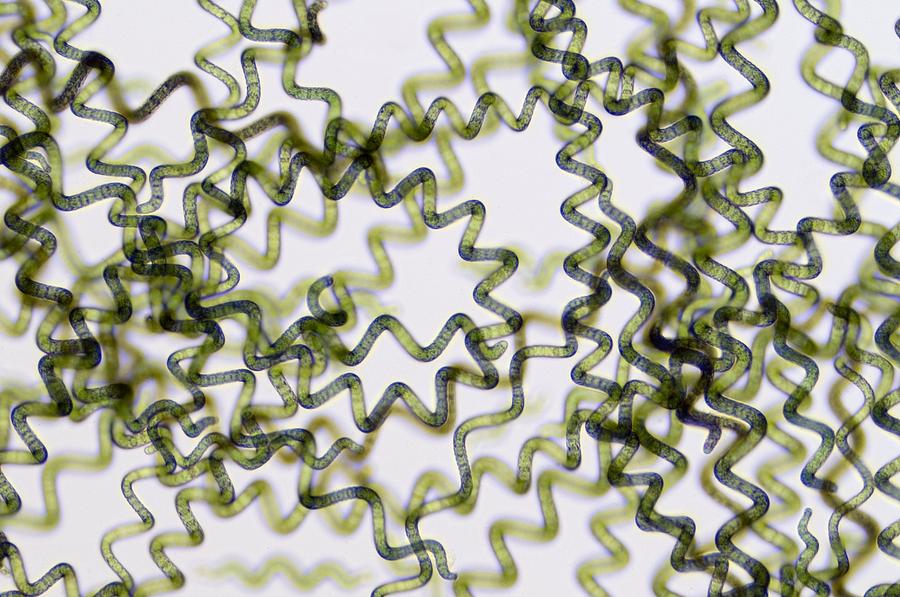
One time a fellow intern and I were isolating single colonies of spirulina (many bright green algae* cells in a spiral [1], which is roughly 50 micron wide and maybe 15 micron tall, if memory serves), and I got one colony on it's own in a drop of water under a microscope (using a special pipette & the wick effect for suction).
I took my eyes off of the eyepiece, and looked at the drop of water. I could see a bright green dot in the middle, right where I'd left my spirulina.
I asked the other intern if they saw it too; they did. It was a magical moment.
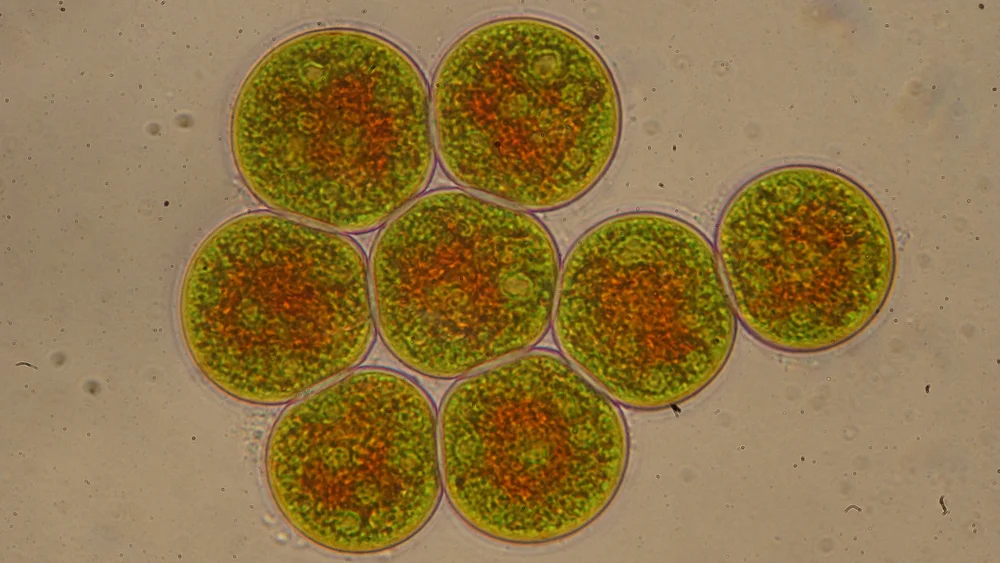
I had a similar experience when I was doing something with H. pluvalis (an algae that turns bright red and forms a film under stress [2], you've likely seen it in a birdbath or shallow puddle) and I put this film under the microscope, looked at it, and saw it was 1 cell thick. I'm confident if I had gotten a single one of those cells on it's own, I could've seen it. Can't confidently remember how big they were, but large on the scale of cells you find in a drop of water (maybe 25 micron in diameter?), but smaller than most animal cells.
* Technically a cyanobacteria and not an algae, but if a lay person looked at a pond of it they'd say to themselves, "that's a bunch of algae"
This is a snippet from Scientific American, October 1993, 50 and 100 years ago:
October 1893: "It now does not seem improbable that, when by the power of thought an image is evoked, a distant reflex action, no matter how weak, is exerted upon certain ends of the visual nerves, and, therefore, upon the retina. Helmholtz has shown that the fundi of the eyes are themselves luminous, and he was able to see, in total darkness, the movement of his arm by the light of his own eyes. This is one of the most remarkable experiments recorded in the history of science, and probably only a few men could satisfactorily repeat it, for it is very likely that the luminosity of the eyes is associated with uncommon activity of the brain and great imaginative power. It is fluorescence of brain action, as it were."
--Nikola Tesla, in a paper read before the Franklin Institute
For context, it's important to remember that Tesla was an accomplished experimental scientist, but he was prone to wild claims and flights of fancy which weren't based in scientific reasoning, even by the standards of the day. Not everything he said or wrote was literally true.
> Helmholtz has shown that the fundi of the eyes are themselves luminous...
This is erroneous -- no part of the eye emits light. Some animals, like cats and dogs, have retroreflective surfaces within the eye, and I wouldn't be surprised if that's what got Helmholtz (or possibly Tesla in quoting him?) tripped up.
> ... and he was able to see, in total darkness, the movement of his arm by the light of his own eyes ...
If this experiment occurred, it's far more likely that there were low levels of light present in the room, and/or that the experimenter was imagining the position of his arm as sensed through proprioception.
> ... it is very likely that the luminosity of the eyes is associated with uncommon activity of the brain and great imaginative power
And this is one of the flights of fancy I was talking about. :) There's no basis for this claim.
Genuine question: I’ve never taken LSD, but could some of its purported visual effects be explained as seeing photons via a depressed neurological filter?
No, eliminating the photon count filter would just make your vision look noisy/staticky in dark conditions.
Most of the effects of LSD (patterns etc) are actually pretty well understood. It's probably caused by a stable geometric pattern generated by a reaction-diffusion process in your visual cortex. https://plus.maths.org/content/uncoiling-spiral-maths-and-ha...
Related to your question (although minus drugs) - I very recently figured out how to "turn off" shot noise suppression in my visual processing. I woke up a few months ago and was struggling to understand something I was looking at in the room (it was a low-contrast scene with confusing shadows) and something clicked, and all of a sudden I could see the shot noise from my eyes. Very bizarre! I can now detect it just by paying close attention in moderately dim conditions.
In the dark I perceive an extremely "noisy" visual field, with lots of different color dots like on a shitty camera sensor at low light. Is that not normal?
Certainly not normal for me! I can now do it if I focus, but prior to learning how to do that, I would never have described my dark-environment vision as "noisy".
As someone who's never taken LSD and have talked to people who have, the number of times people express irreversible changes in how they think about things just from trying things once makes me think that it is not a very good idea to even try once. A chemical that causes irreversible random brain chemistry changes from a single use sounds like damage has happened and the user simply interprets that damage as an improvement of some sort. In the same way we used to cut out pieces of people's brains in the early 1900s and they would report more comfortable lives.
LSD as well as psilocybin and a number of other natural psychedelics exhibit what's called a "classical psychedelic effect". I've tried a couple of them and consider LSD to be essentially the same
It's worth noting that psychedelic fungi and plants are absolutely GLOBAL in distribution. Psilocybe can be found basically everywhere and there are a few related genera of fungi that also contain psilocybe. South America has a ton of psychedelic plants, but even Native America has some psychedelic grasses used to make "prairie ayahuasca". There's a ton of psychedelic cacti species including a very famous cactus (which I shall not name) that very few people know is psychoactive because the Native American group that uses it wishes to protect it from being overharvested. Some very poisonous plants like nightshade are also psychoactive. The fact that indigenous people throughout the Americas have managed to develop techniques to safely utilize these plants suggests close study and attention. There's a famous "Jesus was a mushroom" take by an archeologist that the early cults from which Christianity emerged dreamed up Jesus through their use of psychedelic mushrooms. The take doesn't hold much water but what is agreed upon is that even those groups regularly consumed psychedelics. Christmas also comes from cultural usage of psychedelics. Amanita muscaria, perhaps the most famous mushroom, is that red mushroom with the white spots (kinda looks like Father Christmas, don't it). It's poisonous and very psychedelic. To consume the psychoactive, indigenous European groups would drink reindeer piss. The piss neutralizes the poison but leaves the psilocybin. And so these reindeer allow Amanita muscaria to fly around dropping gifts for us.
I could go on about sweatlodges, the tens of thousands of different psychedelic plant species known, and other ways psychedelic experiences shaped cultures around the world.
My point is is that psychedelics are likely a universal cultural norm. In fact I'd argue we're living in a very strange culture where their use is not very widespread.
I personally didn't try a psychedelic until after highschool. My first experience cured my debilitating social anxiety and I went from my heart racing any time anyone talked to me to organizing community events within the span of a year. I've had similar effects with my depression and other mental health struggles. I'm not trying to suggest they're for everyone, but I'd say the fact that there's "irreversible changes in how [you] think about things" is exactly what makes them such a useful medicine
Who said it altered brain chemistry or that it would change you forever? I called it an interesting experience, that is it. Maybe for some people it is life changing, but then again some people say seeing the northern lights was life changing.
"A chemical that causes irreversible random brain chemistry changes from a single use sounds like damage has happened"
From what I understand, LSD does not change your brain chemistry directly, but you make deep experiences, and those might change your deep thinking (and therefore the brain chemistry). Opening up your perception to other information channels. But sure, that doesn't mean it must be beneficial. And whether it is a damage I would say depends on the outcome.
I know people where LSD was beneficial (solving cluster headache or overcoming addiction) and people where it clearly wasn't (became spaced out weirdos). But everything you do or don't do, comes with a risk. If LSD does not appeal to you, then just don't do it.
The big problem for me is that everyone I know who has done psychedelics and enjoyed it says "yeah it was fun, not a big deal" while the people who have bad trips have REALLY FUCKING BAD TRIPS. The upside doesn't seem that big, and the downside is possibly going insane for a few years like someone I know of. It's an extremely small chance and you basically have to be predisposed and making poor choices about your setting, but it's still there.
sorry to hear about your friend. I know someone who got hit by a bike while crossing the street and hasn't been the same since. Bad things happen, the question is prevalence.
also, I don't think it's fair to say "the upside doesn't seem that big" when the vast majority of users report life-alteringly positive experiences, including Steve Jobs and many many others:
Any profound experience (and many a mundane one) causes permanent change. We call that "memory".
But people who are borderline schizophrenic should never do LSD. They may tip into full-on psychosis. They should, however, take MDMA, and experience quiet, maybe for the first time.
If you look carefully, you can see a little bit of noise in very low lighting, probably because of the small number of photons. However, the amount of noise you see with your eyes is orders of magnitude less than the camera in your phone picks up. Camera technology is still well behind biological cameras. To get similar performance you’d probably have to cool the ccd with liquid nitrogen.
As a layman in modern physics, I struggle to understand the shape and size of a photon as a wave. As far as I understand, e.g double slit experiment would implicate that the size of a single photon wave would be clearly macroscopic in nature. Is there any text available that would discuss this without a need of Ph.D in physics?
So I think one conceptual issue that makes this so hard to understand is that we tend to imagine a physical reality where light is a wave or a stream of particles. However, that is absolutely wrong. Both the wave and the particle concept are mental models we have constructed to explain light as a phenomenon and to calculate things. And in their respective realms, they work exceptionally well.
However, where things start to get complicated is when the models give different results. However, this doesn't mean something is wrong, it just means the mental model we use to make sense of nature is stretched beyond where it's applicable.
So to preface, light is neither a stream of particles or some sort of wave like the ones on the surface of water. Light is the excitation of the electromagnetic field and is described by a quantum field theory called the standard model. So. photons are 0-dimensional (so no size) excitations of this field and they interact with matter like our eyes, surfaces, sensors in an experiment and produce physical effects.
> sensors in the retina can respond to a single photon. But neural filters only allow a signal to pass to the brain to trigger a conscious response when at least about five to nine arrive within less than 100 ms
Like an activation function in artificial neural networks
Yes, modern CMOS image sensors have quantum efficiencies of more than 80 %, and modern CCDs are well above 90 %. This depends on wave length, particularly in the NIR spectrum. This means that 80 or 90 % of the incident photons are converted into electrons. This number does not include photons being reflected from the surface of the sensor or the filter stack on top.
There's also SPADs "single photon avalanche diodes". These are sort of like a geiger counter for light, i.e. a single interacting photon triggers an impulse that can be counted or timed. These are very commonly used for time-of-flight sensors.
NB that CMOS and CCD sensors might have a QE approaching 1, but they cannot (yet) be used to detect a single photon due to internal noise (unless you get a really expensive sensor and make it super cold).
For detecting single photons, you need really high in-sensor amplification. Options include SPADs or photomultipliers if you don't need an image, or image intensifier tubes (used in night vision) if you do need an image. Semiconductor cameras that use IIT-like operational principles are in development now, undergoing testing for next-gen (digital) night vision.
There are Photon-counting Cameras but they can not be used when there are allot of photons. As an example; the max nr of photons per second and pixel from one of the commercial ones is 10^7 photons/s/pixel.
TL/DR: No, we cant. The retina itself can respond to a single photon, but we are not retinas. Instead, the eye filters out this low light sensitivity lest we go crazy with the resulting visual noise at night.
Well that's expected when SNR is low. But in a dark room it's harder to see because SNR is low. I was just saying that I wouldn't want to artificially lower SNR in all environments, but maybe it wouldn't and maybe others do.
I think the noise is suppressed not merely because it's harder to see, but mainly because neural networks tend to hallucinate given such an input. In other words, there's fine tuning between losing weak signals and hallucinations.
Somewhat related- high energy cosmic rays (not photons, but ultra high energy protons, or helium nuclei) are theorized to cause flashes of light and other visual phenomenon in astronauts.
This reminds me; if I look at a red LED in the dark, my eyes seem to add a purple shape around it, kinda like an infinity symbol. Does this happen to anyone else?
I thought that's astigmatism, which distorts different wavelengths differently. Some LEDs have very few, widely separated wavelengths, and your astigmatism separates them.
Obviously you're not going to be able to taste a single proton in your mouth. But maybe only a very small fraction of those protons are actually interacting with the receptors. Figuring out the threshold on the cellular level would be complex because it would depend on the rate of diffusion of H+ through the relevant channels and the number of relevant channels.
I’m convinced you cannot taste single protons. Water self ionizes, so there will always be acidic species (H+, H3O+, …) way way above the concentration of single molecules.
its an interesting space to try and inspire engineering from biology, a quick search says eagles have the best eyesight
i just saw a video about a dog's nose being used for particle detection in crime scenes, i'm wondering if there's already been, or when there will be work on recreating the basis of an eye as a detector
or if maybe this has already been subverted by lens manufacturing
It's amazing what happens in an eye: retinal (C₂₀H₂₈O), an aldehyde of Vitamin A, exists in two forms: all-trans-retinal gets hit by photos, flips and becomes 13-cis retinal (simplifying slightly). If enough photons are involved, the info gets transmitted to the train. If the photons were in a particular constellation, we see a "rectangle" or "circle"; quite a miracle if you think about it.
Autism is described to not affected as in missing "filters", the inability to process faces for example or to shut out noise. If the noise level is higher for sound, why should the noise levle for visuals not be higher and thus percieved lightsources as small as a photon be visible.
There's a fun way you can try seeing individual photons yourself! With a Nuclear Spinthariscope, somewhat popularized in this XKCD comic
https://xkcd.com/2568/
You can buy them for about $50 from some science education sites. It's quite a conversation starter, as long as you're ready to sit in the dark for 15 minutes.


Overview https://www.nature.com/articles/nature.2016.20282
The actual work https://www.nature.com/articles/ncomms12172
> Here we report that humans can detect a single-photon incident on the cornea with a probability significantly above chance.