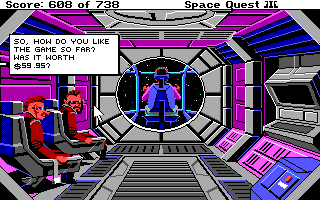
Speaking of keeping up with inflation: AAA video games have been $59.99 for like fifteen years. Sony has been flirting with finally inflation correcting this and a lot of people freaked out for some reason. I wonder if 2023 will be the year this takes hold.
I'm convinced that's more that games were very overpriced for a long time. Or at least they were expensive because sales were generally lower. Games used to be ridiculously expensive.
Big publishers like EA, Activision, Take Two, etc. All still made/make killer profits on games. Development costs more today, but games are also selling a lot more plus there's other revenue streams like microtransactions and subscriptions. They really aren't struggling for cash.
Nintendo has the right idea. They just basically never drop the price of their games. Whereas most other publisher's reduce prices by 50% within just a month or two. Big games often have long tails.
His takeaway that video game pricing doesn't make any sense, and never has.
$60 for a beautiful work of art that you'll remember for the rest of your life is the deal of a lifetime, whereas $60 for a forgettable, shameless cash grab is a complete rip-off.
I'm run a retro games business now, and the pricing honestly makes a lot more sense from an economic point of view. $300 for EarthBound is still a better deal than $8 for Final Fantasy XIII-2.
> $60 for a beautiful work of art that you'll remember for the rest of your life is the deal of a lifetime, whereas $60 for a forgettable, shameless cash grab is a complete rip-off.
This exactly. I can't remember what I paid for Factorio or Subnautica or Valheim but 100x what I paid still would be amazing value vs 1/100th of what I paid for Fallout 4 would still be too much.
>$60 for a beautiful work of art that you'll remember for the rest of your life is the deal of a lifetime, whereas $60 for a forgettable, shameless cash grab is a complete rip-off.
I don't think this is how experiences work. Because you haven't had them in the first place, there's no way whether you'll like it or not. Second thing is, what's the point of the pricing? Covering the expenses of the creator, publisher? Making them have a buffer for a future work? Extracting as much from the people as they can? These yield very different outcomes.
In the end, pricing making sense boils down to one's economic view. If you think about it, it's about the fairness of the compensation, and so, the thinking centers around what's fair, how to ensure fairness, and whom should be included in fairness and to what degree. And so, you get the "let the market decide" people, the "manage it centrally" people, and many other people too of course. And pricing might make sense only in a framework like that. With no framework, it will never make sense.
A used games business has the luxury of hindsight. Earthbound is a great example: Nintendo didn’t know it would be a “$300 title.” They weren’t even confident it would sell in the West.
Lots of titles we know today as timeless classics were like this. They were incredibly anxious about Super Mario Kart and Mario 64. They were so unsure of the entire N64 console that they made a controller with a fallback D-pad for 2D gaming.
Also some fraction of sales have moved digital. Meaning the whole retail chain that used to exist is not there to take their cut, moving it entirely to publishers.
Manufacturing, warehousing, shipping, warehousing with distributors and shipping again to stores. Who then hold inventory and sold it was not cheap.
I don't think the games were overpriced until you factor in overmonetization through season passes, DLC, and microtransactions in many games that release at full price. The full price would have been fair, the rest of the anti consumer business model means the full price is userous.
> AAA video games have been $59.99 for like fifteen years.
AAA video games haven't actually been $59.99 for over a decade. AAA games for the last decade or so have had an "entry-level" / beginnners plan (at that $59 price point) but content that previously would have been in the base game has been sectioned off into upsells / DLC / add-ons for an extra $15 to $40/ea.
I don't personally care much (indie games have gotten so good, I barely play AAA stuff much anymore) -- but in the interest of honesty, inflation correction has already been happening in gaming this entire time. However, the "add on another extra 15% just for the CEO alone" increase that other industries did in 2021/2022 hadn't happened in gaming yet, and that's what the higher base price is for here.
Man, some of my sibling commenters are out of touch.
Tens of millions of dollars funding for log analysis / picture / messaging b2b startups, selling $100/host/month is fine, using mostly off the shelf tools (every part of the stack, even the UI components, nice).
But wanting $60 for a game that you spent $60m+ and 4 years to make, is "corporate greed" and send people into passionate youtube video style opposition. Despite needing to sell over a million copies to break even in a hit-driven business (how many b2b or even b2c businesses here do that?).
I would love to see people try to work with those rough economics (and no, it's not "reduce the price by half and sell 2x as much" when you want to make something AAA with a niche (apparently 1 million is niche) audience. This is why when the price is not allowed to rise, the quality drops: it has to appeal to more people, lowest common denominator). Instead, they are making $300k a year tweaking load balancers for picture, chat, advertisement, and api connector apps, when they arent trying to automate away artists with AI, the only decently paying job artists had being in games.
It is no wonder there's so many "live service" games now. They simply see how much, how predictably, and how risk-averse they can be with the payment of people paying into SaaS-tech is and got inspired.
I would have no problem with that if you paid a sum and got the full game. However the situation we have today is that you pay $60 for what is essentially 10% of the actual game and is constantly milked for the rest of it.
The scenario you're presented is how this situation worked in the past, but today the industry has changed into something else entirely.
Yeah I get the frustrations gamers have around buggy "we'll patch it later" releases,
And sure some level of things like lootboxes can become predatory (I don't believe they are in an of themselves: they are like crane games for toys).
Especially for kids, when dollars are like 10x-100x more expensive compared to a working adult.
But DLC->IAP/ads->live service is tempting to de-risk. Sure some behemoth publishers get greedy with it and shove it in games that have no business having those features in there. I just don't see those in and of itself as greedy.
To be fair to the other side of the argument, Hollywood has a similar problem, and have kept prices flat. Though big budget things have to be de-risked in the form of predictable-earning superhero movies (which can be used to fund riskier projects, but don't have to be).
I just don't like games becoming too much like Hollywood, dependent on huge brands and celebrities to guarantee enough sales. The budgets and expected quality moat are already approaching it
> AAA video games have been $59.99 for like fifteen years
Be warned, the author/presenter of the following linked video is quite a character, but they do actually make sense:
https://www.youtube.com/watch?v=N7kaK2-725w (2020) deals with those BS excuse as the very same trotted out for years, debunked even by quotes from top gaming execs, the corporate financial filings and exposees on the industry.
- $60 has for years just been the shell price with predatory monetization practices raking in more money than ever
- the same excuses have been used a few years ago to justify cramming "micro"-transactions down the collective throat of customers, nickel and diming them for the complete experience after having already paid for the shell price; now it's still being said that games' prices haven't increased in decades, while only the entry prices on the box haven't changed
- the audience size has only gotten larger
- distribution has largely gone digital, saving costs of physical distribution
- wages have been stagnant while inflation rose, even some employees of these very same games companies aren't making enough to eat in that very same company's cafeteria
- tax evasion by the games companies through pretending their IP is registered in empty offices/basements the world over means they gift themselves hundreds of millions of you US taxpayers money every year.
RPGs were more expensive than other games due to a combination of high development cost, high cartridge cost (RPGs took a lot of ROM storage), and relatively small market (action games were more popular).
Factored in with translation costs (or god forbid an included manual) and it's crazy these things even made it to the US in the first place. No wonder NES/SNES RPGs are in such short supply.
I know these companies keep posting crazy numbers and make wild pre-sale money, but I do wonder how many people are like myself who:
(1) play video games with friends most weeks
(2) buy new games regularly
(3) have not purchased a game over 40 CAD since I was in high school, with the average being closer to 20 CAD.
My friends and I just don't have the appetite to drop 80 CAD on new releases, and just play other games until the big releases go on sale, which usually happens relatively quickly.
I feel like after Cyberpunk and No Man's Sky and Fallout 76 that the "do not buy pre-sales" wisdom is quite well known and regarded. I do wonder if there is some chance that people will increasingly just wait-and-see when it comes to new releases.
Although that's probably just wishful thinking. I just know that I'm happy waiting for sales to play a year old game with all the patch fixes.
You’re not alone, but there’s a specific experience to participating in the launch buzz of a new AAA game, just like there is with a new blockbuster film.
Even if the buzz for the game or film turns sour, or you personally hate it, there’s something to enjoy in being a part of a big cultural event in your community. Each launch/opening is as much about the festival as much as it is about the product.
There will always be people willing to pay to attend that festival, and always companies willing to compete for the opportunity to host it.
The best recent example of this I have is the Elden Ring release. The first couple months of playing that alongside a global community of people parsing the story and discovering obscenely fleshed out secrets (to entire different maps no less!) was one of my favorite videogame experiences.
I totally understand the slow gamer philosophy though, I think it's important that there's people out there doing that. The slow gamer that picks up Elden Ring on sale in 5 years and runs it at 4k60 on equipment half the price of mine will have their own uniquely special experience, not the least because the game will have been changed through patches and the community's understanding of the game will be more fleshed out... And we'll all get to enjoy their excited first time play through posts on the subreddit or wherever, which will be a delight after the game has faded into memory over years.
I have 100+ games sitting in my library that were either free, or purchased for less than $20.
When you think of all the effort and man-hours that went into making them, and the number of hours of entertainment they'll provide, that pricing is insanely cheap. It's not even that I can't afford to pay more for games - I bought Zelda + Mario Kart at full Nintendo price - but with so many options available for less than $20, does anyone really ever need to?
I've been pricing my own (non-game) software product and I can't see any way to make money unless the sticker price is at least $100, or with cosmetic micro-transactions. I would never in a million years build a game atop MTX, but I'm more open to it for other types of software.
Many AAA games have microtransactions. Look at FIFA - a 60 dollar game, and for FUT, more money on packs. Apex Legends is a free example of a AAA game with microtransactions. Overwatch initially had cost and dropped it. COD MW2 is another example.
In any case that makes the argument even stronger - the fact that games are offered free, shows that raising the price isn't as profitable as making games with microtransactions and simply making them free. The revenues are simply in another stratosphere.
AAA games increased pretty much across the board to 70€£$ last year (adopted by most publishers, you can Google it since there's a lot of different articles for each publisher). But the reality is that they've been increasing in price for two decades now. People like to forget all the special editions that include all the removed content from the base game (some are so bad, you need a spreadsheet to know what is in what version of the game), all the DLC, microtransactions, expansion packs, season pass, lootbox, pre-order bonuses, subscriptions... (the list of monetization goes on). The reality is that games stopped being 60 a long time ago, the 60$€£ is what you pay for the base game.
And lets not even get into the fact that we're glorified beta tester these days, and require an online connection to get the constant patches to make games playable.
It was, though :(. There are some "I am rich" editions of games that sell for around $100 now but the base game is still $59.99 (and sometimes all the extras have little to no effect on the game). And sales are generally quicker and deeper now (games are often 50% off or more by the time the most obvious bugs are fixed) and wait a few years and they are often $5 or less.
Probably, market growth has sustained it. I do expect it will saturate at some point, but it's not clear to me that has happened yet. Though the growth of the market has been non-constant—probably sigmoid-ish, and it is certainly on the decline now.
According the USA BLS inflation calculator [1], $60 in 1990 is $140 in 2023. I'd love to see what a game company could do with a $140/unit price point. Then again, it would probably be equivalent to what we have now with a base game ($60) and several DLCs ($40*3).
Yeah, I hate price hikes as much as anybody, but the fact that gamers pitch a fit if anyone contemplates moving the magic $60 price point is not sustainable. In real terms, games have been getting 2-3% cheaper every year for like two decades, with a huge cut this year due to inflation. It has to move eventually.
Why? Games are easier to develop today than they’ve ever been. The only class of game that can push the $69.99 envelope are those making AAA games.
Games and movies are the two cheapest forms of entertainment. They’re not going to mess with the formula, especially since both these industries do really well in a depression
I've paid 20 bucks for Minecraft, and got over 4000 hours of entertainment out of it. If there's a book with a similar cost-benefit ratio, I'm not aware of it (except for public-domain or open-source e-books obviously, can't beat free).
For what it's worth, it's commonplace in Japan for new release domestic-made games to sell for upwards of 20,000 to 30,000 JPY (roughly $200~$300) USD depending on how much premium flair is tacked on; even base games going upwards of 15,000 JPY (roughly ~$150 USD).
On the one hand they are expensive compared to standard western fare, but on the other they do look more representative of the kind of money game devs should be getting.
I think the reason video games have been able to stay at $60 for so long is because the industry has been growing. Even though the unit price stayed at $60, the number of customers has grown year after year, and software has it's notoriously low marginal cost.
Where I live, a new AAA game costs 80 CHF/USD and sometimes even over 90 CHF/USD. I really wonder who actually pays those prices for games. You could buy a whole spare console after only 4–5 games.
It may cost more to make games, but people don't have more money to pay for games, so raising the price might end up a net loss. I bet there are a lot of people analyzing scenarios.
They were $59.99 (and more) in the late 1980’s. Of course the media they are on has gone to $0 but the cost to bring to market is much higher. Much larger audience today of course.