Nowhere in the release does Tesla refute that owners have "bricked" their batteries. Nowhere in the release do they say that the battery can not be bricked by leaving it for a long period without a recharge. All they say is that it would take a period of weeks for a Tesla roadster to reach 0% charge, and that the Model S has battery disconnect technology that can extend this to several months. They also point out that the car will provide increasingly strenuous warnings to plug it in (which, no matter how loud they are, would be hard to hear from across the country, if you've left it in an airport parking lot).
If it were true that a Tesla battery pack couldn't be destroyed by letting it fully discharge, or that it had never happened, then they would have mentioned it in the release. In fact, they take the opposite tack, re-emphasizing near the top of the document that users should always plug the car in when parked.
Don't get me wrong, I'm still very enamored by Teslas, and I don't think that this is any different than the owner of a gas-powered car letting it run out of oil and seizing the engine -- it's neglect. If you don't get it by now, Tesla owners, you need to plug in your cars.
This is almost PR mastery. PR mastery would be saying that the blogger is correct before listing the facts about how insanely long you have to leave the car unplugged for the battery to become inoperable, and detailing what steps Tesla is taking to make this less of an issue (i.e. making it more prominent in their manuals, working on "deeper" sleep, etc.)
As it stands, this makes me think that Tesla likes to play with words to dance around hard truths. They also didn't mention the privacy implications of them being able to remotely track your car by GPS, which is a bit worrisome.
Saying "the blogger is correct" at the top of the post would cause a significant portion of the readers to close the tab and never think about buying a Tesla again. To me that's a PR fail.
Also, nowhere in the post do they mention GPS--only that the car (optionally) phones home its charge level. As best I can make out that's an unfounded rumor based on a single incident.
Real PR mastery would be to issue a modification to the warranty to include this condition within X years of owning the vehicle and be done with it. If it really is rare, it will cost them a lot less to cover it than the PR costs of fighting bad press every time it pops up.
I disagree. You buy a car that only needs maintenance once a year, but you have to plug it in at least once every few weeks. They are willing to go well above and beyond what most would expect in order to remind you of that. I think that's a pretty good deal.
Responsible owners do not let the battery charge reach zero. The consequences are serious enough that owners with unusual usage patterns that make this difficult will go out of their way to make sure it doesn't happen. There is a strong negative financial incentive for owners to do a simple thing like plugging in the car.
Modifying the warranty means Tesla accepts financial accountability for owners' (in)actions that are beyond Tesla's control. That's a bad deal for Tesla. It could mean financial ruin if there are too many irresponsible owners.
This thing is so blown out of proportion. When I first read the blog article I was thinking it was pretty bad. Once I had some time to think about it I realized there isn't anything unreasonable about this except the price of a new battery, but that's the cost of being an early adopter.
If you let a high end sports car sit in a garage for months with a tank full of gas and then go drive it fast you are going to wreck it. It's going to be expensive to fix. That's if you can even get it to start in the first place. A responsible owner starts the car every couple weeks or has someone else do it while they are out of town. What's the difference in effort between that and plugging in a Tesla? The only difference with the Tesla is the cost of the repair.
I think this is a case of some people being ignorant of their responsibilities as owners and failing to properly maintain their cars.
"That's a bad deal for Tesla. It could mean financial ruin if there are too many irresponsible owners."
On the contrary, if there are too many irresponsible owners then Tesla is ruined if they DON'T cover it. Imagine what "too many Tesla bricked cars" would do to their product image.
Look, this is very simple. Warranty systems are underwritten like insurance policies. It's little risk to Tesla -- the question is the underwriter's risk assessment. If the underwriter won't cover it on affordable terms, it suggests the risk is too high and the product is poorly designed. At that point, the path of failure is chosen (expensive underwriting policy vs expensive PR debacle) is irrelevant. The only issue is whether the risk assessment is accurate -- it becomes a gamble.
I think this is a case of some people being ignorant of their responsibilities as owners and failing to properly maintain their cars.
You're absolutely right. Nonetheless, it's Tesla's problem. Why? Because electric cars are new. After 100 years of internal combustion, there's a common understanding that cars need their oil replaced if it all leaks out. No one would gain any traction with a story about ruining their engine by running it with no oil. But a story about a driver who left his car at the airport for a month and bricked it will gain traction, and will cost Tesla money by spreading FUD in the market. More money than simply covering that case in its warranty, which I predict is exactly where they're going to end up if this story gets picked up by the mainstream media. They're just taking the long way around to get there.
And it wouldn't with a Tesla, either. The car shuts down before you can discharge the battery enough to damage it.
If, after you ran out of gas, you didn't fill your gas tank for weeks and ignored the car's insistent complaints that it should be filled with gas, then you would have a point. But I doubt you've ever done that.
I've driven my car until the tank was empty, then left home to go on a trip for two weeks. When I came back, there was still enough fuel to let me go get more.
Everyone seems to think that Tesla owners are housebound in these threads.
Discharging a Li-ion battery completely chemically changes it so it can't be recharged and can set on fire if you try. And they lose charge even if you shutdown all circuitry and just let them sit.
To fix this problem you need your car in a garage, a replacement pack of 6000 high-tech niche market batteries shipped from wherever they are made, mechanics skilled on a niche sportscar, and responsible disposal of of the old battery pack.
To 'fix' your problem, you need to pour easily available cheap liquid into an empty container. There's no comparison and it's not a Tesla design flaw, it's a battery technology limitation which applies to other li-ion cars, laptops, etc. too, if left long enough to drain past the controller reporting 'empty'.
You have to realize that when a Tesla or your laptop hits 0% battery, the battery is not actually fully discharged - it keeps some in reserve so that it can still sit for a very long time.
And yet in your "$40k to fix" scenario you were wealthy enough to be able to afford a $100k+ exotic electric sports car, in the first place.
If you buy and wear a $20k watch, and you irresponsibly destroy it or lose it, it'll probably cost you $20k to replace it. And the obvious lesson for people considering buying $20k watches is you shouldn't buy one if you couldn't afford to lose it or pay to replace it. "If you have to ask the price, you can't afford it."
I call foul on the "if you paid 100k for a car you should be able to pay 40k to recover from a mistake" logic.
If we were talking about a regular gas car - many families have cars worth $60k and we'd still be asking serious questions if, by inaction, we ended up with a $24k repair bill.
And to continue your logic, if you buy a new car for $20k, it's entirely possible through neglect and failure to follow manufacturer's maintenance requirements that you'll end up with a car that no longer works and requires at least $6k to get the engine and transmission back into good shape again.
R < B
and
R (is proportional to) B
The pattern being that sometimes things which are expensive to buy are also expensive to repair. In a gas-powered car, the engine+transmission is probably the most expensive component to brick and replace. In an electric car, it seems to be the battery system.
Neglected maintenance on a $500k house can easily create situations requiring $100k in repairs or liability.
How much neglect do you need to get a car's engine and transmission to fail?
Even if you didn't change the engine and transmission oil for 18 months that wouldn't happen. I bet it wouldn't happen if you didn't change it for 24 months.
Compare and contrast with not plugging in a car for < 4 weeks.
Such condition would be tempting to abuse. Warranty expires in 6 months--drive to 0%, wait a month and call dealer.
Instead manufacturer could make it very clear in on webpages, in owner manuals, PR materials etc. the importance of keeping batteries charged. Make it common knowledge. Then they would be morally right to treat bricked batteries same as running with no oil or with flat tires.
I never heard of a battery warranty that wasn't prorated over the life of the battery. You know, if it fails 1 month before the end of a 5 year warranty, you get a credit for 1/60 the replacement value, often redeemable only as a credit towards purchase of a new battery of the same brand from an authorized dealer.
I am sure you have heard of prorated battery warranties and are familiar with them, aren't you? Granted that, why would you make such an intentionally misleading post suggesting that warranties are prone to abuse when this is a solved problem?
Hadn't heard of prorated battery warranties, but yes, makes sense. This fixes intentional abuse. But I imagine with free brick replacement, people would more easily and frequently forget to keep the battery charged. Without the risk of $40K, brick rate would probably go up.
I imagine with free brick replacement, people would more easily and frequently forget to keep the battery charged.
It wouldn't really be free; the car would be out of service for some time. And Tesla could charge some kind of nominal-but-not-insignificant service fee. I doubt that the bricking rate would be sensitive to the actual dollar cost: as Tesla points out, it isn't that easy to do. Just being careless isn't sufficient, there would have to be other circumstances like a long trip away from the car where the cost of repair wouldn't have any impact.
It's actually more common with tires, but there are battery manufacturers like Interstate that give prorated battery warranties (of course there are all kinds of stipulations on the warranty protecting them from negligence claims)
Hm, interesting. Anyone who has owned a car has had to replace the battery at some point and they all have warranties and all car battery warranties are pro-rated. (Maybe there is some exception, I've never seen it.) Same for lawn and garden batteries for driving mowers. It's possible some of the overseas readers here have never owned a car though and just haven't ever needed to buy a car battery and weren't familiar with this.
I've always just bought new batteries. They weren't expensive enough to bother with any redeeming a prorated warranty. If a battery goes out after several years, how much I going to get anyway? $10?
There are definitely car owners who have never dealt with battery warranties.
Sears has a nationwide network of car maintenance shops called Sears Auto Center that has been quite popular for tire, battery, and alignment work for decades.
Information about its warranty are printed in large letters on the side. It would be quite difficult to purchase this battery without understanding it has a warranty. This is not atypical. It is extremely common for batteries to have such information printed legibly on the side. Furthermore, car batteries typically have a punch out on the top designating the month and year of purchase. These are punched out at time of purchase and enable the warranty can be honored even in the event of losing one's receipt.
Battery displays in stores nearly always contain comparative information about the warranty periods, with premium batteries highlighted for having longer warranty periods.
I find it astonishing that people can buy batteries and never notice any of this, and some of these people are here claiming that owners whose Teslas become bricked are at fault because the manual obliquely suggests in an obscure section that bricking is possible, a possibility that is at the same time denied by the same group.
It says "3 Year Free Replacement". First, what does this have to do with the assertion about prorated warranties? Second, I don't know many people who have to replace their battery within three years.
The comment said the person felt people didn't know about battery warranties. But their existence is written on the side of the battery for brand names. Many Prorated ones like this Sears one have a period over which the prorated value is 100%. After the 3 years, the 100% declines on a linear slope, ending at 0% at 100 months. You could of course have looked this up rather than ranting and making dumb comments.
I think if you'll look back through the thread, I've made two brief comments demonstrating how your assertions that we should all know about prorated battery warranties are faulty. Others have made similar comments. This is neither ranting nor dumb.
If you don't want to be challenged on your assertions, you should probably find somewhere other than HN to make them. It's kind of what we do here.
This was my take away as well but the mastery part is where it sounds like they are refuting something. Basically, having read that post three times, I conclude that if you ignore the warnings and let your battery pack completely discharge your car will be unusable, aka a 'brick'. Which completely validates the 'rogue bloggers' point that it is a 'known issue' and one to be aware of.
I found the 'no oil' comparison to be weak. Sure if you run your gasoline engine vehicle with no oil it will likely seize up and require an engine block replacement. However, you can leave a gasoline powered car in a barn for 20 years and then re-discover it, fill up all the proper fluids and run it. (assuming it was in running condition when it was stored). You won't have to replace the engine.
The part that is missing from the Tesla response is, if your car is in this state (fully discharged), what can be done. Is there a way to 'reboot' the car? And if so what is the procedure? Can anyone do it or only the factory? And why? If the batteries become disconnected does that also brick your car? Or can you just re-attach them ? Why doesn't the Tesla vehicle have a 'full power down' state for storage?
"Why doesn't the Tesla vehicle have a 'full power down' state for storage?"
I assume this is because of the nature of Li-ion batteries. Even if you aren't pulling any current from the battery, they will still discharge over time, and eventually go through a chemical process rendering them unusable and/or dangerous. Having a "long-term storage" mode for the vehicle would only serve to make it more likely to happen by lulling owners into a false sense of security. Better to simply reinforce the need to constantly keep the vehicle in a charged-or-charging state.
I would like to understand where you get that information.
I've had a lot of experience with rechargeable batteries over the years in doing robotics, and a variety of chemical makeups. My experience is that the "self discharge" function is the result of the anions managing to convert by one means or another not related to electron injection at the anode. The mechanisms that enable this are things like electron tunneling which are probablistic, such that the discharge curve is asymptotic toward zero charge while never achieving it. That sort of discharge does not lead to the development of dendrites in the battery which would create shorts or other hazards to recharging.
My understanding is that because the Tesla has a constant drain on the battery it can drive the battery to zero.
It would be interesting to know the answer to the question can you just disconnect the battery for storage. Not willing to invest $100,000 to find out :-)
According to the GPBatteries guys LiON have no self discharge if they aren't being drawn down by a monitoring circuit. But they also mention that embedded safety circuits can run the batteries down a bit until those circuits stop working because there is insufficient charge in the battery to run them, and then the battery can't be charged (aka its a brick).
Of course you could charge it if you could get around the safety chip in that case it would just require a bit of cleverness.
Again my experience with LiON cells is that once they get to about 3V if you don't put a load on them they don't discharge any further on their own. That would seem to be supported by the chemical energy needed to absorb the anions but I am not a chemist, just an aging EE. Thanks for the links.
Here's a nice graphical rendition of what can happen. The undervoltage situations are not driven by current travelling outside the cell, they can happen even if the cell voltage drops by self-discharge.
IMO, this was horrible, horrible PR. They basically confirmed all allegations, while still coming out as snotty jerks (talking about "unfounded rumors"?!). Linking the ad-hominem attack was just low.
They are in a difficult situation, as the problem is real, and difficult to address. In fact they are clearly doing a lot trying to address it, which is to their credit -- now if instead of downplaying it, they presented it clearly, and focused on what they are doing and planning to do, and thought about more solutions, it would do them much good.
And solutions don't have to be just technical -- offering insurance (even if high-deductible) would do quite a bit to calm some fears, as would the GPS based service if explained and offered right. Either way, without some kind of fix for such problems, they will never see any adoption beyond the "toys for the rich" market.
Totally agree. Good PR lets the bad news out all at once, and the good news out in drips.
Day 1:
We are very sorry that a handful of our thousands of users has had battery problems. It is true that a battery can be irreversibly damaged by a "deep discharge". It has not been covered by our bumper-to-bumper warrantee, as it is considered to be a misuse. This is only possible if a car is not being used on a regular basis, and provided our cars are left with a 50% charge they can last for months without a problem. Please do not leave your Tesla with a low charge if you will be away for a long period of time. This should not be a problem for the vast majority of our customers, but some may need to take special precautions, if they will not be driving their car for a long period of time.
Day 2:
Compare old Tesla to new Tesla. Note how long the new Tesla can last on 50%. Note that all cars have problems (oil, radiators, fan belts); and that it takes time for the new rules to sink in. Note that only a small handful of customers have been bitten, despite it being a completely new system. Note how many people have their engines get cooked, even after 100 years of oil burning cars. Note that electricity is fundamentally simpler, and easier to maintain, and that will only get better with more design work, and as people become accustomed to it.
Then wait a while, and find (or make) some good news. Free replacements for the handful of effected customers?
The more time people spend reading and arguing over the fine points of PR spin, the more time your name is dragged through the mud. Get it over with quickly.
It's really no different than early fuel-injected cars being damaged by running out of gas. The solution? Don't run out of fucking gas. That didn't stop fuel injection from becoming the dominant technology, and neither will this halt the rise of EVs.
Non sequitur. While the circumstances surrounding the different engines and technology are wildly different, it doesn't change the root issue: if you neglect your car, it will break, and it will be a very expensive fix.
Sorry, but circumstances matter a lot in life, and you can't just brush them off because you don't like them. Try telling your insurance company that the circumstances don't matter. Or the hospital. Or the police. Or your boss. Or your customers.
He's not saying that the circumstances are completely irrelevant, he's saying that the specific circumstances don't matter (as long as they add up to neglect), because it takes different circumstances to cause different problems. That's not at all like trying to ignore who's at fault in a traffic collision.
There's a lot of variables at play here. The fact that the battery is so expensive vs. what a consumer has become accustomed to paying for vehicle maintenance on a traditional gasoline car. The tech is new. The way the vehicles operate is fundamentally different, and require different attention to different things. But it's all noise convoluting the argument.
The root: if you neglect your vehicle -- any vehicle -- you are in store for an expensive repair bill. It could be a $2,000 transmission. It could be a $10,000 engine replacement. Or it could be a $40,000 electric car battery. Because of all the aforementioned variables, the largest of which being the cost associated, there has been a massive amount of FUD surrounding bricking your Tesla. This response from the company is attempting to bring things back down to earth. If you plug in your car, you won't brick your car.
Which should really be common sense for anything at this point. Regardless of cost, if you take care of your possessions, they will last longer.
The circumstances do matter here. First, electric cars are novel which means the market is susceptible to FUD, and manufacturers like Tesla have to be sensitive to their customer's fears even if those fears are overblown. Secondly, I don't know of any conventionally powered car that can be permanently ruined simply by parking it in a garage for a month, unless that garage is on fire or underwater. For every other vehicle on the road, a reasonable person would say that leaving it parked in a garage is taking good care of it. It's up to Tesla to overcome the cognitive dissonance that comes from the idea that simply parking your car for a long time without plugging it in can actually destroy it.
It will not run out of gas. But it can - and will - get damaged if sitting unattended for too long.
It might be the tires (check your owner's manual!), it might be the AC (again, manual - it should be turned on from time to time), you might now notice a strange smoke due to new oil leaks inside the combustion chamber, it might make horrible noises for a couple of seconds (because the oil drained to the bottom of the engine), etc, etc.
Hell, last extended trip we went on, we had someone to start the engines (and the damn AC) for a few minutes at least every week. It is just good practice.
If indeed the battery management system on a Tesla is able to keep the batteries alive for months at 0% reported charge, then it is a non-issue. Noone is going to leave such a car unattended for months, really. Specially if it is a Roadster.
Yes, it is entirely different. Running an early fuel-injected vehicle out of gas didn't result in a repair bill that is approximately half the purchase cost of the car.
Secondly, you could leave your fuel injected car idle for months on and end without having to worry about the car slowly slurping the fuel down and then leaving you an empty.
So it is much easier to run a EV out of battery power and far more expensive to fix it when it does happen. No amount of PR spinning, FUD or wishful thinking changes that.
If you leave an IC car for a long period of time with 1/2 a tank of gas you can destroy the engine. Gas like everything else breaks down and if you left leave your car sitting for a long time you may need to completely drain the gas tank.
PS: Gas can noticeably degrade in as little as one month depending on ambient conditions. But, condensation is the largest risk for mid term storage. After 1 year you will probably have trouble starting the engine even after replacing the battery. And 3-7 years your probably looking at major repair work.
All very true; but I don't think very many IC engines have died just because the owner took a longer than expected trip and came back to the airport to find their vehicle's engine is destroyed. Furthermore, the costs of any such IC repair wouldn't be nearly as high as what it is in the Tesla.
The point is simply that Tesla should give more warning and attention to the very high cost of repair when you forget to plug the vehicle in or leave it unattended for long periods of time.
I've done this plenty of times. It's a common risk in cold climates when tractors, cars and lawnmowers are parked outside and one forgets to drain the tank. It gums up the carburetor. So you rebuild the carburetor, which takes 1 hr and $5 to do at home, or $100 at the dealer. Not $40,000. It also doesn't "destroy the engine". There is a high probability either don't know what you are talking about and made that claim up, or you are intentionally being misleading in order to promote a viewpoint using false claims.
First off most cars build after the 1980's don't have a carburetor and generally use fuel injection. Also, to much water in the tank can easily lead to a blown head gasket among other things.
Second most cars don't cost 40k, but if your talking about a say a bugatti veyron it's not that hard to do 40k of damage. If you want to compare it to the cost of the car then for an older car having a few thousand dollar repair bill can easily cost more than the car is worth.
I really don't see the problem. Tesla clearly states in the manual that completely depleting the battery and then leaving it without charging it will cause damage to the car. This would be completely analogous to running a brand-new early car without oil, destroying the engine. It's a serious neglect of your maintenance duties.
I mean, yes. You can "destroy" your car by not charging it. You can also destroy it by accidentally running it into a brick wall. No PR spin will change that either. That the repair would be very expensive is a moot point - this is a maintenance responsibility to you as the owner. As long as you are aware that this is an issue - just plug it in. It's not like you can forget by accident when you're aware that letting it completely deplete over a couple of months will cause an incredibly expensive repair job.
The problem is that this isn't common knowledge yet and it needs to be.
Is this Tesla's fault? Not entirely. But let's be honest, a small warning in the middle of the owners manual is not good enough.
I'm sure they feel it would be stupid to advertise something that to the general public looks like a defect with the technology. But I think it would have been better for them in the long-run if they were more informative. Now they are doing damage control, and a number of people have probably been turned off due to this whole saga.
tl;dr This information needs to be common knowledge amongst owners, Tesla could have avoided this if they handled it upfront instead of waiting for it to leak out on a blog.
>The problem is that this isn't common knowledge yet and it needs to be.
They definitely inform the owner that completely depleting the battery will damage it. Why does everyone seem to think they don't?
The newer Roadsters even come with a system to notify Tesla if the batteries are too low. What else could they do to educate the owners? Make them take a weekend class?
I don't know that there is a problem except when people compare it to running a car out of gas. One is a minor annoyance; the other a hugely costly repair. The fact that EVs also consume battery while idle makes the comparison even less useful.
You can destroy a Tesla by running it into a brick wall too. Yet there is no warning in the manual for that. Probably because it's not a risk unique to Teslas. Leaving your car at the airport for two weeks and coming back to find it suddenly worth $40K less than when you left it is more-so unique.
Tesla seems to be somewhat downplaying the high costs involved in forgetting to plug it in or leaving it too long.
Yeah, I think the comparison to running out of gas is extremely misleading and very prone to spreading FUD. The Tesla doesn't destroy itself when you're driving and it runs out of range, so I think we should stay far away from saying things that sound like that, because that's what many less tech savvy people will immediately think.
The problem is that obviously some people have not been aware of the issue. Tesla has (supposedly) only given very vague warnings in the instruction manual, without much emphasis and with no clear description of the consequences of reaching 0% charge. Except for a "You may risk damaging your battery".
It's not reasonable to assume that ordinary people know the inherent risks in lithium ion batteries. As such, the massive risk should have extreme emphasis in the instruction manuals, be explained in detail by the sales people, exist as clear warnings in the car, and so on.
Repair cost doesn't matter. It's up to the owner not to be an idiot, and to take care of the vehicle. The vast majority of owners of early fuel-injected cars knew not to let them run out of gas, and didn't. Similarly, when Tesla tells you not to let the battery go completely flat, you take care of your property and follow their instructions.
If I leave my house long enough, the roof will decay and I'll get massive water damage. Halfway-intelligent homeowners know they need to get their roof done once in a while. Bike owners know that if they leave their bike in the rain, it will rust.
Many of the trappings of modern day life require active measures to ensure they work properly, and this is no different.
I wonder, is running the batteries down when driving an electric car with a very limited range and general unavailability of high current outlets more, or less likely than running out of gas in a car with a very large range and widespread availability of refilling stations?
Many of the trappings of modern day life require active measures to ensure they work properly, and this is no different.
It's different because people are familiar with all the things you mention: roofs and rain, bikes and rust. People aren't familiar with electric automobiles. Once someone buys them, sure, they'll become familiar and the vast majority won't brick them. Tesla's problem isn't the owners, it's the people thinking about becoming owners. And those people (if they've heard the story) are now fearful of bricking their cars, where they're not at all afraid of bricking the Mercedes they were considering as an alternative to the Tesla. Now they're thinking, maybe I'll wait another few years on this electric car thing. That's Tesla's problem right now. Not bricked cars, but the fear of bricked cars. And that's why they should cover this under warranty.
I believe the problem (or at least one of them) with early fuel injection was that the injectors would overheat if they didn't have have the fuel passing through them to cool the solenoid. Newer cars won't even attempt to fire the injector if a high enough fuel pressure isn't sensed.
I commented above about this, it actually happened to my car. The pump overheated.
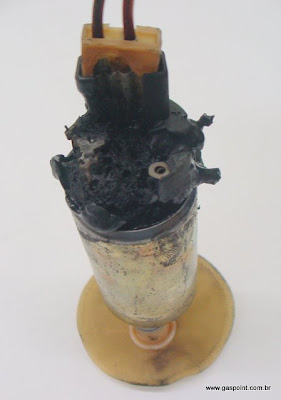
There were some natural gas kits sold that would not disable the fuel pump when you switched to gas. Some owners, when running out of gasoline, would switch to the gas. The fuel pump would keep running dry and melt. Something like this: http://2.bp.blogspot.com/_WafeVL7IZss/S5VP0fVNvuI/AAAAAAAAJP...
I would think its a little different since the infrastructure was already in place for gasoline. There isn't the same infrastructure nation-wide for electric vehicles.
I'd say it was significantly worse under gasoline. Then, if you ran out of gas, the car was bricked.
Tesla is saying that even if you drain your battery driving, it would still take 30 days of failing to charge it to brick it. While the infrastructure for just "filling up real quick" may not exist for electric cars, the infrastructure certainly exists at a person's home, otherwise, they wouldn't buy an electric car.
I think there would be a much more compelling case for this if electric cars were being mass-adopted, and the education for maintaining them was poor. Neither is the case here. Electric cars are still largely in the early adopters phase, and Tesla is telling people to not leave their car unplugged for months on end.
Running out of gas doesn't "brick" a car. You can either push or tow it to a gas station, or you can deliver more fuel to it, and it will continue working without missing a beat. Letting a Li-ion battery discharge completely damages the battery, which means you have to replace the entire battery, not just fill it back up. This is physics; Tesla can't change the laws of chemical reactions.
What about not keeping enough fresh oil? I believe keeping a minimum charge on an EV is analogous to the common knowledge of maintaining a gas-powered vehicle's oil. The problem is that people don't have experience with EVs.
I'm sure in the early days of gas-powered vehicles, plenty of engines seized up because people were unaware they had to change the oil and keep it at a certain level. And it certainly still happens on occasion.
Assumine new vehicles, doing nothing to a Tesla for ~30 days means $40k. Changing your oil 6 month later than the service schedule in most cases means inmeasurable (by owner) reduction in overall engine lifetime.
Sounds like you knew all along that the Tesla battery could be bricked by running out of charge? That would make you one of a very small minority.
The original story got play because it was a surprising, unknown, and frankly, sucks.
If all of my fuel-injected laptops had never been damaged when they ran out of fuel, I would be pretty shocked and disappointed when it was a problem with the Kugelfischer. Much like the Tesla owners this affected.
Tesla isn't a "cause" it's just a product. So whatever happens to Tesla one way or the other has a smaller influence on "the rise of EVs" than you can imagine. Mahalo.
I'm actually pretty surprised at how few people knew this about lithium batteries. I guess that goes to show how much protection is actually built into the devices, and how rarely it actually happens. This problem isn't fixable, but it happens very rarely and is easily avoided.
And even so, Tesla (and others like Nissan) has made available a warning system just in case, and all the blogger managed to do was to point out the privacy concerns with this solution.
So you agree, as we all do, that if you do what the "blogger starting an unfounded rumor" describes, then you will brick the car, as he claims will be the result. So you agree the blogger is telling the truth and the PR release from tesla is a lie, correct?
This is the second time[1] you have said precisely the same thing in response to a comment of mine in this thread. I don't care about whatever agenda you're trying to push; stop being so belligerent in your attempts to get me to say something completely orthogonal to my point.
Right. It's well-executed PR, but if you read carefully, you will note that if you have an older model, discharge it to 10-20% and leave it at the airport for 2-3 weeks, you might indeed end up with dead batteries. Which I think is entirely reasonable and something I would expect.
> Don't get me wrong, I'm still very enamored by Teslas, and I don't think that this is any different than the owner of a gas-powered car letting it run out of oil and seizing the engine
Unfortunately, that's exactly the issue: many uninformed people are getting people like you wrong simply because they lack perspective on the Tesla "bricking" issue. Electrical cars are a new technology and people don't have the perspective to shrug off serious but very unlikely problems.
This is why Tesla's post isn't simply "PR bullshit" -- it provides context for the discussion and perspective. As others have pointed out, perspective exists with ICE vehicles today: we know that there are potential bricking issues, but we keep perspective and shrug them off because we understand how unlikely they are.
It's fair to over-focus on the Tesla bricking issue, but it's more fair to place this discussion in a context: how likely is this problem to occur, and what can be done to prevent it, to spot it before it occurs.
> (which, no matter how loud they are, would be hard to hear from across the country, if you've left it in an airport parking lot).
Which is presumably why they're doing this:
> Starting with Roadster 2.0, owners can also elect for their car to contact Tesla headquarters once the state of charge falls below a specified level, and we can then contact the owner.
Probably easier to have one non-changeable email/phone number in the firmware than have to modify/update it for every person they sell the car to.
Plus, it means the company gets to have a personal connection to all of their users, and when you're talking about a $100k buy-in, that might be the sort of attention a lot of these owners are expecting.
The two-month period to reach 50% has nothing to do with the original poster's issues. He said that in unusual circumstances - driving it heavily, then not charging it for a short time - was sufficient to brick it. If it only takes two months for a 50% charge to drain, how long does it take a 10% charge to drain?
If it is PR mastery (not convinced) it's in the tone of the writing.
It reminds me of a notice of late payment I received from The Economist magazine some years back. It was so darn polite and diplomatic, I kept it in a shoebox ever since.
Now, whenever there's an outstanding payment issue with a client, I read the letter for inspiration.
> Nowhere in the release do they say that the battery can not be bricked by leaving it for a long period without a recharge.
I happen to have first-hand experience with a gas-powered Porsche that was left parked for so long (years), with no starts, that the engine eventually became effectively "bricked", and had to be written off. And I had to fork out 1000's of dollars on engine repair (attempts) to even reach the point of deciding it had to be written off. This is with a gas-powered engine, a traditional car. So there is precedent where a car owner can misuse and/or fail to maintain the vehicle properly per the manufacturer's guidelines, and it becomes bricked. This is not a new kind of problem introduced by Tesla.


Nowhere in the release does Tesla refute that owners have "bricked" their batteries. Nowhere in the release do they say that the battery can not be bricked by leaving it for a long period without a recharge. All they say is that it would take a period of weeks for a Tesla roadster to reach 0% charge, and that the Model S has battery disconnect technology that can extend this to several months. They also point out that the car will provide increasingly strenuous warnings to plug it in (which, no matter how loud they are, would be hard to hear from across the country, if you've left it in an airport parking lot).
If it were true that a Tesla battery pack couldn't be destroyed by letting it fully discharge, or that it had never happened, then they would have mentioned it in the release. In fact, they take the opposite tack, re-emphasizing near the top of the document that users should always plug the car in when parked.
Don't get me wrong, I'm still very enamored by Teslas, and I don't think that this is any different than the owner of a gas-powered car letting it run out of oil and seizing the engine -- it's neglect. If you don't get it by now, Tesla owners, you need to plug in your cars.