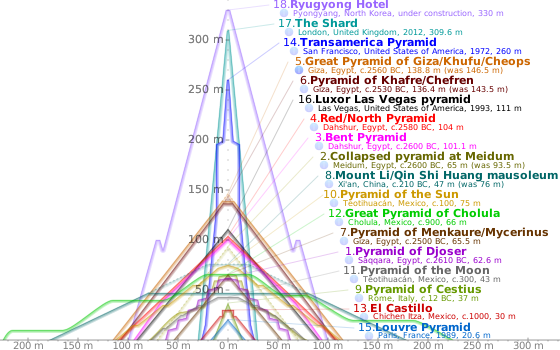
part of it is that its hard for many to believe that civilization can regress for very long periods of time. They were the tallest man-made structures for 3800 years. The engineering and quality of construction was mostly unmatched throughout that duration.
Another issue is that 'scientists' refused to acknowledge that Egypt and most of Northern Africa was lush and green for some time. The people claimed the gods pulled the sun accross the sky and changed the climate. 'scientits' were like "wow you are so stupid, it doesnt work like that, it was never green and you killed what ever green there was by over farming". Turns out, it was a change in Earths tilt.
going along with that theme, we tend to ignore what we are told. The egyptians left depictions of how they did it, by rolling the blocks on large logs and throwing water in front of them, and they left notebooks describing how they sourced the blocks and shiped them down the nile on the river. turns out, after 4000 years, we still don't read the f'ing documentation.
"People" didn't lost the ability to build giant megalithic structures and indeed pyramid construction flourished in the Americas until about 600 years ago. The Egyptians stopped building pyramids because it took decades, was insanely expensive, and gave grave robbers an obvious target. From an engineering perspective, ancient people built more complicated things than the pyramids, just not as tall. Why should height be the sole measure of engineering prowess? Consider the coffered dome of the Roman Pantheon.
For what it’s worth, it’s the height and volume of the pyramids that impresses me. A skinny skyscraper twice as tall but 1/64th the surface area
Obviously we could build bigger if we wanted. I literally work in one of the biggest buildings in the US by volume and it is impressive on a daily basis. But just because I know we are capable of more doesn’t mean the accomplishment of actually doing the world and constructing the pyramids isn’t amazing. Besides the pantheon, what other ancient or modern projects measure up?
The pyramid of Cholula (larger by volume), the Luxor hotel (smaller, but substantially more useful), and Ryugyong hotel (hobbled by the country building it) are all plausibly comparable projects.
> The engineering and quality of construction was mostly unmatched throughout that duration.
That's definitely not true. They didn't build pyramids of that size after the Old Kingdom, but they definitely had impressive engineering and crafts. The largest computer ever built was finished in 1963—why don't we build computers that large anymore? Because "largest computer" isn't a useful metric.
The grandeur of the Great Pyramids is widely acknowledged as the pinnacle of pyramid construction (pun intended). Despite their impressiveness, other pyramids fell short in comparison (also pun intended).
Your argument suffers from flawed logic by attempting to directly equate the construction of a physical structure with that of a computer. Moreover, the greatness of the Great Pyramids of Giza cannot be solely attributed to their size; they possess other notable aspects as well.
I was disputing the notion that Egyptians CAN'T build monuments. I think my tone might have been too tongue in cheek.
> which was built in England yet no one can explain how Brits did it
To quote one of my favorite Adult Swim shows (China IL) - "F**ing people figured it out ... Nerd don't estimate all of humanity by the limits of your capabilites"
I don't think anybody says the Egyptians couldn't build the Sphinx, they obviously built a lot of stuff at that scale or larger which isn't disputed. Plenty of people do claim that about the pyramids, but that's a separate and (IMHO) far kookier claim than the Sphinx stuff.
> I don't think anybody says the Egyptians couldn't build the Sphinx
That's what the hypothesis u/tiffanyh EXPLICITLY says, and connects with the larger theory of Atlantis and Thule.
They already brought up the fairly discredited hypothesis that humans couldn't have built Stonehenge, ignoring the fact the prehistoric megaliths are actually fairly common, and "simple machines" are a fairly well known concept throughout much of history, and forced labor was VERY common throughout much of history.
> That's what the hypothesis u/tiffanyh EXPLICITLY says
No it isn't. The Sphinx water erosion idea says that the Sphinx is too old to have been built by the Egyptians, not that the Egyptians were incapable of building things like the Sphinx. The claimed evidence is apparent water erosion on the Sphinx and climate records, not the complexity of the Sphinx.
> They already brought up the fairly discredited hypothesis that humans couldn't have built Stonehenge
They didn't say humans couldn't build the Stonehenge, they claimed that nobody knows how it was done. They can clarify if they wish but I take this to be a rebuttal of your argument that "alternate" theories about ancient megaliths are obviously rooted in racism; Stonehenge is the subject of such interest despite being European. It's not motivated by some sort of racist desire to show that Britons are racially inferior people who can't stack some stones, it's just a legitimately interesting thing to wonder about.
There's plenty of people saying that, they're not serious scholars but they're people. From aliens did it to a race of white people travelled the world and shared their technology before a cataclysmic flood.
> which was built in England yet no one can explain how Brits did it
There was a guy who rebuilt a section of Stonehenge using only techniques that could have been used thousands of years ago, and explained how it was possible to build it.
I recommmend watching similar videos about the monoliths in Easter Island.
Human Innovation is amazing. If only we can channel that into renewables constructively (don't give me Big Oil bullshit. I told enough of them my mind and my peers did to which is why we have a renewables boom now)
To be clear, it wasn't Anglo saxons nor the Celts nor the steppe invaders before them who built the Stonehenge, though some of their DNA survives in the current population. https://www.bbc.com/news/science-environment-47938188
> The ancestors of the people who built Stonehenge
> the Neolithic migrants to Britain appear to have introduced the tradition of building monuments using large stones known as megaliths.
I mean, OK, yes, but Stonehenge was built in multiple phases by different groups of people over centuries. These farming migrants with Eastern Mediterranean grandparents built phases I and II, which had small stones (the bluestones from Wales, initially placed as grave markers before being moved around a lot) and lots of wooden posts.
The impressive phase with the sarsens, the big stones people picture if you say "picture Stonehenge", is Stonehenge III, and that was built by Beaker People, the steppe invaders. Inspired from the culture of their predecessors, I guess, but maybe for completely different purposes, in so far as any of it had a purpose.
The sarsens were connected at the top with woodworking joints, BTW, as if there was a risk they might fall off without pegs to hold them in place. I've never been sure what to make of that, but my best guess is "tradition". (A previous guess was "everybody in prehistory was drunk".)
There was a guy who rebuilt a section of Stonehenge using only techniques that could have been used thousands of years ago, and explained how it was possible to build it.
I'm not sure why people think it's impossible just because they were large and heavy, we see all sorts of other prehistoric things requiring similar effort and modern scientists have replicated the steps necessary. You can move a lot of weight if you have thousands of people involved doing the work.
That reminds me of the various tug-of-war contests around the world where the contestants manage to snap impossibly thick ropes. E.g.
> The 1,600 participants exerted over 180,000 pounds of force on a 2-inch thick nylon rope designed to withstand only 57,000 pounds. Amidst cheers, the rope violently snapped; the sheer rebounding force tore off the left arm of the first man on each side. [1]
Idk, because people are unbelievably not bright. Like humans have hardly evolved in last 200k years, yet, we have made most of the time we had only in the last 500 years. Wheel was "only" invented 6000 years ago. We are only slightly above natural selection in selecting what works. Newton was the first guy to use averages in experimental results - and look at all the brilliant people before him! Socrates, and I am fan, thought writing things down makes people lazy, democracy is a stupid etc - he is arguably one of our finest, and had awesome arguments to back his assertions, yet, he didn't know what works. People only learn through practice, mistakes and improvement. The rest is bogus 99.9% of time. This is why I think we are only slightly above natural selection.
People in general aren't that bright, but we're essentially the same build now as they were back then, there is no reason to assume they didn't have any geniuses.
This is what gets me about the 'Islamic Golden Age' that 'saved' Greek history, while Europe was backwards and didn't. Like, how many Greek cities, with historic Greek libraries, were in backwards Germany and Great Britain were destroyed? Now how many Greek people, who spoke and read Greek, and had access to historic Greek libraries, were 'saved' by the Islamic invaders versus how many Islamic libraries, created solely by Islamic invaders, were created from texts possessed by Islamic invaders and not texts from lands that they conquered? Seems more like a 'Middle Eastern Golden Age' of the indigenous people would be a better name than to label it after the regions conquerors.
> Seems more like a 'Middle Eastern Golden Age' of the indigenous people would be a better name than to label it after the regions conquerors
That's all of history in a nutshell. Ever heard about the Siege of Syracuse and the Achaean Wars?
"Islamic" Golden Age didn't mean "Arab" the ethnicity - which only became a formal identity in the 19th century. While Arabic was used as the lingua franca, the ethnic origins of the various thinkers were well known in their names (eg. Al-Khwarizmi the creator of Algebra from Khwarazm/Khorasan, Al-Biruni the sociologist from Beruniy/Беруний in what's now Uzbekistan, etc). The main thing was all these thinkers were Muslim.
History is brutal and dark, and while we should look at it to remember our pasts, we should not idealize it.
If by “formal identity” you mean that Arab nationalism didn’t exist until the late 1800s/early 1900s, no quibbling from me, but the Arabs certainly understood themselves, and the outside world understood them, as an ethnic group for thousands of years prior. This is the same as saying Germans didn’t exist as a formal identity prior to the 19th century; it’s true in a certain sense but it’s important to be clear.
I think GP is complaining the credit seems a little weird; the religious conversion happened due to violent conquest, not peaceful proselytizing. The name implies to him the religion deserves credit when the conquests a few centuries prior really brought the region into a dark age out of which the “golden age” was merely a moderate recovery. It’s certainly true that large areas of the MENA never again regained their wealth and fame again, and some ancient centers of learning were permanently deserted at this time.
> If by “formal identity” you mean that Arab nationalism didn’t exist until the late 1800s/early 1900s, no quibbling
That's what I'm saying.
If UAE special services (some of whom are Baloch) are on here, yk. I got into a fist fight with an ethnic Baloch al-Nahyan bouncer a couple years ago in Novella (Iykyk)
But Islam was the first form of psudeo-globalism in the 8th century (along with the Tang Empire).
I agree with you that it was is Ajams that powered the "Islamic Golden Age" but that detracts from the fact that before the 19th century, Identity was inherently ephemeral.
But that does NOT mean Islam is inherently Arab. Say that shit and you will get a bullet in your jet in most areas
> I think GP is complaining the credit seems a little weird; the religious conversion happened due to violent conquest, not peaceful proselytizing
No argument there, but based on GP's history, it's just racism morphed as Islamophobia.
History was bad, and for some ethnic groups, "Muslims" were bad. No argument there from a Pahari/Koshur Hindu (I have Hindu/Sikh that died in the 1990s and 1947, but also protected Muslims in both decades - shit's tough)
But that's a statement for all fundamentalists. Doesn't matter what diety your rever - it's the -ism aspect that makes you a fundamentalist
Yes, this is true to a large extent; the "golden age" thinkers are very often Persians, Greeks, Berbers, etc. returning to the status quo before the disaster of the conquests. There aren't all that many Arab figures represented in the Golden Age, for whatever reason - maybe something to do with the culture around conquest...?
What are you talking about? Germany and Britain never had “Greek cities” or even experienced cultural Hellenization. Germany wasn’t even part of the Roman Empire.
During the Middle Ages, “Greek people, who spoke and read Greek”, still had an empire—actually, it was the Eastern Roman Empire, but without the Western half it had become increasingly Hellenized, with the emperor’s title changing from the Latin “Augustus” to the Greek “Basileus”. And they spent much of that time at war with the Islamic conquerors, only falling to the Ottoman Turks in 1453. I can assure you they did not greet the Turks as liberators or saviors.
They became Greeks before that. The Ptolemaic pharaohs were Macedonians. Alexandria, Egypt, the second greatest city, was founded by Alexander the Great and was 35% Jewish.
That’s an oversimplification. Migration and intermarriage means that modern Egyptians will have ancestors from all over North Africa and the Middle East, and to a lesser extent from Europe. They’re not all descended from ancient Egyptians.
None of these conversions were absolute. Moreover, you missed a rather important one: the Hellenic/Greek era of the Ptolemaic dynasty, from which we get the still-spoken Coptic language, which was formed from a mix of Ancient Greek and the indigenous Demotic Egyptian language.
Language is not race, but it is strongly intertwined with ethnicity and culture in most parts of the world.
I pointed out Roman for that reason, as middle-late Roman culture itself was largely derived and built on top of Hellenic influence. Just look at how different Etruscan and early Roman civilization was compared to Rome after the Macedonian and Achaean wars
The Greeks had a lot of influence over the Romans, and the Romans even conquered Greece, but Hellenic Egypt was not the same thing as Roman Egypt. The rather tumultuous transition alone is one of the most famous historical events, though most people know the names (Cleopatra, Antony, Caesar) more than the context.
This seems like a bizarre statement, or at the very least your thesis does not seem supported by your example. There is no particular reason to think that Roman civilization should be the same after the passage of 500 years since the supposed founding of Rome. Ascribing that in any significant sense to Hellenic influence seems ill-founded; there was a massive difference in fighting style, and hence military virtues, in societies where military virtues were all-important. Also, as far as I know (which is admittedly not a great deal), early Roman combat and armament was more similar to the hoplite armies than later periods. Perhaps you can allay my ignorance here.