I would rather be zapped with a 240v AC current vs 240v DC current.
AC power crosses the zero line twice per cycle while DC does not. AC has a lower ‘let-go’ threshold, but DC contracts your muscles and makes it harder to let go.
You are correct though, if you de-energize your panelboard and have a deadfront cover over the line side conductors and lugs, working inside a panelboard (or on electrical wiring) is safe.
DC interferes with your heart's rhythm much, much less though, due to being constant. AC's frequency easily causes ventricular fibrillations even at low currents and voltages. AC is considered potentially lethal starting at 50V. For DC it's 120V, because it's significantly easier on your heart.
It’s the amperage that kills you, not the voltage. 5000VAC at a 1.0 nano amps is not going to be something you can feel, not even as something like static electricity.
We're talking about proper sources here where the voltage doesn't disappear as soon as you start mildly conducting. So volts and amps will be proportional in this context.
I don’t buy that the volts and amps will always be proportional. In my experience, the volts are usually pretty fixed, depending on the circumstances. Like 120VAC in most homes in the U.S., but variable amps — 15, 20, 30, 50, 100, etc…. Or 240VAC in Europe and certain other places around the world.
And if you want to talk about power lines, then the neighborhood medium voltage lines are going to be roughly the same in most places within the same jurisdictions, and distinct from the true high voltage lines that are used for long distance transmissions.
You are not conductive enough to get anywhere near 10% of the circuit's capacity. Therefore, the supply might as well be an infinite amp supply. You, in any particular situation, act as a particular ohm resistor. The amps that flow through you from mains voltage or big solar arrays will be directly proportional to the volts.
If a 120V 15A supply puts 50mA through you, then a 120V 100A supply will also put 50mA through you.
A supply that's "5000VAC at a 1.0 nano amps" really means that it starts at 5000 volts but super rapidly drops to zero volts as it conducts. A household supply is going to have negligible voltage drop by the time it turns deadly.
Edit: The other way to put it is that 99.9% of supplies don't give you a certain number of volts and amps. They give you a certain number of volts and they have an amp limit. If you're not approaching the amp limit then the only thing that matters is the volts.
I get what you're saying, amps are pulled, not pushed. But you should consider ohms law. Hand to foot, with a dry hand, typically is 400ohms. You can pull a lot of amps through 400 ohms if the voltage is high enough
The focus here is the 30-750 volt range with tens of amps, with a secondary mention of neighborhood power lines. For injury purposes, we can treat all of these as having unlimited amps available. By the time there's enough kilowatts going through your body to notice the curve shifting, we're well past the point of wondering whether or not you die.
My point is that the number of amps you can get from the circuit is irrelevant, it's "more than enough" and that's all you need to know beyond the voltage and the exact way the human is being exposed.


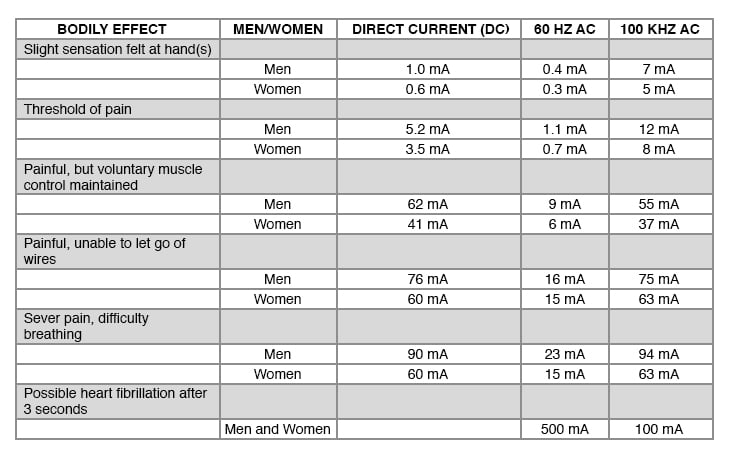
AC power crosses the zero line twice per cycle while DC does not. AC has a lower ‘let-go’ threshold, but DC contracts your muscles and makes it harder to let go.
You are correct though, if you de-energize your panelboard and have a deadfront cover over the line side conductors and lugs, working inside a panelboard (or on electrical wiring) is safe.