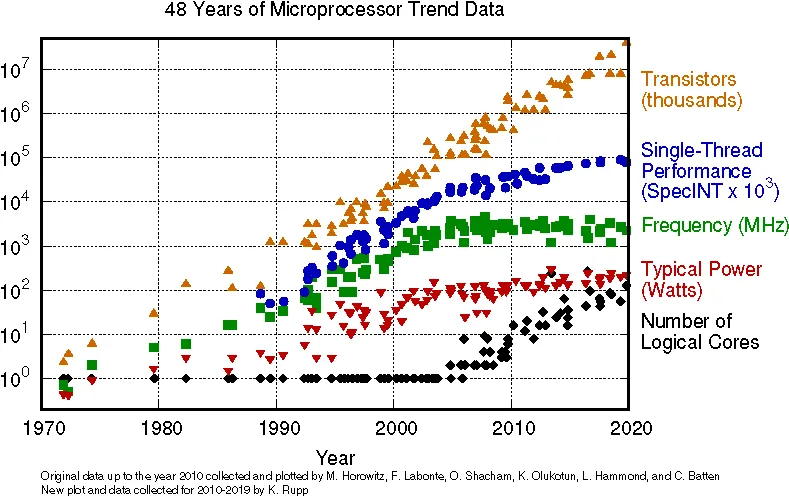
That's an interesting thought. However, it assumes that the problem scales with the number of transistors, i.e. O(N). I expect that the complexity of place and route algorithms is worse than O(N), which means the algorithms will fall behind as the number of transistors increases. (Technically, the algorithms are NP-complete so you're doomed, but what matters is the complexity of the heuristics.)
It's worse than that, isn't it? Not only are the algorithms presumably super linear, the transistor count has been increasing exponentially, but the compute power per transistor has been decreasing over time. See e.g. [1].
Although I suppose if the problem is embarrassingly parallel, the SpecINT x #cores curves might just about reach the #transistors curve.
yeah, that plots single-threaded performance, not total compute power. the point it's making is that now those transistors are going to parallelism rather than to single-threaded performance, and also the compute power per transistor stopped increasing around 02007 with the end of dennard scaling
your problem doesn't have to be ep to scale to 10² cores
i suspect it's true that compute power per transistor is dropping because thermal limits require dark silicon, but that plot doesn't show it