ATLAS was expanded in 2022, and this object was discovered by the new telescope in Chile - the more we look the more we find. With more survey telescopes coming online (Vera Rubin just recently, Nancy Grace Roman and Xuntian coming soon to name a few), I suspect we'll start seeing quite a few more of these.
Hopefully we humans get a mission ready to go that will allow to go and have a look when a suitable one turns up with enough notice. Presumably one that isn't nailing though quite so fast as 3I/ATLAS (ʻOumuamua and Borisov were about half the speed each - about 30km/s). Annoyingly the speeds mean that really all you can do is a very fast flyby, unless you are incredibly lucky with trajectories, the object moves very slowly or we can ship a truly massive amount of "rapid" (e.g. not ion engines if you want to catch it this side of the heliopause) delta-v to orbit.
The rocket equation is really not on our side here if we wanted use chemical means. If you have a specific impulse of 300 seconds, you basically cannot get a 100kg probe to 30km/s delta-v without a slingshot. 100 tonnes of fuel gets you to about 20km/s, 2000 tonnes gets you to 30km/s. And a craft that holds 2000 tonnes of fuel probably masses more than 100kg.
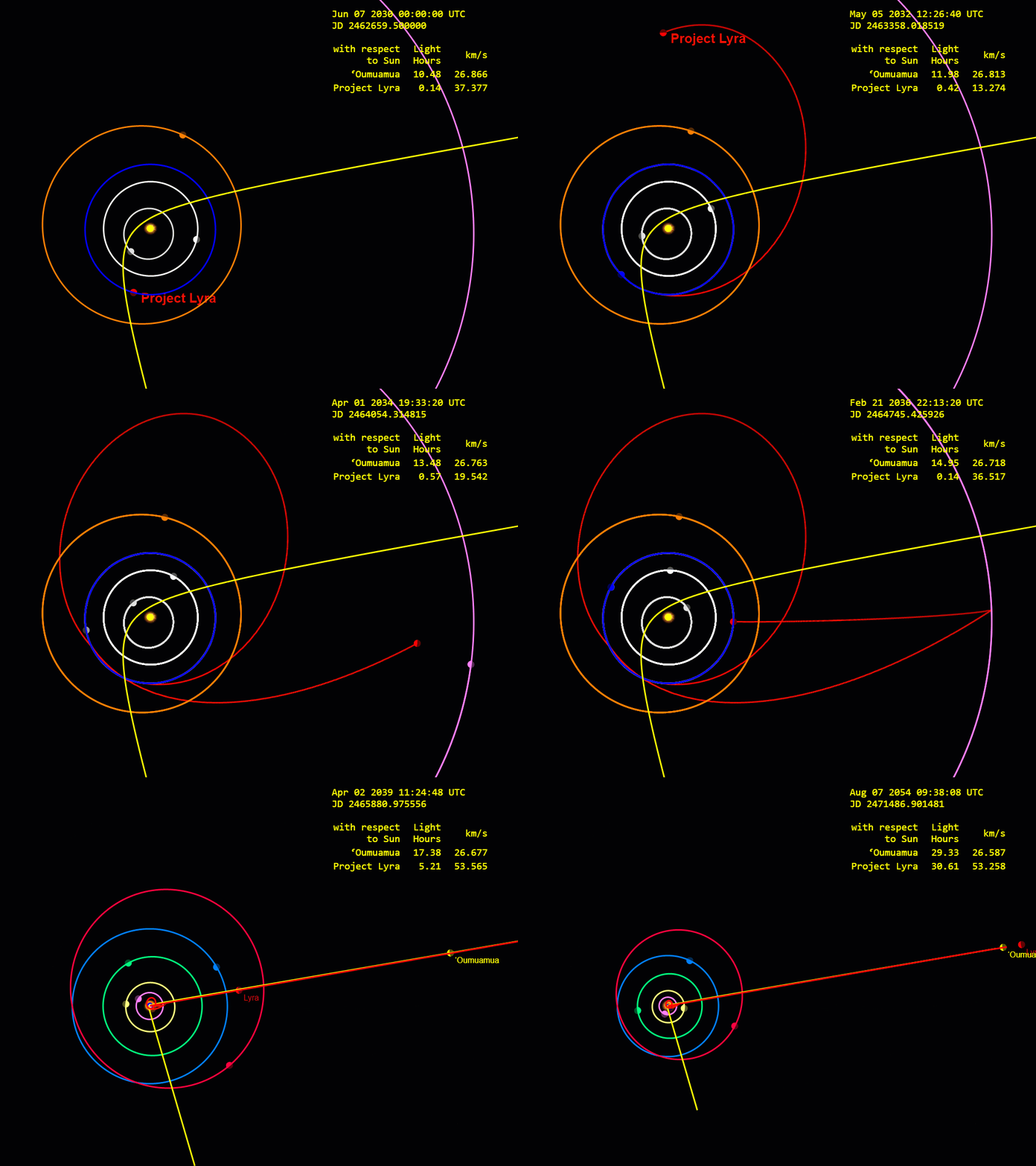
Maybe the better bet is a really good sunshield and then everyone works on their cardiac health so they can see the intercept in 30 year's time, and even then it's a blink-and-you-miss-it flyby at over 20km/s: http://orbitsimulator.com/BA/lyra.gif
> The rocket equation is really not on our side here if we wanted use chemical means. If you have a specific impulse of 300 seconds, you basically cannot get a 100kg probe to 30km/s delta-v without a slingshot
Using the Wikipedia example of a 1km, 5600g superconducting rail gun that launches at about 10km/s, we just need about a 10km gun to achieve 30km/s (length goes with launch speed squared).
Put it on the lunar surface for a roughly 2.5km/s penalty (I think, plus you obviously need to shoot it when the moon faces the right way).
No humans though, far too squishy. But you could launch a whole swarm of microprobes which could be a very effective distributed observation platform with a gigantic baseline.
If you haven't read it, the short story Maelstrom II by Arthur C. Clarke has a lunar rail gun in it. And the rest of the The Wind from the Sun collection is very good. The namesake solar sailing regatta story is great too.
> Using the Wikipedia example of a 1km, 5600g superconducting rail gun that launches at about 10km/s, we just need about a 10km gun to achieve 30km/s
That's a lot longer gun than I expected! Didn't the navy get to 6 km/s with a 5m barrel? That's a lot more than 5.6kg, of course.
> But you could launch a whole swarm of microprobes which could be a very effective distributed observation platform with a gigantic baseline.
For the beginning I'm going to assume each shot will end up vaporizing a significant fraction of the gun. Getting something to 30km/s once is certainly going to be much easier than doing it hundreds/thousands of times.


Since they are often small and dark, it's very possible we missed a few.