> There were unspoken rules, commandments passed down from teacher to student, year after year. The first commandment? Thou shalt begin with a proverb or a powerful opening statement. “Haste makes waste,” we would write, before launching into a tale about rushing to the market and forgetting the money. The second? Thou shalt demonstrate a wide vocabulary. You didn’t just ‘walk’; you ‘strode purposefully’, ‘trudged wearily’, or ‘ambled nonchalantly’. You didn’t just ‘see’ a thing; you ‘beheld a magnificent spectacle’. Our exercise books were filled with lists of these “wow words,” their synonyms and antonyms drilled into us like multiplication tables.
Well, this is very interesting, because I'm a native English speaker that studied writing in university, and the deeper I got into the world of literature, the further I was pushed towards simpler language and shorter sentences. It's all Hemingway now, and if I spot an adverb or, lord forbid, a "proceeded to," I feel the pain in my bones.
The way ChatGPT writes drives me insane. As for the author, clearly they're very good, but I prefer a much simpler style. I feel like the big boy SAT words should pop out of the page unaccompanied, just one per page at most.
Obsession with short sentences and generally pushing extreme simplicity of structure and word choice has been terrible for English prose. It’s not been terrible because most people aren’t aided by such guidance (most are) but because the same people who can’t be trusted to wield a quill without the bumper-lanes installed see a sentence longer than ten words, or a semicolon, or god forbid literate and appropriate nuanced and expressive word choice and dismiss it as bad. This stunts their growth as both readers and writers.
… though, yes, in average hands a “proceeded to”, and most of the quoted phrases, are garbage. Drilling the average student on trying to make their language superficially “smarter” is a comically bad idea, and is indeed the opposite of what almost all of them need.
> strode purposefully
My wife (a writer) has noticed that fanfic and (many, anyway—plus, I mean, big overlap between these two groups) romance authors loooove this in particular, for whatever reason. Everyone “strides” everywhere. No one can just fucking walk, ever, and it’s always “strode”. It’s a major tell for a certain flavor of amateur.
"He walked up to Helen and asked, 'What are you doing?'"
"He strode up to Helen and asked, 'What are you doing?'"
"He sidled up to Helen and asked, 'What are you doing?'"
"He tromped up to Helen and asked, 'What are you doing?'"
Each of those sentences conveys as slightly different action. You can almost imagine the person's face has a different expression in each version.
Yes, I hate it when amateurs just search/replace by thesaurus. But I think different words have different connotations, even if they mean roughly the same thing. Writing would be poorer if we only ever used "walk".
I know you know everything I'm about to write, but I read a lot of dubious quality fiction. It needs to be made clear that if the butler "strides" up to Helen, then I, the reader, am expecting him to eject her from the party, tell her that her car is on fire, or something equally dramatic. The writer can subvert this expectation, but must at least acknowledge that it exists. The butler can stride up to Helen with a self-important sniff and welcome her to the house, but he can't just stride up for no reason: the striding must be explained and it must be relevant to the rest of the story.
Conveying meaning is the whole problem here. An unexpected word choice is a neon sign saying "This is important!" and it disappoints the reader if it is not.
Between stride and walk, it seems like it would be unusual for any character in a romance novel to merely walk rather than stride. If anything the simple walk would need explanation.
Agreed. As always, it depends on what the author is trying to convey. At the first meeting, you probably do want to describe the walk in a way that reveals the character's inner motivation. Are they excited to walk up to the woman? Scared? Bored? They would walk differently depending on the feeling.
But a different scene might be better with the pedestrian "walk". Imagine that the main character enters the woman's office with an ostentatious bouquet of flowers. In that scene, maybe the emphasis is on the flowers or on the reaction of the woman or her co-workers. In the scene, a simple "he walked" might work best.
Very much agree. In the rush to "simplify" writing, we've stripped out a lot of the colour in the prose and made it boring. Sentences have a certain rhythm which becomes even more apparent when they're read out loudly or performed by someone with good vocal training.
I can see the appeal in, perhaps, technical writing but even there, I feel that there's room to make the prose more colourful.
The Hawaiian language has a concept called Kaona, which is essentially embedding deeper meanings in contextual word choices. It can go way beyond the literal meaning of the words, and tie into bigger concepts of culture, lineage, and places. It's super cool hearing about it from native speakers.
We don't really do it intentionally in English, at least to the same degree. But there's still a lot of information coded in our word and grammar choices.
Feel like this debate might be way different for novel writing vs every day writing.
I’m biased because I am not a very good writer, but I can see why in a book you might want to hint at how someone walked up to someone else to illustrate a point.
When writing articles to inform people, technical docs, or even just letters, don’t use big vocabulary to hint at ideas. Just spell it out literally.
Any other way of writing feels like you are trying to be fancy just for the sake of seeming smart.
Spelling it out literally is precisely what the GP is doing in each of the example sentences — literally saying what the subject is doing, and with the precision of choosing a single word better to convey not only the mere fact of bipedal locomotion, but also the WAY the person walked, with what pace, attitude, and feeling.
This carries MORE information about in the exact same amount of words. It is the most literal way to spell it out.
A big part of good writing is how to convey more meaning without more words.
Bad writing would be to add more clauses or sentences to say that our subject was confidently striding, conspiratorially sidling, or angrily tromping, and adding much more of those sentences and phrases soon gets tiresome for the reader. Better writing carries the heavier load in the same size sentence by using better word choice, metaphor, etc. (and doing it without going too far the other way and making the writing unintelligibly dense).
Think of "spelling it out literally" like the thousand-line IF statements, whereas good writing uses a more concise function to produce the desired output.
Those examples were simple, so it’s less of an issue, but if the words you use are so crazy that the reader has to read slower or has to stop to think about what you mean…then you aren’t making things more concise even if you are using less words.
For sure! Every author should know their audience and write for that audience.
An author's word choices can certainly fail to convey intended meaning, or convey it too slowly because they are too obscure or are a mismatch for the the intended audience — that is just falling off the other side of the good writing tightrope.
At technical paper is an example where the audience expects to see proper technical names and terms of art. Those terms will slow down a general reader who will be annoyed by the "jargon" but it would annoy every academic or professional if the "jargon" were edited out for less precise and more everyday words. And vice versa for the same topic published in a general interest magazine.
So, an important question is whether you are part of the intended audience.
I would not understand the last two sentences. Sidle? Tromp? I don't think I've seen these words enough times for them to register in my mind.
"Strode", I would probably understand after a few seconds of squeezing my brain. I mean, I sort of know "stride", but not as an action someone would take. Rather as the number of bytes a row of pixels takes in a pixel buffer. I would have to extrapolate what the original "daily English" equivalent must have been.
English is hard, even for native speakers. But it's also wonderful! English loves to steal words from other languages, and good writers love to choose the right word. It's like having an expansive wardrobe and picking just the right outfit for every event.
Bad writers, of course, pick a word to make them seem smarter (which, of course, often fails). That's what the OP was complaining about: using a fancy word just to impress.
But "stride" is not just a fancy version of "walk". When a person strides they are taking big steps; their head is held high, and they are confident in who they are and where they're going.
"Sidle" is the opposite. A person who sidles is timid and meek; they walk slowly, or maybe sideways, hoping that no one will notice them.
And "tromp," of course, sounds like something heavy and dour. A person who tromps stamps their feet with every step; you hear them coming. They are angry or maybe clumsy and graceless.
My best guess is they lean so hard on “strode” because they are trying to convey “this character is confident” and aren’t very good at it. So you’ll get like ten “strodes” in a short novel. Everyone’s “strode”ing into every room they enter.
Maneuvered, marched, slid over to, snuck up on/to, rolled on up to, ambled, thread his way through the crowd to, slithered, slunk. Pimp walked. Danced over to. Hopped over to. Sprinted! Jogged! Charged!
> Well, also he will notice in the course of time, as his reading goes on, that the difference between the almost right word and the right word is really a large matter—’tis the difference between the lightning-bug and the lightning.
But also:
> Unconsciously he accustoms himself to writing short sentences as a rule. At times he may indulge himself with a long one, but he will make sure that there are no folds in it, no vaguenesses, no parenthetical interruptions of its view as a whole.
Another annoying fact is that using a bit rarer words sometimes triggers weirdos into thinking you somehow want to brag or use that kind of language to "look smarter". Like a crab bucket for language.
The internet has been even worse. We tend to speak literally and simply. And I don't really know why that is. Perhaps it's because if there's something beyond the overt, it might go completely missed.
For instance Mark Twain is basically full of endless amazing quotes with lovely nuance, yet in contemporary times how many people would miss the meaning in a statement like "Prosperity is the best protector of principle"? I can already see people raging over his statement, taken at face value. Downvote the classist!
"Prosperity is the best protector of principle" taken out of context can be used in many ways, including by a rich person arguing that rich people have better morals, and poor people have worse ones, and that's why they're poor.
Whether one is trying to use it literally or ironically, it means the exact same thing. The only question is whether the speaker and the reader understand what it means. And in fact in this case there was no context at all in Twain's original usage - it was the epigraph for a chapter in this work. [1]
And that's what I mean in that modern writing, on the internet - though rapidly leaking into 'real life', has become highly infantilized where we assume everybody reading is an idiot, and speak accordingly which, in turn, infantilizes and 'idiotizes' our own speech, and simply makes it far more bland and less expressive.
Interestingly, this is not ubiquitous. In other cultures, including on the internet, there remains much more use of irony, and more general nuance in speech. I suspect a big part of the death of English fluency was driven by political correctness - zomg what if somebody interprets what I'm saying the wrong way!?!
Having read a fair amount of Faulkner, I have to respectfully disagree. Or, at least, point out that are diminishing returns to flowery, complex writing.
> Drilling the average student on trying to make their language superficially “smarter” is a comically bad idea, and is indeed the opposite of what almost all of them need.
I mean, it seems like it could work if you get to follow it up with a "de-education" step. Phase 1: force them to widen their vocabulary by using as much of it as possible. Phase 2: teach them which words are actually appropriate to use.
I consider myself fluent in English, I watch technical talks and casual youtubers on English daily, and this is the first time I encounter this word lol.
The only "stride" I know relates to the gap betweeb heterogeneous elements in a contiguous array
>
I consider myself fluent in English, I watch technical talks and casual youtubers on English daily, and this is the first time I encounter this word lol.
> The only "stride" I know relates to the gap betweeb heterogeneous elements in a contiguous array
I am also not a native English speaker, but I got to know the verb to "to stride" from The Lord of the Rings: Aragorn is originally introduced under the name "Strider":
"Aragorn is a fictional character and a protagonist in J. R. R. Tolkien's The Lord of the Rings. Aragorn is a Ranger of the North, first introduced with the name Strider and later revealed to be the heir of Isildur, an ancient King of Arnor and Gondor."
People don't discuss how people walk in daily conversation, so it's a word primarily encountered in literature, and more common in specific types of literature (like romance novels to describe how a man paces about with swagger).
Focus on short sentences and simplicity is an American trait. It is a bit different with UK English. As a native Portugese speaker, I spent my time before the US doing exactly the same as the author, I could write well structured prose by the time I was in 5th grade. I grew up with a dictionary. My mother would come back from work and ask me for the list of "difficult words". The expectation was that I spent time reading and would have found some new words, looked them up and now needed to sync with her to see if I got the correct meanings in the context where I found them.
Then I moved to the US and noticed that even the books were sort of written in a way that required no extra effort. The English I learned while playing RPGs (with no speech at the time) was enough to read most books from the library and a dictionary was only needed occasionally. And everyone basically just knew the same set of words, youth and adults alike. I also noticed that US English has a distinct tendency of making up new words that are simpler and more intuitive than the original expressions. It turns things into verbs. This is why people Google, Tweet and Vibe.
Then I went to an Engineering College, and it teaches us to distill everything into it's simpler fundamental components. I like it, and I now want people to be as direct as possible.
As a non native english speaker, I've always had to speak and write better than native speakers, and always had to tolerate the "You speak/write really well, where are you from?". Today they no longer ask, AI is their answer and they judge accordingly.
The article itself does an excellent job spelling out the background:
> This style has a history, of course, a history far older than the microchip: It is a direct linguistic descendant of the British Empire. The English we were taught was not the fluid, evolving language of modern-day London or California, filled with slang and convenient abbreviations. It was the Queen's English, the language of the colonial administrator, the missionary, the headmaster. It was the language of the Bible, of Shakespeare, of the law. It was a tool of power, and we were taught to wield it with precision. Mastering its formal cadences, its slightly archaic vocabulary, its rigid grammatical structures, was not just about passing an exam.
> It was a signal. It was proof that you were educated, that you were civilised, that you were ready to take your place in the order of things.
Much of writing style is not about conveying meaning but conveying the author's identity. And much of that is about matching the fashion of the group you want to be a member of.
Fashion tends to go through cycles because once the less prestigious group becomes sufficiently skilled at emulating the prestige style, the prestigious need a new fashion to distinguish themselves. And if the emulated style is ostentatious and flowery, then the new prestige style will be the opposite.
Aping Hemingway's writing style is in a lot of ways like $1,000 ripped jeans. It sort of says "I can look poor because I'm so rich I don't even have to bother trying to look rich."
(I agree, of course, that there is a lot to be said for clean, spare prose. But writing without adverbs doesn't mean one necessarily has the clarity of thought of Hemingway. For many, it's just the way you write so that everyone knows you got educated in a place that told you to write that way.)
Sometimes it's about matching the fashion of the group you aspire to be part of, sometimes it's about having that fashion imposed on you so you look "professional".
Security guards at tech company offices are the only ones who wear suits, presumably because it's a mandated uniform, not by choice.
Well there are two forms of writing, each serving a different purpose.
(1) writing to communicate ideas, in which case simpler is almost always better. There's something hypnotic about simple writing (e.g. Paul Graham's essays) where information just flows frictionlessly into your head.
(2) writing as a form of self-expression, in which case flowery and artistic prose is preferred.
Here's a good David Foster Wallace quote in his interview with Bryan Garner:
> "there’s a real difference between writing where you’re communicating to somebody, the same way I’m trying to communicate with you, versus writing that’s almost a well-structured diary entry where the point is [singing] “This is me, this is me!” and it’s going out into the world.
Rich vocabulary allows a lot of meaning to be packed into short, simple structures. The words themselves carry the subtleties. It might take three or four simple words to convey the meaning of one uncommon word.
Even when communicating ideas, there's a simplicity/nuance trade-off to be made.
I could say "Trump's unpredictable, seemingly irrational policy choices have alienated our allies, undermined trust in public institutions, and harmed the US economy"
Or I could "The economy sucks and it's Trump's fault because he's dumb and an asshole"
They both communicate the same broad idea - but which communicates it better? It depends on the audience.
> They both communicate the same broad idea - but which communicates it better? It depends on the audience.
Ugh. They say different things. The first describes the policy mechanisms and impacts. The second says nothing about those things; it describes your emotions.
The biggest communication problem I see now is people, especially on the Internet, including on HN, use the latter for the former purpose and say nothing.
I don't think they communicate the same broad idea at all. Making "unpredictable, seemingly irrational" choices is far from equivalent to being a dumb asshole. Your second version assumes the equivalence, which, hypothetically speaking, could provide a nice cover for purposeful malfeasance, could it not?
> I'd characterise Americans as less pretentious and more straight talking.
Various registers representing a huge proportion of US English we see and hear day-to-day are terrible. American “Business English” is notably bad, and is marked by this sort of fake-fancy language. The dialect our cops use is perhaps even worse, but at least most of us don’t have to read or hear it as much as the business variety.
> The dialect our cops use is perhaps even worse, but at least most of us don’t have to read or hear it as much as the business variety.
Ugh, and journalists often slip into cop dialect in their articles. It's disgustingly propagandic.
Notice that cops never kill or shoot someone, even in situations where they're blatantly in the wrong. It's always, "service weapon was discharged" or "subject was fired upon." Make sure to throw a couple "proceeded to's" in there for good measure.
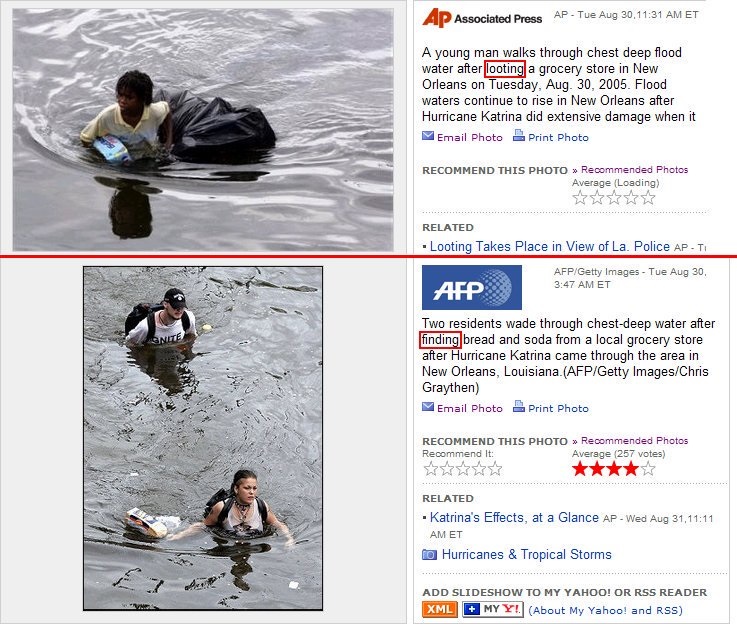
2005 Hurricane Katrina, news described a black man carrying bread through floodwater as "looting a grocery store" and white people carrying bread through floodwater as "finding bread and soda from a local grocery store".
someone starts using business english and my bullshit meter pegs.
my significant other loves the "real life mormon housewives" and "lovingly blind" reality shows, and when they use business english (a weird thing to do when talking about relationships, but hey, what do I know I'm an engineer) it's a tell that they're lying.
I think it has much more to do with porting the vernacular vs. formal register distinction common in other languages into english than how english people actually used to speak and write.
It's most likely that they are. As farfetched as this sounds, the CIA and the Iowa Writers' Workshop influenced American writing a great deal, encouraging writing to be taught in the "American" / Hemingway style.
> “the American MFA system, spearheaded by the infamous Iowa Writers’ Workshop” as a “content farm” first designed to optimize for “the spread of anti-Communist propaganda through highbrow literature.” Its algorithm: “More Hemingway, less Dos Passos.”
I worked at Amazon and we were taught exactly the opposite. Say what you want about the company, but the writing culture there is superb. I wish other large firms valued clarity and precision as much.
> Perhaps flowery language expands your ability to express yourself?
What you call "flowery" is actually "expressive". Different words, although related, convey subtle differences in meaning. That's what literature (especially poetry) is about.
I would add that our words define our world: a richer vocabulary leads to more articulated experiences.
So, writing "flowery" sentences can actually denote someone capable of conveying the rich gradient of experience into words. I consider it as a plus.
It's a pain to read your reply because it's wrong. The poster you're replying to correctly wrote the phrases and you are trying to malign his or her painstaking work by such a low effort reply without explaining exactly where he or she is wrong
>I'm a native English speaker that studied writing in university
I am a native english speaker who had to unlearn OP's writing style to pass my tertiary education. In particular I sat an english bridging course for non english speakers. I was often told off for "editorialising" and wasting space with useless descriptions.
I'm bilingual (so not fully native by most criteria) and I read enough classic English literature to actually use "proceeded" regularly, as well as multiple other more established means of conveying my intended meaning :)
I meant it more in the modern usage where it's either thrown in liberally when using cop-speak, or by tumbler/redditor type writers when they're trying to be funny.
"He then proceeded to" in these situations can basically always just be "he (verb)".
I also wonder if these unspoken rules were inherited from their more recent orality norms. Condensing an idea into a pithy, rhyming, statement w/ lots of colorful adjectives is a great way to preserve and transmit information w/o data loss in a pre-literate world.
GPT writing uses varied sentence lengths, deliberate rhythm, lots of full breaks, and few needless words. It also tends to read as if intended for a William Shatner performance. I don't think the annoying bits about GPT's writing are structural. It probably writes technically better than most of us do in our second drafts.
It certainly overuses some techniques which might be valid in smaller doses, like negation. Not negation with some clarifying point to it MASSIVE EM DASH but negation as a rhetorical trick to use fifteen words instead of five and add a veneer of profundity to something utterly banal. It doesn't just use it one time per paragraph, but three. These aren't particularly long or convoluted sentences; they just could easily convey the same thing with fewer words.
tbh I kind of prefer it that way: it's an AI wrote this flag. If a human can't write about their day without constructs like "Not a short commute, but a voyage from the suburbs to the heart of the city. I don't just casually pop in to the office; I travel to the hub of $company's development" they need to get better at writing too
Tangent: the thing I find most annoying about ChatGPT's use of em-dashes is that it never even uses them for the one thing they're best suited for. ChatGPT's em-dashes could almost always be replaced with a colon or a comma.
But the true non-redundant-syntax use of em-dashes in English prose, is in the embedding into a sentence of self-interruptive 'joiner' sub-sentences that can themselves bear punctuated sub-clauses. "X—or Y, maybe—but never Z" sorta sentences.
These things are spoken entirely differently than — and on the page, they read entirely differently to — regular parenthetical-bearing sentences.
No, seriously, compare/contrast: "these things are spoken entirely differently than (and on the page, they read entirely differently to) regular parenthetical-bearing sentences."
Different cadence; different pacing; possibly a different shade of meaning (insofar as the emotional state of the author/speaker is part of the conveyed message.)
But, for some reason, ChatGPT just never constructs these kinds of self-interruptive sentences. I'm not sure it even knows how.
Personally, I do not see the distinction here between the two sentences, but your last paragraph got me thinking: should we be using parenthetical, self-interruptive clauses? When we are speaking extemporaneously, we may need them, but when writing, could we rearrange things so they are not needed?
One reason I came up with for doing so is to acknowledge a caveat or answer a question that the author anticipates will enter a typical reader's mind at that point in the narrative.
If that is the case, then it seems to me that when an author does this, they are making use of their theory of mind, anticipating what the reader may be thinking as they read, and acknowledging that it will likely differ from what they, as the author, is thinking of (and knows about the topic) at that point.
If this makes any sense, then we might ask if at least a rudimentary theory of mind is needed to effectively use parenthetical clauses, or can it be faked through the rote application of empirically-learned style rules? LLMs have shown they can do the latter, but excessive use might be signalling a lack of understanding.
> These things are spoken entirely differently than — and on the page, they read entirely differently to — regular parenthetical-bearing sentences.
> No, seriously, compare/contrast: "these things are spoken entirely differently than (and on the page, they read entirely differently to) regular parenthetical-bearing sentences."
Those are spoken the same way, they read the same way, and they mean the same thing.
They do mean the same thing, but they have different moods. With the em-dashes it's self-interjection that foregrounds the detour, but with parentheses it's, well... parenthetical.
Aside: it's probably just style (maybe some style guides call for the way you did it), but using em-dashes for this purpose with whitespace on each side of them looks/feels wrong to me. Anyone know if that's regional or something?
Not universally. I disagree, they read differently to me, and I'd say them differently.
Parentheses to me always feel like the speaker switching to camera #3 while holding a hand up to their mouth conspiratorially.
Em dashes are same-camera with maybe some kind of gesticulation such as pointing or hands up, palms down, then palms up when terminating the emdash clause.
Is this maybe a thing like how only designers are aware of kerning? These read / sound very different to me, and to everyone I've brought up the subject with (who admittedly are in a certain bubble of people who either write professionally, or "do things" with their voices, or both.)
• The length of the verbal pause is different. (It's hard to quantify this, as it's relative to your speaking rate, which can fluctuate even within a sentence. But I can maybe describe it in terms of meter in poetry/songwriting: when allowed to, a parenthetical pause may be read to act as a one-syllable rest in the meter of a poem, often helpfully shifting the words in the parenthetical over to properly end-align a pair of rhyming [but otherwise misaligned] feet. An em-dash, on the other hand, acts as only a half-syllable rest; it therefore offsets the meter of the words in the subclause that follow, until the closing em-dash adds another half-syllable rest to set things right. This is in part why ChatGPT's favored sentences, consisting of "peer" clauses joined by a single em-dash, are somewhat grating to mentally read aloud; you end up "off" by a half-syllable after them, unless you can read ahead far enough to notice that there's no closing em-dash in the sentence, and so allow the em-dash-length pause to read as a semicolon-length pause instead.)
• The voicing of the last word before the opening parenthesis / first em-dash starts is different. (paren = slow down for last few words before the paren, then suddenly speed up, and override the word's normal tonal emphasis with a last-syllable-emphasized rising tone + de-voicing of vowels; em-dash = slow down and over-enunciate last few words before the em-dash, then read the last syllable before the em-dash louder with a overridden falling voiced tone)
• The speed at which, and vocal register with which, the aside / subclause is read is different. (parens = lowest register you can comfortably speak at, slightly quieter, slightly faster than you were delivering the toplevel sentence; em-dashes = delivery same speed or slower, first few syllables given overridden voiced emphasis with rising tone from low to normal, and last few syllables given overridden voiced emphasis with falling tone from normal to low)
• The voicing of the first words after the subclause ends is different. (closing paren = resume speaking precisely as if the parenthetical didn't happen; second em-dash = give a fast, flat-low nasally voiced performance of the first one or two syllables after the em-dash.)
To describe the overall effect of these tweaks:
A parenthetical should be heard as if embedded into the sentence very deliberately, but delivered as an aside / tangent, smaller and off-to-the-side, almost an "inlined footnote", trying to not distract from the point, nor to "blow the listener's stack" by losing the thread of the toplevel point in considering it.
An em-dash-enclosed interruptive subclause should read like the speaker has realized at the last moment that they have two related points to make; that they are seemingly proceeding, after a stutter, to finish the sentence with the subclause; but that they are then "backing up" and finishing the same sentence again with the toplevel clause. The verbalization should be able to be visualized as the outer sentence being "squashed in" to "make room" for the interruptive subclause; and the interruptive subclause "squashing at the edges" [tonally up or down, though usually down] to indicate its own "squeezed in" beginning and end edges.
Note that this isn't subjective/anecdotal descriptions from how I speak myself. These are actually my attempt to distill vocal coaching guidelines I've learned for:
• live sight-reading of teleprompter lines containing these elements, as a TV show host / news anchor
• default-assumed directorial expectations for lines containing elements like these, when giving screenplay readings as a [voice] actor (before any directorial "notes" come into play)
I'm not a native speaker, I don't do work with my voice, and my English writing is confined to work – almost always with other ESLs – and short comments on the Internet; but what you write feels correct.
I mean, it's usually wrong in its rhetoric, and the writing isn't "good", but it's technically well constructed and it's well constructed in a way that "Hemingway" doesn't reject.
Like, if I ask GPT5 to convert 75f to celsius, it will say "OK, here's the tight answer. No fluff. Just the actual result you need to know." and then in a new graf say "It's 23.8c." (or whatever).
It already bugs me when ChatGPT describes how it is going to answer before answering, but it's 10x more annoying when I'm asking for a concise response without filler etc.
As an aside, I've noticed the self-description happens even more often when extended thinking mode is being used. My unverified intuition is that it references my custom instructions and memory more than once during the thinking process, as it then seems more primed than usual to mimic vocabulary from any saved text like that.
Right, it is currently incapable of providing a straight answer without clearing it's throat selling the answer. It reminds me of those recipe blogs that just can't get to the fucking recipe. It's bad writing! But it's not bad technically, in a style-guide kind of way.
Sometimes I wonder if the throat-clearing is an indispensable part of getting to the "good bits" that follow. Like, do those extra tokens give it more "room to think" even if they're basically meaningless in themselves?
The output tokens are the only information that is carried forward through each inference pass, so "more room to think" is incompatible with "basically meaningless". Perhaps one could imagine it somehow stenographically encoding information in its precise choice of meaningless throat clearing, but there are only so many variations on that theme - word choice is heavily constrained, so it doesn't feel like you could store a whole lot of information there without it starting to read froopiliciously.
I thought PP was saying that the "Thinking" text is only used for one turn, and the response text is the compressed thinking that survives into future turns.
> [...] I'm a native English speaker that studied writing in university [...]
As a native English speaker who studied writing at university, do you think "who" should be used with people while "that" should only be used with things or the other way round. Or should I just not care?
I think you might intend to compare 'that' and 'which'? Common advice is to use 'that' with people and 'which' with objects, though that isn't necessarily followed and omits many nuances.
Use 'who' with people especially, often with other living beings ('my dog, who runs away daily, always is home for dinner') or groups of them ('the NY Yankees, who won the championship that year, were my favorite'), but never with objects unless pretending they live ('my stuffed bear, who sleeps in my bed, wakes me every morning').
If you care about these things, the Chicago Manual of Style is a large, technical, highly respected guide aimed at publishing. Fowler's Modern English Usage is more focused on usage. A short and beloved guide is The Elements of Style by Strunk & White. You can find all on the Internet Archive, I'm almost certain.
Some don't like it and many do, and it's been assigned for decades. Just a few years ago I looked at a website that collects college syllabi and it was one of the most assigned books.
It gives clear, practical advice in a very accessible style and format. If you have any comparable substitutes, I'm all ears.
Thanks. Is that true only for American English or other areas too? I've only noticed this the last couple of years on HN. Before that "who" and "that" were used more carefully. Or at least I had the feeling it was. Sometimes I wondered if it's just whatever people's autocomplete happens to spit out first.
It's true for all of English, even historically. Ignore the grammar police. The differentiation between "who" and "that" in this particular context is extremely low on the list of things you'll ever need to worry about.
Genuine question, what would you write instead of "proceeded to"? To me, as a non native English speaker, it seems reasonable to use this expression, and it would not even stick out to me tbh
I didn't claim that this was exclusively American. Though I'd have to admit that one doesn't have to be American to adopt Ameracanisms: rhotic Rs, Netflix color-grading, and copy-cat political movements are other American cultural artifacts showing up across the world due to America's dominance of the zeitgeist.
Rap verses in pop songs wasn't a spontaneously phenomenon across the globe, the origins are tracably American - but that doesn't make all rappers American.
"Went" is a powerful word. With suitable helpers it can replace "proceeded", as you demonstrated, "attended" ("I went to a good school") as well as "became" ("On hearing this, Joe went all silent") or "said" ("So then she went 'Dude!' and we all laughed") and hundreds of other words.
Only a handful of words ("got", "y'know" and "fuck") rival its versatility.
Hemingway was still a master of word choice. I recall an entire class spent on a few lines that conveyed a sense of heaviness to the scene. 'Plodding' was given a lot of attention.
I remember a college English class where a good part of the lecture was on this sentence from Big Two-Hearted River: "He liked to open cans." Forget the details but it got into the difference between achievement and accomplishment.
> Well, this is very interesting, because I'm a native English speaker that studied writing in university, and the deeper I got into the world of literature, the further I was pushed towards simpler language and shorter sentences. It's all Hemingway now, and if I spot an adverb or, lord forbid, a "proceeded to," I feel the pain in my bones.
I'm the complete opposite. Hemingway ruined writing styles (and I have a pet theory that his, and Plain English, short sentences also helped reduce literacy in the long run in a similar way TikTok ruins attention spans). I'm a 19th century reader at heart. Give me Melville, Eliot, Hawthorne, though keep your Dickens.
I entirely bounced off Dickens in high school, but over a decade later read and loved Oliver Twist.
I tend to struggle with art when I can’t tell whether it’s supposed to be funny, but I’m finding it funny (I’ve been very slow to warm up to hip-hop for this reason, and metal remains inaccessible to me because of it). Something clicked on that second approach and I just got that yes, it’s pretty much all supposed to be funny, down to every word, even when it seems serious—until, perhaps, he blind-sides you with something actually deeply affecting and human (I think about the fire-fighting sequence from that book all the time).
Dickens is an all-dessert meal, except sometimes he sneaks a damn delicious steak right in the middle. Like, word-for-word, I’d say he leans harder into humor, by a long shot, than someone like Vonnegut, even. But almost all of it’s dead-pan, and some of it’s the sort of humor you get when someone who knows better does poorly on purpose, in calculated ways. If you ever think you’re laughing at him, not with… I reckon you’re probably wrong.
What’s perhaps most miraculous about this turn-around is that I usually don’t enjoy comedic novels, but once I figured Dickens out, he works for me.
(To your broader point—yeah, agreed that this sucks, good advice for bad writers becoming how most judge all writers has been harmful)
Very much the same; many a US writer's prose is terribly tedious, it comes across just as clinical as their HOA-approved suburban hellscapes. Somebody once told me a writer's job is also to expand language. It wasn't a US citizen.
> the deeper I got into the world of literature, the further I was pushed towards simpler language and shorter sentences
Language is like clothing.
Those with no taste - but enough money - will dress in gaudy ways to show off their wealth. The clothing is merely a vector for this purpose. They won’t use a piece of jewelry only if it contributes to the ensemble. Oh, no. They’ll drape themselves with gold chains and festoon their fingers with chunky diamond rings. Brand names will litter their clothing. The composition will lack intelligibility, cohesiveness, and proportion. It will be ugly.
By analogy, those with no taste - but enough vocabulary - will use words in flashy ways to show off their knowledge. Language is merely a vector for this purpose. They won’t use a word only if it contributes to the prose. Oh, no. They’ll drape their phrases with unnecessarily unusual terms and festoon their sentences with clumsy grammar. Obfuscation, rather than clarity, will define their writing. The composition will lack intelligibility, cohesiveness, and proportion. It will be ugly.
As you can see, the first difference is one of purpose: the vulgarian aims for the wrong thing.
You might also say that the vulgarian also lacks a kind of temperance in speech.
> Language is like clothing. Those with no taste - but enough money - will dress in gaudy ways to show off their wealth
You got the first bit right. Language and clothing accord to fashions.
What counts as gaudy versus grounded, discreet versus disrespectful—this turns on moving cultural values. And those at the top implicitly benefit from this drift, which lets us dismiss as gaudy someone wearing a classic hand-me-down who isn’t clued into a hoodie and jeans being the surfer’s English to Nairobi’s formality.
(Spiced food was held in high regard in ancient Rome and Medieval European courts. Until spices became plentiful. Then the focus shifted "to emphasize ingredients’ natural flavors" [1]. A similar shift happened as post-War America got rich. Canned plenty and fully-stocked pantries made way for farm-to-table freshness and simple seasonings. And now, we're swinging back towards fuller spice cabinets as a mark of global taste.)
I have two kids in high school. It's frustrating to me that the teachers spend so much of their time encouraging kids to make their writing more interesting, and less direct, and padded to meet word length criteria.
They'll then spend the first few years of their career unlearning this and attempting to write as directly and clearly as possible with as few words as possible.
This is like complaining that they teach the Bohr model in science classes until they reach chemistry.
The ideas, concepts and expectations can be refined after you've learned the foundational knowledge, skills and history required to do so.
A lot of "why do we do things like that" questions students will naturally have can be answered with "because we used to do things like this/we need to avoid things like this/etc"
I can’t guess how old they are but there is some sense in doing that if you think about it like math exercises. It makes for terrible prose but the only way to get the ability to write more complicated sentences is to practice writing them, even when they are not necessary.
The problem is that teachers stop pushing complexity for complexity’s sake way to late.


Well, this is very interesting, because I'm a native English speaker that studied writing in university, and the deeper I got into the world of literature, the further I was pushed towards simpler language and shorter sentences. It's all Hemingway now, and if I spot an adverb or, lord forbid, a "proceeded to," I feel the pain in my bones.
The way ChatGPT writes drives me insane. As for the author, clearly they're very good, but I prefer a much simpler style. I feel like the big boy SAT words should pop out of the page unaccompanied, just one per page at most.