If something can be said for Mr McConnell's methodology here, it's that he fully disclosed his assumptions, making it easy to identify the faulty one that sent his analysis hurtling 180 degrees in the wrong direction.
Why are you measuring the efficiency of energy sources in dollars, Mr McConnell? No, I don't mean to say Euros or Yen would have been better -- rather, that the reason you find yourself writing about the efficiency of energy sources in the first place is that their efficiency and availability has changed in recent decades and will change even more in decades to come, yes? Which will in turn affect how you and your readers think about your energy costs, correct? Ah.
But it will also affect how energy providers think about their energy costs, won't it? If one of those lines on your graph goes spiraling up or down, it will affect the other lines, won't it? And it won't affect them equally.
Solar panels can be as cheap as they want while oil is cheap. Will they still be cheap when oil is expensive? When the cost of transport for the many materials that go into their manufacture skyrockets?
There exists a better measure of energy efficiency than dollars per gigawatt. It's called gigawatts per gigawatt. Input-output ratio. By that measure, as everybody knows, oil kicks everything else's ass. Whereas solar power won't be even be net-positive until 2020 according to Popsci, which, adjusting for Popsci's track record on predictions, projects to around 2075-2100.
Yes, you read that title right. Only as of this month did new panels stop having a net-negative energy efficiency. If that's your idea of disruptive, well, I advise you to quit reheating your Domino's with hydrogen fuel cells.
Except you missed the point, which is that solar PV systems have been posting compounding gains in terms of power output per $ for 35 years. No other energy source I am aware of is becoming ~15% cheaper per year. I'll assume that most of the people here are familiar with compounding interest and its implications.
The point isn't that solar energy is disruptive today, it's that it will be in the not distant future. It's sort of like cellphone technology. It started out as a niche technology that hardly anybody used (even in San Francisco circa 2000, I know eons ago, people outside the tech industry didn't use them, now everyone has a smartphone).
I put my money where my mouth is on this, and retrofitted my pre-WWII home with solar some eight years ago. Even then, the amortized cost of the solar array was 50% less than what I paid to PGE for grid power, and I basically have a net zero electric bill.
Maintenance? A couple times a year I go up on the roof and hose the panels down to wash the dust and pollen off (no moving parts, etc). That and I make a point to double check that a meter reader hasn't flipped the safety cutoff switch. Other than that, I don't do a goddamn thing and my house generates about 75-80% of its power.
Gigawatts per gigawatt is a poor measure of energy efficiency because all forms of energy are not equal. Gasoline is a highly compact easily portable power source that also happens to fit into a lot of existing capital equipment, a gigawatt of "gasoline" power costs more than than same amount energy in the form of natural gas becausee it has a lower energy density and isn't not as easily portable. A process that used two gigawatts of coal or natural gas to displace one gigawatt of gasoline would be inefficent under your measure but make perfect economic sense.
We live in an economic world. Rational people are going to make choices about what type of energy they use based upon price. If one choice uses more gigawatts than another but is still cheaper people are going to chose it and it will be disruptive.
It isn't about the energy returns of panels finally hitting 1 (he actually puts it at about 10 for end to end systems). It is about comparing the growth of the solar panel manufacturing industry and the installed base and doing some analysis of that. One of the conclusions is that installed panels are currently providing more energy than is being used to manufacture new ones. The 2020 number is when all the energy ever used to make solar panels will have been paid back (the talk (and I imagine the paper) makes that claim too, not just PopSci).
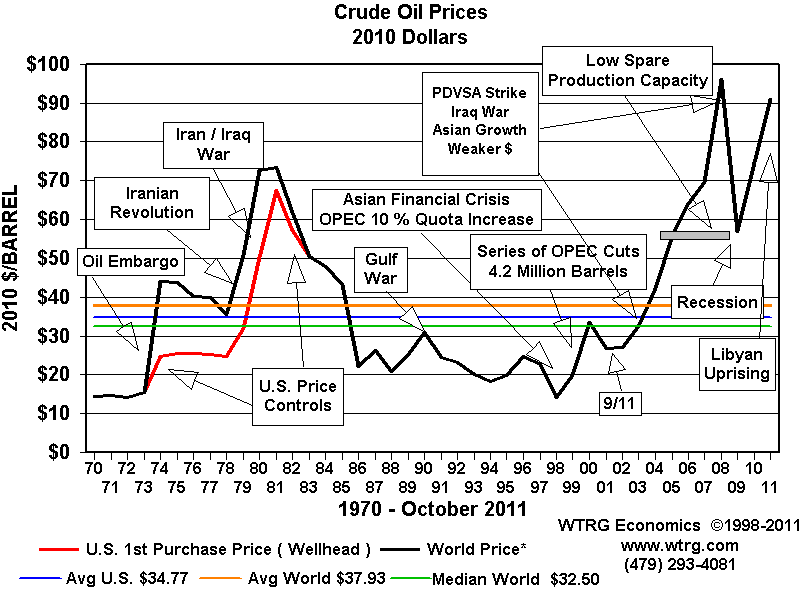
I don't understand why the oil price is so flat. Between the lower and higher point the difference is like one "mouse-cursor" in my computer. The graph is logarithmic, and the difference between the 200 and 300 marks is approximately one "mouse-cursor". So we have a 3/2 variation in the oil price.
I used annual averages from the EIA. This smooths out short term variations (I am looking at a 30-40 year trend). Also be sure whatever price history you're using is adjusted for inflation.
That said, even with short term price fluctuations, the decrease in solar energy costs (100:1) trumps the variation in conventional energy commodities (5:1). The point of the article is the long-term "moore's law" trend and how that will play out over the next 10-20 years.


Why are you measuring the efficiency of energy sources in dollars, Mr McConnell? No, I don't mean to say Euros or Yen would have been better -- rather, that the reason you find yourself writing about the efficiency of energy sources in the first place is that their efficiency and availability has changed in recent decades and will change even more in decades to come, yes? Which will in turn affect how you and your readers think about your energy costs, correct? Ah.
But it will also affect how energy providers think about their energy costs, won't it? If one of those lines on your graph goes spiraling up or down, it will affect the other lines, won't it? And it won't affect them equally.
Solar panels can be as cheap as they want while oil is cheap. Will they still be cheap when oil is expensive? When the cost of transport for the many materials that go into their manufacture skyrockets?
There exists a better measure of energy efficiency than dollars per gigawatt. It's called gigawatts per gigawatt. Input-output ratio. By that measure, as everybody knows, oil kicks everything else's ass. Whereas solar power won't be even be net-positive until 2020 according to Popsci, which, adjusting for Popsci's track record on predictions, projects to around 2075-2100.
http://www.popsci.com/science/article/2013-04/solar-panels-n...
Yes, you read that title right. Only as of this month did new panels stop having a net-negative energy efficiency. If that's your idea of disruptive, well, I advise you to quit reheating your Domino's with hydrogen fuel cells.