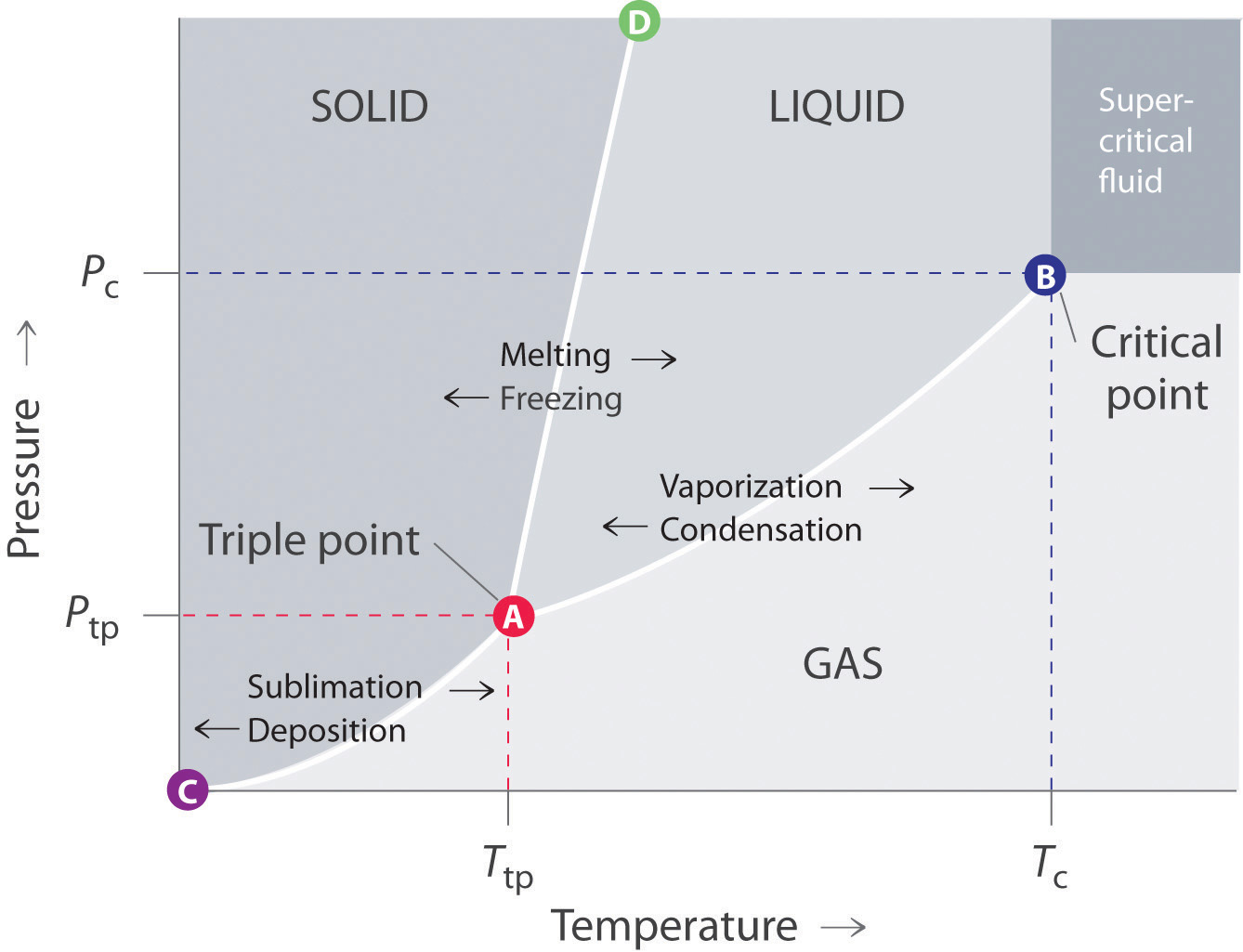
have a line that separates gas from liquid, but this line has a finite length. One endpoint is on the triple point (solid, liquid, gas coexist at one P,T) and the other is on the critical point. That's where the distinction between gas and liquid vanishes -- the viscosity, index of refraction, etc of one phase approach those of the other until differences vanish altogether at the critical point. It's a little arbitrary to say that steam at a given temperature or pressure is supercritical (there IS a rigorous definition, T>T_criticalpoint&&P>P_criticalpoint, I'm just saying that it's a bit arbitrary), but the gist of it is that you're in the part of the phase diagram where movement in the phase plane is going to avoid the gas/liquid transition. Nothing physical happens in a liquid->supercritical or supercritical->gas transition and there are no phase transitions in the supercritical region.
This is exploited for the production of aerogel. Normally you can't dry out a gel and have it retain its shape because the liquid/gas interface during evaporation/boiling has enough surface tension to tear apart the microstructure of the gel. But if you scoot around the liquid/gas transition in phase space (e.g. by heating past T_criticalpoint, lowering pressure below T_criticalpoint, cooling below T_criticalpoint, and finally releasing any lingering pressure, or in other words liquid->supercritical->gas) then you can get rid of the liquid without ever boiling/evaporating it -> no nasty surface tension to tear apart the microstructure!
Here is a video of CO2 being heated past the critical point. Since there is a gas-liquid equilibrium, the system will move more or less exactly along the curve separating gas from liquid until it "slips off the end" into the supercritical region:
Actually, according to (http://dx.doi.org/10.1063/PT.3.1796) the boundary between liquid/gas and supercritical fluid is inherently poorly defined, it's not a sharp boundary like the line of evaporation or fusion.
To be slightly more specific, it is not that it is poorly defined, it is that it doesn't exist. The boundary between liquid and gas is defined by a boundary at which it requires additional energy and an accompanying abrupt change in density to change between the states. In a supercritical state, there is no additional energy or change in density.
In other words, you can smoothly transition from "liquid" to "gas" without needing to boil. The two states are a single phase.
I'm guessing you were responding to an earlier version of my post where I kept mentioning that the liquid->supercritical and gas->supercritical boundary was poorly defined (in agreement with you) but then, in apparent contradiction to what I had just written, linked to a video of what happened at the transition, which I reconciled with my earlier claim of arbitrariness by emphasizing that the transition is well defined and physical you have a 2-phase system in equilibrium that you slide along the phase boundary until it "slips off."
That's still true. You can see the evidence in the video :)
But at every other point along the liquid->supercritical and gas->supercritical phase boundaries you are correct, the boundary is an arbitrary definition and not physical.
Warning: This is highly simplified and thus not exactly correct.
The temperature at which a substance freezes, melts, condenses, or boils is not fixed, but varies with pressure.
When a liquid crosses the "critical temperature" (at atmospheric pressure), it boils and becomes a gas with an obvious transition.
Less well known, when a liquid is subjected to pressure above the "critical pressure" (at a fixed temperature), it can actually become a compressible liquid.
The location on the graph where "critical temperature" and "critical pressure" meet is the "critical point" and that's where you can become supercritical. In that region, there is no difference between liquid and gas; there is no "boiling" or "condensing", because the substance effectively behaves like both at the same time. It has no surface tension, yet can dissolve things like a liquid solvent, but it can also diffuse through tiny holes like a gas.
Tiny variations in temperature or pressure can radically alter the density, allowing you to adjust for the exact behavior you want. Above the critical temperature, no amount of pressure can force the substance into liquid form, you can only solidify it. Some substances refuse to be made liquid or solid due to crazy critical temperature or pressure values required. Mixtures are another matter entirely, for example high pressure may force one component of a mixture to solidify and drop out of solution.
We think of matter as having "normal" properties because that's how it behaves at the earth's atmospheric pressure and temperature ranges but in reality the way we experience matter is just one of many different and just as crazy states.
To bring it back down to earth, the point of mentioning "supercritical steam" is that it means they can heat the water well above boiling by keeping it under high pressure. If they didn't, additional heat added to the water would just create more steam, not heat the water any further (and steam is vastly less efficient at absorbing heat than liquid water).
If you heat water under a high enough pressure, when you release the pressure it instantly becomes stream.
Normally, when you boil water the vapourisation happens piecemeal. That's why you see bubbles rising to the surface. For supercritically heated water, the vapourisation is a runaway chain reaction, triggered by a reduction in pressure, so the whole body of water flashes into stream.
---
Edit: added note about reduction in pressure being the trigger.
You can note in this diagram that what you are describing is true whether or not the system is supercritical, and can be seen in how water will boil into steam when the pressure is decreased from atmospheric as well.
What you are describing is how higher pressures allow you to add energy to the water while it remains liquid, and how if you add enough energy it will overcome the enthalpy of vaporization and cause it to convert to steam as the pressure is reduced.
As I understand it, a container of boiling water will have liquid in the bottom half and steam in the top half. As the pressure and temperature rise, the steam/water goes supercritial, meaning the water/steam boundary disappears and the whole container becomes a homogenous mush of supercritical fluid.
Am I right in thinking that this supercritical fluid can flash into steam faster than a combination of water and steam? My thinking is that for a water/steam combination to convert into steam, the water molecules have to take the time to break their bonds and separate into a gas. For a supercritical fluid it's faster because there are no bonds to be broken?
I'd be grateful if you can correct the above, as I can learn something here.
There aren't really formal bonds being broken transitioning from liquid to gas, but I suppose it is fair to say that the supercritical state will transition more quickly to steam than a subcritical liquid with enough energy to become steam at atmospheric pressure.
The reason for that would be that there is a nucleation process in forming gas from liquid, which does take some time. Or at least more than not needing to do so.
There is some terminology you're using that bothers me, like "flash into steam" isn't really a good way to describe it. At that point you'd be better off describing it as "super pressurized steam" converting to "normal pressure steam" or something. It's just expanding, but there is no flash (which to implies a sudden change). It's gradually and continuously decreasing in density.
I think part of this may be confusion over how we overload the word "water" to mean "liquid water" as well as "water the chemical". I am meaning "water the chemical" which can be a solid, liquid, or gas. Steam is water that is a gas.
With a supercritical system, you can take liquid water, stay in the liquid state until the water becomes supercritical (where the liquid and gas phases are indistinguishable), and then move across a boundary from "liquid like" to "gas like", go back into a sub-critical state as gas, and never formally boil/flash/etc.
Layman's - stuff like water it made of molecules, H2O in this case and the H has a positive charge and the O a negative charge (the electrons head over to the O atom due to quantum effects). These charges tend to make the molecules attract and stick together (the -ve are attracted to the + charges). The temperature of anything corresponds roughly to the kinetic energy of the bits of stuff it's made of. At 0K everything is still. At 373K (== 100C) the water molecules have enough energy at normal pressure for the molecules to fly apart and have your kettle boil. You can raise this temperature by putting the water in a pressure cooker to physically push the molecules back together - this works to about 120C in a normal pressure cooker. At some temperature however, no matter how much pressure you put on, the molecules do not stick to each other to form a liquid because they have too much kinetic energy and keep flying apart. This happens at around 647K in water. Above that the steam/liquid is called supercritical. This is important in power generation because you can squish it as hard as you like without worrying about it condensing.
Weird Chemistry happens at a certain temperature. At above a certain pressure (above 217.755 atmospheres) and above a certain temperature (705 Fahrenheit or 373 C), water is neither a liquid nor a gas.
Physicists have made special engines that operate on this "super-critical" fluid, that only works above this temperature / pressure combination. For the first time ever, a solar-panel has achieved this critical mass of temperature and pressure, allowing solar-energy (in very hot regions) to take advantage of the same technology that makes conventional fossil fuels so efficient.
The critical point is displayed on the phase diagrams on the triple point page. I linked to the Triple Point page because it might be more familiar, not to suggest it is the same thing as a critical point. Your link is probably better, though.
Replying because I don't think the explanations you've got so far are easy enough to read || accurate. Here's my understanding:
Supercritical steam is a special form of steam that can not be described as a gas or a liquid. It's somewhere between the two: molecules aren't bunched together in dense clusters that settle at the bottom of a container (as they are in a liquid), but they also aren't flying all over the place individually in a low density vapour (as they are in a gas).
How's that possible? Water molecules have relatively strong intermolecular attractive forces between neighbouring molecules. They like to stick together, even though there's no permanent connection between them. They are like mini-magnetised marbles. This explains why water has a much higher boiling point than most tri-atomic molecules.
When you increase the temperature of liquid water, the molecules in the liquid vibrate and move around within the liquid, and as you cross the boiling point, the vibration and movement of the molecules is so great that they are able to escape the pull of their attractive interactions with their neighbours en masse. When this happens, the molecules shoot off into the vapour, where there is an (almost) unlimited amount of space for them to shoot around in.
Now consider what happens when you do this at high pressure. High pressure essentially means that there are lots of molecules in the gas phase moving around really quickly. Now, when the temperature gets high enough that molecules have enough energy to overcome their attractive interactions with neighbouring molecules, they leave the pack: but this time with nowhere to go to. The pressure is so high in the 'gas' phase (i.e. there are so many other molecules up there) that they are forced to just bump around where the liquid was but at extremely high speeds. This type of behaviour is pretty difficult to distinguish from the behaviour in the high pressure 'gas' -- in fact, after the system has time to equilibriate, they are exactly the same.
Clearly then, the transition from 'liquid' to 'gas' at this point is pretty much indistinguishable. The liquid may begin to display the molecular kinetic behaviour of a gas, but the density stays the same.
The end result is: When the pressure and temperature is high enough, to onlookers it appears as if the entirety of the fluid is half way between a liquid and a gas, and is stable in that state. That's called a supercritical fluid.
A straightforward way to distinguish between liquids and gasses is their density. Liquid water is a high density fluid and steam is low density fluid.
There is line on the phase diagram that separates the liquid field from the vapour field. On that line is the only place on the diagram where liquid and vapour can coexist, i.e. where boiling can occur. It happens to be the case that the surface of the earth is in the liquid field, but within vicinity of that line, so if you heat some water up, you can watch it boil. However, at ~250°C, you need to be at a pressure of ~4 MPa to observe boiling. At those conditions the density of the liquid will be ~0.8 g/cc and the vapour ~0.2 g/cc.
The liquid-vapour phase boundary (the boiling curve) terminates at the critical point (647 K and 22.064 MPa). Above the critical point H2O is supercritical. On inspection of the phase diagram we see isochores radiating out from the critical point. Above the critical point the density of water can vary smoothly as a function of P and T, and there is no boiling, condensation, etc.
I don't know anything about power generation, but presumably when you can maintain temperatures higher than the T of the critical point, you don't have to worry about losing energy to phase changes.
Well... yes technically anytime you have hotter steam its more efficient.
A big gain is your stereotypical turbine blade doesn't like condensing conditions. Supercritical can't condense by definition, so its inherently good. Water droplets literally wear away the blade. Kinda sucks. They're expensive. So those expensive little things last longer if superheated steam is used. Its not so much that you can't make a condensing turbine, its that a condensing turbine will be less financially / economically efficient, its going to have to be much bigger and stronger for a given power output. Also the flow of steam is very predictable and constant, but once you start condensing no one really knows how it'll put vibration loads on, which can break the blades and wear out the bearings. Its false economy to use saturated or "wet" steam in a turbine to save money, usually.
You can add a reheat stage to the middle of a turbine to prevent condensation. Of course that costs money and maint labor and energy. You can see the appeal of just using higher quality steam and avoiding all that. Sometimes you just have to eat the losses. Especially with nukes, they have relatively wet steam, well compared to coal plants anyway.
Note that what some people call a condensing turbine doesn't involve condensation in the blades, at least not intentionally LOL. Its just a turbine with a huge condenser on the output instead of using a small condenser with an intermediate stage of process heat. Process heat is like, here's cruddy wet steam, but its hot, so how about using it in the office radiators, or to help heat preheat cooking ovens or something. Its hot by human standards but by power generation standards its only lukewarm and no longer economically useful to generate electricity. Its useless on the turbine floor, but perhaps a neighboring bread bakery would pay real money for it.