While I tend not to be too impressed by UK politicians I'm quite proud that the government is able to say to Scotland, OK have a vote and go independent or not. So many of the world problems seem to have been caused by governments taking the opposite view and saying it's mine all mine. See Ukraine and about 1000+ other examples.
Not Ukraine. Crimea could have conceivably voted to leave, if they were given a fair vote -- they were not. As for Eastern Ukraine, there is far smaller Russian support there and any talks of federalization or referendums is an attempt by the Russian side to repeat the Crimean takeover. The only referendum Russians will allow is another "occupendum", and if Ukraine tried hosting a fair one, Russia would do anything to undermine it, discredit the results and then invade anyways. Russia's goal is to destabilize the country, best course of action is to stand firmly in union, not play Russian games, which everyone seems to lose.
Cremea voted to be independent of Ukraine in 1991, it was invaded by Ukrainian forces during the referendum and after. I't just that Russia had it's own problems back then and didn't have the ability to deal with local conflicts.
http://en.wikipedia.org/wiki/Crimean_sovereignty_referendum,...
Crimea was the most interesting since it actually had the legal structure in place for a secession and if a proper referendum had been held it would actually have been a close call.
What happened was not actually a proper referendum though; even Russia's own internal sources indicated an actual turnout of only about 35% which is nowhere near enough to qualify for the legal way of seceding from Ukraine.
The Forbes article isn't fair in that the polls indicated 55% in favor and a turnout of 30-50%, but it's to be expected that those that voted disproportionately voted in favor so the final tally of 22.5% voting in favor is probably not accurate.
It's also important to keep in mind that the current faux-referendum was not about independence but joining Russia. Independence would have gotten much more votes, also from the Tatar population.
What most people forget is that the Tatars were forcibly removed from Crimea in a mass deportation/genocide under Stalin and returned to Crimea, their original homeland, after the fall of the Soviet empire. They were understandably wary of accession to Russia, rightfully so since Russia almost immediately barred their main leader from (re-)entering Crimea, and would never have voted in favor of the referendum.
I doubt this is true. Russians are not accustomised to living in tiny independent states. This is a dream of a few national theorists, to peacefully split Russia into more manageable states with local transparent government, more responsible fiscal policy - but there's not much ground under this idea.
There is no "Crimean nation" to build a successful state on.
Sadly, most off-block small states won't know what to do with their independence and will be forced to side up with some larger state sooner or later.
And tatars are a minority. A significant minority which is at risk of civil war and ethnic cleansings in the suggested independent state. Which they may eventually even win, but I think they seen enough pain already.
I meant that independence, whether just greater autonomy or full independence, would have been able to capture the ethnic Ukrainian and Tatar vote in a way accession to Russia never could.
From what I understood Crimea was already very independent so it was already more a matter of degrees either way...
You're absolutely right though that independence would have meant becoming dependent on Russian influence in practice (which is what the world expected and why everyone was so shocked by the annexation.)
"independence, whether just greater autonomy or full independence, would have been able to capture the ethnic Ukrainian and Tatar vote"
Yes it's possible to vote for greater autonomy, but how to make sure it is granted? Crimea has already voted this greater autonomy in the 90s - and it was promptly ignored by Ukraine.
Regarding independence - why would Crimean Ukrainians vote for it? They are content being part of Ukraine.
Why would Tatars vote for independence of tiny state where they will still be a minority, maybe even the persecuted minority. Much safer bet is any stable large state.
Why would Russians vote for independence? They don't consider themself "Crimeans", rather they consider themself Russians.
"which is what the world expected and why everyone was so shocked by the annexation"
You see the problem right here. World expects independent puppet states to be created, because that's how it works in the modern world. But this arrangement will be harmful to actual people living in Crimea. And that's what matters here.
Also I should remind that the situation in Crimea (and the conflict in Ukraine too) is not purely ethnic; many ethnic Ukrainians are pro-Russian, and some Russians are pro-Ukraine.
It's not even ideological divide, rather different views on past and future history of the place.
I think we're pretty much on the exact same page, just using different interpretations of terminology.
I'm not that sure accession was better for Crimea though, since international tourism has all but dried up and after giving it a try this year Russians will be right back in Turkey next year... but that's just debating the finer points of punditry.
Maybe it wasn't. They will surely have to live thru several hard years, maybe even regret they ever did this. But now this accession has a point.
I don't think Crimea had much international tourism.
When I checked two years ago, Crimea didn't have single plane or train scheduled from Poland, for example. It had some connections to hubs like Frankfurt, but I doubt many non-ex-USSR people ever considered Crimea. As for Russians, they always were the bulk of visitors. In the summer, trains from Moscow to Crimea departed like every 20 minutes, and you could meet all kinds of Moscow friends on the streets.
This year, a lot of railway service were disrupted, understandably. I hope it returns once. I think that mainland Ukrainians will visit Crimea too once the situation stabilizes.
Ukraine is something of a mess but in principle both sides could treat the ethnically Russian eastern areas a bit like the UK treats Scotland, as semi independent and able to choose if they want to go fully independent or not. In practice both sides seem more set on trying to control the area militarily, unfortunately. Though Putin does seem to be moving that way.
The geopolitics in Ukraine are quite different though. Right now they're focusing two things:
a) maintaining control over as much territory as possible, given Russia's original goals [1] and the huge importance a land-bridge to Crimea has to Russia (imagine having to ship water, food and oil for 2.5mln people by sea.)
b) preventing a Georgia-style frozen conflict, which is Russia's preferred technique of destabilization lately.
It seems they have only just given up on b) but they're still working very hard on a).
Either way; I doubt there are many parallels with Scotland at this stage of the conflict.
What other option do they have though? They can't go spewing democracy across the rest of the world and then iron fist things back at home.
No. The only thing they could do (and are doing) is attempt to undermine and scare everyone out of it.
- "You don't even have a currency figured out!"
- "You are not getting to use the pound, no way!"
- "You are not getting into the EU either, we've checked and got the big wigs in the EU to say as much, publicly, as well."
- "... and there'll be no more commonwealth for you either!"
- "Your north sea oil wells are drying up, you'll all be starving to death in a decade. The horror!"
- "It's a big world and you'll be in it on your own. Be afraid!"
...etc.
*PS. The above quotes are a summation of actual quotes made by the opposition.
Both sides have talked up their own side and down the other.
The Yes side have sidestepped questions where they dont have answers or provided partial answers or over simplified things to make the yes decision seem like the better decision.
Anyone voting on this issue should read this book:
90 page PDF explaining both sides of the biggest questions, providing the Yes and No side and then an analysis by independent experts.
Even if you are not voting it is a worthwhile read. I am not eligible to vote as i dont live in Scotland but this give me a much better understanding of the issues at hand. Personally i would like to see a Yes vote, partially because it will be interesting to see how it all pans out, but also because there is a genuine feeling in Scotland that they may be able to make a difference to the lives of residents of Scotland, who lets be fair, are usually at the bottom of the pile in terms of health, employment, life expectancy etc.
Your last sentence is what it's all about. If Scots have worse health, employment and life prospectives, then it's clear that the union isn't working for them. Why shouldn't they vote to leave?
These stats may not improve in an independent Scotland, but it's clear that given our history, it's unlikely things will improve in the union and actually, I'm pretty sure the feeling is the devolved government has been doing a better job since the SNP won power.
Apparently, polls suggest those who are educated are more likely to vote yes. I guess it comes down to whether those who aren't are going to fall for the fear tactics of the "better together" campaign.
However it should be noted that health and life expectancy are related to one another, additionally the Scottish government has been in control of NHS spending in Scotland since 1999 and health and life expectancy have not improved in that time. Additionally Scotland have spent much more on the NHS (per person) than the rest of the UK, about £300 more, £1750 v £2150.
So if you are voting yes because of these issues you may want to look into them further. Of course if you just want to rationalise an emotional decision then people will assume what ever suits them I. E. London is to blame for ill health in Scotland.
I agree, it is an emotional decision but it's also not really fair to expect a change in life expectancy throughout 15 years of government, the majority of which was a lib/lab coalition.
As that article is looking at historic records from 1980 we would need to see the per decade breakdown to see if there was a marked increase since 1999,or roughly half way through the period they looked at. They have averaged it at about 2 years per decade but if we had better info we could determine if the greater benefit was post 1999 and whether it is a statistically significant difference or not, I. E. Life expectancy is usually always increasing but did it improve by a greater percentage under the SNP.
You'll get no debate with me there. Personally, I'd be suprised if the SNP had actually made the biggest dents in those stats, I don't believe they've been in power long enough to have done so.
I do hope that something like Alcohol minimum pricing[1] will have a positive effect in Scotland, time will tell. However, I very much believe we'd never get legislation like that without a Scottish Government serving the interests of the Scottish people[2], something I neither believe Westminster nor devolution with Scottish arms of UK parties in power would get us.
[1] I generally don't like such legislation, I very much believe in flat tax and letting people spend it on what they want, but Scotland sadly us have a cultural problem and I think the pragmatic view is it's worth doing.
[2] This is obviously just an example. It's hard to quantify a feeling, and that's not thet point. I'm just trying to describe how I feel, which is basically the rUK parties cultrually will bend to big business in an attempt to have the best economy possible, which I don't believe reflects Scottish values, nor common sense unless you're already rich.
I think willingness to permit a referendum is largely a function of how unlikely a Yes result seems (or seemed when the Edinburgh Agreement was signed).
In Spain, where a Yes result in Catalonia seems likely, there is opposition to a referendum. In the UK the opposite is true.
It's also a function of how much the rest of the country cares. In the UK the political classes care an awful lot more than everyone else.
One of the great confusions of separatist movements is they seem to always want to pull away from a host that needs to be seen to want them at all costs. The idea that the host may push them away or act indifferently is met with moral indignation.
I think the Westminster government had no choice. David Cameron was dithering about the decision to allow a vote on independence, and Alex Salmond just went and announced a date. What's Cameron going to do, forbid it?
Why forbid it when you can just ignore it? E.g. Spanish government said they wouldn't recognize results of a Catalonia independence vote. (Whether they actually would is another matter.)
That would symbolise everything the independence movement asserts about the arrogance of Westminster politicians and their alleged couldn't-give-a-damn attitude towards the Scots. Personally, I think there would be riots.
If there is a legally-held and popularly-supported vote in Scotland which decides in favour of independence, it would end badly if Westminster somehow decided to declare it null and void or just pretend it didn't happen.
All great, logical points. But that's not how governments usually operate when it comes to nationalist movements. Spain is fighting tooth-and-nail to prevent Catalan independence. Catalan independence has much greater support than Scottish independence, but the Spanish government is determined to stop it. It looks like the Spanish government will even try to punish them if they leave (doing their best to deny them EU membership and the like and probably not recognizing them as a country even if they have independence). By contrast (and despite some early posturing), the UK will want a Scotland that is well-integrated and will obviously recognize it.
But even the UK hasn't cared about popular sentiment for independence in the past. Look at the United States, Ireland, and India. But I think the UK has changed a lot and recognizes that it can get much of the same benefits without needing to rule over places. Frankly, it's a mature attitude to notice that you can succeed without force.
And it's that maturity that's going to make this a mostly good experience regardless of the result. If Scotland becomes independent, the UK will try to make it as easy as possible so that Scottish and other British people will barely notice a change. It's best for the UK if an independent Scotland has no barriers for their people and firms. Similarly, if Scotland remains in the UK, politicians seem to recognize the desire for even more devolved powers to the Scottish Government.
Normally, countries don't recognize a piece of their land becoming independent easily. Popular sentiment and even riots often don't deter countries from asserting dominance. Heck, sometimes countries even want to take over pieces of land that are currently independent where popular sentiment is 95%+ against being taken over. Yes, the UK government is doing the pragmatic thing where "it doesn't have any other choice". But loads of other countries are faced with the same issue and they're not facing it with that sort of logical pragmatism.
It will also set a good example of how it's possible to handle nationalist movements, particularly if Scotland becomes independent, and would give the UK and Scottish governments a lot of clout when mediating nationalist disputes in future.
An interesting aside on this is how Spain would treat an independent Scotland. They might decide to try and make an example of how miserable life could be for a region that becomes independent.
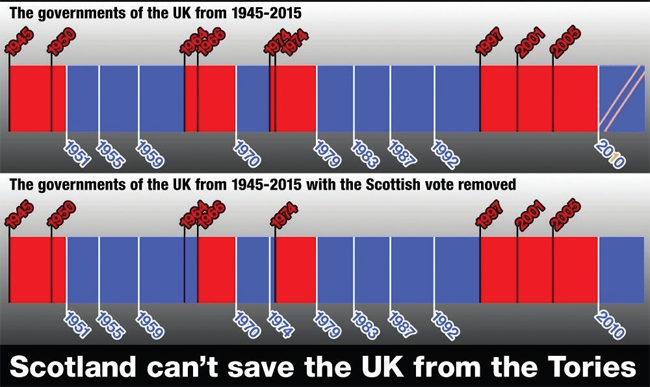
Here's some irony for you: the Tories, who are the people the "independence movement" is complaining about, would gleefully sign off on Scottish independence because it would give them complete and permanent dominance over the rest of the UK - without the Scottish MPs there is no possibility of any other party controlling the UK government. (Post-independence Scotland would likely have a very unhappy experience negotiating with a permanent Tory government)
LDs will back the outcome of the referendum whatever happens. Labour are the only party that might attempt to ignore the referendum because Scottish independence will end their existence.
> Labour are the only party that might attempt to ignore the referendum because Scottish independence will end their existence.
Labour would have gotten elected quite frequently discounting Scottish votes. This link has been posted further downstream by nmeofthestate but worth reposting here: http://theweebluebook.com/principles-and-politics.php
I hadn't really thought through the implications for the remainder of the UK, you've made some interesting points. In terms of international politics, I could see it diminishing Britain's status considerably.
Well, maybe, I guess by Britain you mean England, Wales and Northern Ireland?
My main concern is what does this mean for the position of Wales and NI in the union? I think that it will diminish Wales as an entity, and lord alone knows how it will play in NI.
I'm English, I think England will muddle along, a bit like a sort of very militant and eccentric version of Holland. No bad thing that...
> That would symbolise everything the independence movement asserts about the arrogance of Westminster politicians and their alleged couldn't-give-a-damn attitude towards the Scots.
What, any more than Maggie? I agree that it would be extremely unpopular in Scotland, but there's ways to spin independence referendum results for propaganda in the outside world. Claims of unclear/biased question, claims of voter eligibility "irregularities", claims of bad faith independence negotiations, etc.
If push comes to shove who's going to ostracize UK over 5 million people? U.S. wants HMNB Clyde to stay, big European countries will be afraid of UK leaving EU, and the UK doesn't listen to the rest anyhow.
If UK wants to hold onto Scotland against its will they will, but let's hope they don't.
They could have ignored it easily, Alex Salmond announcing it would be worthless without an agreement from the 3 main UK political parties to adhere to the outcome. They agreed and that was why Alex Salmond announced the referendum. He had to essentially get permission first. Probably worth reading this if you have a dog in the fight:
I think the whole thing has been impressive, but I think a lot of that comes from the fact that the Yes Scotland campaign isn't about hating English people or barricading themselves off and the Better Together campaign isn't about oppressing Scots and ruling over them. In a certain sense, the British-American sensibility about the world is that if you can trade freely with people, come and go as you please, etc. then that covers a lot of what you care about. An independent Scotland is about different local setup, not receding from the world. Similarly, even the No campaign recognizes that the UK isn't about imposing laws and policies on people that don't want them.
In the past (post-Empire, pre-EU), national borders have meant a lot. Your citizenship gave you a very limited area that you could live and work in. Today, if Scotland is separate, what is the downside? Europeans have the right to live and work in Europe. Keeping the pound, things would look much as they always have for Scots. Even things like consular representation wouldn't change rapidly: Europeans can already use the embassies and consulates of other EU countries if they don't have their own representation in a country. And for all of the posturing, I think that any rump-UK government would allow and, in fact, want an independent Scotland to be as close and integrated as possible.
In some ways, it feels like the world is trying to figure itself out. In the past, empires brought lands together. If you were part of a tiny country, you could be at a distinct disadvantage. Empires broke up for many reasons into a more fractured world. Today, I think we're trying to build institutions that allow for independence while getting the benefits of trade, freedom of movement, etc. For non-Scots, the question somewhat becomes, "does it make a difference to us whether Scotland is independent or not?" If one is English and will have the right to live, work, vote, etc. in Scotland, aren't those the same privileges you have now?
And ultimately this campaign, on both sides, has (seemingly unknowingly to anyone in it) laid some of tracks of what our future might look like (worldwide). I think the Yes campaign has been a rebuke of nationalism based on race and hatred, while showing that nationalism can still be relevant when it's based on governance and values. Similarly, the No campaign has recognized the importance of democratic governments not simply imposing themselves on people and the flexibility and changing landscape of modernity. No matter how the vote goes later this month, the UK should be really proud.
Unlike other nationalist movements, the UK-Scotland situation feels so modern, regardless of the result. They're almost to that point of asking themselves what it means to be a nation, in which ways are locations important to be independent and in which ways should they be integrated, and how do we best provide for happiness and prosperity in the modern world.
I'm a little concerned that Scotland might end up outside the EU against its will, regardless of whether or not they vote for independence.
If Scotland stays in the UK and the UK leaves the EU, Scotland is out as well. If Scotland becomes independent, the Spanish might block their EU membership to deter Catalan independence.
And similarly, whatever the result, Scotland can be proud to have pursued a peaceful approach, unlike the majority of both successful and unsuccessful independence movements in the past and in present times which have resorted to bloody terrorism and/or revolution. (No offence intended to a large number of the world's countries.)
At this point, methinks there is not the top-down passion for unity that would stop secession. If those wanting out are sufficiently unified and intend to impose a new order by sheer will (a la "consent of the governed"), the central gov't will not have the will to maintain/restore status quo thru force.
I actually expect some morning radio stations in the southwest USA will declare "it's time for Azltan's independence", millions will simultaneously just refuse to comply with existing sociopolitical infrastructure, and those in authority will simply have no idea what to do about it - or may even support it, given the developing tribalism. We'd lose about half the land of at least three states in the process. Individual states not having their own armed militia, they could not stop it (the "National Guard" troops of each state can, and would, be "called out" by the central gov't as a trump move for purposes to defuse their influence). Things would get very tense, but separation would ultimately be peaceful.
Texas has long been considered to have some ill-understood legal standing to ease secession (being the only state to volunteer for annexation as a former independent country), but I don't see that actually happening. It's akin to an oft-angry spouse who frequently threatens divorce but never actually will.
We have already fought a war because of that issue, we even added it to the pledge of allegiance. It's some what different in that England was an empire, they aren't giving up land but releasing it.
As an American, what I find truly fascinating is that they trust democracy with such a substantial issue. Can you imagine how things would be if we had a simple up/down vote on abortion or gay marriage or the war on terror?
Slight nitpick: the UK is a union not a remnant of the Empire. The leaders of Scotland at the time, partially due to a failed colonial expedition to Darien, agreed to the Union.
Edit: One interesting part of this story is that the Union was pretty much bought - the English bailed out Scotland and the institution that was created to handle the payments eventually evolved into the Royal Bank of Scotland (RBS).... famous for briefly being the largest bank in the world and one of the largest casualties of the recent financial crisis, requiring a vast bailout from UK taxpayers....
This referendum is not binding in any sense. The government in Westminster will make the decision, and it will not be made by the current government (there isn't enough time before the general election). If the next government is formed of different people, then under British sovereignty traditions it will feel no obligation to pay any attention to the referendum run by its predecessor.
In practical terms: if Labour gets into power in 2015 then Scottish independence will not happen regardless of the outcome of this referendum, because Scottish independence would eliminate Labour as a political force in the UK (Tories would win all UK elections, SNP would win all Scottish elections).
>If the next government is formed of different people, then under British sovereignty traditions it will feel no obligation to pay any attention to the referendum run by its predecessor.
That is incorrect, all 3 parties (not individuals within the parties) gave a promise to respect the outcome of the referendum. So even if a labour govt gets in at the next General Election they will respect the decision. The dificulty will come in negotiations for the exit, that will be impacted by the format of any new government, but the decision to allow independance will not.
"The government in Westminster will make the decision"
Sorry no - one way or another the people of Scotland will make the decision. Whether the government of the UK lives up to that decision is up to them, I honestly believe they would abide by what the people say.
I think it's inconceivable that the result of this referendum would be ignored. The loss of credibility would be corrosive to every commitment of the UK and successor states, but it would also destroy whichever political party attempted to make that decision.
If this would happen, I'm pretty sure some or other power-hungry fractions of the party would try to make a new party, so you'd again have two (or more) competing.
I would not be surprised by seeing a Tory split (into the nationalist and libertarian factions), but it would take years - there's a lot of money holding the two halves of their party together. I wouldn't like this outcome much though - it would mean Cameron was the representative of the "nicer party" in British politics.
A new party isn't necessary , Labour/Liberals would poach ambitious tory backbenchers by offering places in the shadow cabinet and UKIP would poach Euroskeptics. Most of these MPs could probably take their seats with them.
I can't see the Scots rushing out to vote labour if they reneged on the outcome of a referendum.
Labour would still be able to win elections in the UK without Scotland (in fact Blair would still have been PM without Scotland), At most some policies would change, or worst case another party rises as competition.
In the latest opinion poll from the most No-friendly pollster[1] 'Yes' is ahead in all age groups apart from the over 60s, where No is way ahead. If there is a No vote it seems likely to have been won by the old. This backs up the narrative from this article that Britishness is dying out in Scotland (of course, pensioners have also been frightened by scary stories about their pensions, and tend to be more small-c conservative, so it's not entirely an identity thing)
[1] YouGov. Different polling companies appear to have different systematic errors in their results, meaning that polls are spread fairly widely. This particular polling company has until recently been showing large leads for No. In their most recent poll the lead had been cut down to 6%, reflecting a feeling 'on the ground' that there's a genuine shift happening. Personally I am still totally unsure what result we'll get in two weeks (two weeks!)
Going to interject here. YouGov is pretty good with their predictions on political matters. It appears their panel is roughly aligned with the outcome which is a pretty powerful place to be.
Not suggestion that it isn't any more than hocum but it's quite easy to deduce this from the media and the pollster statistics (which is something that YouGov do).
The SNP probably brought in voting for 16 and 17 year olds on the basis that it might counter the strong 'No' vote in the 60+ group.
However, that group is fairly equally split (45% Yes/44% No). I reckon they underestimated how strongly popular culture, which is focused on London, influences the 16/17 age group.
"The SNP probably brought in voting for 16 and 17 year olds on the basis that it might counter the strong 'No' vote in the 60+ group."
Support for votes at 16 is long-standing. As is support for the same measure by most UK parties.
On the subject of 16-24s being 'equally split' - note the same could be said of other age-groups (apart from the more strongly No cohort old people), so 16-24s being the same doesn't say much for a resurgence of Britishness amongst the young.
Its a dangerous game though as young people are unpredictable. I'm trying to find a link to the source but I read recently that the far right Jorge Haider was elected in Austria in the first election after 16/17 year olds were given the vote and the youth vote was a strong factor in his success.
Edit: Whoops this was meant to reply to cstross below as a general point about unpredictable youth voting intentions not the intentions of Scots youth in particular.
Pensions of the old are guaranteed by the UK Government, there is very little for them to be afraid of in the event of a yes vote. It would be a shame if that were the reason for a No win.
I appreciate the politics may not impact many here, but I enjoyed the (by now fairly common, I suppose) design and the information being presented seems to me to be a good background to the current state of affairs.
> but I enjoyed the (by now fairly common, I suppose) design
The opposite for me, I had to use Clearly (restyling extension for easier reading) to remove all their distracting and annoying, erratically moving backgrounds (especially together with the semi transparent text background, if it was opaque at least).
The designed seemed so bad to me that I skipped reading it. I don't appreciate having to scroll down pages just to see the beginning of the body text. I don't understand the reason for the giant font either, which means that I have to scroll far too much.
It’s not just politics, though, but also a fair bit of history, economics to a degree and that whole fuzzy area of “what is a nation?”. I found it a very interesting read after stumbling over it from the deep sea ‘mushrooms’ article.
It's really exciting to follow this referendum, even if purely from a democratic perspective (out of the last 68 years, Scotland has voted Conservative for 6 years, but has had Conservative governments for 38 of those years). The No campaign has a difficult job, because it's not easy to sell the status quo - but they've essentially resorted to fearmongering, and it looks like people are starting to see the lack of substance. I think that theweebluebook.com presents the argument for independence quite well.
I'd say it's the opposite. Selling radical change is harder than selling the status quo. The Yes campaign has to prove Scotland "has what it takes" and dispel all the fears and uncertainty which comes from big change. All the No campaign has to do is convince enough people things are fine as they are.
What's truly amazing about this referendum is the engagement. It's projected to be an 80% turnout, with many, many people becoming involved in politics for the first time. There were queues to get registered to vote over the last few days. The level of awareness amongst the electorate is staggering compared to previous elections. It's an exciting time to live in Scotland; no matter the result, Scottish politics won't be the same again :)
From my perspective, it's very much the opposite. The Yes campaign are fearmongering - I've seen cinema adverts from them which essentially try to claim that staying in the UK would be the death of our children's future. "Think of the children" is the argument of people who have no other argument.
On the other hand, the No campaign are very open about the fact that they expect that Scotland can take more powers from the UK without becoming independent, which is a huge deal for those of us who consider ourselves British, and consider the UK to be our country which we have rights to.
It happens on both sides, but my feeling is that the No campaign is hard to outdo when it comes to spreading fear[1].
Fair point about "think of the children" - though I'd say that it happens on both sides[2]. Not that there's a lack of arguments for independence - again, the Wee Blue Book I linked to above presents them quite well!
Part of the problem there is in the nature of each sides campaign. The most common way to build an argument is to weigh up the pro's and con's, the upsides and downsides. The "Yes" campaign can promise the world on the upside, say that it'll all be amazing in the future, simply becuase nobody really knows what will happen.
Whereas the "No" campaign can only say the upside is it will be exactly the same as today, just the boring status quo. So they've been kinda forced into negative campaigning just by the nature of the decision to be made.
They could've tried some bribery perhaps, "Hey, we'll invest billions more in Scotland", but that would be really transparent on both sides and probably lose them more than they'd gain.
Yes. In the 13 general elections dating back to 1964, the Conservative party have been 2nd, 3rd or 4th in Scotland's vote share for the Westminster parliament. In the three elections since 2001, the Conservatives have finished 4th (in a 2-party system).
Yet 6 of those 13 general elections, including the most recent, have resulted in a Conservative Prime Minister.
>> out of the last 68 years, Scotland has voted Conservative 6 times, but has had Conservative governments for 38 of those years
Do you mean that Scotland has voted Conservative in 6 general elections? If so, with a maximum of 5 years between elections, they voted for a Conservative govt for up to 30years of those 38. That's quite a misleading way to represent that statistic isn't it?
On this page you can see graphical representation of Scottish and UK voting patterns, and how 'subtracting' Scottish votes would have affected UK results (in fact, very little):
I take issue with your use of the term very little.
Granted it didn't change the ruling party, however our system isn't just the ruling party there is also the consideration of the majority of the house.
From the linked source on your page [1] we see:
41 Labour MPs were sent to Westminster
11 Liberal Democrats
1 Conservative
From the overall election we know that there was a total of 646 MPs in Westminster [2]. So combine the (41 + 11) - 1 is a combined swing to a Conservative majority in the House of Commons. That's giving the Conservatives about an 8% greater majority.
Whilst Scotland didn't pick the Westminster parliament, they certainly had a hand in providing opposition to any Conservative government.
In both the unit is years. However, the figure of 6 is incorrect as I assume it refers to the fact that in 1951 the Conservatives (at the time the Unionist and National Liberal and Conservative parties in Scotland) got the same number of seats as Labour in Scotland. If we count this, the correct figure is 8 of 68 years.
Sorry, I phrased that wrong. I meant that they've voted Tory in one (and a half) election, so 6 years - like nmeofthestate wrote, there's a good image on the website linked.
It's even more interesting than you think. The Conservative Party do much better under Scotland's system of proportional representation than in Westminster.
It seems right that the Conservative Party should have representation in Scotland's politics, but it seems wrong that Scotland is ruled by them.
The disproportionate Westminster system - where a reasonably sized body of Scottish Conservatives currently have 1 representative out of 304 in the London-based party - contributes to major underrepresentation of Scotland in the existing government.
> It seems right that the Conservative Party should have representation in Scotland's politics, but it seems wrong that Scotland is ruled by them.
That's a bit like saying that you only believe in democracy when it's your own party that wins the election, otherwise you'll take your ball and go home.
One thing to note is that prior to the current Conservative coalition, we had a huge Labour majority for 13 years that was largely Scottish. So the Scots were ruled by a party that they voted for.
When we talk about independence, we're not talking in the same way as say, India for example. Where we had one nation that was immensely ethnically and culturally different, being ruled by people who had no interest except in what they could squeeze out of it. This is two countries that have far far more in common than they do apart. Not one country being consistently screwed by the other; the Empire and the Union was fantastic for Scotland, as the article states.
So the argument here is - are the Scots so different from the rest of the UK that they need to be ruled separately? To a greater degree than now that is; they already have their own parliament to set most Scottish laws.
NB: I'm pretty neutral on independence. I think it'll be a bureaucratic disaster if it happens, but equally, if it's what the Scots want then fair enough.
> That's a bit like saying that you only believe in democracy when it's your own party that wins the election, otherwise you'll take your ball and go home.
I'm going to bite the bullet and agree with you here. But the situation is worse than that: even if your chosen party won at this flavour of democracy, you should still consider taking the ball home.
400,000 Scottish people voted for the Conservative party - and yet these voters are unbelievably underrepresented or unrepresented within the Conservative government with only 1 MP and quite probably 0 again in the future (I concede that Scottish voters were overrepresented in the recent Labour era of government, although this was only slight)
The present UK government has no commitment to Scotland and limited reason to represent Scotland's interests, and that's likely to continue to be the case in future governments. It's not healthy or sustainable for Scotland.
Why wouldn't you choose self-rule over being locked out of government?
I think part of the problem lies in the question "Where does it end?" Not just UK/England, even within Scotland there are multiple different factions. Once you've set the principle that it's ok to divide a country because you don't think you're being represented by the current party, where does it stop? In 10 years time we might be hearing calls for Islay or the Highlands to separate from the rest of Scotland for example. Or Cornwall from England...
So to my mind, wouldn't it be better to work at improving Scotland from within the UK rather than just abandoning both it and the democratic principle?
For example, instead of voting SNP, Labour or Conservative - vote Scottish Coalition. If the Scot MPs had been a united block, independent of the major UK parties, they could have easily taken the junior party position in the current coalition. They would also have had enough seats to do the same to the previous Labour government. Then you'd see some real change, without the all the potential downsides that independence could bring.
It's a third solution that nobody even seems to be mentioning or even trying. It seems to me anyway, that people have just given up as soon as the Conservatives got in. Will there still be this same sentiment after the next election when Labour probably get back in power? Or is it just a protest vote against the Conservatives? In which case, isn't independence a seriously drastic measure that's nigh on irreversible and has a large number of potential downsides?
PS: My personal favourite idea for the future of the union is actually devo-max (not independence) for every region big and small, with the Lords being replaced by a regionally elected House with longer terms. But if you want to work within the current system, a Scot Coalition is the way I'd go.
This books presents a balanced view of the situation, which is better than something which presents itself as one sided. the other side will never read it and undecided voters will see it as just one sided fluff piece.
> For 15 years the Scottish Parliament has been a fiscally lopsided institution. The money comes from a block grant from the UK Treasury. Westminster decides how much tax we all pay and how much government there should be in relation to the economy but not how it’s spent.
> You can see why there’s little room in the Scottish national discourse for a party that says “vote for us and we’ll cut your taxes; vote for us and we’ll make government smaller”.
I'm not sure how this follows. Can someone clarify?
Scotland's parliament does have tax varying powers but has never used them . So, it takes the block grant from the Westminster parliament and decides how to spend it through something called the Barnett formula.
Scotland is essentially a socialist country (and socialist isn't a dirty word here). There is a sense of fair play and looking after the poorest in society - a party that would propose a tax cut for a smaller gov. wouldn't do well in the popular vote in Scotland.
It's worth pointing out that the only variance it can make under the existing powers is to _raise_ income taxes - this is why it's never been used. Doing so would be political suicide and see a population drain as those able to would quickly move "next door" to an England with lower taxes.
The Barnett formula determines the size of the block grant, not the spending of it. The Scottish Government spends the grant according to its priorities. At the moment these include: free healthcare (including prescriptions), free higher education, and free care for the elderly.
For people not in the UK: people in England pay for each item on a prescription. The charge is currently £8.05 per item. You can get discounts if you need multiple items. There are a bunch of exemptions - people with a thyroid problem for example - which mean that about 90% of items are free.
I would strongly disagree with the CDF being "excellent" – it's basically money cut from other NHS budgets and repurposed for expensive individual cancer therapies.
At the very least, an expansion and improvement of the existing equivalent system in Scotland (individual treatment request) would offer a better solution for the need to fund individual specific treatments that haven't been widely approved.
I guess it depends on your definition of socialist. It's the common term thats used here - the Labour party which until recently was the dominant force in Scottish politics is a member of the Party of European Socilaists.
(source: http://news.bbc.co.uk/1/hi/world/europe/8011001.stm#socialis...)
I'd argue that the vast majority of Scots would be in favour of re-nationalising both the railways and royal mail. In the case of the railways, I think there is fairly broad support across the UK for that too.
Also Railways, Post and other infrastructure are all things that make perfect sense as nationalised industries. They often end up as monopolies anyway in a free market so they might as well be state monopolies with democratic accountability.
I think there is a big difference between a socialist state and socialist policies within the context of a liberal democracy - we're clearly talking about the latter.
As Aneurin Bevan, founder of the NHS said:
"A free health service is pure Socialism and as such it is opposed to the hedonism of capitalist society."
We have an old Scots phrase: "common weal," meaning both wealth shared in common and for the well-being of all. Sounds fairly close to some definitions of Socialism.
On renationalisation, as noted elsewhere in this thread, the idea of taking Royal Mail back into public control has already been floated and there's support for doing the same with the railways.
This is why I flag articles about politics, and why they are considered off topic in the guidelines. This is certainly a well-written, interesting article, but the discussions it's generating are going downhill fast.
The issue comes down to how the money is distributed and spent. The current Scottish Government has control over something on the order of 75% of the money spent in Scotland (the other 25% coming from central government in Westminister on reserved matters like defence). Conversely, as it currently stands (ignoring the new rules from 2016), the Scottish Government only has control over something like 15% of tax raising powers (again, everything else coming from Westminster).
Thus, if you were a party who wanted to promise cutting taxes to the population you could, but you'd have very little impact on the taxation's bottom line. I actually don't know what the Barnett formula says about money the Scottish government doesn't spend from Westminster (wondering if you could in theory as a party in Holyrood decide just not to spend the money you were given, as a forcing tactic).
Regardless, all parties (in both London and Edinburgh) and the Scottish population are in agreement, the situation of controlling spending but not tax raising is an unfit state for a government to be in.
> Thus, if you were a party who wanted to promise cutting taxes to the population you could, but you'd have very little impact on the taxation's bottom line.
Are we talking about the UK parliament cutting taxes, or the Scottish parliament? I get the impression that the article is talking about the UK parliament: the author is trying to explain why the Conservatives have limited support in Scotland, and why they're trying to make the Scottish parliament responsible for raising their own taxes.
But if the UK parliament cuts taxes everywhere (including Scotland), and that has little effect on Scottish spending, then it seems like incentives are such that the Scottish population would most likely support that.
OTOH if it has disproportionate effect on Scottish spending, they would oppose. But if I read you correctly (do I?), you're saying that's not true; and a priori I have no particular reason to expect that the effect would be small or large relative to the cut.
I was talking about the Scottish parliament. As I read it, the article talks about both (as I read it). Feels like I'm derailing the discussion a bit but essentially:
Overall Scottish spending is not related to UK tax levels directly, but is directly related to spending in England and Wales[1]. So the argument is that there is little point in a party trying to get voted into Holyrood (the Scottish parliament) promising a smaller states and fewer taxes at the moment, because they have little proportionate control on the taxes (although again, on the spending they do in theory).
The reverse is not true for Westminister - the more they spend in England and Wales, the more is available for Scotland to spend, and vice versa.
It's because the role of the Scottish Parliament is in deciding how a given block of money should be spent. A party that is in favour of lower taxes (and by extension lower spending) can only implement the lower spending bit - we'll cut spending and your taxes stay the same isn't much of a sell for a political party.
there is no way they can cut taxes in the short term, not without risking the scottish economy, they may be able to offset some tax cuts at the lower rate with an increase for higher and highest rate payers.
They may be able to make a smaller government that is more streamlined than whitehall however. This is not a tax based argument but basically a way of finding efficiencies in a new civil service/government that the UK parliament (as the dinosaur it is) cannot.
The worst outcome is increasingly looking like what will actually materialise: a narrow margin.
It doesn't matter who wins, if either side does not win with at least 60% of the electorate, it's going to undermine their position going forward. We could see Referendum v2.0 in 2-10 years, quite easily.
Nobody on either side wants that, but it's starting to feel inevitable.
Indeed. I can't see the rest of the country being happy with a limbo that ends up giving Scotland ever more powers in order to prevent a by then meaningless "No" in the next round while they all live in statusquoville. Combined with the apparent rise of UKIP the situation is all looking to be a bit of a mess.
The SNP may have successfully engineered the divisive conditions that the Parti Quebecois never quite managed, with the PQ example being that the uncertainty is almost more damaging than what is being debated.
Tangent to the Decision per se: that article is a really beautiful presentation, to my eyes. The implementation isn't perfect -- e.g., there's a bunch of low-hanging WPO fruit -- but on a good browser (Chrome 37 / OSX 10.9.4 / 1920x1200) and a fast connection, the UX is fantastic. IMHO. :)
The BBC is supposed to be neutral but, personally, I believe there is resonable evidence to suggest the majority of the UK media is bias towards the status quo.
That said, since accusations of bias have arisen there has seen some fairly cutting questions pointed at the UK Govs lies on the matter from the BBC and others, and we've started to see a much more interesting and closer debate.
I don't live in Scotland anymore though, so I can't say I know what things look like from within the country at the moment.
The BBC's charter states that it is not allowed to express a view on the matter: https://en.wikipedia.org/wiki/BBC_News#Political_and_commerc.... Of course, an organisation is made of people and so individuals will occasionally stray from that line (and get called out for it). But they do strive to be balanced on the matter. Here's a link to their "Scotland Decides" pages to give you an idea of how they're trying to balance it out: http://www.bbc.co.uk/news/events/scotland-decides
While that should prevent their reporters / news readers (for example) from voicing a certain opinion, it doesn't however limit them in doing one-sided reporting (for example doing more coverage on the 'no' campaign or politicians leaning in that direction).
BBC is a British institution and as such support for Britain is ingrained (imagine US TV stations providing unbiased objective coverage of an 'independence for California' referendum). In Scotland, the BBC is a cash-starved token organisation with close familial and friendship ties to Labour, the erstwhile establishment party of Scotland.
So, in my entirely biased view, the Beeb is very much on one side of this argument. Not as a result of some silly straw-man conspiracy theory, but just because the views of its people are bound to seep into coverage.
You can look at the tags to see the bias of biasedbbc. I'm sure there are plenty of people that would argue that if not pro-conservative, the BBC neglects many of the issues that would be detrimental to current government - the BBC completely ignored phone hacking, the privatisation of the NHS, among others. It's still probably significantly more neutral than almost any corporate controlled broadcaster though.
The "bias" in the BBC is primarily to "favor" the current government of the time by not running highly controversial stories until they have become mainstream. They also avoid running purely political stories outside their politics section, like "the privatisation of the NHS" (which is a Labour party press release, not a thing that has happened to report on).
What they don't do is run directly biased stories; they're "neutral" in the content they put out, and any perceived bias is the result of their tendency to hold off on running boat-rocking stories. You could easily argue that this is a bias in itself, but it's not a partisan bias and it's hard to see how they could do this differently; it comes from their entirely legitimate fear that if they annoy any current government too much then they might lose the license fee advantage.