I think there's some good information in this article, but the elephant in the room is "why didn't he just use an adjustable standing/sitting desk?" You can't make a transition to standing all day cold turkey, I'm shocked anyone thinks they could.
When I stand at my desk, I'll do it until I feel uncomfortable/fatigued. When I sit at my desk, I stand when my back and legs get tight. It's that simple.
Like the author of the article, I was totally stoked about jumping on the "standing desk" bandwagon. I had thought about getting a counter height table to save on costs over a sit-stand.
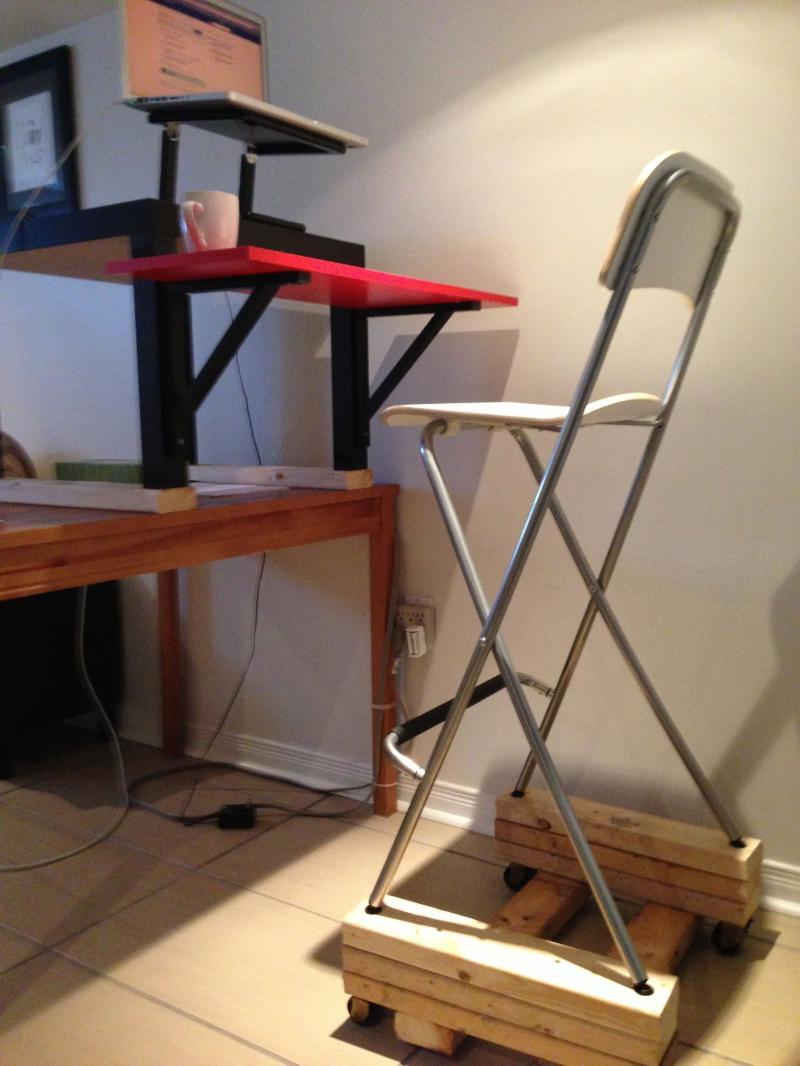
Before I made a big purchase decision, however, I figured I'd set one up using some spare furniture as stands just to make sure the idea worked for me.
For the first 30 minutes of standing, I wondered "wtf was I thinking?" After standing for an hour, I did get used to it.
After a couple of weeks, I realized a stand-only table was actuallly not a good idea for me. It wasn't so much related to fatigue (I do squats periodically to break the monotony and get the blood flowing), but I realized that for me, some work was just better done sitting.
My hand-eye coordination was never good to start with, and it was a little less precise (or maybe I'm a little less patient) when standing. I find that mouse-intensive work like manipulating an SVG in Inkscape or placing objects in a PowerPoint requires me to sit down.
I use the varidesk, it works well for me. I've had it for about 2 years and it's handling the ups and downs well with the load of my 27" iMac. Not the prettiest thing, but it gets the job done.
Does your iMac wobble after doing an up or down motion? That's currently my main concern with the Varidesk. I guess you could bolt on a monitor arm to prevent that though.
It wobbles ever so slightly, but that's mostly due to the fact I'm using it with a $20 Ikea Lavia desk on carpet. It's plenty stable for my needs, but there may be better solutions out there.
How about a tall chair/stool? Seems cheap, though not as comfortable as a good chair. (But then again, maybe you don't want it to be too comfortable if you want to avoid sitting.)
I use the varidesk, I think it was $250 when I bought it. The quality definitely justifies the price, but I didn't find it too expensive to begin with especially since it was a write-off.
The adjustable Ikea Bekant sit/stand desk is "only" about three times the price of the non-adjustable Bekant desk. (I don't have one but have been tempted.)
Agreed regarding sit/stand desk. The prices of these things are off-putting, but I was able to get a new workstation for around $600.
I ended up ordering a base [0], and bolted on an 8'x3' melamine sheet from Home Depot [1] (they chopped off 1 foot, lengthwise, in the store).
Three extra things I had to do to make this work:
1.) I had read that unsupported melamine will sag. I bought a thin steel beam [2] to add support in the middle. They chopped it in half in-store and it fits nicely between the base and the top.
2.) Iron-on edge banding [3] will "finish" the sides.
3.) I failed a couple times at getting the adjustment console attached to the bottom of the table. You have to pre-drill some holes near the width of your screw, and you have to make sure your screw isn't so long that it comes out the other side(!). The diameter of the head matters too. You'll see why when you see the console. Order the base first, and when you go to Home Depot take the console thing with you to find the appropriate screws.
Now I have a sturdy, 8 foot(!) adjustable desk. If it starts sagging in a couple years (and it very well might), I can spend $25 for a new top. I should point out that I'm not that good at building things, and this wasn't too bad. The hardest part was getting an 8'x3' board from Home Depot back to my house (they'll rent you a truck for like $20 if you need it).
At the same time, I switched my chair to a red exercise ball ($30 at Target). I think this was a really good idea (even if one doesn't change their desk), if only for the fact that when I'm standing on a conference call I have this giant ball to mess around with, now. Others might be able to speak to health benefits.
I also had to ease into standing, like others have mentioned. I started with standing for two half-hour chunks a day, for maybe three days, then bumped it up to two 1-hour chunks a day, etc. Now I'm at about two 3-hour stints a day, which is probably where I'll stay.
In three months with this setup, my back feels 10 years younger and I'm much better at standing (both the state of standing as well as standing up from a sitting position*), getting out of bed and bending down to pick stuff up (most notably shoes and small family members). I also walk taller and have better posture.
Anecdote here: it took me around 3-4 weeks to get fully acclimatized to my standing desk, a period during which I was often tired and sore. However, once I got used to it, standing became a normal part of my day. Because I'm already standing, I have an easier time walking away from my desk - to get a drink, go to the bathroom, confer with a colleague, go for a walk, etc. - and I've also been incorporating squats, calf raises and stretches into my daily movements. Several months after going all-standing, I feel better than I have in years. My posture is better, my back no longer aches, my knees have stopped hurting, my mood is better and my productivity is as good as, or better than, it was when I sat all day.
I have to second this. I've had multiple runs at standing desks, and the only time I've been able to hack it for full days is when I was already doing squat exercises.
Interesting point. I started doing squats because I was already standing, but it didn't occur to me that I was able to stand because I was doing squats.
One additional note that I should have mentioned (indeed, emphasized): I also spent a couple of months tweaking and tinkering with the ergonomic layout of my desk - chiefly the position of my keyboard, mouse and monitors - until I found an ideal arrangement that nudges me to maintain good posture and leaves my shoulders and wrists pain-free.
> Because I'm already standing, I have an easier time walking away from my desk - to get a drink, go to the bathroom, confer with a colleague, go for a walk, etc. - and I've also been incorporating squats, calf raises and stretches into my daily movements.
But if you were sitting, you would get a half squat out of having to get up to get coffee etc. ;)
Humans assume that standing, walking or running (or even sitting!) is something that you just pick up along the way. It is not. Doing it right requires practice and technique.
Couple of months ago I was in Bali and I saw local women weaving fabrics. They would sit for hours with their legs straight on the ground and a perfectly straight back, like a letter L; no back support of any kind (try it!). Bad back? That's western problem. We sit in our "comfortable" chairs with "lumbar support" and slowly decay.
When I started doing deadlifts I found the posture quite strange and the motion felt very unnatural. Too many things too keep track of. But my trainer would point out all my mistakes and I'd improve, bit by bit. After few months the results are great.
Standing is in the same bucket. It is a physical activity. One shouldn't assume it is something that humans are just supposed to be able to do right without practice. Most certainly not after years of bad habits. If you don't have the proper physique it's going to hurt. If your posture is bad it is going to hurt. So figure out what are you doing wrong and fix it!
> Humans assume that standing, walking or running (or even sitting!) is something that you just pick up along the way. It is not.
People are so presumptuous. What are they going to arrogantly assume next? That they can breathe properly without proper training; that they can socialize without a dating coach; that they can chew food properly without getting digestive problems; that they can listen to their own intuition without a consultation by a life coach?
Of course you're going to get fatigued if you're not used to standing for long periods of time. You're constantly engaging muscles that you let lie comfortably for most of the day when you get into the office and sit or slouch into your chair.
Of course it's going to take training, as building up any muscles does, and it's going to be tough while you're doing it.
I'm glad to see others here saying they're happy with their standing desks. It's something I've been really eager to try but haven't been able to for a number of reasons yet.
Whatever the future is, I don't think it's sitting at 90 degrees at a small desk for long periods of every day.
Personally I find it very hard to recline and get work done. I find it harder to engage with what I'm doing, get drowsy more quickly, etc.
I use a sit-stand desk at work that allows me to switch between standing and sitting at will. I couldn't imagine having to choose between either setup. It's a little more expensive than a traditional desk but the flexibility that it offers is worth it.
I've also found that a big factor in how much I stand (and enjoy standing) is what I'm standing on. Comfortable shoes and a padded mat make the all the difference and stop my legs from getting sore as quickly. At first, my experiences were pretty similar to this authors, but I've since warmed up to it a bit more.
"Even though I was fighting some pain, I thought it was good pain — like the pain you get when you’re building muscle when you workout. It felt like I was training my muscles for better posture and this was all part of the process."
Completely the wrong approach. Fighting chronically tense muscles with more tension is not going to help anything, standing or sitting.
It worth noting that muscles can only pull. He should have been trying to relax the tense muscles rather than trying to counter with more tense muscles. This is not easy though. Have a look into the Alexander Technique or Feldenkrais Method, or the book Somatics by Thomas Hanna for some different approaches to re-educate your sense of kinesthesia.
I built a standing desk and a sitting desk at the same time when I moved into "downtown" office from my home office. For a year I had them in an "L" and didn't really use the standing desk as much as I thought because like the author I would get sore/tired very quickly and the nice chair was always a couple of feet away.
About 2 months ago I decided to reorganize my office and I put the sitting desk across the office looking at a wall and the standing desk by a nice window view. With that little bit of change I started using the standing desk more and more and now I use it all day.
One important note: I've also been taking a break every 1.5 hours (I have several alarms set on my phone) to do some hamstring stretches on the floor. I bought some cheap interlocking foam flooring that I sit on for stretching. On the days I ignore the reminders to stretch I do start getting a tense back by the mid/end of the day. Maybe I should add some squats...
When I built my standup desk, I paired it with an elevated chair that resembles a saddle for horseback-riding[1]. The hip position is adjustable and IF the monitors are at the right height, the back is straight even though the chair has no back support.
With that setup, I could switch between sitting and standing, while keeping a straight back.
If you are finding it difficult to stand for extended periods, consider getting your feet checked, and if you have already, using your prescribed orthotics (insoles/shoes/other supports) whilst standing.
When I come home, I routinely take my outdoor shoes off. I spent most of my time at home sitting at my desk, but last year I began to learn bass guitar. I found that standing to play for less than an hour was enough to wipe me out for the entire evening, with knock-on exhaustion until the next day.
I have pes cavovarus - a deformity of the feet characterised by high arches and inward turned heels. When I finally got orthotics and placed them into my outdoor shoes, walking suddenly became easier and instances of debilitating cramp reduced in frequency and severity.
Following my experiences with playing my bass, I placed a spare pair of orthotic insoles into my slippers. This was not something my medical team had suggested previously. Suddenly I found it less exhausting to stand for extended periods. The change was actually quite immediate and significant.
Flat arches are far more common than what I have, but I suspect the same concept still applies - and orthotics for flat arches are far more widely available to consumers!
I don't understand the attraction to non-adjustable standing desks. Standing all day seems just as bad as sitting all day, especially if you start standing all day after sitting for years. As long as you're relatively active (~3hrs of exercise/wk) you're probably OK just standing an hour or two a day.
I opted for an adjustable standing desk that I love. After doing a lot of research I ended up going with a brand called EvoDesk (http://www.evodesk.com). Their parent company is NextDesk, which has nice products, but cost more than I was willing to spend for what I wanted.
I ended up getting the smallest desk they have (48"). With all of the options, including the speakers it came out to around $1,000, which I consider reasonable for a tool I use ~14hrs a day, ~everyday. Though, I ordered the keyboard platform add-on, but didn't like it (I'm fairly tall) so it's sitting in the closet.
I've had it for a couple weeks now and love it. I stand anywhere from 1hr - 6hrs/day depending on what's going on. This isn't the best image of the desk, but I took this picture the other week for a "show us your office" thread: http://imgur.com/ybIEoqB The desk is at sitting height. The bubble looking thing under the desk is the subwoofer for the Harman Kardon sound system option that came with it. You could probably order it for $30 or so cheaper separately on Amazon, but I didn't want to hassle with drilling/finding my own screws. It has 4 height memory presets. I'm 6'1" and the highest desk height is about 6" higher than what I use standing.
Now that I have a standing desk I can't imagine going back, but I'd definitely want an adjustable desk. If I had to choose between a fixed sitting desk or a fixed standing desk I'd choose a fixed sitting desk.
No, it's attached very securely to the desk so it doesn't rattle.
If I play hip hop with a lot of bass and turn it up loud you can feel the bass hit as you'd expect to, but nothing on the desk shakes, it's pretty sturdy. Besides, I only turn it up that loud when my wife and I are hanging out in the living room, not while I'm working.
I know at least one workplace where they use desks that can be adjusted to a standing or sitting position. If you feel like standing, you stand. If you prefer sitting, you sit. Isn't this the best of all worlds?
I tend to find the reclining & feet up posture described near the end the most comfortable for me, though it also tends to make me drowsy. Ergonomics "experts" however have told me again and again that the sitting upright position is the best for my back, which seems to contradict this article.
I guess it depends on whether we're talking spine, muscles, circulation or back-as-support for the whole body.
Standing seems like "paleo" to me. Our ancestors did it so it must be best, am I right brah? They died younger or had much worse old age, but I guess it depends on the definition of best/better as well as definition of spine.
I hear you about the "paleo" fads, but in this case I think spending so many hours sitting in front of a computer, without taking breaks or exercising your muscles, is genuinely bad. I know I have a terrible slouching posture, and wonder if it's caused by my extremely sedentary computer-induced habits.
What's wrong with an adjustable desk that lets you change postures to whatever you feel more comfortable at any given moment? I know I wouldn't use it in a standing position all the time, but maybe some of the time?
I had a standing desk for several months - and it was a mixture of good and bad. When I had a delayed flight though Dubai and ended up stuck in a queue for 4 hours waiting to rebook tickets, it meant I didn't feel too much more fatigue than a normal day at work. :-)
I think it was helping me not slouch so much - so probably good for my back.
But then, with our newborn (colic, etc.), I was just so exhausted in general, that I found I'd arrive at work and not have the energy to stand upright for more than an hour or so, and sometimes just walking upstairs to my desk would make me feel out of breath and floppy.
So when I had to move offices, I simply couldn't be bothered to re-set up all the stuff I'd need for a standing desk, and resorted to a chair. I've only been back in the chair for a month or so, so I don't know if my posture will end up as awful as before. Maybe the thing to do is to use a standing desk half the year, and a sitting desk the other half... An adjustable desk would be best, but either expensive, or complicated.
Sounds like a great option. The desks that can rise/lower to standing/sitting positions are pretty damn expensive. Setting up an Ikea standing desk with a barstool so you can stand/sit when you want to sounds optimal and cost effective.
I am sorry to say this, but the entire article sounds like you are rationalising an irrational decision. As the studies show sitting is bad for you and while is understandable that not everybody can get used to work standing, just arguing against the research will not do any good. The final conclusion:
"The key is to do some activity every day. It doesn’t have to be a five-mile sprint. A walk to and from work, taking the stairs, or some squats while you’re waiting for your lunch can be enough to do the trick."
Sounds exactly like the stuff smokers say to justify their smoking habit.
I don't want to defend any religion (the standists? lol), i can just say that i like it, and i like it so much that after 3 years of standing i would keep doing that and i would really suggest to everybody to try for at least 3/4 months. You need time to get really used to it. After that make your decision.
Whenever I've tried standing, my feet ache within about 10 minutes. Walking I can do for much, much longer stretches. Either way, it's a big change to go from sitting all day to either walking or standing, and a good idea to blend it in to your work day slowly over a couple of weeks rather than force yourself to go whole hog from the the first day.
Now that I think about it, when I switched from sitting to walking, I got a tall sit/stand stool so I could switch a lot. It was a really cheap stool, and it put my butt and legs to sleep in 10-20 minutes. It was so uncomfortable that I would only use it when standing was starting to hurt, and I'd sit until sitting was starting to hurt, and then have to stand again. That stool didn't last long, but it might have helped me transition more than I thought.
Aching in the balls of my feet is the most common pain I get. I've tried using a soft mat which had no effect compared to a hard floor. It seems to be down to footwear - running trainers can be fine for several hours but with converse flats I'll barely last 2.
Standing desks can be "affordable", though still not cheap. I've been using the Jarvis base, and putting my own locally sourced hardwood tops on them. The base is $500 shipped inside the US ($520 with the digital controller), and you can put whatever top you want on it. The Jarvis base is high quality, i've got 10 of them in my office now.
For me, the key was to alternate the standing with the sitting phase. Someone suggested to sit for one hour, then stand for twenty minutes. After that, walk around (get a coffee, talk to a colleague, go to the bathroom). This was so good for me that I wrote a little app to remind me doing it on time: http://papamufflon.github.io/StandUpTimer/
Feel free to use it, it's gratis.
I sit on a ball chair. It encourages me to bounce and move, not "slouch" or crumple into the chair (since it has a minimal back) and also makes it easy for me to pop up and stretch my legs.
Sitting in my home office leather/traditional chair causes my feet to go cold, the ball chair doesn't have this same side effect.
Also, leaning in a pinching your neck muscles/nerves is a major factor. Make sure you're screens are high enough, and close enough to discourage this behavior.
I just bought a Bekant adjustable desk from Ikea a couple of weeks ago and I can say I'm very happy with it! I wouldn't be able to stand all day through, but it feels so good to sit after an hour of standing and to stand after an hour of sitting. Would totally recommend it, although it's quite expensive.
The point isn't to stand 100% of the time. The point is to be able to switch it up as your body needs. Stand sometimes. Sit sometimes. I often change over the course of the day.
I bought that desk in 2013 and have been using it ever since, would not be able to go back to a normal desk.
The secret is definitely that it should be adjustable, that is you should be able to vary between sitting and standing. I switch about 4 to 5 times per day.
It's glaringly obvious that you're not supposed to stand and work the whole day. I don't understand how the author of the linked post (and many other "standing desks suck" articles) didn't realize this.
I have one. It's ok. It's not very stable so the monitor arm I attached wobbled with the LG-34UM95 I have.
It was a cheap arm and a cheap desk. A cheap desk with a better arm might have turned out better. I am kind of wishing I had looked at a few more desks, but I worked things out by shimming the monitor arm and putting 110 pounds of lead on the desk to stabilize it. I hope that doesn't burn the motor out!
The sit/stand functionality works well. If you go to Ikea you can see one in person in the US. Their stock info was wrong when I went and they didn't have the regular desk only the corner desk which was 100$ more.



When I stand at my desk, I'll do it until I feel uncomfortable/fatigued. When I sit at my desk, I stand when my back and legs get tight. It's that simple.