France electricity is mostly (72%) from nuclear power. Aka the most under-appreciated clean energy that everybody is panicky about and wants to get rid of. Which means, unless you have a luxury of having tons of hydropower or something, nuclear is probably the best way to lower carbon footprint. Of course, this is also the least discussed way.
I am one of the "panicky" ones and I want to explain my point of view.
When I was a kid, living in the equivalent of Kentucky, a nuclear accident in the equivalent of the Bahamas made it so we couldn't eat wild berries from the woods anymore.
Now a middle aged man over 30 years later, sheep from my home area still measure levels of radioactivity too high for human consumption.
That's why I feel most options are better than nuclear power, for any purpose except perhaps space probes.
If you look at the seriousness the human race dedicated to creating safe nuclear energy, it looks almost comical:we settled on the first technology we found(pressured water reactors), because it fitted best for the requirents of the Navy at the time, not because it offered the best safety for citizens, far from it.And than, in the name of safety, we created an environment that prevented from new designs to become commercialized.
Why wasn't it safe ? Because that type of reactors creates a lot of high pressure radioactive gassses , and in the case of an accident, those gases spread far.
But we now have reactors types that (a) can't physically blow up , their temperature is limited, and (b) contain very little to no radioactive gasses , so even in the worst case scenario, we'll be just left with an enclosed pool of radioactive material, which is safe.
> "But we now have reactors types that (a) can't physically blow up , their temperature is limited, and (b) contain very little to no radioactive gasses , so even in the worst case scenario, we'll be just left with an enclosed pool of radioactive material, which is safe."
Interested in learning more about these reactor types. I hear different reactor names discussed, but I'm not sure what's right on the cutting edge.
It's practically impossible for any type or reactor to "blow up". Nuclear weapons are very different from reactors.
The most dangerous types of reactor is graphite moderated ones. (Because graphite burns lot more readily than water.) Practically all of the actually severe accidents happened with those. They have not been built since Chernobyl.
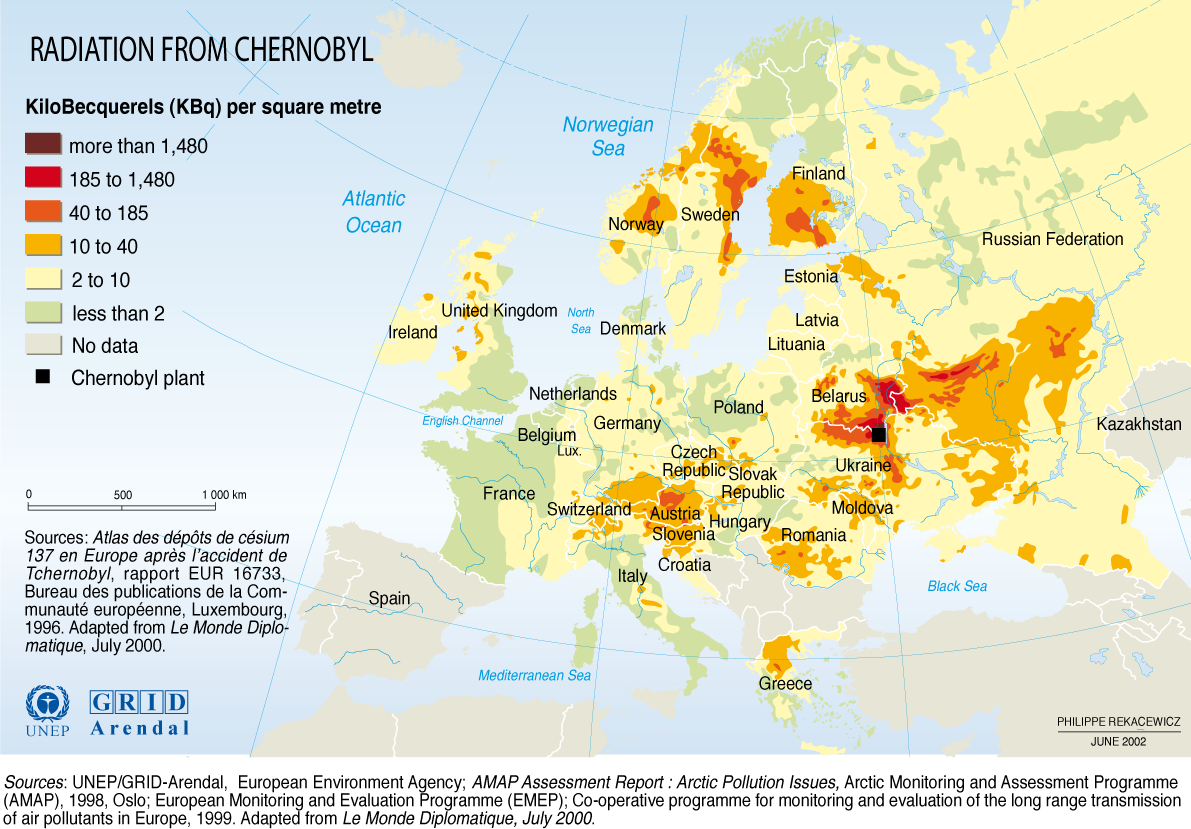
Here in Bavaria, every single wild boar shot still has to be checked for radioactivity, quite a few have to be destroyed for too high radiation values. Equally, it is recommended not to eat too many mushrooms from the forest. All of this due to the Chernobyl accident more than 30 years ago.
I have very hard time believing anything harmful can get from Chernobyl to Bavaria and still be dangerous by now. I think it's just overreacting. There are millions of people living between Chernobyl and Bavaria, including cities such as Kyiv (3 mln people, less than 100km from Chernobyl), and there seems to be no sign of mass morbidity and mortality from any of radiation related causes. Makes it kinda hard to believe there is still danger in 1400km away.
The thing is that there are long living isotopes in the upper soil of the forests. As they are long living, they have not decayed yet enough and are not going to in the next decades. Something does not need to kill 80% of the population to be a significant health risk. With the isotopes relevant in Bavaria, they are only dangerous when eaten. So there is nothing dangerous about living in those regions. However mushrooms tend to aggregate the radioactive particles and so do the wild boar eating from the mushrooms. Not every animal is contaminated, but every single one has to be scanned for radiation, before they can be eaten, and quite a few have to be destroyed every year.
200 grams of mushrooms with 3,000 becquerel cesium-137 per kilogram corresponds to a load of 0.008 millisievert .
This corresponds to the radiation load on a flight from Frankfurt to Gran Canaria.
And:
If wild game or wild growing fungi are consumed in conventional quantities, the additional radiation load is comparatively low, but it is avoidable.
In other words, there is no danger to one's health - no more that one is exposed to by living regular life and being subject to various low-level radiation sources present in the environment. The regulations have very low acceptable level, just to be safe, but there is very little actual danger from the levels present right now.
From Wikipedia[1]:
For comparison, natural radiation levels inside the US capitol building are such that a human body would receive an additional dose rate of 0.85 mSv/a.
So, working in a granite building for about 4 days is as dangerous as eating a meal of "contaminated" mushrooms. Thousand of people do the former every day. Or about the same as one dental xray. I think my conclusion that it is done out of overabundance of caution still seems to be correct.
First of all, it makes a lot of difference, whether you are exposed to external radiation, or eating contaminated food. Especially if, as for Iodine, the elements are accumulated in certain organs. Not sure how much this is the case here.
Anyway, I have not claimed, that occasional eating of mushrooms is going to kill you. Still, the doses are high enough to warrant an official warning not too often to eat these mushrooms (you have a dental X-ray not every day either), and enough animals are contaminated high enough to be destroyed.
Overall, the life in Bavaria is not impacted by the radiation. But I find it startling, that over a thousand kilometers away from Chernobyl, the Bavarian landscape is contaminated and will be for decades. It shows me, that we do not want to risk a reoccurrence of such events.
This article: http://www.umweltinstitut.org/themen/radioaktivitaet/tschern...
claims, that the Bavarian soil used for agriculture tends to not transfer radioactive particles quickly into plants. It seems the soil was also deeply plowed to distribute the particles amongst a large volume of soil. The situation in forests is different, as the trees captured more particles than the open farmland, and the soil is not plowed, leading to still high particle concentrations in the top layer.
Bavaria had been contaminated the most, other parts of Germany have less residual radiation - the weather situation (wind, rain) created very inhomogeneous distribution back then. I found this map about the distribution: http://files.abovetopsecret.com/files/img/gz54e7a9f2.png
Well, these days when I see nuclear power discussed in the popular press, it's usually talking about how it's extremely expensive and also almost caused Toshiba's bankruptcy. Probably not what you had in mind.
Do you prefer spreading the pollution over the vast area around the thermal power plants? Because that's the current alternative in most of the countries. Nuclear waste is treated securely enough for now in Europe, and future may bring us scientific development to resolve this problem in future.
You make it look like coal is the only alternative. Where is this coming from? Trump campaign train?
> Nuclear waste is treated securely enough for now in Europe, and future may bring us scientific development to resolve this problem in future.
No it's not. We have quite big problems with storage in Germany[1]. Other waste is stored next to the nuclear facilities who created it or on the road to and from La Hague where radioactivity is leaking into water and air[2,3].
Or hey, don't forget Sellafield where 2014 the employees have been asked to stay at home but everything is totally OK. Unfortunately nobody told that to the birds who were drinking contaminated water from open SFPs.
So they will get rid of all the waste that is currently lying in rusty containers all over the world? Or do we have enough to clean all of the waste that is being generated? Please provide sources since I know some countries who are struggling to find a hole deep enough to make it disappear.
E: how is the wikipedia artikel solving the problems we already have and which resulted from the current nuclear waste storage?! I've asked that above. This whole thread results from a quasi "roses and butterflies" comment.
Nuclear power is discussed a lot as a CO2 friendly option. The huge drawback is that we haven‘t found a way to deal with all the radioactive waste yet.
We never found a way to deal with the radioactive waste that coal plants emit into the air (look it up) or the millions of deaths that coal and petrol/diesel are responsible for, but we still use those.
Per Wiki:
> According to the World Health Organization in 2011, urban outdoor air pollution, from the burning of fossil fuels and biomass is estimated to cause 1.3 million deaths worldwide per year and indoor air pollution from biomass and fossil fuel burning is estimated to cause approximately 2 million premature deaths.[14] In 2013 a team of researchers estimated the number of premature deaths caused by particulate matter in outdoor air pollution as 2.1 million, occurring annually.[4][5]
> We never found a way to deal with the radioactive waste that coal plants emit into the air
Sure we did. We close them down where ever it's possible. Just like we should do and do with nuclear power plants.
> Nuclear is safer and better in every way even if you multiplied all the past disasters by ten. There really is no comparison.
What a brilliant argument you have there. Oh wait. No it's not. You actually did not bring anything up to counter the problem caused by nuclear plants: nuclear waste. Just some juicy whataboutism.
> its a political problem because humans have no sense of scale.
People have enough sense of scale to realize that the waste will be there forever and while some are safely away from it, others can watch your rusty barrels go to hell and pollute the environment. Funny because John Oliver had a piece about that just last week:
But if it turns out that we'll need an active (as in "needs manpower") care-taking of this waste for several thousands of years, we get into the compounded interests area.
Also, there's the immediate (last 50 years) issues such as barrels of waste being treated in silly manners; e.g. thrown into the ocean near the coast and shot to pieces by air-planes if they surface...
Politicians and corporations will do anything to save money, if they think they'll get away with it. That makes nuclear waste much more dangerous than it should be.
It's not a problem, we'll have clean fusion in 20 years :D /s
(1) We have to keep something dangerous deep underground in some remote places, and if something goes wrong, it may leak out and contaminate dozens of kilometers around the spot. Dozens of kilometers.
(2) Every coastal towns, cities, estuaries, and natural preserves will be wiped out within a thousand years. Across the globe. Including entire nations. (Well, to be fair, they will cease to be nations long before that.)
> A study in 2015 found that assuming cumulative fossil fuel emissions of 10 000 gigatonnes of carbon, the Antarctic Ice Sheet could melt completely over the following millennia, contributing 58 m to global sea-level rise, and 30 m within the first 1000 years.
Out of all wastes to be mismanaged, higher radiation would probably be the easiest to detect - simple detectors are widely available commercially.
Yes, we need ways to store, or recycle - there are ways to do that too - nuclear waste, but that doesn't seem to be an intractable problem, and I don't think this is the main hindrance to the wider spread of the nuclear energetic. Irrational fears of "radiation" and political issues seem to be more prominent there.