They want to run transmission lines at high voltage, so the same power can be delivered at lower current (meaning smaller conductors and less losses due to resistance), then step those down to lower voltages as you get closer and closer to the customer. High voltage AC transformers are very simple and have been around for 100+ years; they're just loops of wire around a core.
High voltage DC transformers would require very modern switching technology, or a difficult and inefficient switch to AC and back again.
True. But while a high voltage converter might be expensive, it's far more efficient and would pay off costs over the duration of the life of a home. Having a single one of those per home should surely be a net win. The utility is responsible for high voltage AC transforms down to the home, and the homeowner fronts the cost of the centralized expensive but efficient converter to power the DC circuit within the home.
If solar and local generation are thrown in the mix, they bypass the converter and directly power the home circuit.
As it is, typical home electrical systems have no active components. There are just wires, panels and bimetallic circuit breakers. These systems are nearly maintenance-free over a lifespan similar to that of the structure.
A DC distribution system in the home would require both a high power rectifier at the main panel to something like 125 VDC, then many smaller DC/DC converters throughout the home for your usable voltages like 5/9/15/20 V that are too low to be effectively distributed.
All of those things would need to be maintained and upgraded over the years, because there is no such thing as power electronics that last forever. After a few electrician visits, you might find that you haven't saved any money at all.
Even if you have solar, you still need a DC converter because it will not output a constant voltage let alone all of the DC voltages you need for your devices. And generation any further away than your own rooftop is going to need to be stepped up to higher-than-home voltages and then back down for use in your home - all of which is exactly why we currently use AC for distribution.
You forgot the magnetic trip of the breakers and the now-mandatory RCDs. The latter are far more complex than a simple rectifier would be.
And even then, there's no reason such a rectifier module couldn't be a pluggable module. They still last 10~20 years, easily.
I don't see what all those low voltage rails should be for. Computers typically work fine on 300~350 V DC, and if anything, there is reason to go from 12 V to a higher supply bus voltage, actually deployed in some modular servers by now (with a 48 V bus between the local battery backup modules, AC-fed supplies, and motherboards).
The ostensible benefit to DC distribution in homes is to be more economical and simpler for devices that already run on DC - not to redesign ever device ever made to accept mains-voltage DC. If your iPad and your laptop and your blender still need a power brick to work, what's the point?
Using high-voltage unnecessarily to avoid using a DC converter is also not going to save money. Yeah, you can use a 300 V DC motor in a coffee grinder, but why? It's just going to cost more money to make.
90% of things in your home would happily run from 150V DC, even though they aren't rated for it.
Source: I sometimes connect my solar panels direct to my AC wiring without an inverter, and my house works entirely except my washing machine and fridge (both of which have AC motors in). Even my vacuum cleaner works (although it's on-off switch doesn't work, since it uses a thrysistor!). Phone charger, laptop charger, oven, microwave, doorbell, furnace, routers, TV, monitors, desktop pc, all work fine.
If some country declared tomorrow that all electrical devices must accept AC or DC, not that much would have to change.
I had no idea about this. Can it damage things that won't work (eg things with AC motors).
I've been building out electrical in a campervan and always wonder if there were DC equivalents to a lot of things.
My point is, that the European accidentally-DC-capable mains equipment can be expected to complain/sustain overcurrent damage, provided it isn't able to handle US residential voltages.
Hence you might as well take the opportunity and switch to a higher in-house distribution voltage than the typical 120 V.
And that 300 V DC motor may actually be cheaper, as you could run a BLDC driver directly from the DC supply with just minimal filtering.
The enhanced power density and copper-efficiency of these high-frequency 3-phase motors may make up for the cost of said inverter, even neglecting the considerably increased energy efficiency over a typical single-phase-capable "oldschool" motor.
Yes, but single-stage conversion from 48 V to ~1.2 V core/memory voltages is inefficient with the typical buck topology, due to the low duty cycle.
There are solutions based on ZCS (+ZVS) (semi-)resonant switched capacitor topologies that could (technically) do this in essentially one stage. But because they are still somewhat recent and rely on either GaN enhancement-type FETs or low-average-blocking-voltage topologies that make use of e.g. small 5V-capable IC process nodes and some tricks to have the individual power transistors floating.
> But while a high voltage converter might be expensive, it's far more efficient and would pay off costs over the duration of the life of a home
AC is easier to transform. Those transformers are cheap and rugged. DC is very difficult to monitor and control, especially in larger voltage and current levels.
That's actually what Edison's original DC power network was designed around. DC power lines, and a coal chugging power station every mile. Turns out that all the extra pollution and expense is a bad idea, so AC won out. It's been working just fine for over 100 years. Read more here:
50 or 60 Hz AC, especially 3-phase, makes it really easy to build and operate electric motors, too, and to transform between different voltages.
The OP’s argument is that solar power generation, plus the fact that most electrical consumption is now fundamentally DC-friendly (LEDs, electronics, electric cars, etc.), may change the equation. The concept of a whole-house rectifier is an interesting one, and something that is already used in some data centers. You still have the problem of different electronics wanting different voltages, though...
As you note, for facilities like data centres that are engineered for a specific type of load, a building-level rectifier makes sense. For a home where you have many devices using a little bit of power at a variety of voltages, you're going to end up with lots and lots of small DC converters everywhere which defeats the point. Just run 120 VAC.
> 50 or 60 Hz AC, especially 3-phase, makes it really easy to build and operate electric motors, too
Three-phase motors are never used in residential settings, and most residential motors would be more efficient as brushless DC. There's no need for sinusoidal AC motors any more except in specialized industrial applications.
Whilst most devices may use DC internally that may not be true of consumption. You still have electric showers, cookers, hobs, washing machines, dryers, heaters, air-conditioning, vacuum cleaners and kitchen appliances like blenders.
Even if power generation is distributed and localized, you still need higher voltages than what is in a home to transmit it unless you're talking about not having a power grid at all. You still need voltages on the order of 1 to 40 kV to distribute power around a neighbourhood, for instance. You aren't going to wire your house at distribution voltage - it would be expensive and unsafe.
Sure, in an ideal world. But economies of scale do exist and everyone having solar panels and expensive personal batteries remain difficult and not a viable solution compared to the larger, distributed system that allows people to draw what they need when they need it.
Long-range high-voltage DC (HVDC) interconnects are being discussed in Europe, and have already been widely deployed in China.
For local (100km) connections AC is still used almost exclusively, only exception being for some underground cables where induction losses would be too high.
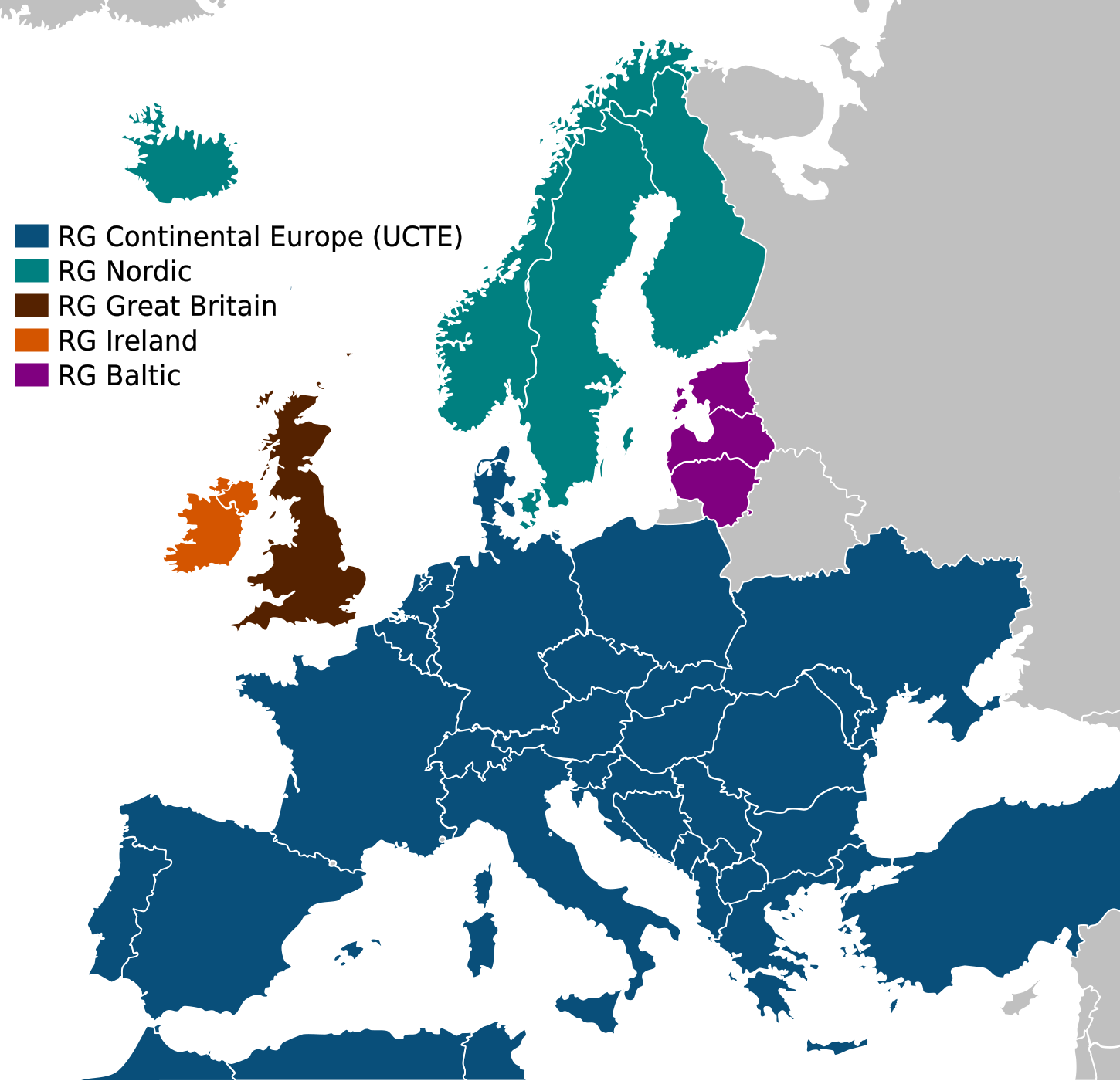
You are entirely correct. Power between different AC regions is mostly transferred using HVDC-links because it avoids synchronisation requirements between them.
Additionally the capacitive losses of an undersea HVAC cable are prohibitive, leaving only HVDC as an option.
You'll notice almost all of these are undersea cables. HVDC connections are used there because you can't really hang air cables over the ocean and the capacitive losses of HVAC cables under the sea makes them prohibitive.


High voltage DC transformers would require very modern switching technology, or a difficult and inefficient switch to AC and back again.