The Fed at this point controls the whole economy and they have two options:
1. Raise interest rates and stop printing. Crazy inflation stops, but asset prices crash and we enter a major recession or depression. The end result will likely be unrest and blood in the streets.
2. Do nothing, keep printing. Inflation picks up massively. The economy keeps humming along but young people, including myself, are permanently priced out of home ownership and many other things. We enter a new era of cyberfeudalism, which probably involves some blood in the streets.
It seems like they are going with option 2. I am 24 years old and I can't say I'm particularly excited. It doesn't even really seem like any of the high paying jobs are enough to keep up with this insane market. All I can do at this point is raise my fist to the sky and say fuck the fed, fuck the financial system, fuck the greedy rich, fuck BlackRock, and fuck you.
This is only part of the problem - and a small part of the problem at that.
The real problem as always is zoning. Houses cost roughly the same on a $/sqft basis, adjusted for inflation, as they did in the 1970s. They're more expensive now because outside of town they're twice as big on average [1] - in part due to zoning rules. In town, zoning rules preclude densification necessary for supply to meet demand [2]. And, families are smaller.
Check out Japan housing CPI - a market where supply meets demand thanks to federal zoning rules, and is also centrally banked. Dead ass flat. [3] This chart alone basically debunks the theory the Fed is solely responsible for lower housing affordability.
Zoning is the issue, not the Fed.
[edit] Yes, the fed contributes a little - monthly affordability of a more expensive house is the same when interest rates are lower, but down payments are not. However, if you want to solve the affordability crisis build more houses. Any houses. Now. Compare the Japan housing CPI in [3] to the US housing CPI in [4] and weep. Housing in the US is driving inflation, not responding to it.
While I agree zoning is a huge issue (I think that interest rates being so low doesn't help, either, but I concur with your thesis that zoning is the bigger problem), this, however:
> Houses cost roughly the same on a $/sqft basis, adjusted for inflation, as they did in the 1970s.
Sorry, but no. My parents bought their first home for $72/sq ft. real¹. They sold it for $99/sq ft. The same house last sold for $208 sq ft., and is Zestimated today at $302/sq ft. The value of the home has averaged >7% gains YoY, well outpacing published inflation.
Their current home, built significantly later, and like you say, significantly larger, was $149/sq ft. at purchase, and is $182/sq ft. today.
Every house I look at sings this same tune. Accounting for inflation, where my parents got a large house ready to move into, for the same amount to day I'm looking at what I call a "contractor's paradise", and that will require significantly more than the sticker price to make it habitable.
¹all dollar figures in this comment will be in 2021 real dollars, not nominal ones. I.e., adjusted for inflation.
The inflation adjusted $/sqft statement is a blended average across the US. It’s lower outside of towns and higher inside towns. This is tracked by the Census bureau but as always with averages there are values on both sides of the mean. [1]
One caveat is it does reflect only new construction.
You're conflating the market for suburban family homes with the market for real estate. What about apartments, commercial real estate, etc.? Rent has absolutely exploded, which might not be priced into suburban family homes that aren't built to be rented and don't directly compete with more urban apartments.
under market, no. but due to locality there are a lot of different real estate markets. dragging prices of wyoming into the dataset when you are interested in nyc or sf makes just no sense. then you have the problem of the different types of new constructions too. i don't see how averaging helps here.
at least where i am looking (european country), cities have roughly seen a 100% price increase since 2010. income hasn't kept up with inflation or the housing prices.
Part of the problem with the first item you mentioned is that developers don’t really want to build cheap housing (I guess this is an assumption, but it makes sense financially.) They can make way more money catering to the people who can “afford” to build a $500k home, and people who want a very custom design and lots of space. On the renting end, “luxury” apartments will make more money than really basic cheap units. So most of the new housing stock doesn’t help address the problem for people new to housing. Even if you want to build out a very basic, small house, you have to have cash to DIY without a bank, or find some way to finance a builder (increasing the significant labor cost) without having existing equity. So the part of the market that does want cheap, basic housing doesn’t even have a way to influence those units. There is loads of demand for them (young people without money make up a huge portion of the population), but no developers willing to meet that demand when they can just make expensive units. And not enough developers so that some need to chase the cheap market.
And in cities, the lot cost is very prohibitive too, before even getting into building a very basic house.
> Part of the problem with the first item you mentioned is that developers don’t really want to build cheap housing (I guess this is an assumption, but it makes sense financially.)
This is like saying that Toyota would rather sell Lexuses than Camrys.
Yes, it's true, but they sell Camrys anyway. Why? Because the market for luxury is only so big. They can make more money total addressing other parts of the market.
So why doesn't this apply to housing? Land + zoning. Imagine if Toyota was only allowed to produce 10,000 cars a year. What kind of models would they choose to make?
Can only speak for my city (Seattle), but no one’s building Camrys and building is constant. It’s not because any zoning prevents building affordable units. It’s because there’s limited land to develop at all and demand for property of any kind is extraordinarily high. All of the development in residential neighborhoods is already zoned for everything that could accommodate 4-10 times as many tenants. But they’re building luxury units anyway.
Doesn’t surprise me but this zoning explanation ain’t it.
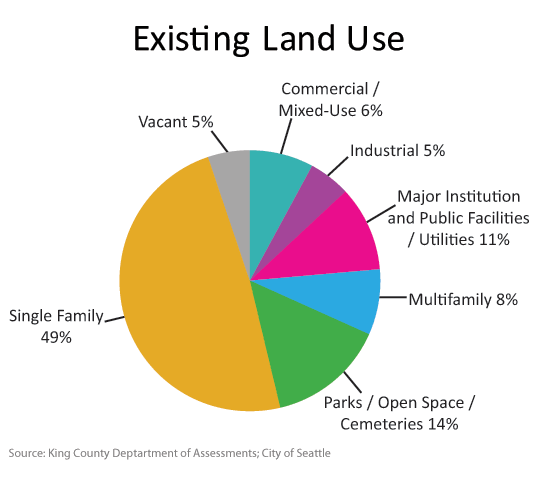
50% of the developable land in Seattle is designated for single-family homes, and not one single inhabitable SFH in Seattle city limits is what anyone would call "affordable". The fact that it's illegal to replace those SFHs with duplexes, quadplexes, or midrises is a primary driver of housing unaffordability.
Seattle's population growth has outpaced its housing growth for multiple decades. There's a huge amount of "catching up" to do, and SFH zoning is blocking that from happening.
Once enough there's enough housing to hold all the rich people that want to live here, of which there are many, you will see some downmarket construction happening. But we're a long way away from that.
They’re replacing SFHs with multiplexes all over the city all the time. Instead of assigning A/B/C units or fractions they just split the numbers already designated for the lot.
Zoning for MFHs won’t change that. It’ll maybe bring more skepticism to luxury developments. But people buying million dollar units with no lot will know they’re buying the same thing.
And mixed use luxury apartments are the only development otherwise. No one is building anything more affordable in zoning more favorable for it. At best this is trickle down economics where everyone who needs somewhere affordable to live might be able to get scraps at the most dangerous furthest flung place in Lake City.
So if this is a "problem" for government to fix via either Zoning being abused or the free-market being naughty, then why doesn't the government just create very specific and targeted "high-density, high-rise, cheap-price" zone that can only be built with the right and necessary units?
Dude have you been to lake city? The only area that’s dangerous is where there city built one street up with all projects. It’s significant safer than Ballard university district and and capital hill
> As of 2019, there were 367,806 housing units in Seattle, representing a 19 percent increase since 2010 (according to Washington State Office of Financial Management). The growth in the number of housing units in Seattle from 2010 to 2019 surpassed the 14 percent growth seen between 2000 and 2010. However, even with the rapid increase this decade, expansion of our housing stock has not kept up with Seattle's population growth of 22 percent between 2010 and 2019.
And here's Seattle's land zoning ("Land Use" tab on the same website):
> Can only speak for my city (Seattle), but no one’s building Camrys and building is constant
I'm in the Seattle metro. Building higher density housing is still illegal in most of the city, because attitudes there are still fundamentally NIMBY, even if it's not as bad as SF.
The city has generally upzoned little slices at a time around 'urban villages', and while that's certainly better than nothing, it's a lot less effective than largest scale upzones, and streamlining building processes.
This is a poor analogy. People rely on cars way differently then they rely on housing. If the only car you could buy was a Lexus, you might stretch you budged, take out a big loan and buy one, or you might simply not buy a car, get a bicycle instead, take the train, a cab, or pay a coworker to carpool.
Housing doesn’t give you this option. If you don’t want to be homeless you may be able to rent, but that is pretty expensive too.
It seems to me like your list has analogs in housing without squinting too hard: spend more of your budget on housing, get a mortgage (big loan and buy one), get a smaller place (bicycle), rent a place (train), or move in with roommates (carpool).
So many landlords have taken old homes and converted them into single apartments, raising the cost without creating any value. I would say destroying something of intangible value as well. That trend has definitely driven the cost of housing up.
Because selling a Camry doesn't reduce the selling price of Lexuses built in proximity to it by more, in aggregate, than the profit from the Camry. Which is why developer-founded and controlled HOAs have much more restrictive rules than public zoning rules.
One theory, and this may just apply to my location, starter homes supply is being eaten up by firms who are going to turn around and rent it out. So they are essentially grab what little supply there is of new construction starter homes, then turning around and renting them out for quiet a bit of a sum that still prices quiet people out of them unless they are fine eating shit.
We don't seem to have an issue with Hertz coming in and scoping up all the camrys.
There are plenty of yuppies to buy up any fancy new houses in town, though. So no cheap houses are built inside the cities proper.
In the US, there's always more land - it's just further away! The cheap "Camry" houses still get built, but never as infill. It just gets pushed further and further out to the exurbs.
Unless you take money (or cheap debt) out of the hands of the yuppies, nothing changes here.
It doesn't really matter if you add new stock at the top end or at the bottom end, people from the bottom move up, and make space at the bottom for new entrants. Any new stock you add increases supply, which leads to lower prices across the board.
[edit] and btw, I think builders aren't tripping over their shoelaces to service the low end of the market because they know the city is so aggressively capping how much they can build. This means they will only build the most profitable units, the high end today. But once the high end is saturated, the low end ones will be the profitable ones anyways.
> It doesn't really matter if you add new stock at the top end or at the bottom end, people from the bottom move up, and make space at the bottom for new entrants.
Only if the old housing stock isn't torn down to make room for the new housing stock. Thankfully property taxes aren't driven in the potential value of land (rather, they are tied to actual value), but most small scale landlords of affordable housing right in it are in it for property appreciation, not rents. Their exit plans are often to sell to a developer as tear downs.
> This means they will only build the most profitable units, the high end today.
There are costs are too high (to acquire property and build) to justify anything but going after the highest end of the market. Once the high end is say satisfied, money (investment) could simply move away from housing if it can't make any money there. Money chases the highest returns between all of the markets, not just one market.
> Thankfully property taxes aren't driven in the potential value of land (rather, they are tied to actual value)
That's not a thankful thing at all, it incentivises using the limited land in wasteful (low-value) ways.
> Once the high end is say satisfied, money (investment) could simply move away from housing if it can't make any money there. Money chases the highest returns between all of the markets, not just one market.
Available capital is practically unlimited these days, anything that's profitable and legal to build will get built.
> Only if the old housing stock isn't torn down to make room for the new housing stock
This is about zoning too. Normally, if the demand is there for it a smart land owner would build more housing on the same plot, e.g. turning a single family into a two family, but of course that is illegal in many places.
Yes, that is exactly what is happening in Ballard (Seattle area) right now. Those cheap 100 year old low income housing complexes (one or two stories) are being raised for a bunch fo three story townhomes, smart developers can sell each of those town homes for $1 million each, and they could get much less if they kept it as a hotel-like complex. I just bought one of those town homes, so I'm not going to complain too much, but I'm self aware about what is going on here.
So poor people are still getting screwed. My daily walk to the grocery store passes by a few places that are pretty shabby (so low income) and right across the street they are building a bunch of luxury town homes. It doesn't take a rocket scientist to figure out what will happen to those shabby places in a year or so.
> a smart land owner would build more housing on the same plot
This is an uncomfortably extremist position, should maximizing revenue per investment be the one and only consideration society takes into account?
I do many things that provide joy in life in other ways, even if I know they don't maximize revenue or savings. I wouldn't want to go through life thinking about nothing else than ROI for every action.
>property taxes aren't driven in the potential value of land (rather, they are tied to actual value)
That means multifamily properties have higher tax bills for absolutely no reason. Expensive locations need to provide more housing per area so charging a fixed fee based on the value of the land is a much better approach. You get to build a single family home and pay through the nose or split the bill with a multi family home.
I hear this repeated a lot. In practice, at least in the cities I've lived in, I've only seen housing go downmarket when there's an explicit exodus. The reason is that housing is built for a specific living space size. Los Angeles has so many single family houses that it's impossible to cater to people downmarket...unless houses are torn down and multi-unit housing is built. You could rip those down and build upscale, large apartments, but I feel like I see them sitting vacant instead of moving downmarket. The bust sucks for everyone and the boom (gentrification) sucks for the less well off.
Maybe we're saying the same thing, but instead of gradually reaching a equilibrium like you're describing I see a dramatic boom bust cycle--both are held back by lack of building.
> It doesn't really matter if you add new stock at the top end or at the bottom end, people from the bottom move up, and make space at the bottom for new entrants. Any new stock you add increases supply, which leads to lower prices across the board
I could definitely see that being how it works in a lot of cases, but it seems like a stretch to assume that's some sort of natural law of prices. If I have a market of ten potential buyers, the first who has $1, the second who has $2, and so forth until the tenth buyer has $10, I could put an infinite number of goods for $10 for sale, and none beyond the first would be able to be purchased. Sure, you could argue that it would be silly of me to price in that way, and you would be right, but in reality you don't know the exact financial details of every potential buyer of your whole market. GP is hypothesizing that basically this exact scenario is happening with housing, and I don't know if they're right or not, but your rebuttal doesn't seem very convincing that this is an impossibility.
My point is that it's at least mathematically possible for a scenario to exist where the assertion I was responding true does not happen. If the idea is that _in practice_ people always lower the prices, then it seems more direct to just say that rather than claim some sort of law of economics that doesn't actually have any mathematical proof.
If they priced at $6, they’d sell 5 units for $30 and 5 people would still be unable to afford to buy housing while the seller held onto 5 more units waiting for another person to come along with $6. If they priced at $7, they’d sell 4 units for $28, which still might be better for them.
This might not be that far off from what’s happening.
We have the same problem with the car market. I can only afford a $5,000 car, but the car manufacturers make all their money building $20,000 cars. I just can't see how Honda making another $20,000 fit is going to help me afford a $5,000 car.
The problem from the manufacturers' perspective is that the gear required to meet 2021 safety, emissions, and fleet efficiency standards by itself almost pushes a new car's price over $5000, and that's without leaving any budget left over to make it a car anybody would want to buy.
They do sell vehicles at that price which get around all of those standards, but they lose two wheels in the process.
You used to be able to buy a decent used car for $5k but as of recent you can't find any without connections. I've been telling folks interested in Japanese cars that it's $10k at this time to buy used with low mileage for a sedan and $15k to buy used with low mileage for an SUV.
I mean VW makes $100,000 Porsches and $20,000 Jettas. At some point it’s not economical to make cheaper cars due to materials and workmanship. You can certainly buy an e-bike for half that, I did.
The cost of construction in America is $150/sqft. We’re not even close in cities. Off by an order of magnitude.
Sorry I guess I was more obtuse than I intended. My point was I can buy a used car for $5,000, and Honda building new cars allows that even if the new cars are out of my price range.
Some analysts believe that in another 5-10 years in the US, you'll get if not quite a $5K USD car off the Internet, a $10K USD car from a Chinese manufacturer, and the Detroit automakers will reprise their arrogance-into-bankruptcy role from the 70's again when Japanese cars entered the US market, when they famously remarked the new entrants can have that cheap unit market.
Watching the Detroit product roadmaps, I'm inclined to agree with that analysis at this time.
In cities with no zoning todays luxury housing is tomorrows affordable housing. For example in Houston apartments and houses that were touted as luxury in the 80s are slums now.
This also holds for smaller cities in the Rust Belt. My childhood home, purchased almost new in 1980, is only worth about 2x what my parents paid at a time of 20% interest rates. It has been very well kept and sits on about an acre and a half. Everyone with means has moved away. Retirees and people with no better options are all that's left.
We're seeing a massive demographic shift to single person households all across the first world countries from Canada to Korea. But for some reason the housing market is still geared towards families.
Households with two or more incomes are more likely to be able to afford real estate than single-income households - both in absolute income levels as well as in economic crisis where it is less likely all family is losing their all of their income simultaneously than a single person..
If the real problem was always zoning, wouldn't dense cities like NYC and Shanghai be cheaper than average, not way over average?
> Check out Japan housing CPI - a market where supply meets demand thanks to federal zoning rules, and is also centrally banked.
Japan went through a huge bubble in the 1980s. Also, housing (the structures at least) rapidly depreciates in Japan, which prevents them from being used a speculative asset as in countries (even then they still went through a huge bubble in the 80s). It is definitely an alternative model to our own, but I'm not sure how many people will want to experiment with that. Japan also much more strictly restricts immigration than other countries, which makes it, for example, a bad place for Wenzhou house wife real estate speculation.
> If the real problem was always zoning, wouldn't dense cities like NYC and Shanghai be cheaper than average, not way over average?
It's not about supply by itself, it's supply vs demand.
Big cities have big populations and economies, which means a lot of demand.
But as far as zoning goes, note that like other metros, NYC has actually effectively downzoned areas over time; in fact, a huge proportion of buildings there would now be illegal due to different types of density restrictions: https://www.nytimes.com/interactive/2016/05/19/upshot/forty-...
A lot of NIMBY's tend to go, "well, there's still some areas where it's possible to build more, so there's no real issue there". This is approximately like restricting car manufacturing to one state, and then when car prices go through the roof, saying "well, there's still more land to build car factories there, so I don't see the problem, it couldn't possibly be this rule".
NYC housing has pushed outwards into Queens and the Bronx, manhattan is less populated these days because it lacks full time residents (the apartments are still sold, but their owners list upstate/Connecticut/long island properties as their permanent addresses, and they have many less occupants in them even when full, not like the turn of the century when more than a few people were crammed into small apartments).
> A lot of NIMBY's tend to go, "well, there's still some areas where it's possible to build more, so there's no real issue there". This is approximately like restricting car manufacturing to one state, and then when car prices go through the roof, saying "well, there's still more land to build car factories there, so I don't see the problem, it couldn't possibly be this rule".
My only point was that making cities more dense seems to make them more desirable, causing more people to want to live there. Yes density is a great thing! But it doesn't solve affordability problems on its own. Can you imagine if San Francisco (6.2k/sqm) had NYC-level density (27k/sqm), would it be more or less affordable? I'm going to go with the less.
What is really holding us back are the American libertarians who are afraid of a public housing system like the one in Singapore.
> My only point was that making cities more dense seems to make them more desirable, causing more people to want to live there.
Increasing housing in this manner would probably boost land prices, but over a greater number of units, so result in overall decrease in housing cost.
NYC is a bit of a weird spot in real estate, in that having a Manhattan address (and probably a Williamsburg or Bushwick address to a lesser degree these days) is a status symbol for foreigners, in the same way that London or Paris might be. Most American cities do not have this kind of cachet and so at some point prices will fall if you build enough.
The problem is really that housing production would have to increase by an incredible amount to get to affordable. To use the example of Tokyo as affordable, let's look at comparative housing production statistics.
* The 23 special wards of Tokyo, 8.9M people, built 110,000 new homes that year.
* The entire country of England, population 53M, built 115,000 homes a year.
* The metropolitan area of NY, population 20.3M, approved 27,000 units in 2012, but approvals != actual construction.
> * The 23 special wards of Tokyo, 8.9M people, built 110,000 new homes that year.
Since housing is refreshed in Japan on a 20-30 year basis, you can't quote the number of housing built without comparing it to the number of housing torn down (since, as mentioned before, housing depreciates).
> * The metropolitan area of NY, population 20.3M, approved 27,000 units in 2012, but approvals != actual construction.
So the way it works in NY IIRC, you can get an approval and not actually act on it, and the reason you can do this is because the approval can be sold with the property, which isn't an uncommon thing.
NYC does not track construction starts like that, or at least not when that article was written
Demand isn't unlimited, and you have the causation mostly backwards. Cities being successful causes people to flock to them, which means there's demand for density.
The problem is that it isn't just those on the right opposed to density -- the left is little better. Sure, progressives are largely okay with what density already exists, but propose upzoning and they flip out. Just look at the California state legislature, or major west coast cities.
Demand is pseudo unlimited. The real problem is betting on a single location. All 300 million Americans won't fit into new york. Why not build more new yorks?
New York became a hub for commerce and culture because it was a very successful port city. With the completion of the Erie canal, it connected the American heartland to the Atlantic Ocean. This naturally led to it being the main port for immigration as large numbers of people came to the US in search of economic opportunity. Decades of sitting at the center of the northeast corridor, the richest metropolitan area in human history, has made it a solid contender for the financial capital of the world. You can't simply build more New Yorks, the geography and history that produced it are unique.
Of course not everyone wants to live in New York, indeed there are many cities that each have their own unique circumstances drawing vast numbers of people, and all of them experience great demand. But there's a reason you can't just through up a bunch of skyscrapers in South Dakota and get everyone to move there.
> My only point was that making cities more dense seems to make them more desirable
You have it backwards, it is making the spot desirable that leads to them becoming dense. More people keep moving in, you build denser to accommodate them. Can you imagine how expensive NYC would become if 77% of current residences suddenly stopped being unavailable?
Yes, you will have some non-linear effects, people do want to live in big cities where the action is, but the reason those cities exist in the first place is because the action's already there. New York is a massive hub of commerce and culture which is ultimately a consequence of it's position as a major port. You won't make it undesirable by decreasing density so long as its still the center of the financial world.
I'm pretty sure this is wrong. Yes, it's the first answer that comes up if you Google this stat, but this is off by a factor of 3 or so. Before the pandemic San Francisco had a density of around 18K/sqm. Although a lot of people left SF during the pandemic, 6.2k/sqm is still way to low.
Now, that we have that out of the way. In general, I agree with you. Most cities that have a high population density are expensive places to live. It's a good thing to allow cities to accommodate more people, but those places will still have a high cost of living, because many people still want to live there.
Doesn't it make sense though? In 1910, manhattan was expensive but a lot of people still lived/worked there. The apartments would be crazily subdivided so you could fit 10 people into a 3 or even 2 bedroom. Now they are all owned by wallstreet bankers with small families, and they spend much of their time somewhere else (they might not even list their manhattan apartment as their "main domicile" during the census).
Demand for Manhattan apartments is crazy high, it's just illegal for taller ones to be built to meet demand most of the time.
People think Manhattan is mostly skyscrapers, but the reality is very different. Only a small portion of the land has high rises on it, just glance at Google Maps with 3D view on.
Manhattan is mostly multi level apartment buildings, at least 4 stories or so. I don't know why your point would contradict mine. Yes, units in the taller skyscrapers are more expensive and sell for tens of millions of dollars, if not more.
I wonder how NYC would do with cheap 30 story Chinese concrete apartment blocks? (30 stories, because any taller requires steel, at least with construction practices that use cheap migrant labor).
This pattern of living is still common to a lesser degree in outer-borough immigrant neighborhoods, which is why they were so hard hit during NYC's massive COVID wave.
No, demand is actually down in Japan[0]. That chart shows residential housing vs. under 65 year-old population. So demand is decreasing but residential RE is rising slightly. Your analysis is also ignoring that services cost a lot more in the US than they did in the past. You can't build cheaply in NYC or SF or Seattle anymore because construction workers cost more.
The idea that zoning is the issue is always funny to me because it’s very easy to disprove. Plenty of paces in the US have permissive zoning (like the NY metro area). If zoning was the issue, then one would expect affordable housing in these areas, but it is still totally out of reach for most.
> Zoning issues/lack of supply would imply that there are lots of homeless people without a roof over their head.
The price of housing only matters to people who don't already have homes they own. 65% of Americans own homes, so that cuts down your working set dramatically.
There are a lot of homeless people, yes - 0.2% of the population - but lack of affordable housing tends to be roughly equivalent to "perma-renting" as renting has a lower barrier to entry.
To buy a home you have to come up with a lump sum of money to make a down payment. If you can't do that, you're forced to rent or split accommodation or live with your parents. Lack of affordable housing doesn't mean homelessness. There's a lot of elasticity there.
> Investors have too much access to property. It's a system of greed that benefits those who entered the market early (typically boomers).
Investors buy property to rent because home ownership is unaffordable. Blackrock buying up property is a symptom of the market, not a cause. They don't see houses becoming cheaper because they don't see zoning reform on the horizon, so they believe there will be long-standing demand for their rental units.
If housing were to become affordable, due to a large increase in supply, these investors would get bowled over twice - once due to lower real property value and once more due to lack of demand for rental units as folks buy instead.
Even foreigners parking capital abroad, more supply makes that (a) a bad idea and (b) kind of irrelevant. I'm not saying that shouldn't be tackled too, but once again, zoning would solve the problem.
There are lots of homeless people. There's an even larger population of people who are, for example, living in their parents basements, or over-occupying small apartments, or commuting for hours because they are living in distant, cheaper areas.
The die was cast for option 2 30 years ago. Once policy flipped to “we will provide capital to prevent bad things”.
Half the economy is based on real estate… people building buildings to avoid taxation (if you have $) and borrowing against equity (joe homeowner). You cannot break equity values without breaking the economy.
The people who are getting screwed are the same people who have been getting screwed since the Vietnam era. Go watch “clerks” and read early 90s op/ed pieces - it’s the same cycle.
A lot of large corporations are basically real estate companies. You know, companies like McDonalds.
It's actually funny how the efficient market hypothesis makes no sense once you consider the role that land has played in human history. It's the biggest unsolved problem in economics that no politician really acknowledges.
Even anti government or extreme free market ideologues still insisted that land should be heavily taxed or regulated in the name of efficiency.
In retrospect, it rings true. I think I had my eyes opened during 2008 crisis and FED was effectively buying everything thrown at it. I remember thinking how can government own its own bonds?
> I think I had my eyes opened during 2008 crisis and FED was effectively buying everything thrown at it.
They definitely did not. [1]
The bailouts were largely loans, ones that were repaid to the US government for a pretty substantial profit, not less. And assets the Fed took on were literally that, assets, which the Fed was profitably unwinding before COVID hit.
On the chart shown at your link, Fed-owned assets go from ~.8T to 2.5T (blue line, assuming the MBS (red line) are part of that.) and then grow as QE takes effect and the Fed buys all manner of things. That .8T was all US Treasuries, no longer true of the expanded balance sheet. If you look at the updated chart (https://fred.stlouisfed.org/series/WSHOSHO), whatever you make of it, it doesn't look like much in the way of loans getting repaid. Whatever you want to say about loans being repaid, I think that the 1.5T (conservative number) that the Fed spent buying non-UST assets was then spent by the sellers on raising other asset prices not on paying down loans.
The bailouts were via Treasury. [1] QE was via the Fed. I believe, and correct me if I'm wrong, back in 2008 the Fed could only pick up bonds and maybe mortgage backed securities?
You can see the Fed unwinding its balance sheet here [2], up until 2020, and in the link you provided.
If the Treasury lends out ~700B for ~MBS and is repaid ~700B for MBS, and the Fed buys $1-2T (low end of the repayment you mention) in MBS, who is really doing the bailout?
Treasury made loans with repayment schedules to specific businesses. The Fed purchased certain kinds of assets to hold temporarily on their balance sheet.
They both filled different roles - one was meant to manage inflation and the other to secure the stability and function of the markets. The Fed's dual mandate is to maintain maximum employment and low, predictable inflation rates over medium term. Spotting Ford in a rough patch doesn't fit the mandate.
It seems to me that tripling the monetary base and investing two parts of it in MBS is going to have an inflationary effect on house prices. Am I being obtuse here?
To be clear, I don't think you're being obtuse at all.
Fractional reserve lending means that an increase in the monetary base is a result of lower interest rates - money supply operates on a pull model not a push model. Lower interest rates mean a more expensive house costs the same per month when mortgaged, which in turn increased the outstanding supply and balance of mortgages, hence new money. Lower interest rates increase the price of houses, but to a much lower extent the affordability of those houses - which is more likely to be measured on the monthly cost of a 30 year fixed loan. It will move the goalposts on down payments, however, but down payments are only 2-20% of the cost of the house.
In my opinion, however, I believe zoning to be a much bigger contributor to overall affordability.
So, I’m 36, and I promise you don’t want a deep recession. Cheap housing doesn’t matter if you don’t have a job. We dodged a freaking bullet economically with COVID. We recovered quickly. Heck, even in 2008 we did better than the countries that tried fiscal or monetary austerity.
And yeah, the real enemy is zoning. It’s fun to blame Blackrock, and they deserve it, but it’s regular homeowners trying to restrict more housing that is the cause.
I think graduating into the 2008 mess gives us peculiar point of view. Two years older, we might have already had burgeoning careers. Two years younger, we might have avoided it altogether.
I remember so much impending doom from those years. Pretty different than the current sentiment.
2002 here got into the market right after the 2000 bubble and the second Irak war… my lessons learned since has been to travel and go where the market is better.
Didn't mean to imply that things were back to normal by 2010, only that it was (in theory) possible to prepare for it a little. In my case, there's no way I would have dropped CS in favor of anthropology if I knew what my prospects would look like!
But yeah, it was rough for everyone. Even now, young careers are shaped by what happened in 2008.
One of the ironic twists is that EU is doing all the "hardcore" free market austerity stuff (think Greece's imposed austerity or Germany's balanced budget) while the US is doing the Keynesian stuff (tax cuts, stimulus checks, infrastructure projects).
That's not true, the Netherlands has a budget deficit of 60 billion this year saving the economy from COVID. The US gives money directly to citizens while Northern European countries are giving it to businesses.
I am also 36 and zoning is not stopping me from buying a house, lack of trucking to move out of state is because I want my stuff to actually show up in a reasonable amount of time.
Inflation can be good for young people. If you really think there will be significant inflation, go buy a house, borrow more than you are comfortable with it necessary. Inflation will make the debt easier to deal with in time.
This is borderline romantic at this point. What bank do you think would ever possibly agree to this? Most people can’t even prove to their banks that they can afford a mortgage that’s less than the rent they’re currently paying.
There’s a lot more expenses as a homeowner than the mortgage (even the PITI (principal, interest, taxes, and insurance)).
I can’t think of a year where I didn’t have $5K of crap that needed fixing/replacement/improvements*, the year with the fence was 6x that, and I’ve got a boiler coming due that will be a $15K project in all likelihood, $25K if I go higher-end and improve the piping configuration for more even heat on the far end of the piping runs.
* not making improvements is a major saving point in favor of renting. Improvements are a money and time pit and most return less than $0.50 per $1.00 spent on them. It means you live without the improvement, but it’s wildly less expensive over time.
This sounds like someone buying 15yrs old heavily used car and complaining that all of the cars are expensive to upkeep.
Therefore its better to use taxis.
My mortgage cost are half the rent for same property I dont see myself loosing money anytime soon on my deal. Plus nobody will kick me out on the whim of truing rental into AirBNB like my parents got few months back.
> I can’t think of a year where I didn’t have $5K of crap that needed fixing/replacement/improvements
For a contrary anecdote, I've been living in my current house for well over 20 years and not once have I spent 5K in a year in maintenance. Rarely have I spent even over 1K.
I can't think how I could even spend that kind of money in maintenance every year. What's there to fix that costs you so much?
> I can’t think of a year where I didn’t have $5K of crap that needed fixing/replacement/improvements,...
To the younger generations out there mortgaging themselves into housing: the closer you are to median income, the more you should make damn sure you're computing PITI+Maintenance when crunching your numbers (there are a couple good calculators out there now, discussed in the past on HN), staying below a 33% post-tax DTI, and taking on as much of the fix/replace/improve work yourself as possible.
With increased US income precarity due to the medical debt adverse lottery selection pressure (major source of bankruptcy), conventional housing is a bigger gamble for median income earners, and conservative personal financial planning around housing mortgaging decisions is completely absent from mainstream American discourse. The field is entirely tilted against the common folk, and young generations in particular are specifically preyed upon.
With the high cost basis of housing today, try to avoid transaction churn and look to stay in one property for as long as the numbers make sense to you, and crunch the numbers for any moves to include round-trip realtor fees. At 2-3X gross pre-tax annual income for a house, while moving around and buying each time you move wasn't optimal, carrying the cost for big career income increases was justifiable. At today's ratios, with today's decreased class/income mobility, the round-trip realtor fees to sell-then-buy are tone-deaf by the industry to the reality on the ground for young customers.
The US real estate industry is tremendously out of alignment with serving the majority of the US population and especially the younger cohorts, and their extractive orientation only eats their seed corn to set up an asset bust down the road. The demographic time bomb that is now unfolding even in the US will be challenging to reverse/slow/halt, and has likely already indelibly written the secular asset bust into the real estate industry's future. No doubt the central bank will bail out the private underwriters again by making the quasi-public underwriting facilities take on the overleveraged valuations at their lows and unload as the private balance sheets can pick them up again to profit off them in the up cycle.
The real estate industry in general thrives upon a population who generally cannot get along with each other living in close quarters with each other as individuals, and that is also a hackable vector (among many others). If you can find extremely close (forged over 7-10 years) friends who you can thrive together even when living with each other under the same roof, then you've found a de-leveraging function against the industry's imposed costs instead of going at it yourself.
While all the efforts at YIMBY and related legislation are great, people need to get on with their lives and fund their retirements today. Hack your own solutions at your own level now instead of waiting for those efforts to bear fruit, because for damn sure the politician meat puppets of the real estate industry and the industry itself aren't ever going to do anything for us.
That's an ideological concern, not a financial one. The fact is that regular people can do very well investing in real estate, and inflation is very good for real estate investors.
Jerome Powell has already made it clear through his actions that everything is now 'Too Big To Fail'. Capital is at an all-time low in terms of actual real cost to the borrower.
You'd be an idiot not to borrow right now. If we keep seeing dramatic inflation, there will be some increase in wages, and it'll be enough to offset whatever interest rate you get, unless you're just an utterly unqualified borrower.
There's a reason /r/wallstreetbets exploded in popularity right around the time COVID-19 hit and money was being printed nonstop and assets were dramatically increasing in value... the hoi polloi know the playbook that the wealthy elite have been using, and now they're using it too.
There's no guarantee Jerome Powell will always be the fed chair (and if inflation really gets out of hand he could just be the fall guy).
But the bigger problem is that in an inflationary environment, real assets get bid up high to compensate. This has already happened in housing (clearly) so you're late to the party. If you knew for certain that inflation was going to get to this level before everyone else, maybe it would have been a good idea to do what you're describing.
> There's no reason to think you know what the future holds.
Prior behavior is the best predictor of future behavior. The world has become complacent and dependent upon cheap capital, and no one - and I mean no one - is ready or willing to turn off the faucet yet.
Prior behavior includes the 50% stock market crash in 2008 and ten year periods of negetive real stock market retutns. A financial plan that doesn't include a probabity of these events recurring isn't one I can get behind.
No expert recommends dwelling on only the most recent behavior.
Yes, but people were saying this several years ago too. The truth is no one knows what is happening. We're in a new market regime that has not been explored before. Everyone is just guessing what's going to happen. Some of them are going to be right and do very well. Some of them are going to be wrong. People will say the ones who were right were smart and the ones who were wrong were dumb.
As Adam Smith said, the true price of everything is in human labor. Inflation generally raises the cost/price of new labor at the expense of historic labor. Demand for labor is still high, the price will likely continue to increase.
Housing is also not a great comparison metric because it was so perturbed by 2008. New unit starts dropped precipitously and still have not fully recovered: https://fred.stlouisfed.org/series/HOUST
We know how to build housing quickly and now it's clear there is demand. If the current trend continues it looks like we will again have a housing surplus within the decade.
> As Adam Smith said, the true price of everything is in human labor.
Cite?
Also who died and made Adam Smith's word synonymous with fact?
Last I checked the true price of anything is the price I have to pay to acquire it, which is incidentally more in line with Adam Smith's actual quote which was: "The real price of everything, what everything really costs to the man who wants to acquire it, is the toil and trouble of acquiring it.". The price I have to pay to acquire something translates to money, that I gained through "toil and trouble" so to speak. Quite far from the true price of everything being human labour.
Wealth of nations, book 1, actually. "toil and trouble" could be interpreted as "labour". I certainly take that interpretation.
though Smith really didn't make much use of the labour theory of value, as he thought it would be less relevant in an advanced economy. Riccardo and especially Marx developed and used it much more. (For Marx see the first part of Capital)
> Wealth of nations, book 1, actually. "toil and trouble" could be interpreted as "labour". I certainly take that interpretation.
You are free to interpret it any way you like, but then taking your interpretation and saying that is what Adam smith was trying to say, when it is quite literally not what he said, nor even close to what he said, is called lying, and that is not really okay.
There's no need for interpretation, Smith makes it quite clear with nearly an entire chapter dedicated to it:
> The value of any commodity, therefore, to the person who possesses it, and who means not to use or consume it himself, but to exchange it for other commodities, is equal to the quantity of labour which it enables him to purchase or command. Labour therefore, is the real measure of the exchangeable value of all commodities.
> It was not by gold or by silver, but by labour, that all the wealth of the world was originally purchased; and its value, to those who possess it, and who want to exchange it for some new productions, is precisely equal to the quantity of labour which it can enable them to purchase or command.
> But though labour be the real measure of the exchangeable value of all commodities, it is not that by which their value is commonly estimated.
The idea of "value" independent of price is something treated by Marx as a normative claim that neither Adam Smith or Ricardo developed. When Ricardo or Adam smith talked of "value", they just meant "price" but in some notional unit of currency which was irrelevant to the discussion at hand. E.g. they wanted to discuss prices in a barter economy.
Adam Smith explored the labor theory of value in the context of primitive societies with fixed capital. In that case, you do get prices scaled to labor inputs, as capital is constant.
Ricardo tried to develop more sophisticated models than those with fixed capital, but did not have the tools to determine price setting, and finally admitted "I am not satisfied with the explanation I have given of the principles which regulate value.".
It wasn't until economists started using math more seriously and included production functions and utility functions that they were able to formulate a more general theory of price setting involving marginal costs and benefits. This allowed the creation of numerical estimates for things like price elasticity that provided useful information for price setting and allowed (in some cases) for falsifiability and even laboratory experimentation. See the famous experiments of Vernon Smith, for which he won a Nobel Prize. https://www.econlib.org/library/Enc/bios/SmithV.html
Thus standard economics was able to go bit beyond the thought experiments of Ricardo and Smith whereas Marx continued the process of philosophically musing about value in a normative sense, now removed from any actually observed prices, and far off into the world of political economy rather than economics per se.
Unfortunately none of the modern economic theories apply to real estate, because it is a land market in disguise and has little to do with housing.
Price of land is determined when looking at the world as a whole (margin of production), so it can't be measured in a simple microeconomic laboratory experiment.
It can actually be studied using models, but one would have to go back to Smith and Ricardo and add the third factor of production (land) back into the equation. Which was removed by marginalists for simplification to study simple markets of bananas and yogurts.
The modern economic foundations simply don't have the tools to study land markets, so they will always fall into the trap of a drunk man looking for keys under the lamppost only.
Honestly, I am disappointed with Marx. For every day people only two things really matter. Fix money (usury and debt) and land. Once you do that, there is no need for a communist utopia.
Is there any measures of what percent of those pre-2008 builds were speculative investments vs. occupant-owners? It reminds me of the scene in The Big Short when he knew the system was on a precipice of disaster when the a stripper was telling him about the multiple homes she owns.
It seems to me many bubbles are the result of speculation with easy credit and I’m not sure 2008 can be considered a “perturbation” instead of a correction.
Thank you. Maybe you can help me understand this correctly.
Your link shows the "owner-occupied" housing was relatively flat during the housing crises. The link below shows new housing units were still increasing during that time.[1] Does that imply most of the new builds were investment properties (i.e. not owner occupied) during this time period?
I think this is what matters most. It's good to have some vacancies so that people have options but too many likely indicates there's some speculation/over-building going on that the market doesn't support.
There's a world of difference between high interest rates (which are good and healthy) and rising interest rates (which implode the economy).
You gotta look at the derivative.
Rising interest rates are really, really bad. Anyone who relies on revolving business debt, credit card debt, or other non-fixed-rate debt goes bankrupt.
I kinda wish I entered the economy when we still had 12% interest rates. Each time a recession hits, we level it off by lowering them a bit, and we've kinda hit the floor.
I don't think we can get back to 12% interest within my lifetime without some kind of economic collapse or cataclysmic event.
> Anyone who relies on revolving business debt, credit card debt, or other non-fixed-rate debt goes bankrupt.
This is hyperbole. Rising interest rates aren't fun, but they aren't cataclysmic. Rates have gone up and down for decades. Further, if you signal that you're taking the option to raise rates off the table, risk tolerance and asset prices will explode (some would say this has already happened due to Fed signaling).
To explain more about the logic used by the guy you replied to...
...the problem is people think: interest rates go up, economy slows down, we can never raise interest rates. This logic takes on a life of its own.
The US economy was in this position in the late 60s: the Fed was under pressure to accommodate govt financing, they raised rates in 1959 and were blamed for causing a recession that influenced the outcome of the 1960 election, in 1967 they attempted to raise rates briefly but did so at the wrong time...eventual result (combined with some unfortunate timing with oil price changes) is rates never rise, inflation does, serious problems.
When the discussion moves to this point, and we have been moving this way for years, I think it is a sign that something has gone quite wrong. And that expectations around interest rates and Fed behaviour are actually adding volatility and uncertainty, not reducing it.
You are quite correct though. Rising interest rates are not bad. It is just the price of money. Falling interest rates can be just as bad too, but the problems are usually subtle (i.e. financial repression, which is what is happening now, no-one will realise what has happened until they try to retire in 20/30 years and realise they can't). Public policy has moved to this risky stage where people blame everything on politicians...the result is, unfortunately, inevitable.
This is the exact situation many financial commentators highlighted post-2008, so I think your historical points are very relevant.
The Federal Reserve is supposed to have independence from the government. It will develop its own monetary policy which doesn't need government approval. In reality, the President appoints all the Governors, so people get selected based on doing what the President wants done.
The Fed's monetary policy is typically an inflation target - keep the money supply growing to encourage growth, but keep inflation in check as well.
The problem is the political influence starts to impact the pure decisions about what's best for the economy. Election coming up? Well, hold off on increasing rates since we need good employment numbers for the next few months.
If the economy gets unstable the Fed ends up riding the razor's edge trying to stick to policy but not piss off the President. Problem is that the economy can go off the rails faster than the Fed can response.
The issue highlighted after 2008 was that "yeah, printing new dollars and buying distressed assets worked pretty well! and no massive inflation so far. But there will be incredible pressure to not raise rates later and if the Fed waits too long to apply the brakes, they won't be able to get ahead of it and inflation will skyrocket."
Chairman McChensey Martin (who served in the late 60s when all this started to blow up) used to say that the Fed is independent within government. So the Fed is able to develop policy independently but doesn't have room to actually run counter to whatever the Executive is doing.
I don't think the impact is necessarily elections anymore, if it ever was. But the Fed was supporting bond auctions through 2020. I don't think it will stop them raising rates but it has stopped them raising rates fast enough imo.
The apparently only empirical study relating interest rates and growth was done by Richard Werner, concluding growth actually historically happened in high interest rate environments, whereas the current economic dogma states exactly otherwise.
I don't know what his point is. There is no absolute level of low or high interest rates.
Interest rates merely balance the supply and demand of/for labor.
Growth usually happens when there is high demand for labor and that means interest rates are high during periods of growth. When you think about it, interest is just the risk adjusted yield of a labor saving investment plus minus bank fees and profit share of the borrower. That means the existence of high yielding investments is what drives interest rates up as lots of borrowers got to the bank and present their fantastic business ideas and the bank picks the highest yielding ones.
Well, I also have to say something. Growth didn't really stop with lower interest rates. The economy is much bigger than 30 years ago.
Also about negative interest rates, it's a fallacy to think they are supposed to stimulate borrowing. They are supposed to balance people's desire to be in debt with people's desire to hold onto credit (equivalent to demand/supply of labor). That means negative interest rates exist as a disincentive to save money because nobody wants to borrow money.
Richard Werner is a bit nutty but his work does have value. He takes a heavily heterodox position on interest rates, some of this is him being misleading in order to be controversial. But his points about the impact of interest rates on bank profits are very trenchant (and btw, the reason why he is a bit nutty is because his professional experience was Japan in the late 80s/90s, that scenario tested all the assumptions about macro and found a lot of them were false, his book Princes of the Yen is good...although, again, very heterodox).
The extent to which you might be right or wrong depends to some extent on how much debt there is in the system (or how leveraged/wound up the economy is).
A debt-based economy is much more vulnerable. Last time we raised interest rates rapidly, in the eighties, household debt was less than half of what it is today, adjusted for GDP.
Yes, whenever rates eventually rise, it's going to hurt some people. People and companies burdened with debt. Some will in fact go bankrupt (most will not, of course). But that's not a reason not to do it, all that is, is more evidence of fiscal irresponsibility. Any company which is unable to withstand higher debt costs is just as poorly managed as one which is unable to withstand a rise in any other input cost. If McDonald's went bankrupt tomorrow claiming rising beef costs, you'd say their business plan was flawed, being overly reliant on subsidized farming and not planning ahead for contingencies. The same is entirely true for a company that is bankrupted by higher interest rates. Making excuses and accommodating heavy debtors by keeping rates artificially low is one of the most damaging things you can do.
I really don't know if this is correct or not, but one thing I've heard is that low rates disincentivize lending by banks because loans are less profitable. Higher rates will actually encourage lending. Much of the money in circulation comes from the banks because of fractional lending and not from the fed's printing presses. I'm curious if anyone has a take on that.
Also, I think rates need to be looked at in comparison to GDP growth. High rates are fine when GDP growth is greater. If rates shoot higher because the fed is trying to stop runaway supply-side driven inflation while GDP growth is low it could easily kick off a depression.
Higher rates increase willingness to lend. Lower rates increase willingness to borrow. You need both a willing lender and a willing borrower for lending to happen.
Spreads compress when rates are low, so yes, loans are less profitable per dollar when rates are low. But many more people and companies want to borrow so banks make out fine. And there are plenty of other financing sources available for companies, including issuing equity, VCs, junk bonds, which grow in popularity when investors need to chase yields.
Even worse than rising interest rates is a society addicted to the fentanyl of zero interest rates.
There is a reason major religions regulated debt in general, because that is how societal slavery develops. Of course we, the modern people of technology, 'know better' than our primitive ancient ancestors.
I don't get it. Most religions were against usury and they insisted on debt forgiveness if the debtor can't pay.
Charging 0% interest is absolutely fantastic. The only problem is that we don't do the debt forgiveness. We bail out banks and then expect tax payers to shoulder some or all of the losses. It was especially bad with Germany vs Greece. German banks were bailed out and public healthcare was basically eliminated in Greece.
The only reason why anyone would be against low interest rates is that they noticed that those interest rates eat into economic rents and therefore the owner of money benefited from the economic rents rather than the owner of the monopoly.
In that sense, the only difference is that the money goes to the land owner instead of going to the bank. People don't realize that if they buy a $600k house with 0% interest that they would still have to pay $600k at 5% interest except most of the money goes to the bank instead of the seller who only gets $250k (made up number).
I think people forget just how bad the early 80s recession was, possibly because most of the people affected then are dead or senior citizens now. Nationwide was 10% (on par with the 2009 recession), and in some cities it went up to 25%. Farmers drove their tractors into Washington DC and blockaded the Eccles building. Car dealers sent coffins containing the keys of unsold vehicles. Construction workers sent 2x4s to Volcker because nobody needed them for home construction. The Treasury Secretary publicly undermined him, and the House Majority Leader called for his resignation.
Sure, but the mortgage rate was around half that in the year before and just as high in 1974. Though compared to today, 13% is high but not ridiculous. 13% today would be ridiculous.
Canada already did #2. Average home prices in almost all metro areas are around 10x yearly income. There is no blood on the streets and it is still considered a destination country.
it's human nature and backed by human history. blood on the streets will come, maybe tomorrow, 10 years from now or 50 years from now. in the face of inequality, it's either war or fascism. no two ways about it.
My Canadian friend mentioned this but then followed it up by saying no one in Canada cares what the Bank of Canada does and all eyes are on the US. Could that be one reason there wasn't a significant effect?
Also, there's quite a bit of cash in savings accounts now, and rates are still low by historical standards. We'll see what happens when mortgages are above 5% again.
10x isn't terrible, though, is it? Assuming 20% down on a mortgage, if you're frugal, you can save for a down payment in 4 or 5 years or so. Not ideal, of course, but not impossible. In some places in the US folks could save for a decade or more and still not be able to afford a down payment.
3x is based on early-80s interest rates (12%). I did out the math [1] for someone on Reddit and it turns out that if you buy 3x your income @ 3% interest, you'll only be spending about 12% of your income on housing. To get to 30% of gross on housing (the other common rule of thumb), house prices need to be about 7x income.
3x is not based on 80s interest rates. And the mortgage is only part of your expenses, you need to budget for home repair, taxes, and insurance. Plus any other savings that are needed, like putting yoyr kids through college or retirement.
I did out the math in the Reddit comment, and you can run the numbers by Googling [mortgage calculator] and plugging them in. 12% is the equilibrium interest rate where the "home price = 3x income" and "housing expenses should be no more than 30% of gross" rules of thumb are both true. At 3% interest rates, a 3x home will cost you about 12% of monthly gross, and 30% of gross will get you 7.5x income. Those two rules of thumb cannot both be true at 3% interest rates.
With taxes and insurance, those numbers change to 3x = 17% of gross and 30% of gross = 5.4x, assuming California tax rates. Things like emergency funds, retirement savings, etc. are included in the "housing should cost no more than 30% of gross" rule of thumb.
Housing expenses should be no more than 30% gross isn't a rule of thumb, it's a maximum amount lenders will traditionally lend you. It's called the front end ratio.
Quoting investopedia "Lenders prefer the front-end ratio to be no more than 28% for most loans and no more than 31% for FHA loans."
Lenders don't care if you can retire or if your kids can go to college, they care if you are likely to default on your loan. So I wouldn't take the front end ratio as personal finance advice.
The 3x income housing advise in not related to the front end ratio. 3x income is the max you should borrow (according to the advise givers, you are of course free to disagree), the front end ratio is what you can borrow.
There literally doesn't exist a 3x property where I'm from in Europe. I make almost triple what the average salary is, and shitty old properties start at 5-6x.
What? Save 2x (20% of 10x) your annual income in 5 years? What planet are you on where you think people can save 40% of their net income, let alone gross
And even if by some miracle you save 2x for a 20% deposit, what bank will lend you 8x income for the rest ?
There seems to be a possible, overlooked cause & effect in the current landscape:
If FIRE followers scale the strategy of investing and renting multiple homes, are they not limiting housing supply for other potential homeowners or exacerbating homelessness?
It is not just that houses are not being built, but that a shortage of supply is caused by the FIRE generation: buying houses as investments rather places to live, with the goal of living off on other people's rents or Airbnb, not paying taxes and leeching on society for the rest of their lives.
Would these houses even be built if someone is not paying for them. They are not leeching but investing. May be we could call it leeching when they form a cartel and start raising rent prices in unison (which only biggies like black rock can do).
They invest in housing specifically because there's a bunch of tax avoidance loopholes for small-time landlords. There's nothing wrong with honest investing, but tax breaks are for leeches.
If tax breaks are there to be availed, why wouldn't anyone avail them. Does anyone pay more tax than they are legally obligated to ? It doesn't make much sense because the house prices already account for tax breaks, low interest rates and high rents. If one is to voluntarily to reduce rent or pay more tax or take higher interest loans, they would just be making losses and won't be in business for long. Many of these are not individual choices. They are choices of the market as a whole. Of course you can certainly get lawmakers to remove these tax breaks but till then no sane person would pay more tax even if they are progressive leaning in beliefs (not to mention most tax money goes to military spending so its not like paying taxes is even good by default).
The tax breaks are popular because they're advertised as making it easier for people to buy homes; in fact as you say they get priced in and so end up pushing up prices and making it harder for people to buy homes.
"No sane person would voluntarily refrain from exploiting tax loopholes" is the same kind of argument as "no sane person would voluntarily spend money to avoid damaging the environment". In fact there are plenty of people with a decent moral compass who do exactly that.
Tax breaks are written for two major purposes: giveaways to influential donors and incentives to take certain actions.
Rarely are they exclusively the second, but landlords get to deduct the economic costs of doing business. Loan interest and property taxes cost money, buildings and fixtures wear out (but the land does not). Maintenance costs money. Landlords have the ability to deduct these costs of doing business against rental income just like every other profit-seeking business does.
Can you name a tax loophole for small-time landlords that you think is improper in the context of a tax system which taxes profits?
You're begging the question; the fact that regular people are taxed on their gross income while the rich get to be taxed only on their profits is a big injustice in the first place. But on top of that: that rental properties are usually an investment that grows in value, so that's where a lot of the expenses you mentioned actually go, but they're deductible as business expenses; unrealistically high depreciation is also often deductible.
> the fact that regular people are taxed on their gross income while the rich get to be taxed only on their profits is a big injustice in the first place.
In many countries (including the two I've lived in as an adult) regular people get to make deductions for stuff like the cost of commuting to work, work clothes or equipment (to the extent that's not supplied by their employer), etc. By "deductions" here I mean, subtracting this money[1] from their pre-tax income and have their income tax calculated on what's left. In effect, getting taxed only on "the profits from work".
Surely even the USA must have some similar thing?
___
[1]: Often implemented as a default deduction anyone can make without proof; if your outlies are larger, save the receipts and deduct the actual amount. This general-deduction-amount at least used to be high enough that most people benefited from just checking the box to use it.
You can deduct costs that are narrowly specific to your job. But for most regular people the biggest costs of working are the rent/mortgage cost of having to live near a centre of employment, and perhaps the cost of a vehicle which they use for commuting, and neither of those is deductible.
Assuming this is not sarcasm, why not make that extra buck and donate whatever savings you make to what ever cause you see fit. It's odd to trust the government to use your money more prudently than yourself.
The rise of passive investing and FIRE is just a natural consequence of the "infinite" bull market and resulting widening equality gap.
Whether it goes down in a gradient to common people like FIRE folks, or is strictly restricted to the higher classes, someone will position themselves to profit from the Fed policies. I don't see how they can be blamed. Blame the people that create these economic conditions, because they and their friends certainly aren't benevolently leaving profits on the table, they're grabbing everything they can.
Isn't it likely that this is happening at a larger scale by private equity firms, REITs, and other commercial organizations? I don't see how FIRE is anything more than a drop in the bucket.
People buying houses and renting them to others to live changes ownership stats but does not increase homelessness, at least not in an obvious way. If a housing unit is occupied by N people, that’s N people who aren’t homeless because of that unit.
Buying additional houses and then not renting them out would contribute to homelessness as that unit would be housing 0 people.
He might be referring to the problem that the landlord has a subsidized mortgage whereas the renter is paying by earning money from the circulating economy.
> The Fed at this point controls the whole economy
No, it doesn't. Congress has a lot more control than the Fed (in fact, a strict superset of the Fed’s powers), and definitely much finer, more targetable control, but they have a little more problems coordinating on action.
> and they have two options
They have a near infinite spectrum of options between two poles.
> Raise interest rates and stop printing
Well, the first. “Printing” is just metaphor.
> Crazy inflation stops, but asset prices crash and we enter a major recession or depression.
There is no real reason (though its a popular unsupported idea from some quarters) to believe that there is no distance between the tight monetary policy sufficient to acheive the first effect and that which will cause the second effect.
> Do nothing, keep printing. Inflation picks up massively. The economy keeps humming along but young people, including myself, are permanently priced out of home ownership and many other things
Again, very little reason to thibk the last thing is at all true. We had high inflation with a weak economy with stagflation in the 70s, and young people then weren't permanently priced out of hone ownership. More normal, strong-economy inflation isn't going to do that.
> It seems like they are going with option 2.
Tapering QE is not “doing nothing”, its taking the foot off the accelerator.
The OP's #2 is actually an exponential growth in money printing.
If the growth stops being exponential, it moves away from the target in an exponential way. If the growth just becomes an exponential with a smaller exponent, it moves away from the target in an exponential way.
In theory you could have an exponential that grows in a very slow, controlled way. On practice, it will get out of control, because nobody has any idea what the target actually is, so you either always correct towards it, or deviate.
The big risk now is that the fed waited too long. They could have already raised rates when the economy started doing better before delta hit. They would have had more ammo this time around, and the supply side driven inflation we're seeing might have been tamer.
If the permabubble option is so predictable, though, it should be easy to account for. Just empty your bank account and send all your funds to a stock brokerage and go all in on TQQQ (triple-leverage NASDAQ-100 ETF). Your gains should predictably outpace inflation and even real-estate appreciation so long as the Fed doesn’t prick the bubble by hiking interest rates like they did with the dot-com bubble.
This is why I think inflation is not as big a deal as it historically once was. It’s never been easier to convert cash to inflation-sensitive assets and back again. We could very well transition to a world where cash simply becomes a short-term medium of exchange and loses all purpose as a store of value. All your wealth could kept in hard assets until the very moment you need to spend it.
Note that this is exactly how countries undergoing hyperinflation operate. Nobody keeps savings in the national currency, and if they do, they don't have savings for long. They keep their wealth in stocks, gold, foreign currency, bottles of alcohol, bullets, or any other durable liquid asset.
I don't quite understand the obsession with homeownership.
If a large enough percentage of people rented from property management companies, there would be more impetus to have strong tenant's rights laws to protect residents, and people would have more flexibility to move around. Moreover everyone would have an interest in increasing supply to keep their own rent down, pushing prices down toward cost-of-materials and upkeep.
As it is people willingly submit to homeowners associations that are in many ways worse than the laziest landlord. I don't see what gets worse by just becoming a nation of renters.
It seems pretty simple, I can spend money to rent a place, and after 30 years (rent), have nothing to show for the money I put in, or I can buy a house (mortgage), spend money for 30 years, and then have an asset I own.
Not to mention the freedom to do whatever you want to your home / house without having to ask for permission, or being in a position of putting money into an asset that you don't own.
It's not that simple. Right now the interest portion of my mortgage, plus my property taxes, plus my HOA dues, not to mention maintenance and upkeep, is more than what I was paying in rent right before I bought my house. That money is "thrown away" in the same sense as rent is; only money going toward mortgage principal gives me something to show for it. It absolutely would have been more economical to rent than buy. But I wanted to buy (see: your totally valid argument about having the freedom to do whatever I want to my home), and was lucky enough to be able to afford it, so I did it.
Sure, you can make the argument that I can hopefully expect some capital gains down the road if/when I sell the place. But that's not guaranteed (consider all the people underwater on their mortgages, for example, after the 2008 financial crisis; I wouldn't be at all surprised if something like that happens again during my lifetime), and it may well be that putting that money in the stock market would net me better returns over time.
But it really just depends on your local housing market. In some places it makes more financial sense to rent (rent < interest+taxes+upkeep), and in some places to buy (rent > interest+taxes+upkeep). And sometimes the financials aren't the #1 driver of the decision, anyway.
It's not simple, it's a calculation to do but at the end of the day the calculation gives you a number of years you need to live in your house to make buying worthwhile.
If you sell your house 2 years after buying it, unless the prices really skyrocketted during that time you should have rented instead.
If you stay 30 years in your house however it's financially much better to buy rather than renting.
Of course there are non-financial aspects (freedom of modification for homeowner, easier to move out for renters) but the financial equation boils down to how long you stay in the same house. Exactly where is the cut-off depends where and when you live.
Interest is amortized in most mortgages so that this type of analysis on year 0 of homeownership is always going to look very unfavorable owing to the large interest payments in the early years of the mortgage. You have to consider what happens over the life of a 15 or 30 year mortgage to understand the financial benefits of ownership. As the years go by, you will be paying a larger fraction toward principal while inflation has shrunken the real cost of your debt and it feels cheaper to you over time.
If your wages keep up with inflation (say 3% for example), in 10 years you'll be making about 35% more dollars but your housing payment stays the same. If your home value tracks inflation, it will also be up 35% after a decade, but your payment stays the same. And if you're lucky, there may have also been appreciation above inflation. Inflation melts your fixed rate debt and grows the nominal value of your asset, speeding the rate at which you build wealth in the form of home equity.
Over that same period, a renter is certain to have experienced significant increases in their housing costs. They may have saved and invested more than the homeowner over the first few years of homeownership, but as you know this is a long-term game.
I guess it comes down to what form of risk/investing you are most comfortable with and whether you value the intangible lifestyle things like getting to customize things to your liking. Getting to purchase an asset with between 5-33x leverage in the form of low fixed rate debt seems like a pretty unique opportunity for most people who would not be comfortable borrowing for other forms of investment.
With rent, it's a guaranteed loss, with a mortgage on a property there's a high possibility of a return of investment, in addition to a return on investment.
This is what most people get wrong about home ownership. Mortgage and rent are two different, unrelated things.
Rent is part of the value of a property. If you live in it, you're essentially paying its opportunity cost. That in itself has nothing to do if you borrowed money against it or not.
The only way to not pay rent is to make someone else pay for you (eg live with someone else that doesn't charge you)
Yes, they're different things. However you need a place to live so unless you already own a paid off house, you can choose between paying a rent or paying a mortgage.
It's the bigger part of your "housing costs" in both cases.
Yeah I know. The point is the comparison is not really mortgage vs rent. From a purely financial perspective you're paying mortgage + owning costs + rent opportunity cost + liquidity risk.
If you can pay a mortgage most likely you can pay a rent, and it's going to be way cheaper if you factor everything in. And in both cases you can be evicted if you don't pay anyway.
I think people who parrot this line try to ignore the total cost of their mortgage being quite different from the purchase price of their home, property taxes, repairs, etc.
As a lifelong renter, I’ve done quite well by keeping my rent low (my preference is studio/1-bedrooms in relatively dense urban areas) and putting extra money into the market.
30 years from when I started renting, I’ll have quite a lot to show for it!
Screw the apartment. You could save so much money living out of a van.
I honestly don't understand this line of thinking. "Why do people even want [tangible good]?"
If an explanation is really needed: it's nice to have a large, private space. People like cars in garages, a room for their work, a room to cook, a room to relax, a room to sleep, a room to store stuff, etc. Why do people bother with any of these things? Why isn't everyone a minimalist? Why do people even bother living?
It's bizarre and alien to me. It also misses the point that people are supposedly free to pursue happiness.
I think this argument gets confused because some people refer to it as an investment/asset while others refer to it in emotional terms as a means to pursue happiness. They aren’t always the same thing.
For most people it's both. There's a reason home ownership is often a component of "the American Dream".
Owning land and a house is a huge step in status and financial security. Owning a house is also a huge luxury. It's strange to deny either of these realities. Some people don't want luxuries, okay, but it should be clear that nearly everyone does.
Recognizing it is one thing, but thinking it’s a good “investment” is another. Often funding/chasing status is a fools errand IMO.
Part of the problem is that homes being the largest asset that a person owns because they’re chasing the status of that American Dream. Can you think of any other illiquid asset that people would suggest piling a majority of your net worth into?
There is no other asset I can own that alleviates the financial burden of burning nearly half of my take-home pay in perpetuity to fund some rich landlord's beach vacations.
If someone is well-off enough to be in a position to choose, renting is essentially paying a premium for freedom of movement. Used smartly, this can be an avenue to dramatically increase earnings over time because in today’s economy switching jobs is one of the faster ways to increase wages. While previous generations may not have had that problem, I think it changes the own/rent calculus for younger people.
I was living in a place in SF that would have cost me 3x to purchase versus my rent. I could take the leftover and invest in other assets. I'm actually ahead of where I would be had I owned since condos have dropped in SF with Covid.
If you’re spending that large of a percentage on housing you’re already running against most prudent financial advice and probably shouldn’t be thinking of housing as an investment asset
With that aside, I absolutely do want to foster social mobility. I actually think it’s still possible but probably not in the dream-world way many people think where it comes completely on their own terms. In most cases, it involves avoiding a few basic things like substance abuse, onerous debt, living outside ones means, and having kids before one is financially stable.
But that often flies in the face of what people emotionally want or are told to pursue, so sometimes people want to go into massive debt for depreciating assets or to go to college because that’s what “everyone” does, or to live in an expensive, trendy area because it’s cool or they think that’s where they need to be to chase status. Barring those types of mistakes, social mobility (towards the upper middle class level at least) is generally available. I’m willing to bet many people on HN are already close to that status even if it doesn’t feel like it because they’re comparing themselves to economic outliers rather than the average citizen.
I don’t disagree, but that’s the reality of many Americans. Their home is their largest asset by type. This is also why home ownership is one of the largest drivers of wealth.
It's factored in your net worth (i.e. your wealth) but it's not something you can leverage like the rest of your wealth.
Note that if you're a homeowner, and the overall market goes up, you don't benefit from it at all. Your wealth goes up on paper, but it doesn't change anything in your life except it will be more expensive if you want to move.
I completely understand the distinction, but it’s not entirely different from other assets for the typical American. The two largest wealth assets are their homes and 401k/pensions. Both those groups have a lot of friction before their gains can be realized.
And many people do downsize as they get older, meaning it’s less expensive to move events if their home value increased. Unfortunately, many people (just skim this thread) assume home values always go up so they consider them an investment.
You're doing the same thing though. The whole argument against apartment living is that nobody can imagine that anyone would want to live this way, "Why do people not want [tangible good]?"
The argument against apartment living is the lack of choice in the matter. More people are living in apartments now than before and it isn't because of preference.
You also have government guaranteed mortgages. This is probably the most unusual aspect of the American home market in comparison to other markets...it is essentially publicly owned (the only place that has a similar structure is Denmark, and even then there is no Freddie Mac/Fannie Mac...just a large secondary market for resi mortgages) and makes mortgages very cheap with little rate risk (I am in UK, 30yr fixed mortgages are unheard of, the most you can get is 5yr fixed and it costs 200bps more than a 30yr fixed in the US).
Just a broader comment: the main financial argument against home ownership is really the size of the deposit. If you are paying 25% down (this is now standard where I am in the UK, we went from 120% mortgages to 75% mortgages in the last ten years...and house prices kept rising, so the upfront cost of housing is way way way up) then it may be close for some people. But you add in the security, the potential for capital growth...it is attractive financially (and I wouldn't say this is true in the UK, downpayments are too high, mortgage rates are too expensive and come with massive interest rate risk...it isn't worth it on a pure financial basis).
I can't see myself every buying a house because I just don't like having a lot of stuff, it tends to worry/distract me. But I think it is unfortunate that housing has become associated with this "I got mine" mentality. Germany is a nation of renters, it has led to levels of wealth inequality higher than the US because all that value from rising property prices has gone into the pockets of a few large corporations (the median net financial wealth of a German citizen is EUR20k, about the same as Greece...and they have one of the highest per capita rates of billionaires). Maybe we can tax rising property values more efficiently but the US model (essentially, publicly guaranteed mortgages) works quite well too.
It can be both, but in US real estate historically was seen as a good way to park money. I will venture to say that you are an outlier. I remember renting with my SO. The jumps in rent were getting onerous to the point, when it became cheaper for us to actually buy a place.
But again, each situation varies. Before living with my now wife just like you I lived in a small apartment, because that was all I really needed at the time ( and it was very budget friendly ).
Yes, as long as you start with a modest home that you can actually afford, it can work. The mortgage payment, including taxes and insurance, on my first home (a small 2-br bungalow) was hundreds of dollars less (monthly) than the 1-br shithole apartment I was renting (shithole because I was trying to save for a down payment). At that point, as long as home values do what they normally do, you can upsize every 5 years or so if needed until you are in a home that really fits, rolling the equity gain in the former house into a larger down payment on the newer house.
Mistakes people make: starting with too big a house where they are in trouble immediately if they miss a paycheck. Refinancing and taking equity out to spend on other "things" that depreciate or are consumables like boats, new cars, extravagant vacations, expensive furniture, etc.
Yeah this entirely. I had a 600 sq ft shoe box in a high-rise in a major city center for $1800/mo. My mortgage a mile and a half away on a 3000 sq ft house is $2000/mo.
I don’t even use half the rooms in my house and it’s still a way better deal. And no less convenient as I still have everything I really need within a 3-4 block radius. And my mortgage will only get cheaper over time — especially if we get a ton of inflation.
Precisely. People really underestimate the costs of home ownership.
You need to include everything like: 1) mortgage interest, 2) property taxes, 3) insurance, 4) maintenance, 5) opportunity cost of down payment, 6) transaction costs buying and selling.
Clearly if you see major appreciation in the value of your house you'll clearly come out ahead of renting, but I've been in two situations (one while renting, one while owning) where I would have come out ahead renting. In one case the home values went up 20%, but the stock market went up 50% and adjusting for transaction costs, I made more money continuing to rent than buy.
> You need to include everything like: 1) mortgage interest, 2) property taxes, 3) insurance, 4) maintenance, 5) opportunity cost of down payment, 6) transaction costs buying and selling.
Factor 1 to 4 are all included (with additional profit margin on top) in rent so you're always paying for those regardless. As an owner at least you don't pay the extra profit margin on it to the landlord.
On #6, if you're moving very frequently then yes, you're better off renting. If you want to settle down, buy.
So realistically that only leaves #5 as a consideration. In the short haul it favors the renter but over a lifetime, not so much.
Most homes are bought with 5x or more leverage. In a year where the stock market is up 50% and houses up 20%, recent homeowners probably did better than renters, not worse.
I wish more people (in the US, especially) would think of housing in this way. I think we'd have much more sane housing markets just with that change, even without fixing a lot of the other structural problems we have around housing.
Mortgage on your home residence also acts as life insurance. If tomorrow I die, my mortgage will be 100% reimbursed by the mortgage insurance. This was a motivation to buy in my case, to protect my kids.
Money aside, there's a big difference in lifestyle (some might say quality of life) of homeowners vs renters. There's a lot you can do in a property you own yourself that you simply cannot do in a rental. It's hard to put a price on being able to customize things exactly to your liking. For example I recently had 20 year old thermostat replaced with a Nest thermostat that gives me a lot more flexibility and efficiency in how I heat my home; I never would have made that type of change in a rental. I can paint whatever I want without permission from the landlord. Ditto for having pets.
And greater housing security in old age is very appealing. That people will need a place to live even after they stop working is something even the financially illiterate can understand and plan for with home ownership. For my parents who are retired on a fixed income, having a paid off home is the difference between a comfortable enough retirement lifestyle and being stressed a landlord is going to claim an even greater share of their meager income with every passing year. As owners they still have exposure to property tax increases, but that's modest compared to escalating market rents.
> And greater housing security in old age is very appealing
This can't be overstated. It's one thing to keep up with ever-rising rents as a young professional, but do you want to compete in that market as an older retired person on a fixed income? Or have a paid-off house?
I have rented my entire life. I just bought my first 'home' which is a condo (with a reasonable HOA). I bought it with savings and no debt. I feel lucky.
I can't tell you how nice it is to not have to worry about rent. How nice it is to feel like if I want to change something about my home, I can and I'm not just improving someone else's capex. How nice it feels to know that I can travel and leave the place empty for a year without worrying about subletting it.
It makes you more money than you earn. Imagine if when you paid rent you got a cheque for twice what you paid in rent. I’m $12,000 in “rent” on my current place and it’s returned $123K, I moved in in May didn’t start paying rent til July.
When you’re done with it you can rent it and have someone else buy it for you.
The market might return slightly higher but with leverage (mortgages) the returns are unbeatable.
In Canada selling your primary residence is exempt from cap gains.
When you combine all of these factors with modern zoning and rent control laws you basically can’t lose money.
If you buy presale by the time the unit is built it rents for more than the mortgage.
> Home owners are more likely to maintain homes well (and efficiently).
That property owners aren’t willing to maintain property well if they don’t live there is not an indictment of the renters, but of the property owners. The renters pay the property owners to do this very job.
There's something to be said for privacy, and owning your own slice of the universe to do (mostly) whatever you want with. Not to mention a nice asset and something to pass along to family.
I live in Denver. My monthly housing costs of a fully owned home is $600 a month. The house next to me, very similar, is renting for $2400 a month. Do the math.
Then you don't have an asset. You paid for the option of living there for the duration of your leas, but you have no control on the property, or your future.
a house isn’t a particularly good investment. it’s just the one everyone, in america, makes because they’re financially illiterate. anyone can buy ETFs now with zero commission and zero gate keeping.
It’s money you have to spend (shelter is non-optional), and mortgage is definitely a better investment than renting (you’ll get at least some of it back on selling, unless it dips very far) whereas rent is guaranteed to be burnt.
And the difference between rent and mortgage as a monthly payment isn’t that far for same-lifestyle, assuming you can put up the standard up-front capital requirements.
> And the difference between rent and mortgage as a monthly payment isn’t that far for same-lifestyle
That doesn't seem to be true in the Bay Area which has a very high buy/rent ratio because everyone expects housing here to be a great investment. The property tax alone on a townhouse can be higher than the rent on a similar apartment.
And property tax, mortgage interest, HOA fees/utilities like garbage and water, are pure expenses like rent, not investments.
Anecdotally, I live in the bay area and bought a house 4 years ago in a very desirable location, and my mortgage + property tax is cheaper than the equivalent rent would be.
It is a differentiator if those things would add up to more than rent. In that case renting is literally saving money that you can e.g. put into the stock market instead of real estate.
interest payments from the mortgage can be directly compared with rent, but not the principle repayment portion of the mortgage.
> assuming you can put up the standard up-front capital requirements.
which is also a cost - just more difficult to imagine as a cost. This cost is called the cost of capital, and is non-zero. If you take the minimum return, which is the risk-free rate from buying treasuries, this can be considered your cost of capital for this upfront deposit. More, if you consider this capital could be invested in the markets for some risk.
It isn't always clear cut which wins out, mortgage or renting. For the past few decades, mortgages have been winning out due to declining interest rates, but that might not last.
> interest payments from the mortgage can be directly compared with rent, but not the principle repayment portion of the mortgage.
You keep saying this but my mortgage payment for the past six years has been 0. And when I had a mortgage the payment always was comparable with the rent I was paying on a 2 bedroom apartment before buying the house. That apartment would never accommodate my family of four.
If renting works for you that's great, keep renting. But don't pretend it's because it is somehow cheaper than owning - it's not.
Believing people are stupid for owning their homes is a rather interesting opinion, especially with the implication that putting the same money in the stock market instead is smarter. It certainly seems higher risk and potentially more lucrative as a result, but you can't live in an ETF. As someone with both a mortgage and ETFs, I've been pleased with the return on both over the years.
Life is not all about money or investment. Sometimes it's about stability - owning a home lets you plan for the future in ways that nothing else allows for. It puts you out of reach of all sorts of predatory folks and companies.
That, itself is an investment. Stability is an investment. Forecasting is speculation and risk, and stability is to mitigate risk and that is an investment opportunity (or not.)
This discounts the power of investing on margin because loans are easily available to people. And it makes sense, because people are more likely to pay back a loan on their home then on a stock.
Or, maybe you're right and everyone but you is dumb.
rent is often lower, or the same, as the interest payments. The mortgage consists of both interest and principle payments, which is higher, but the principle payments can be considered equity, so it cannot be compared with rent.
My P&I, taxes, and insurance is less than what I paid for rent a few years ago. I get twice the square footage inside, private spaces outdoors, can make any modifications I want.
Meanwhile rents in the area increased 10% while my monthly went down due to refinancing. Taxes are only a small amount monthly overall so even if that doubled (it won't at least anytime soon) it wouldn't be as much of a change as the rental market.
Yep I hit this recently. Over the lifetime of my hypothetical mortgage I would be paying $500/mo more than my rent just in interest. Bleh. Assuming my salary keeps up with inflation this actually becomes a great deal after roughly 15 years (maybe less
if my house appreciates in real value) compared to renting buttttt…
- I lose the ability to quickly scale down my life if something bad happens to me financially before my 30 years are up.
- I’m not really tied to a specific location and right now my career prospects are better if I’m mobile.
- I’m not excited to have to basically stop putting money into the market and into a single asset.
I can pay less for a mortgage but for worse living arrangements. If that was an acceptable trade I could just find a cheaper place to rent.
Quite often the landlord will just be paying off an equivalent mortgage, and price the rent as the mortgage payments + maintenance + profit. In areas where living space is in demand and people are building or buying units that were not rentals to rent them out, the rent will be strictly higher than the mortgage including the equity-building principal part.
Also, keep in mind rents only ever go up (barring a major economy crash) and mortgages only ever go down or stay same.
Long time ago when I was renting, my rent (Silicon Valley) was $1200. I bought a very similarly-sized house and my monthly costs went up to ~$3000. So it hurt for a little while.
In just a couple years I had refinanced down to a sub-$2000 mortgage and the rent on my previous place was up to $1500. Getting close to even already.
Couple decades later, rent over there is up around $5000 and my mortgage has been refinanced down to $800.
By the time I'm retired my mortgage will be $0 and rents might be $8000 or more, let's see what future inflations brings.
My advice to anyone early in their career, just buy a home as soon as you can. It'll hurt initially for a few years but you'll set yourself up for a lifetime of being better off than renting.
The argument for home ownership in a nutshell: if you're spending 40% of your take home pay now on rent, and your pension will pay a fraction of what you earn now, say 40% again, how the fuck will you ever be able to retire?
Home ownership is a sensible part of retirement planning
The quality on homeownership can be several orders of magnitude higher than renting. Every time I have owned the appliances are much better, hardware is better, etc. If you are buying from previous homeowners they often have better maintained properties since someone had to live there longer than a year.
Also moving sucks, when your landlord wants to sell you have zero say and a timeline.
Homeownership gives you way more control over your life. Control comes with responsibilities, sure.
Not equity building, lack of control, and sometimes the "incentives" are off. For example a landlord wants the cheapest possible appliances. A renter wants features, quality and efficiency.. Also having no agency in the layout or functionality of the home is going to lead us all into misery. I don't understand how people think this is remotely OK.
If you’re already paying for the electricity and are willing to pay your landlord to have an electrician to install a 14-50R outlet in the parking area, I’d imagine most landlords would take that deal. That’s a cost that you’d pay even as a homeowner.
Plenty of people own EVs without owning a house. I own a house, but still almost always charged at work before COVID. As in “I’d plug in at home maybe 2x per year in total, because we mostly use street parking.”
Likewise, there are portable/countertop RO systems that can usually be installed with no permanent mods to the building.
Given a strong desire for those two things, they seem achievable.
It is absurd to pay to increase the value of a property I don't own and will not live in after a few years. Should I just spend this money every time I move?
My work doesn't have EV chargers and I'd need 20 hours of slow charging a day to make up for my commute. Relying on superchargers is reasonable though.
I had not heard of portable RO systems before. I'm definitely hopping on that. Cheers.
If I added a 14-50R to my house, its value would increase by maybe $100 versus the same house without that outlet. (It could very likely be exactly $0.)
Have you approached them with an offer to increase the rent you pay by $25/month if the landlord is willing to fit an outlet that you can plug a charger into? Or by $40/mo if they’re willing to put a 40A capable fast charger in so you don’t have to buy anything but can just use the service you want?
Just as you don’t want to spend money for something that you care about using for a couple years but someone else might also later get benefit from, the landlord doesn’t want to spend that same amount of money for something that they don’t even care about at all.
1. Raise interest rates and stop printing. Crazy inflation stops, but asset prices crash and we enter a major recession or depression. The end result will likely be unrest and blood in the streets.
There's zero historical indication that this would happen based on interest rates from the past. In '74 the interest rate was 12%, in '81 it was 19.8%, in 1990 it was 9%. Even going as high as 6% nobody is getting out their seats. If you want to incite violence you need to race bait and then dress it up as "economic anxiety".
And the last relevant number is the WAM (Weighted-Average Maturity) and it's around 5 years for that.
Now imagine how the numbers change when you go back to 12% interest rates and that debt gets rolled over at the new rate? Starting to see why no one thinks rates are going back there?
Fed printing operation is affecting the whole world, not just USA. Because international trade is denominated in dollars, every other country is priced out by USA when buying something just because they are farther from the main printer. IMHO, there will be bloodbath with p.2 too.
the problem is that if inflation continues, then interest rates will go up, whether the fed wants them to or not...once rates go up, money will flow from asset investment to bonds etc...and that will crash asset prices...checkmate...one way or another, asset prices WILL crash
That's assuming a free market with true price discovery. In reality, we have the Fed buying up financial assets and printing enormous amounts of money, and bailing out companies (which reduces risk, keeping rates low)... the entire thing is specifically engineered to AVOID true price discovery.
There is no such thing as a global free market with true price discovery in the real world. Foreign markets exist and you can't control them. They also tend to do insane things like selling products to you for money while lending the money back which drives the velocity of money down while simultaneously fueling speculative bubbles.
Whatever the Fed is doing is just a side effect of things that happen in the global economy. It has more to go with globalization and China than the US economy.
How exactly does this work? I thought that the fed controlled interest rates. Under what circumstances could the interest rate rise independently of the fed?
At the end of the day, money is stored work. If your country is running a deficit, living beyond its means, then you're dependent on other people's work now, on the promise of returning the favour later. If it starts to look like you're not going honour that, then suddenly you have to face the shock of living within your means, and no amount of printing new money is going to relieve you of that. If you can't live within your means, i.e. reduce the deficit to zero, you're going to have to start promising at lot more work in return, for the shortfall you have now.
No, no it's not. USD denominated interest rates are whatever the Fed wants them to be. The Fed controls the entire USD yield curve, although that control does weaken a little as maturity goes out into the future, but not more than about 10%.
Treasury auctions are kabuki theater[1]. Thanks to the Primary Dealer system it's impossible for an auction to fail. While the nominal rate may bounce around a few basis points, at the end of the day the Fed absolutely controls rates. They will literally create reserves and lend them to primary dealers at whatever rate is necessary to assure Treasury sells as many securities as it needs to at something near the target rate.
Typically when weaker countries do this, it was once considered a sign of fundamental weakness and a sure sign that a currency crisis was imminent. The US abandoned the same principles in government finance that it once advanced through institutions like the IMF. It's not that it was bad advice; we see the results of the irresponsibility in today's markets. The US is just a big bad 'basket case' without much in the way of financial credibility past what it can dictate through market manipulation.
Makes you wonder if there could be a scenario where the Fed raises rates for interbank lending and for loans to the general public but maintains a near zero percent interest rate on its own debts. As far I can tell the Fed operates with impunity and can do whatever it wants. So why not stave off inflation while protecting itself at the same time.
Not if they do YCC. Yield curve control. Which they are sort of doing at the tail end of the yield curve. And they did that back in the 40s as well when US had tons of debt from all the spending in the war.
Not an expert, but the central bank can set the interbank loan rate (rate at which banks loan money to each other overnight).
But for things like mortgages, personal loans, corporate bonds, those are not control by the fed and rates are set through auctions.
Of course, the fed controls the money supply so can signal whether they will increase or decrease it, so the rates set at auctions are influenced by what people think the feds will do.
If the demand for labor exceeds the supply of labor inflation goes up which also means interest rates must go up. The Fed exists to moderate inflation down to a 2% inflation goal. When you consider that inflation had been below target for a number of years with no way to increase it, it only makes sense to let it run wild for a bit and then reign it in.
Is this so? The price of other assets going up doesn't change the riskiness of the bank's ability to repossess a home, in the chance the borrower becomes delinquent. You're borrowing money for a physical, durable thing in which the bank retains the deed until the debt is paid off. If the benchmark rate remains low, it's hard to imagine mortgage rates going up due to exogenous factors, or you would have expected us to see that in the past 50 years.
There is another option: The government could buy/build/offer public housing as an alternative to the free market. It was done in the past and in other countries and I see no reason not to do it now.
The way I see it (and the way you put it) the free market has failed to provide housing to people, to an extend that there is no free market solution going forward. If the government (federal/state/county/municipal/etc.) provides and alternative to free market housing, they will directly be competing with private housing speculators. Prices on the free market will likely go down as a result (why pay $1,000,000 for a house from a speculator when you can buy a better house from the county for $400,000). These speculators will get angry, (and some bootlickers/sympathetic middle class) but they will not have the masses behind them to generate blood on the street.
This is not an alien solution, it is battle tested as it has been done multiple times in most countries several times in history, as recently as the 1960s. The only reason not to go for it (given your two other scenarios) would be that the government is so sympathetic to the few rich that it is willing to let everything else crash and burn in just to cater to the interests of the rich.
Oh well, let's see it from a different perspective, then everything would be much simpler and clearer. The government can actually make housing a lot cheaper but why would it do so?
Just take a look at the budget sheets, you will find out that the government is one of biggest if it's not the biggest one of the beneficiaries from the property boom. By making housing more expensive, it can collect more land/property taxes. If it cannot hike the tax rates easily, the evaluation hikes anyway. By printing more money, it dilutes its liabilities. Almost all the governments have been printing money for decades now, but they claimed there were not enough inflations, really? There seemed to be no severe inflation simply because of the methods used to calculate the inflation rates were biased. Indeed groceries' prices did not raise much, but how about the assets and/or properties? The economy is a dynamic system and can compensate by reducing non-essential expenditures to maintain essentials. But doesn't matter how flexible a system is, it still has a limit which no one really knows what it would be. We are pretty close to a tipping point if we are not already at it. The reason is pretty simple, any system with only positive feedback, doesn't matter how small the positive feedback is, is eventually going to crash as it requires more and more resource as input so that it can maintain the output. When it hits the hard limit, boom...
> the free market has failed to provide housing to people
Is it really a free market in places like the Bay Area where zoning is so restrictive and NIMBYs can show up to planning meetings to basically block any new construction?
It's been pointed out elsewhere in this thread that Japan also had a free market but less restrictive zoning and housing is much more affordable there.
The main argument for government efficiency would be if the government could override the NIMBYs more easily than private developers can.
idk about the housing market in Japan, but I was under the impression that housing prices in Tokyo were far from affordable. Also a quick glance at Wikipedia informs me the governments in Japan actually take a pretty active role in the housing market, including by providing public housing.
Are you sure zoning is the only thing that sets apart the Bay Area from Japan?
Reducing the ability of the neighborhood to prevent you from building housing on your property is probably the opposite of eminent domain; you could argue that enabling excessive NIMBY's is essentially eminent-domain-like taking of your property to do what the (local) government wants instead of what you want.
That $400K house the county is selling. Is it a direct comp to the $1M house the other seller is offering? If it is, where’d the county get the land so much cheaper than the market? If they had a bunch of county-owned land from original incorporation, great, but is giving it away at that price (presumably via a lottery process) the best thing for residents of the county, or is $750K a more prudent use of the people’s resources?
Note that I’m weighing this up as an alternative to the GP’s doomsday scenarios. Given those scenarios spending on fixing the housing crisis seems like the most prudent action for a government.
If public housing was done on a mass scales (like it has been in the past/other countries) you wouldn’t need a lottery process, just a wait period. A lot of people are renting and can afford to wait a year or two. In the status quo we simply can’t buy at all, we forsee renting for the rest of our lives, and are at risk of not even affording that as rent goes up exponentially.
Also if they do 1) just imagine how much interest payment that would mean for US Govt and all the dollar denominated debt. I think a mere rate raise to 5% will cause the US Treasury to have to pay for another military.
Not only less debt, but surplus payroll taxes from Social Security were flowing in and basically landing on the government balance sheet. (Via a special non-marketable bond series)
We no longer have a surplus there, and the issues around it were kicked down the road 39 years, when we had a Senate run by adults instead of the current pack of dull knives.
The military stuff will just get cut. We separately run 4 of the top ten air forces.
We could have a dual/varied interest rate policy where different rates are set for different policy ”targets”. Tltros - targeted long-term refinancing is one example in Europe. Banks receive extra yields on government debt for lending that money in specified ways.
> "1. Raise interest rates and stop printing. Crazy inflation stops, but asset prices crash and we enter a major recession or depression. The end result will likely be unrest and blood in the streets."
no, blood and unrest is an unlikely end result of this scenario, though vested interests would really like us to think that. the more likely outcome is a redistribution of wealth toward the lower 99% (concomitantly with a shrunken pie), since the wealthy and powerful have the most, and the most inflated, assets in the first place. that's what they're protecting as if our lives depended on it. that's what the infrastructure+extra spending bills are about, not us little folks. this is why the deflation approach is so threateningly disfavored, because it would flatten the wealth curve.
retirement savings don't affect day-to-day decisions or welfare, and most folks will not be selling their home, especially not in a recession, so those are both non sequiturs. long-term assets, particularly for the middle class, are relatively recession-resistant.
~17% of people right now are living off their retirement and that percentage will increase as baby boomers hit retirement age.
Remember 2008 when a bunch of houses were underwater, cash strapped poor families could neither make payments nor sell to get out, and the whole thing was awful? Yeah that didn't really help wealth inequality.
most households at/near retirement (55+, according to the fed reserve) are doing fine with an average net worth over a million (note that that's all the boomers), and almost none of them are still paying off mortgages. they aren't losing houses nor going without meals. moreover, social security income is inflation protected, as essentially is medicare, so poor elderly are no worse off. again, that's a disingenous argument, the kind often made by politicians seeking political gain, not general welfare.
Please avoid accusing opponents of bad faith, it's distasteful and childish.
If you have "enough" for retirement and then we have a depression where your retirement significantly drops.. that sort of seems like you may no longer have enough. That money needs to last you 20 some years.
Also your claim that most retirees have "an average net worth over a million" appears to be flatly untrue [1]. Please provide a citation.
Significant amounts of retirees are still paying on their mortgage [2] and are affected by changes in the housing market. This especially is important for reverse mortgages.
Social security income does adjust for inflation, but it does so infrequently and is not always a major part of many peoples retirement plans.
A depression or recession would be worse for the common person than any 1%er.
Population grows exponentially, housing grows quadratically (as circles around towns and cities). About 20 years ago the two curves had met and since then they've been rapidly diverging.
Interest rates on treasury notes need to rise, period the end.
Yes, I understand the implications and entailment, but don't care about the risks. The cure has side-effects, yes... we get it, but low interest rates is cancer that cannot be allowed to become systemic new-normal nonsense. 10 or 20 years from now is when we see the lagging effects, and of course the problem we have now is short-term thinking.
I agree your generation is pretty f-ed (even here in "socialist" Netherlands) and I hope they will raise taxes on my generation until something good can happen for yours. At least here they are really cracking down on my generation owning multiple homes and renting them to yours for a super high price, among other things.
That said, your generation is digital native, you don't need to live in an expensive city, you can collectively decide to work remote from cheaper (and perhaps more beautiful locations). Our generation will eventually start dying. You need to be creative. I'm sorry. Tell me what to do...
I'm 25, and I live in The Netherlands as well. My parents managed to buy a house for 110k with government subsidies back in the 90s, they didn't need a deposit, they didn't even need any money. All they had to do was earn just above minimum wage, and they could include any costs from the buying process into the mortgage. Their house sold for 475k last year, a 90s starter home for low incomes. My grandparents had it even better, their house cost 40k in the 60s, of which 40% was paid for directly by the government through subsidies.
I'm in the top 1.4% of income in the country, yet I cannot buy a house, because I don't have the savings required to overbid by 100k. There's a lot of things causing this overbidding, my parents for example sold their house because they wanted something smaller, but because they now had 475k in the bank, they were able to overbid by 80k on a house listed at 250k which ruins any chances for younger people to buy them. There's no way I can match this, let alone less fortunate people of my generation. I'm currently renting for 1600 a month, my landlord rented the place out to pay for his new house's mortgage. They're unwilling to sell it to me, because they plan to retire here in the next 10 years. The house is worth 300k in the current market, it's a very small starter home, but I literally had no other option because there's absolutely nothing available. And this is in a small town in the east of the country, my commute is over an hour as I work in the west.
There's nothing your generation can do, apart from just owning one home. It's not your fault, it's horrible policy making (such as getting rid of the VROM ministry) among other things.
Yeah I'm happy I have a nice home but we also have some annoyances (minor compared to yours), we have been ready to move on to a bigger property for about 5 years now, very little comes up though. And when it does, we are often too late (they cap at 80 viewers for example, this is talking about 500k+ properties, I swear, 10 years ago you got a couple of viewers for each property, the realtor told me back then he negotiates with 1 person/couple at a time (unimaginable now!) and I think the number of properties for sale in my city easily dropped by 60% over the last 10 years).
Recently we finally got to view a nice property with some land (more rural, 545k) and someone overbid by 105k without and further reservations on the contract. So we are also pretty stuck.
Still it baffled me that when I talked to my bank I can probably sell my 2012 bought house (195k, modernized for 50k) for 330k! And then, I can repurpose my old mortgage to make it repayment-free ("overgangsregeling"), bla bla bla, and I can move to a 600k property with an increase of only 250 euro net per month. It's crazy!!! Yeah your generation doesn't pay transfer-tax but that's a drop in the bucket. Add to that that increasing a bid by 20k only costs you about 60 euro net per month (low rent, 30 years mortgage) and you get into a crazy bidding race really easily.
I feel like we need to build many more affordable houses ("starterswoningen", 200-300k). But I guess that 400-700k properties are where the money is at.
I'm now thinking about buying land and putting a prefab or standard house on it. Still, land is also not easy to find.
Edit: Oh a nice fact about my house: The woman living in it before us bought it for 19500 Guilders (~9k euro's) in the sixties...
We definitely need to build more houses, if you look at Topotijdreis and start from around the 50s-60s, increment by 10 years until now, you'll see that we haven't built anything to house my generation. The homes that were built, are large single family homes, not starter homes. The starter homes that we're meant to move into, are still occupied by the generation that grew old in them (born 30s-40s). Those 60s neighborhoods though are now slowly disappearing and replaced with more large single family homes bought by my parent's generation, with their starter homes being rented out to afford their mortgage. The system is completely broken and most of my parent's generation have been told not to pay off their mortgage, I'm curious what will happen when interest rates rise to 5%+ (or even 10%+ like in the 80s), so many of them will be forced to sell because so many are upside down in interest-only mortgages still.
Fortunately, people of my generation tend to earn better than their parents, so maybe in 10-20 years we'll see a situation it's completely turned around? Parents living with their children?
There's definitely enough houses if we take ageing into account (when people born in the 30s and 40s are starting to die off) but since COVID isn't the grim reaper my generation was silently hoping for, there's nowhere for us to go apart from staying with our parents or renting for insane prices.
dead-middle millennial here. Many of my friends been buying house circa 2016-2018 back when you can still get a 5-10k euro discount, even in Randstad/Eindhoven area. Not anymore. I was just start looking to buy a house and I was just giving up after 4 months and several attempts at bidding with crazy competitors.
I think most people were simply owning 1 house and doesn't benefit much from this housing crisis. Like you said, people who want to go out can't get in to a new house either. We're at the lowest point in NL history with fewest vacant properties available. So taxing all the property owner wouldn't do justice. However, I hope the government start to impose a progressive tax on entities owning multiple properties (hello Chinese/Prince/BlackRock investors?). They're the ones who benefitted the most from this situation. Though realistically, seeing how the current government track records, I kinda feel helpless that they'll help the younger generation. I even feel bad for Gen Z whose racking up student debt on top of it.
>your generation is digital native, you don't need to live in an expensive city
Which is what gets said almost routinely, yet companies are still calling employees back to the office and we're not centralized enough to fight this without some heavy repercussions. Or worse, the majority just doesn't care enough to fight it and continues to invest into this ratrace.
This is even worse considering half these companies love to market their environmental campaigns, social responsibility and whatever, and then they conveniently forget or sidestep the obvious solution.
The underlying reason for the bubble isn't gone. If it crashes it will bounce back up. To be fair, China's real estate sector is dying slowly as we speak.
> but asset prices crash and we enter a major recession
This sort of idea is often posted but rarely do anyone explain why. Asset prices do not have this effect on the brick-and-mortar economy that most people live in.
There was massive inflation in the 70ies and it appears that what you describe hasn't happened. In fact, at least in theory inflation decimates the savers and helps the borrowers (well, if you borrow before it really picks up I guess).
Also, housing-to-income ratio in the USA is (used to be?) one of the lowest in the developed world. Housing is relatively cheap, including in many non-depressing places with jobs (e.g. Chicago, SLC or San Antonio, of the ones I know thru someone who lives/moved there)
There are many middle ways possible, but generally these problems arise because a small, connected group gains significantly and now, while everyone else suffers in minor or delayed ways.
Those systems then keep to one extreme until things break, and as you say, blood on the streets.
But it's worth bearing in mind that there are solutions that'll work for everyone, just that history shows you don't (usually) get to have nice things until things have gone catastrophically wrong and the old system been swept away.
What I hope for is someone to create a fiscal black hole. The more money that is spent to delay the bubble busting, the wider the blast radius will be. Once its size is several multiples of the world GDP, that's when the real fun begins.
> It doesn't even really seem like any of the high paying jobs are enough to keep up with this insane market.
Compared to two years ago, it’s much more likely that you can get paid a coastal tech salary yet live in an affordable city. These still exist in America. Here’s one that I just pulled out of a hat: Ames, Iowa. College town. Median house price $265k, which you can have for less than $1k/month with a 30 year mortgage at todays ridiculously low rates. There are hundreds of places like this across the country. You don’t need to live in the Bay Area, Seattle, NYC or Austin anymore.
Part of the problem is/was, that you probably were going to buy a house anyway. So if you get the high paying job in 'crazy real estate' location, then the bank will loan you money to buy the crazily inflated house, because everyone is gambling on it rising further.
Just the asset price rise could rival a full wage in certain areas/times.
So the cities were actively pulling people into them because of their stupidly high property prices and so worsening the problem in a bubble like spiral.
On the other hand, if this bubble does pop, it'll be the people who just recently bought in that will carry the brunt of it, so maybe now is a good time to not relocate and wait for the pop. Could have said that 10 years ago though.
The aFef is broken and two years behind the open market in terms of interest rates. Its like a broken record to see such mismanagement repeat every decade.
The baby boomers will all die off during your lifetime. There aren’t enough people left to absorb all of their houses. I assume at some point there will be a tremendous glut of empty houses on the market which should dramatically lower prices.
That seems like a slow, one-time correction given immigration and perhaps even before then, demographic shifts changing what types of houses are needed and boomers retiring off the sale prices of their houses. Yes, things don’t normally go up forever, but it’s shocking how much things have gone up and continue to go up, in all financial asset classes. While renting is still seen as an option for many, there will be a market to buy houses (shrinking the “glut” to buy at the low) and pay a bit extra to then rent the house and make some money before selling it again. More interesting to me is whether business real estate will have any kind of dip, given recent work from home, but I also can’t see how that makes residential any less attractive for investment over the long run, unfortunately.
That's what Ivy Zelman and crowd are predicting as well [0]
Predicting future demographics is hard through, because there are so many variables. Current birthrates in America are down but immigration is compensating. However, if the economy starts faltering we could see the desire to move to America go down as well.
> I assume at some point there will be a tremendous glut of empty houses on the market which should dramatically lower prices.
If there are no shocks in the housing market, there will be more than enough investor funds to soak up all boomer housing stock. Rentals and AirBnB will be dominant in a self-perpetuating way, as far as I can tell.
You can participate in wildly inflating markets by other means than buying a home. If you have a high income job, invest your money into things that grow with inflation.
It isn't actually clear if housing is driving inflation or responding to it. Lower mortgage rates can goose prices and demand a bit but can't come close to accounting for current pricing levels. Even at 0% down payments are not trivial... and fed backed mortgage support tops out around the 600-800k mark depending on market.
You can try to fight the market, complain about the market, or position yourself to take advantage of it (using the best info available at the time). When everyone was doom-saying the Fed in 2009 and complaining that everything was fake valuation, a new crash was coming soon, etc. I got fed up and ignored them. Piled my retirement account into stocks. That has paid off quite well.
Also if you find an opportunity you believe in make a bet. I bet $7k on Tesla's IPO. Last week I sold less than half my holdings for $100,000 and plan to keep the remainder. Lots of people had negative things to say but I took a closer look and put my nickel down. Years ago after Apple hit me 700 it fell by around half. I bought the dips at 450, 400, 350, etc. That also did extremely well for me.
Find opportunities and make moves. Fighting the fed and the market means you'll miss huge upside - often so much upside that even when your negative prediction eventually comes true you'd have been better off holding through the downturn when all is said and done.
> All I can do at this point is raise my fist to the sky and say fuck the fed, fuck the financial system, fuck the greedy rich, fuck BlackRock, and fuck you.
Polish your resume, practice stupid useless whiteboard problems, move to the Bay Area, and work for a FAANG company. Keep the same lifestyle you have now. If you work moderately harder than average you can easily have $2m cash in the bank within 10 years or less - even after paying Bay Area cost of living.
Then start writing $20k checks to your house rep's re-election campaign. Guess what? They'll take your calls. Write $50-100k checks and your senator will too. It is surprisingly cheap (in the grand scheme of things) to buy access to political power. That's how the current system got where it is: those hedge fund managers have been writing campaign checks since they were junior associates at a big bank. As a result Congress hears from them and cares about their concerns more than the average rabble.
Anyone in Congress who doesn't do that and isn't independently wealthy either fails to get re-elected (no money to spend on events, travel, ads, ground game) or has no actual power because the party won't give them committee assignments since they aren't bringing any money in for the party's own election efforts (this is how parties enforce discipline).
Unlike most working Americans it is within the grasp of many HN readers to do this sort of thing and make an actual difference. Do you care enough to move? To change jobs?
Full disclosure: I'm just now in a position to start writing checks so I'll let you know how it works out in 10 years.
That's what I thought when I was 24. By 34 I bought the house I'm writing this from for what I thought was an extravagant amount of money, and by 44 I'd paid it off. It is now 3.5x the price I paid. That price was 2x of what the original owner paid a decade before me. I did have some money when I bought the house (obviously) but it still seemed insane. And I think that's actually sort of by design. It's the largest purchase most people will make in their lives, and there is one million ways to screw it up, so of course it feels insane and uncomfortable. And yet, people manage to scrounge up enough money and courage to buy real estate somehow.
Which is to say, if you're on this site, chances are you'll be able to afford a house, just not at the price you like. Your income will track inflation much better than that of Joe Autoworker or Jim Farmer.
The big downside for you is going to be that most tax brackets aren't revised upward with inflation, so you might find yourself paying nutty effective tax rates that you're voting for right now. :-)
Clickbait title. Article is about the real estate prices in Austin, TX after Tesla announced the move there.
Will real estate ever be normal again? I think that what's happening in real estate is perfectly normal from an economics point of view. Mortgage rates are extremely low, more people are moving because of remote work opportunities, and the younger folks wanting to buy homes now outnumber the baby boomers, all of which has created high demand for houses. Zoning regulations seem to have limited the construction of denser, multi-family home options like townhomes, duplexes, etc. And construction of new homes was likely affected by supply problems with labor and materials during the height of the pandemic.
On top of the things you mentioned, the pandemic caused supply shortages, meaning new development was slowed at a time when it should have accelerated. Also, I don't have evidence for this, but there seems to be phycological impact where people really want what they can't have, and are willing to bid more, and go into more debt than they would in normal circumstances.
Right, it's that Pandemic guy who is ruining everything. He's the one who prints money, closes cities, organizes supply shortages, exacerbates poverty. Someone must arrest him already.
Yeah, this article is describing the situation in Austin the spring. I'm here, my wife is an agent. Prices are higher now than they were, but the multiple-offer insanity has long since abated. I saw this article and couldn't figure out why it was news.
> Zoning regulations seem to have limited the construction of denser, multi-family home options like townhomes, duplexes, etc.
I was curious about that claim and had a look in Berkeley; there are _a lot_ of R2 zoned plots, and while I didn't do the math, just eyeballing the colors I'd guess there are actually more R2 than R1 plots https://www.cityofberkeley.info/gisportal/
Does anybody have any guess on when that high demand will come down and match more closely to the supply? I don't see anything that will push residential real estate prices down in the next few years.
Interest rates and property values are linked. Selling agents help buyers target a monthly price figure, all relative to interest rates + property values. Rates low? Raise asking price. Rates high? Lower. In the end, same $x/mo payment they target that they know families can afford/shop by.
agree. this is the "new normal". $4tr stimulus which takes years to permeate through the economy + continued low interest rates + population and worker reshuffle post-pandemic which will take many many years to figure out.
I know this may be sacrilege to some, but: Consider moving to a less desirable place if you can.
I got priced out of my hometown of Seattle. So I moved to a small town in rural Oregon and I couldn't be happier. The combination of spending comparatively little on housing + a tech salary is hard to beat. I have my own shop!
It feels like freedom, even if it comes at the cost of being near my extended family.
> I got priced out of my hometown of Seattle. So I moved to a small town in rural Oregon and I couldn't be happier.
Idk. I grew up in rural Oregon. And I hate Seattle with a passion. But I don’t know if having meth heads for neighbors is really the way I’d go.
Going for more rural/less-expensive regions might be beneficial for some but there are some serious downsides and costs for people with children, people who like to be around educated people, for those who care about diversity, and for those who aren’t aligned with “conservative” or religious people.
It’s not really the same at all and it’s why I don’t move out to BFE. I hate dealing with meth heads and I think it’s one of the worst regions to raise children. But that’s my experience - native rural Oregonian having lived in Seattle and now living in SV.
Would not recommend. Simplest way to put it - it’s like regressing back in time 30 years culturally. Also total shit opportunities for those who aren’t working remotely. (This means opportunities for children too - the schools are real bad because they’re so culturally behind)
It's really great for a lot of folks but not without its drawbacks. Some people need access to 'tier-2' or higher cities for things like specialized medical care or educational assistance.
I think some people moving away from the urbs are going to get a shock when they see what incentives will arise because of global warming. Rising energy costs may force you back to a city in the next decade or two.
That said, I'm jealous. I can't wait to leave the Bay Area in another year or two.
That's true. There are certain things in cities that are irreplaceable. And to be honest, there are tons of things I miss about living in a city.
I'm not sure that energy costs are necessarily higher in the country, but I suppose it depends on the climate and the house itself. In my case, I'm going down the solar/hydro route and plan to be off-grid at some point.
Climate change is a huge issue, though. Drought and wildfire are existential threats to my current way of life.
This is an interesting Post article on that very topic. I used one of my monthly free shares, so you'll be able to read the job even if you don't subscribe.
https://wapo.st/30nLgUm
I don’t think this is good advice financially, though there is more to life than money. First, if by “tech salary” you mean a software engineers salary or a product managers, then you should be able to afford a house in a place like Seattle. It might be tight if you are early in your career, but it is very doable.
The main reason this is likely to be bad financially is that your house won’t appreciate like a house in Seattle. I’ve been doing tech for a long time at this point, and have seen people make both choices and how it plays out over the long run. Those that stayed in the big city are basically financially independent at this point, and those that moved are not. The difference in net worth after 20 years is very significant.
I live in Seattle. I have an engineer’s salary. I cannot presently afford a condo, let alone a house. By the time I have enough for the down payment, I will again not be able to afford a home.
You need an engineer's salary combined with another engineer's salary or very productive equity compensation. You're basically competing with folks who have both an engineer's salary(or two) combined with equity from their previous house.
> Funding from those programs often can be combined with financial gifts from your family and friends to reduce your out-of-pocket costs to buy a home.
I mean, I get the point of saying that (funding from F&F doesn’t disqualify the applicant), but man does it feel like a quasi-government agency is suggesting needy borrowers should just ask their parents for money.
Well, I tried to put 5% down; but, then I realized how much higher above asking things were selling for; and how people skip out on things like inspections. But I still want inspections, so I ask for them. This puts me down on the list of desireable buyers.
I went into a place that was selling for around 300k. I was going to offer as much as 325. I was also willing to go 5k above what the place would appraise for. This matters because you can't get a loan for above a place is worth.
The place sold for nearly 375k.
If it appraised for 325, the buyer is on the hook for an *additional* 50k that they have to pay in cash at time of signing.
You can't just not have lots of spare money in this market.
I make 150k / year. I'm an SDE 2. The problem isn't the monthly payment, the problem is the down payment.
And you've said in several places how engineers make 200k+ after 5 years. Maybe in total compensation and only in FAANG; but there are a loooot of engineering companies in Washington and the Seattle area that aren't getting hundreds of thousands of dollars in stock that's increased 5-10 fold in the last 2 years.
What exactly is the problem with a downpayment on a 350k (or, heck, 500k) unit? Obviously there are exceptional circumstances, e.g. you're supporting multiple people on your salary alone, which might make it difficult to save up 70-100k quickly.
But if you're single, your annual after-tax take-home is ~95k, assuming you max out your 401k contribution, and ~110k, assuming you don't contribute at all. Saving 50% of that does not even require living particularly frugally. That gets you to the top-end of the required down payment in 2 years.
In 2 years, the housing prices will be even higher. I just presently don't have much saving, but that's what I'm planning on doing, yes - well, not saving 50%, I do spend more than that per month; but saving at a fast rate.
Even with saving, though, I should probably save at least one more year to have an emergency fund again, so it's probably more like 3 years, but your point still stands.
It’s not just the FAANG companies. You should really check out your worth on the job market. Why dismiss someone telling you that you should easily be able to get paid more? Why the victim mentality?
I call bullshit unless you are entry level. The average engineer at a big company with 5 years experience is probably making >$200k all in. I can easily find 2bd 2bath condos and townhomes in Seattle for ~$800k.
There are lots of engineers in the Seattle area that do not work for Google, Facebook, Amazon or Microsoft. I make about 150k / year. I have 10 years experience. Were I a senior, it'd be 180k. Still not much more. It's also the most I've made at any job I've ever worked. My previous company, I was one of the highest paid employees at 115k.
Forgive me, but I think you need to check your privilege when you speak about regular matters for people like millenials trying to buy houses.
And I can't imagine a place on the planet where 800 thousand dollars is a reasonable price for a 2 bedroom, 2 bath. In the Work-From-Home days, 2 bed, 2 bath is decidedly a 1-person household (the other room is an office), *maybe* a married couple that get along well.
You are underpaid. You should look for other jobs to fix that. Also, at 150k you should be able to afford a place that is 500k or more. I bought my first place when I was making 115 and it cost 400k with much higher interest rates than today. Those are just facts, and it’s a fact that the average tech salary is sufficient to buy a place in Seattle.
Privilege? I grew up very poor, no one in my immediate family has finished high school, let alone college. I enlisted in the army and did a tour in a war to pay for my college. I was in a similar boat to you and the others complaining when I was early in my career and I’m trying to help with some perspective and experience.
You can complain about the cost of housing, complain about whatever privilege you think I have, but it won’t help you get to a better place. I’m offering advice to help get you all to a better place because I faced the same challenges and overcame them.
I make over 1.5x the median income in King County. Further, my company makes an effort to operate on the 50th percentile in engineering companies for our positions, so LOTS of people are "underpaid" according to you.
And I can afford a 500k place. I cannot afford the down payment and the surprise assessment tax, etc.
I see a lot of tech salaries. I assure you that you are not being paid at the 50th percentile. If your company is telling you that then they are lying to you.
It’s also clear that you don’t really want to be helped, and that you want to find every excuse to play the victim. I wish you luck.
In retrospect, the best thing I could have done with my money would have been to buy the most expensive house in the best neighborhood I could possibly manage. Put it all on the table.
But I didn't want to play that game, and neither did my partner (We have bad memories of the 2009 recession and both hate the idea of debt). So I suppose I traded the future riches for present flexibility.
> the best thing I could have done with my money would have been to buy the most expensive house in the best neighborhood I could possibly manage
Usually the best thing to do is to buy the worst house in the best neighbourhood. That way you are in for less cash, but are anchored to the higher prices around you.
It’s simply astounding to me that if someone runs for an election saying they will reduce home prices, they are guaranteed to lose as land and homeowners simply don’t want that to happen. They don’t care about people who don’t have homes or simply cannot afford to even rent but only about protecting their ‘investment’. The whole setup about HOAs, bylaws, zonal regulations etc. all written around protecting the ‘investment’ instead of just seeing a home as a place to live exacerbates the problem.
There actually are several silver bullets to use like - efficient use of land, better zoning regulations and including more use of land to build more homes etc. but they are all non-starters because of greedy land and home owners.
I see a lot of fellow millenials thinking that the only way to escape the poverty trap that is being chronically burdened by onerous rent payments is to "play the game", i.e. to do all of the house hacking stuff to by MFUs, live-in-and-flip, or whatever the thing to do is.
There is no doubt that this stuff can work. If you become a very savvy investor, you can start seeing net positive on your housing as an investment.
However, what doesn't get written up is the horrible downsides of this, e.g. not being able to find tenants because of a market miscalculation and then being financially screwed for years to come, or having a crappy contractor try to fix your house only to have to deal with their faulty stuff for a year or more while getting another contractor to fix it.
I decided that I don't want to become a "real estate guru" just to avoid paying rent, so I just found a small apartment that was well within my salary and leveraged my existing CS skillset to almost quadruple my compensation within about 3-4 years of studying my ass off and making the right career hops. I am still paying miniscule rent on a small place, but I spend almost no time in my apartment; I'm either at work, or climbing a mountain somewhere. Perhaps I "should" buy a house, but as there is a huge surplus of ADUs as everyone else is trying to house hack (i.e. supply is large!), I can spend a teensy tiny portion of my income "wasted" on rent while spending none of my time worrying about housing issues or avoiding financial ruin in a risky bet.
Basically, this house hacking stuff is about leveraging your time to hopefully produce a monetary gain. You have to learn how to not get absolutely screwed over in some of the largest financial outflows you'll ever make in your life, and it's easy to get screwed when much larger fish (e.g. black rock) are way more savvy than you.
This obviously doesn't apply if a 1br/1ba is not for you (e.g. you have a family) or you want to have a home for sentimental reasons.
edit: Basically, what I'm trying to say is that there is a huge, life-altering downside to failing at the real estate game, but there is almost no downside to mastering a new, valuable skill that can lead towards a better job (and more pay).
As someone who saw all this go wrong with the Irish property market in 2007, this is actually a good option.
Stop listening to everyone telling you that you need to buy in to win.
Personally fixing renter's light bulbs and cleaning up after their mess sounds tortuous.
As someone who also enjoys time in the mountains, how do you find yourself balancing work with your hobbies? In those 4 years you quadrupled your salary, were you also climbing? I feel like it's hard to do both well.
I'm no expert, but seems there's some sort of feedback loop going on:
* leverage existing property to get new loan (sometimes at mere 20%)
* rent goes up because "market adjustment"
* first home buyer dreams inches further way since less disposable income & higher initial deposit
* property owners accumulate equity even quicker
At least in NZ, PM Jacinda Ardern said multiple times no one's equity should go negative essentially offering protection to property investors (whose main risk is over-leverage).
One factor that makes things even worse here in New Zealand is, from what I've heard in the US a home mortgage is usually at a fixed interest rate for the entire term - is that correct? Whereas in New Zealand the rate will usually be fixed for a maximum of five years.
So you might have a 30-year mortgage fixed at 3.5%, but if interest rates go up, then in year five you might start paying 5%, and maybe you can't afford it anymore. I suspect the banks require a bigger buffer between payments and income than they do in the US to allow for potential interest rate increases, but that only works up to a point.
Maybe the “normal” state of the world is some form of feudalism where most people own nothing? I often wonder if the 20th century with a rising middle class was just an aberration and things will go back to “normal”. The rising inequality seems to be a first indicator.
Also, could the 20th century rise of the middle class be explained by the amount of death during the great wars? This would result in reduction in demand which would make things like land much cheaper.
Renters and buyers are increasingly in the same boat - the one where people with money in the bank are finding there's nowhere to live.
In the case of renters, many with savings are facing homelessness - once those savings are burned up on hotels. This isn't a dramatization or overstatement. It's what I'm witnessing personally and very nearly happened to us. We were one of the few to beat long odds and score a place to live.
I have friends who were impressed to see their house has gone up in value by 20-30% or more since they purchased it. But selling is pointless, since they would have to buy another overpriced house to move into.
It doesn't really seem like there are many winners in this current scenario. Unless you're selling to "downsize" or move somewhere cheaper. Or an investor...
You nailed it. This doesn't benefit Principal Place of Residents (PPOR). It only benefits those with investment properties since that equity can be liquidated to purchase other assets and get out.
Why don't you move to a cheaper place/smaller city? I don't understand why there are some many homeless people in big cities (i.e NYC). If people would just move to cheaper areas/cities the whole issue of housing would be fixed.
Yes remote might fix that, eventually. But I strongly doubt that, especially as humans are social animals.[1]
However The UK is a more extreme version of this. People move to london because it has the most concentration of high paying jobs, and as a side effect culture (what that is I leave up to you. I don't just mean music, cinema and posh people shit.)
Now, I could move back to bumblefuck rural england, but I would have to exchange an underserved IT job market, with a median wage of >£60k to a once/two company town with a median wage of £38k. Combine that with houses only being 30% cheaper, and higher transport costs, no nurseries or comprehensive child care, the countryside can be a real pain in the tits.
Costs are higher in the countryside, as there are less public amenities.
So no, people can't just move, otherwise they would have done already.
[1] there are two classes of remote "influencers" the first ones seem to be happy working alone, permanently. The second appears to be the ones that are "jet setting" where they work in a new country every other month. Both of these groups represent a tiny minority. I strongly doubt that we should be optimising for these two noisy classes of people. I suspect, and me, my team and wider company data backs this us (even though its shallow evidence) that they more popular route is hybrid.
This is simply not true. There are a record number of job openings. I would go on to say that there has never been a time in history where finding a job was this easy.
"The number of job openings was little changed at 10.4 million on the last business day of September, the U.S. Bureau of Labor Statistics reported today"
So instead of optimizing for efficient allocation of labor and capital, we should instead optimize for the short-term benefit of the landed gentry class?
Seems like a likely path to either economic ruin or political revolution. Probably both.
Since you don't seem like you're be sympathetic to an ethical argument, here's some real-politik: "fuck the poors" works well enough when the poor are actually poor. Less well when the people being systematically fucked over have significant social esteem, education, and economic means. See: the American Revolution.
I don't see an ethical argument going against what I said in the parent comment.
Here's a non-hypothetical scenario: Boeing lays off thousands of mechanical engineers in Greater Seattle Area. What do you suppose the local government has to do exactly to find jobs in mechanical engineering for them? What does it have to do with ethics?
That's true, but it is also true, that this is (at least partially) a self-imposed problem. Many people are giggling when they hear about a liberal arts graduate who struggles to find a descent job, but they never think the same might apply to their profession too.
So you're saying that instead of optimizing for the job I am qualified for and have experience of, I should move to somewhere where the labour market is more subdued, and move to an industry where I have no experience?
Basically, yes. Local (and global) market only has so many positions for a specific profession. If there are more qualified people, than positions, you are out of luck and might need to do exactly what you described.
You are correct that there are a record number of jobs.
However, the person you are responding is talking about the economic situation in the UK. I'm pretty sure those links to the Fed reports do not characterize the economic situation in the UK, because that's not their purview.
The housing and job situation in the UK is much more difficult than the US.
Considering there is no regional specific trends and the highest % of jobs are actually in white collar jobs (pro services, healthcare, etc.), I think its fair to assume this data represents the whole of the US...no matter where you live.
You should re-read my comment - I was inferring this was the case (to your point) based on the regional numbers. It's not perfect but it's indicative. I didn't have the time to dig into more data.
> If there were 10,000,000 jobs in NYC and 1 job in Kansas or 10,000,000 jobs in Kansas and one in NYC, the graphs would look the same.
These numbers are irrelevant anyway because they're always going to be correlated in some way to local population (thus per capita is important here)
You should also check housing prices in states like Kansas, they're all through the roof - https://www.zillow.com/ks/home-values/ - in other words people aren't magically leaving these places for major metros (people follow jobs).
Anyway took some digging but here is some data that explains it better:
For example - Ohio has 231k openings compared to NY's 345k with a fraction of the overall population.
So, no, leaving a major metro doesn't mean there "aren't any jobs". Quite the opposite actually. This has been talked about endless in media for the last 12 months, so it's no surprise the data supports it.
I guess you missed the 13.6% delta increase in the last year...I meant through the roof relative to previous years. Not sure how you interpreted that any differently given the context...
So your statement was about 2nd order price growth vs the first order prices themselves? You literally said “the prices were through the roof”, not the growth. Yes something that is really cheap can experience rapid price growth and still be relatively cheap.
> You literally said “the prices were through the roof”, not the growth.
Maybe english is not your first language but when something is "through the roof" it means it raises at a very rapid rate. In other words, speaking to the velocity, not the overall speed.
> Yes something that is really cheap can experience rapid price growth and still be relatively cheap.
You're being overly pedantic about this for no reason. Put this into the context of the discussion. Yes, moving from San Francisco, CA to Wichita, KS will mean your cost of living will drastically decrease. The discussion is about whether there are jobs in Wichita. People will naturally migrate where jobs are and a rapid growth in housing costs (i.e. demand outpaces supply) means people are staying where the jobs are.
Again this has been all talked about in the daily news cycle. Covid has allowed a significant portion of the population to virtually live wherever they want. Thus people are moving from large cities and suburbs to more rural locations. Thus jobs are opening up in these areas (think Wichita) because both remote workers are moving there and then local markets that can't be remote (think retail) will grow as a result.
> Maybe english is not your first language but when something is "through the roof" it means it raises at a very rapid rate.
English is my first language, but I get your meaning now. It wasn't that Kansas property was expensive, just that it went from very very cheap to just very cheap very quickly.
Fair. But "cheap" is relative. Most people who don't work in tech that would from <insert big city here> to <insert small city here> are going to get wages relative to their living cost. So "very cheap" isn't really a thing anymore.
No but see my link above, a large plurality of jobs are professional services and healthcare, which if you read any "these jobs pay the highest" article it's usually those two sectors.
There is another factor when it comes to moving: people don't necessarily want to move away from their families and friends. It's becoming increasingly common for families to be spread apart which is really a shame because it makes having children way more difficult (your parents will often gladly give you free "childcare" and it will make them happier too). I also suspect mental health problems are more prevalent in people who don't really have a "home". I've met so many people highly educated people in tech and academia who are essentially vagrants and they are often deeply unhappy at not being able to maintain relationships.
The centralisation of computer related jobs in the UK is sad. I had to move to Cambridge as it seems to be the only option that wasn't too far away and wasn't London. House prices are ridiculously inflated here and you don't even really get anything for your money. All the "culture" here is posh people shit (ie. only for Cambridge University people) or just regular stuff for the plebs that you can find anywhere. I'd have much rather moved somewhere like Bristol, but there just doesn't seem to be enough work there any more.
Right, but I personally don’t see a scenario where living on the street doesn’t trump every single one of those other factors.
In other words, anything that involves me living on the street is a complete non-starter, regardless of how compelling the other factors are.
I get that some people really don’t have the option to just move somewhere cheaper. But if that’s at all a possibility, it seems like that should be a no brainier
There has to be a place to live on the other end. That place has to be affordable and safe. There have to have enough funds for the entire family to move. The funds have to last until all of the jobs that pay enough are secured (in our case 3-4).
The funds may also need to last long enough for the wage earners' business to be reestablished or can find an employer who's hiring portal doesn't auto-discard 20 year job gaps (that portal may not exist).
All this assumes earning family members don't have even the most minor of criminal records. It also assumes family members don't have zero credit (which bar most rentals and many employers) after years of frugal living to save up those funds. God help anyone with medical debt.
Just one of these factors can lead to family homelessness, in some city far away from their support systems.
I think there's definite limits to that. Like you can't expect to forever stay in Amsterdam center because you happen to live there now. Loads of others want your place and can contribute more. But it's not always the case. For example the outskirts of said city are deliberately underdeveloped because the zoning designation says so which is entirely a political choice to expel the poor.
I don't think it's fair to put the onus on individual people to move everytime they're priced out of a market, especially a market that has been heavily manipulated to benefit the few via lower interest rates and poor zoning laws.
You could see this housing crisis coming from years out and the government did nothing but maintain low rates, block multi-unit zoning changes, and allow the wealthy and foreign investors to buy up housing.
My view is one shaped by a family of immigrants. In the end life isn't about right or wrong or morals or ethics. It just is. Much of it is out of an individuals control and never was or will be. All you can do is control how YOU react to those factors. You can complain about them and get ground into powder, or you can adjust to make your own life better.
The threshold for a crisis isn't 50%. For example, our current shortage of housing is 4M-7M homes. That small percentage belays the story of millions of families who are not finding a home.
That said, we've past our historical high of owner-occupied homes. That trend is downward.
As ever, ~0 rentals are owned by the inhabitant. What changed there is that individual-owned rental properties are no longer the norm.
The curse of mobility I guess: people can move in if they want, bid up prices, which can force out those who were there before. The only solutions are to either eliminate/reduce mobility or move housing out from market influences.
Yes, it is sucky to not be able to live where you like, but the attitude seems odd.
Why do you feel entitled to live at any particular location (that was not actually inherited)?
I've never felt it was my "right" to be able to afford any particular location and/or living standard at that location, and always noticed that it was a trade-off between costs, location, commute/travel times. Same whether it is in a resort town vs out in the styx, or in a major city downtown vs the suburbs/exurbs.
As long as I can remember, it's been that way - the workers in the fancy town couldn't afford to live there, unless a big crew got together to rent a house in town. Or, you were looking for a rent-controlled apt or sublet.
Just because you or I have done no wrong, does not mean that we are entitled to do what we want, where we want, when we want.
"... You can't always get what you want / But if you try sometime you just might find / You just might find / That you get what you need "
> Why do you feel entitled to live at any particular location (that was not actually inherited)?
For me, it's less about my own life, and more about how terrible the world is when people get pushed out of their homes.
Most people need stability to have a good life. They do better when they understand their neighborhood. Their kids do better when they can go to the same school system until they are 18. Plus, the employment market is really uneven, so being booted out of a location with good jobs can be a disaster for a family. On top of this, moving is costly by itself, so the cost of moving every year is another tax on those who are struggling.
The argument of "you shouldn't feel entitled to this" just sucks. A better lens is "Do our housing policies help or hurt leading a good life." We're not talking about who deserves the latest fancy SUV, but about whether our housing situation screws up many people's lives.
>>People wouldn't be priced out of their communities if there was more supply of housing
Many of the communities you find attractive would not exist at that level of attractiveness if the supply were massively increased by abandoning zoning.
People live in communities and make their sets of zoning regs to design, build, and maintain the quality of life that makes that community exist, and pay significant-to-massive extra taxes over the course of decades to build that quality of life, which makes the community attractive.
Other communities see development and lower individual tax loads as attractive, and build at higher densities.
Simply saying that 'zoning restricts supply and is thus unfair because I want in' is over-simplistic and, to be blunt, greedy and entitled.
While I don't know what sort of towns you are talking about, the ones that I'm familiar with would see massive environmental destruction if built as you seem to want, since the spacing and open space was specifically created to maintain a healthy ecosystem in which to live. Declaring it is merely about "uniformity and property values" seems like very shallow self-centered thinking.
I have absolutely no problem with people voting for zoning policies that decrease the supply of housing. I have a major problem with incentive structures that are setup such that the people that own houses in that environment become wealthy through no effort of their own.
George figured this out 100 years ago[0]. Implement the Land Value Tax. Go ahead and restrict supply, that's your right. But it's going to cost you in taxes.
>> I have a major problem with incentive structures that are setup such that the people that own houses in that environment become wealthy through no effort of their own.
This is simply wrong.
People are not becoming wealthy with no effort.
If they collectively vote in the zoning conditions that restrict supply, they are ALSO creating a situation where they MUST pay more in taxes to maintain those conditions. Everything becomes more expensive, and is amortized over fewer people.
The residents literally pay every month for those upgrades in higher taxes, longer commutes, higher maintenance costs on larger houses and yards, etc.
In real time, those investments pay off in higher quality of living (which is what you want to access for lower cost).
Over time, those investments MAY, but do not always, result in larger increases in value. I can tell you that values in my town has barely increased in 15+ years, whereas nearby towns have increased 30-100%, and our town has probably the most restrictions.
People are NOT doing this to become wealthy without work. They are doing it for their and their families' quality of life. Sure, there are a few that are flipping houses as a side gig, but the majority of people living in any area I've seen are there building a life and INVESTING in quality of life.
Why do you think communities shouldn't change? If the population growth rate is 1.8%, why should a city be able to decide that 0% growth is completely acceptable?
Would you be willing to pay an uncapped land-value tax on your nicer area? A lot of people are vehemently opposed to paying the full externalities of their choices.
I do not think communities shouldn't change - they do change and grow all the time. Have you ever been to a town meeting?
>>Would you be willing to pay an uncapped land-value tax on your nicer area?
Of course —WE ALREADY DO—, as pointed out above, everyone already pays much higher taxes - based on land and building value, uncapped - to maintain the environment. (Please do try to keep up and have a clue what you are talking about.)
Those changes are fine and should be decided by those affected, not some set of interlopers who just want to basically steal the value that has been created and maintained over decades or centuries.
The externality here is yours - if you want to come in and destroy the value that has been created and maintained, are you willing to pay the costs of that - both the costs of decreasing the value in place, and the excess costs paid to maintain the value- i.e., pay the delta in taxes as if the town had had the higher population the whole time?
> Those changes are fine and should be decided by those affected, not some set of interlopers
Those "interlopers" are people's sons and daughters who want to live where they grew up, growing families that need more space, the retired on a fixed income, the working poor struggling to stay housed, those who spend hours commuting, etc. All of these people are your neighbors, not the enemy.
> who just want to basically steal the value that has been created and maintained over decades or centuries.
That depends on your definition of "value". Do you mean the well-being of everyone in the community? or the market price of your house?
For many people jobs, amenities, and culture make for desirable neighborhoods. Single family single use zoning doesn't contribute to any of that.
I notice that your example start with actual locals growing out of a locale to people who have nothing to do with the locale.
Whether someone is enemy or friend all depends on attitude. Are you trying to work with and build upon what the previous generations have built, or are you trying to merely appropriate it because you don't like the price of single-family zoning?
>>That depends on your definition of "value". Do you mean the well-being of everyone in the community? or the market price of your house?
The market price of the house has little to do with it (and could plausibly increase w/more building by inducing local demand). For me, and everyone I know, market value is not motivating.
What IS motivating is threats to the CHARACTER and ENVIRONMENT of the locale - especially the environment - open land, walking trails, actual wildlife and an ecosystem hosting endangered species, butterflies, birds, etc..
THIS is real value to the people who choose to live here.
And in fact, the property values are not that great, and certainly have not increased like other areas.
So, NO, property values are NOT even close to the top priority of me or anyone I know in this or any other such town I lived in. Yet, in your limited understanding of the issues, property values are all you see.
>>the retired on a fixed income, the working poor struggling to stay housed,
ihe town I currently live in and surrounding towns have all approved some senior and low-income housing developments (and denied other damaging proposals).
>>those who spend hours commuting, etc.
Yes, from here commuting is hours to the city center; about 45min in an off time, but nearly two hours at commute time. So, building more here will just create more massive commuting issues. In fact, an MIT study in the area found that it was only the addition of about 250 commuters in an area of three adjacent towns that caused the commuting traffic to go from doable to regularly 'gelling' into intolerable jams — literally just over 100 extra units now regularly extra choked traffic in the whole region.
>>For many people jobs, amenities, and culture make for desirable neighborhoods. Single family single use zoning doesn't contribute to any of that.
Fine, so find an area that doesn't have single-family zoning and build that up for more jobs, amenities and culture.
Do not presume that you have some right to come and literally trash the place because the population density and pricing is not to your liking.
That is no different than some developer saying that he should be able to put up a condo development, strip mall, and office zone in a National Park because he thinks it has too low a population density.
Your note above contains a lot of assumptions about what I think, and vitriol, words like steal, destroy, trash, etc. This seems to be something that you are emotional about.
Lots of people think it's immoral for neighbors to be able to micromanage the living spaces of other neighbors outside of basic safety issues. I'm not sure how you'd defend imposing your will on other people just because you can at any given moment. Who are you to hijack the decades and centuries that goes into a city, like you mentioned, and freeze it in time for your convenience, at the expense of others who were born into the same society you were. We're all here together, you can't morally just marginalize people you're afraid of.
I stand by my original statement that I think it's wrong for you to characterize everyone who doesn't agree with the way zoning has evolved in this country over the last 100 years as an interloper. We live in a democracy. These are fellow citizens, people who are just as important as you and me.
I'm not in favor of big developers or corporations or profits. I don't want to build a high rise or a factory next to your house. I am in favor of lots more real neighborhoods, as opposed to suburban developer big-box retail car centric sprawl. I am opposed to single use zoning.
If I had a magic wand I think that the way the Japanese do zoning is much better than the way it has evolved in the U.S. [0].
>>Lots of people think it's immoral for neighbors to be able to micromanage the living spaces of other neighbors outside of basic safety issues. I'm not sure how you'd defend imposing your will on other people just because you can at any given moment.
No one is micromanaging the living spaces of other neighbors. As you say, it's a democracy.
I have lived in towns that had zoning, and voted it out. Some years later, there were meetings where people were asking "If we had zoning, this siht would not have happened, would it?", but they did decide to create zoning, then abolish it, then reinstate it.
It is simply false to imply that I have some micromanaging power over my neighbor, beyond the democratically agreed rules that require them to apply for variances to the zoning rules, and allow abutters to submit comments on those variance requests, which must also be considered.
In Switzerland, you will drive around and see poles standing on land. These are marking the corners of a proposed new building and must be erected for months before a hearing on the building, so everyone can comment and post objections, requests for adjustments, etc. before permission is granted to build.
This is not some kind of unfair micromanagement, it is taking into consideration everyone's local concerns before making a decision.
Zoning does not exist as you imaging because of petty concerns over property value and fear of unknown people. It exists because too many people will build things that negatively affect their neighbors, and are democratically introduced. I get to vote on them in my town, and you in yours. I don't get to vote in your town, and you don't get to vote in mine, any more than I get to vote in Switzerland, or some Swiss guy gets to vote here.
> No one is micromanaging the living spaces of other neighbors.
Your statement above seems quite incorrect. I was thinking that most people in the U.S. can't build an accessory dwelling unit in their backyard for their grandmother. Most people in the U.S. can't build a 400 square foot house on their land. Most people can't convert their house into a duplex or a triplex. Most people can't run a low traffic specialty retail or service business out of their house. None of these are safety issues.
You mentioned variances, which can be requested for things like the above. But that's my main point, why should these things require variances? "taking into consideration everyone's local concerns" as you mentioned. Processes like this take away people's freedom to modify their house like in the above examples, without good reason.
This is what I was referring to. Why should the approval of other people be required to make the above modifications to a property you own?
Maybe this is the main thing that we disagree on. It seems like micromanaging to me.
I still don't think you get where I'm coming from when I mentioned Japan. I'm not in favor of developers, and I don't think my ideas lead to that. Did you look into how the Japanese do zoning? I'm guessing you didn't, because all you said to me was "If you like Japan, go there." That just seems reactionary. Japanese homeowners could make all of the modifications I mentioned above without needing permission. It's a good system. Has it's advantages. I think that sometimes people are afraid of change.
Some of the stuff you typed in your two replies was interesting, but doesn't seem to narrow down what we are discussing. I don't think the dictionary definitions helped.
There are several reasons that zoning and variances work.
First is scale. Very few one-off items will have a big effect. But when nearly everyone does it, it entirely changes the loads on the infrastructure, character of the community, etc.
Adding 2x-3x the residents to existing plots will add similar loads to the roads, water, sewage, and services infrastructure. These boil down to very real costs, and if not properly managed, including raising taxes as it happens, will seriously degrade the town. Limiting this is not micromanaging, it is managing.
The other is the direct effect on the neighbors. This happened with my grandparent's house, a one floor ranch built in the ~1950s overlooks the Hudson river north of NYC. Someone bought it and wanted to turn it into a 2-story. There is another large house further up the ridge overlooking the roof, the river, and the hills beyond. This change would have destroyed their view of the river and hills to the west. Despite the new owner's significant funds and lobbying, the request was denied and it was sold on.
I think this is an excellent result. The owner of my GP's house would have imposed a massive external loss on the neighbor.
Sure, there are some neighbors who are absolute asses and will deny everything for spite, and that can be as annoying as micromanaging. At the same time, I do not consider it to be my right to do whatever TF I want, and the hell with how it affects my neighbor - and in particular, I want the same treatment - golden rule.
The problem is that developers DO work by the different golden rule - he who has the gold makes the rules. They are basically growth hackers (and not in a good way). Any hole in the rules they WILL attempt to exploit in order extract maximum profit from a plot of land.
The developer off my back lot line? He's not big, he's a guy from another state who builds additions, and thinks this massive development, with which he has zero experience will be his big retirement payday. Considering the environment and geography issues, I think he is stupid money and that serious developers passed on the lot. But that doesn't stop every random builder with dreams.
So, as soon as you allow general conversion from single to duplex/triplex, that is guaranteed what you will get within a few years. Sure, some of it will be people just building a second unit for their family to live on the same plot. But most of it will be builders buying up lots that can then be built out. And they will do it in the way that makes them the most profit, usually short-term - this means regard for the neighbors is zero beyond what is required and enforced.
So, while these ideas sound wonderful and egalitarian, the reality is that being more loose about it inevitably leads directly do developer abuses and destruction of what has been created.
There may be solutions to this, but if it was easy, it would have already been done.
iIn general I think we have in common a dislike of developers. I'll talk more about that below, and also why I don't like the current system. I do believe we could make changes for the better.
> Adding 2x-3x the residents to existing plots will add similar loads to the roads, water, sewage, and services infrastructure.
Dense city neighborhoods, even poor ones, are increasingly subsidizing less dense areas because there are not enough taxpayers per mile of infrastructure in the less dense suburbs [0]. Due to sprawl there are more roads, sewers, etc, and not nearly as many people per mile to maintain them. Suburbs built in the 70s will be facing maintenance costs soon that many of them can't afford. Transfer payments already happen through county, state and federal budgets [1]. Another reason to say that every taxpayer has a stake in zoning, not just homeowners.
Plus there's a lot of upzoning that is already happening, and infrastructure hasn't been a deal breaker. Tacoma is replacing single family with low-scale residential allowing up to three units [2], and they are not the only city doing this. Others are allowing accessory dwelling units on any property if setbacks allow. In fact California just passed a law that will require that all cities in the state to allow up to four housing units in place of single-family homes, and the ability to split single-family lots [3].
> These boil down to very real costs, and if not properly managed, including raising taxes as it happens.
Before the pandemic the trend of people wanting to live in cities was pushing a lot of poor folks into some suburbs, and you could see things deteriorating over the years in these areas with the poorer tax base, negative feedback loops making things worse. I've seen areas with lots of abandoned strip malls. I've also seen subdivisions overloaded with cars on the street, in driveways, and on lawns because the neighborhoods weren't designed for three or four or more commuters per house, but everyone needs a car to get anywhere. Some are saying that eventually many suburbs will be like this, populated by the poor, the ghettos of the future, extended families and groups of friends sharing large houses, subdivisions and suburbs going broke, people with money fleeing to other more interesting and better maintained places.
> my grandparent's house, a one floor ranch built in the ~1950s overlooks the Hudson river north of NYC. Someone bought it and wanted to turn it into a 2-story. There is another large house further up the ridge overlooking the roof, the river, and the hills beyond. This change would have destroyed their view of the river and hills to the west. Despite the new owner's significant funds and lobbying, the request was denied and it was sold on.
It seems more fair to have consistent rules, like two stories allowed, certain setbacks, etc. than to allow neighbors to arbitrarily decide these things. I don't even understand how that is constitutional, the law and due process in this case being "lets see what your neighbors happen to think today". There should be the same rules for everyone.
Maybe the people who want a view should buy the lot in front of them, if they want it that bad. That's why a water front lot costs much more than water view. Or build their own second floor, or rooftop porch, etc. They had the benefit of the view for a while even thought they didn't own it. It wasn't taken from them. They are not entitled to this. It was never theirs to begin with. They knew there was a house in front of them that could build another floor.
> I think this is an excellent result. The owner of my GP's house would have imposed a massive external loss on the neighbor.
And now the neighbor has imposed a massive external loss on the owner of your GP's house, the loss of a second floor that other people are allowed, for either the view they don't own or the money they think the view might be worth to a future buyer.
Furthermore homeowners have externalized other costs associated with their profits by making it harder for others to find places to live and work while simultaneously benefiting from municipal growth.
Real estate as an investment has made housing more unaffordable. This amounts to a national ponzi scheme, given that prices can't outpace inflation forever without something happening eventually. Our kids, or grandkids, and taxpayers in general, will probably have to deal with a crash in prices at some point, declining suburbs and the infrastructure these communities won't be able to maintain, underfunded HOAs in disrepair, more abandoned shopping centers, more taxpayer bailouts, etc. These are all externalized future costs born by other people to prop up current homeowner values.
I understand that the current system incentivizes rising residential real estate prices and a lot of people have most of their nest egg in their home equity, and/or are highly leveraged, and/or spend way too much time working to pay their mortgage. So I understand why people do this. Water view is worth a lot more than no water view. Neighbor against neighbor.
> Sure, there are some neighbors who are absolute asses and will deny everything for spite, and that can be as annoying as micromanaging.
I agree, but wouldn't push the point. I'd call things like this an outgrowth of a bad system. That's the problem with giving people power over others, it will be abused. I've heard other anecdotes, like the neighbor of my dentist who fought him building a garage like other people had, apparently because she thought a garage in his yard would make her yard look smaller.
HOAs can be another big problem in this regard, empowering petty people to harass their neighbors. There's often a strong push for uniformity in many of these places, with not much acceptance of anything different, even down to the color of curtains and the type of grass. For decades most new home construction has been in developer subdivisions subject to HOA rules.
The bad attitude of so many homeowners is plainly visible on the Next Door website, their disdain for "less desirable" people, opposition to extending bus routes with disregard for the difficulty their hired help has getting back and forth to clean their toilets or whatever, the people who want to keep non-locals away from "their" non-locally funded beach, the people who want more jobs to help grow the area but don't want to allow more housing for the janitors, teachers, clerks, nurses, and everyone else who keeps the lights on, the people who want to remove the benches in the park so that "those people" don't sit there, the people who don't want anyone economically different to live near them, etc. Even worse is the historic connection between zoning and racism, which is still alive today. People often make decisions based on emotion, not reason and logic.
So one effect of the current rules is to enable bad people to do bad things to other people.
> I do not consider it to be my right to do whatever TF I want, and the hell with how it affects my neighbor - and in particular, I want the same treatment - golden rule.
You invoked this in defense of doing someone doing something bad to their neighbor, blocking them from an modifying their house. I assume you meant that the neighbor should have gone out of their way to not block the other person's view? As I mentioned before, I don't understand why they think they are entitled to something they didn't pay for. It seems that you want others to go out of your way for you, but I'm not sure how you feel about going out of your way for people who want something different.
As much as I'd argue with you against this, I can't say that you are completely wrong. Part of me wishes I could prohibit people from getting dogs that bark, and installing floodlights. Everyone has an axe to grind. Everyone is different. It's takes a certain amount of give and take, and compromise, to live near to others. It's not easy to codify. Perhaps that is why so many want to segregate, to be surrounded only by people just like them?
> The problem is that developers DO work by the different golden rule - he who has the gold makes the rules. They are basically growth hackers (and not in a good way). Any hole in the rules they WILL attempt to exploit in order extract maximum profit from a plot of land.
I have something to run by you. Maybe single use single family zoning actually helps developers, to the detriment of everyone else.
For the last several or more decades developers have been buying land on the outskirts of towns, clear cutting it and building a bunch of houses as quickly as possible, nothing else, then handing it off to a homeownwers association, so that neither the developer nor the town have to spend any extra money on amenities. The developer makes their money, then looks for another subdivision to build. What could be more convenient? The houses all look the same, because that is cheapest. Many of them are not well made. These subdivision neighborhoods are all pretty much identical, just house after house, empty streets except for the occasional dog walker, a car being required to get to the nearest strip mall, just past the nearest gas station, everything built since at sometime in the 70s seems to follow this pattern.
Perhaps this is why single familt single use zoning is so prevalant across the country, because that is convenient for developers who want to go on building more subdivisions. Single family homes are the best way to get the most markup per housed person. Either that, or apartment complexes that look like people warehouses. Maybe defending the current zoning regulations plays right into their hands. Works out nice for banks and car companies, too. Developers don't care what these neighborhood are like to live in or the long term problems, as long as they can turn a good profit this year.
Many people, myself included, find all these new corporate developed neighborhoods to be alienating, even dystopian. You say you are against developers but they are the ones who we're currently optimized for. They are making money off the current rules, and leaving behind so many externalities - not just financial but so many quality of life issues, commutes for home owners and service workers, the loss of neighborhood gathering spots, the deteriorated relationships with neighbors and small business owners, serendipity walking down the street, dependence on cars, decades of working to pay for this stuff, kids with nothing to do, insular, isolating, monoculture, etc.
Now we even have the problem of hedge funds buying up housing! I am truly dismayed thinking where that trend leads, given the influence the rich have over politicians to warp things more to their profitability without regard for personal or societal damage.
I'm expressing some of my dislikes above... In the spirit of communicating my fears on this issue, which we haven't addressed yet.
It seems to me that you are arguing to keep things the same, to let developers continue to build these inhumane (to many of us) places to live. Yuck. Keeping things the same sucks so much for so many people.
> So, as soon as you allow general conversion from single to duplex/triplex, most of it will be builders buying up lots that can then be built out.
I would say this happens of how regulated housing is. Only developers have the expertise to navigate the system. That's why often corporations are in favor of regulations, they know that individuals and small companies can't deal with the overhead. Regulatory capture. It did not used to be this way.
Regulation for non-safety issues adds a considerable amount to the price of a new house. We could halve those costs, at least. Other places do. Some places have 99 year leases on the land and houses are depreciating assets, like cars, which people often have rebuild to taste, some every time they move. In some countries the average person pays off the average house in three years. Lots of things are possible, just saying.
Somewhat related, I would be game to tax primary residences differently than investor owned property. Houses and neighborhoods should be for people to live in, not for the rentier class to make money.
> So, while these ideas sound wonderful and egalitarian, the reality is that being more loose about it inevitably leads directly do developer abuses and destruction of what has been created.
Do you not agree that developers have been driving the last several or more decades of building, given that most new construction has been subdivisions and corporate apartment complexes during that time?
It's become almost impossible to do otherwise, based on the current regulations you are in favor of.
I feel like we've been letting developers, corporations, and profit destroy neighborhoods in this country for decades, it's causing significant problems, and that we need to make changes.
> There may be solutions to this, but if it was easy, it would have already been done.
It has been done! There are other places that have solved this. They don't have the problems with developers or housing costs that we have. We didn't have these problems in the past. I'm encouraged that there are more and more places in this country making changes.
Of course those making money off the current system will see these changes as a financial threat and continue to resist. Many others are in favor of these changes for numerous reasons, and will continue to push for them.
I apologize for any erroneous assumptions I may have made above about your position while I was expressing my dissatisfaction above with the way things are.
I guess we could talk about how current zoning regulations make it difficult for individuals to build new housing and have resulted in more subdivisions and apartment complexes, how this has changed neighborhoods for the worse over the last several decades, and the belief that upzoning and/or a better system is not possible.
I look forward to what you have to say about all this.
I can tell you that no one is "freezing anything in time", or "micromanaging the living spaces of other neighbors", or "doing it for their own convenience", or attempting to "morally marginalize people I'm afraid of".
I'm making no assumtions, merely responding to what you put in print. Maybe you are merely playing dumb, but you show little evidence of knowing how any of this actually works, or evidence of having even participated in a town meeting, much less actively worked to get any changes done.
>>I'm not in favor of big developers or corporations or profits.
Actually, that is EXACTLY who you are in favor of - that is how it works.
I've seen in multiple locales how developers make alliance with the old-timers that don't like rules, and then they push through zoning variances, overrides, or elimination. And what goes up is NOT anything in remote characterization related to the neighborhood -- what goes up IS as many units as possible, stacked as high as they can go, or shopping malls/factories if that's more profitable.
If you don't want "single use zoning", you WILL get multi-use, because the appraisal of everything is done by "best and highest use", which means whatever brings in the most money. So, if they can develop a high-rise or factory within an inch if your property line and make the most money, that's what you'll get.
>>words like steal, destroy, trash, etc. This seems to be something that you are emotional about.
Yes, I care about it a lot, but my direct experience is that these are the most accurate words to describe what actually happens (not in your idealized concept).
We literally have right now, on my backyard, a 50+ acre lot that a developer recently bought in a 2-acre zoned area, with typical lots 3-7 acres. This area is very hilly and includs the wetlands that also stretch onto more than half of my lot and harbor multiple endangered species and a great variety of other wildlife. we and our neighbors literally enjoy this wildlife multiple times every day (and some of it also enjoys our gardens).
Did he propose to put up a handful of homes to increase the density but in keeping with the neighborhood? No one would have seriously objected to that, and he could put up a handful of quite profitable high-end homes.
Instead he proposed 5 different plans with 60-300+ 4-story condo units. These 60-300+ units would all add that miultiples of the current traffic to a street that now only serves 20 houses.
It would also completely trash the environment- Their plan was to literally strip-mine the place, put up 35ft+ retaining walls, plant a few trees and some grass. And tap into the same water supply that feeds the 30-odd wells from the same lot - so this could easily run us all out of water. AAnd the land is so steep that the roadways would exceed the allowable specs for fire trucks in the summer, and this is New England which has winters, so people could easily be trapped in multi-unit buildings with fire & rescue unable to reach them.
So, whether you want to talk environment, community, traffic, water, or safety, these interloper developers -- yes, they come from out-of-state and have zero local investment -- are perfectly happy to trash all of it for their own profit, then leave town.
This is literally taking paradise and putting up a parking lot - you don't know what you've got till it's gone.
And this is typical. There are these multi-hundred 3-4 story projects going up everywhere in the region - anywhere they can find a plot and push it through.
And yes, upon finding out about Planning Board meetings to get variances for this, we worked late and weekends for about a month, and shut down this abomination for at least a few years. More people showed up at that Planning Board meeting than ever before, by an order of magnitude. ZERO of them were concerned about their property values. I literally never heard it brought up in a single conversation, email, or meeting. Everyone had concerns, whether it was traffic, safety, environment, water supply, waste treatment, infrastructure, or whatever, but:
ZERO ever even mentioned property values.
ZERO ever mentioned who might move in (and some of these were proposed to be low-income units, because that gets the developers lower regulations).
Yet those are your first accusation, that everyone is greedy and just cares about their prop values, and is "afraid" of who might move in.
And your concerns about "steal", "destroy", "trash" are not emotional, they are simply accurate descriptions of what happens.
And yes, this is a democracy, and you do not have a vote in the towns which you presume you should improve their rules. If you don't have any skin in the game in the locale you propose to change, your are literally an interloper - just check any definition [1-5].
If you like Japan, go there. If you want to make a difference here, then go to a town or city. Get involved in the governance. They are always looking for people to help. run for a position - you will be welcomed in any decent place. INVEST your money and your time in the place. THEN you will legitimately have a say in how it is run.
Until then, stop being so entitled and stop the clueless rhetoric.
While you think you are helping yourself and some other poor people, all you are doing is literally helping developers 1) steal value from others who have spent generations building it, 2) destroy the existing environment and culture where they build, and 3) trash the surroundings.
> I've seen in multiple locales how developers make alliance with the old-timers that don't like rules, and then they push through zoning variances, overrides, or elimination.
I'd say this is why we need a system of more uniformly applied rules, so that we don't have decisions made at the discretion of local boards and variances. A process like that is easy to abuse and corrupt, just as you described above. Those with the money and connections can game the system.
p.s. We might be overloading this comment thread! lol
I replied to your sibling reply. I think that you are on a side-track bringing and focusing on large developers. I mentioned zoning in Japan, and they don't allow for that. To the contrary, they do more than we do to cultivate neighborhoods with small businesses.
> Until then, stop being so entitled and stop the clueless rhetoric.
We both feel passionate about this stuff. It's easy to go off the rails. Doesn't look good, though.
Commuting enables this. If people couldn't commute, they couldn't invade your area. I've long claimed one of the biggest problems with the UK is the tube; it enables people to pile into London every day. Get rid of the tube, and people and business would be more spread out, which would in turn get rid of the elephant in the room being the UK is a one trick pony - "What do you have, UK?" - "London.", "What else?" - "London", "What else?" - "London". Oh, and then there's the medieval monarchy nonsense...
What you did wrong was not keep up economically with the average earnings of those in your community. The market believes that you are not productive enough to live where you currently do. Capitalists believe that you must turn the other cheek for the invisible hand of the free market...
That can happen all kinds of ways. In my case, the economic crisis, then Obamacare's impact on small medical biz, then embezzlement by a biz partner, then my wife developed psychosis & left me w/o a vehicle for a year, eventually agism and most recently housing has increased 70% from last year while transportation costs have tripled.
A lot of times, one's proximity to work, friends, family has a non-trivial cost associated with it. Not everyone can be mobile. That said, the other side of the coin with regard to homelessness - some fall in the above; some follow to where the services/ease of access to one's vice/tolerance (also known as compassion) is.
With regard to moving to a smaller town. The median income in the county in CA I live in is ~40k/year. The average house price has essentially doubled in the last 5ish years. Income, hasn't changed so much. I bought my place ~5.5 years ago and it's basically doubled and is a condo. Same issues around a lack of affordable housing in this rural mountain red county is mirrored by some of the bay area counties I moved from.
Roughly 1 in 10 people in the USA already live more than an hour away from their job, a number that's been increasing over the last ~15 years as people move to cheaper places. This sustained migration of workers has not yet fixed the whole issue of housing.
I wonder if there could be an evaporative cooling like effect in play here? That is, everyone who is willing to move has already moved; as a result, the remaining population biases towards those unwilling to move.
A local move (cheap market) is 4k out of pocket after factoring in 1st/last/sec, utility deposits & endless move/cleaning expenses. The local move (cheap market until this year) we just did was ~5x that.
Moving to another city where savings have to be firehosed until enough jobs are secured (us:3-4) can easily burn thru ten/tens of thousands of dollars. A pretty big chunk of America doesn't have that much cash sitting around.
I am surprized no one me tioned we could just limit home ownership to 2-3 for individuals and lets say 20 or so for a company. The actual limits can be decided based on discussion and metrics but just having a limit, any limit could stop companies or rich assholes from buying real estate as "assets" as opposed to a place where people live. Also a limit on just holding property that is meant to be rented out. Either use it, or rent it out to someone who will use it and keep increasing the fine until they rent it out to encourage a real free market.
Instead of artificially limiting demand I think it'd be better to stop artificially limiting supply (zoning). If there was enough housing to meet demand, then it would naturally be a poorer investment, and so rich assholes would stop buying so much of it.
I finished reading this and the first thing that I thought was this article could be condensed to about half it's size. So much irrelevant information and too many jumps in that Drew/Amena segment.
Any ways... yeah the market is in a sad state of affairs. Doesn't help that the mentioned interviewees are also doing a cash grab for themselves by opening up private real estate firms and AirBnb's. Though it's not all over America, you can't point to Austin to generalize the entire small market. I'm pretty sure houses in Iowa are as cheap as ever.
>I'm pretty sure houses in Iowa are as cheap as ever
As a percentage, they actually aren't [0] if you look at the history of sales on most of them, although maybe the total change is more easily tolerated
Not until zoning or ownership laws change. More people want to live in the places then there are places to live.
There are three ways to fix this: incentivize builders to build more places to live, have the government build housing, or penalize investors. Or any combination of the three.
here is the problem: single family homes have now been financialized--the corporations have invested in them and will want to maintain the increase in home prices...therefore corporations will do what they have always done to increase the value of their assets--they will buy politicians and get the politicians to pass laws to keep home prices up...such as? Ok, such as passing state and federal laws that make home building more expensive, time consuming and costly...more strict environmental regulations are the most likely tool to be used by the corporations & politicians to suppress the supply of new homes...
I have been in real estate development for quite a few years, and opponents to more housing are never corporations. It is always individual home owners who do not want multi unit housing or smaller housing in their neighborhood (i.e. poorer people) or do not want roads to get more congested, etc. Not once have I seen an agent of a corporation come to a city council meeting and protest against rezoning land for more housing.
the corporations go to the politicians and pay them money. The politicians then pass laws that make it harder to build housing. Thus supply is restricted.
> single family homes have now been financialized--the corporations have invested in them
Single family homes have been financialized for decades, well before corporations started investing in them. And corporations own less than 1% of the single family housing, so not enough to make a difference.
> they will buy politicians and get the politicians to pass laws to keep home prices up
Politicians aren't listening to corporations when they pass laws to keep home prices up and keep supply down; they're listening to the "average homeowner", because that's the much bigger political bloc (> 50% in many cities), compared to a few corporations. If corporations had much influence, we'd have a lot more construction years ago when corporations didn't own many SFH, since many (like developers) do want more construction.
Or tell people no, and be happy with a place that works.
Eventually people will leave when they can't be there.
The option of "growing to meet exponential need" rarely, if ever, actually works in the end. By works i mean "leads to an equilibrium that actually is any good"
Usually what happens is people push on creating housing, and think once they've done it, the rest will take care of itself.
This is the easy part. The rest is much worse - now you have more people!
The density and scale of population will increase until the local governments/etc fail hard enough at providing services, which often happens quicker than one would expect. Being effective at providing public transportation/police/fire/schools/health/etc in a dense, populous area is much harder and more expensive than often seems thought. Especially if you haven't been planning to do it for 50 years and setting yourself up for it. It also requires ever more careful planning as it grows (in how land is laid out, etc), and you will hit tons of problems anyway.
For a random example: When your police/fire grows large enough, it ends up with lots of political power of its own.
It's also much harder for governments to stay efficient in spending at all as they grow, making services/etc even more expensive to provide. The places that i knew that were successful at becoming denser were willing to admit this.
The ones that were not, often pretend they will make it back in increased taxes on their own, but they never did (and often end up in cycles of tax increase/drops/etc until the infrastructure fails)
Once you are forced to raise taxes/bonds/etc, you end up with a whole host of practical problems (politicians winning on short-term-lower-taxes-long-term-destruction platforms)
This is just a sampling. Overall, it's like scaling anything human. Having a team of 10 works really well. Having a team of 1000 is really hard.
Lots of cities that go down this path end up as basically tax revenue Ponzi schemes - they have to keep growing because they need to keep borrowing against the ever-more-expensive future
In the end, it simply isn't unreasonable for cities to not want to play the game, and to be happy with sustainable size, services, and tax revenue, even if it makes things unhappy for others who want to join in.
Thankfully population growth is slowing down, and we are below replacement rate right now.
If an economy is booming in an area, and people keep trying to move there, that's a sign that the metro is doing something right, and that it's desirable.
Forcing the government to get in the way and tell people not to go where they want to go is stupid and exclusionary. It's "I'm in, now shut the gates on everyone else".
Like, how is indulging NIMBY attitudes useful or productive at all? It means less freedom for people to live where they want to live, it means higher housing prices that strain people's budgets, it means it's harder for businesses to grow and be productive, and it usually means more suburban sprawl that destroys the environment.
"If an economy is booming in an area, and people keep trying to move there, that's a sign that the metro is doing something right, and that it's desirable.
"
The latter is true, the former is not necessarily. It's like saying "if a company succeeds, they are doing something right". It's never that simple, and lots of things that are not controlled by the company or city (we'll just sum them all up as "luck") play a serious factor.
"Forcing the government to get in the way and tell people not to go where they want to go is stupid and exclusionary. It's "I'm in, now shut the gates on everyone else".
Again, the former is false, the latter is true.
You have this backwards - the governments aren't telling anyone anything. They are trying to maintain what they have, at a scale they can do. They are being forced to scale in ways they don't want and don't think they can make work instead.
Keep in mind your latter is applicable to other situations as well. "US/China/etc got big by horribly abusing the environment, but nobody else should be allowed to do it".
They are in, now shut the gates on everyone else is literally true there.
Nobody argues this is the wrong answer, which is the point. Shutting the gates, often portrayed negatively in this situation, is not necessarily the wrong answer to situations at all!
Beyond that, framing it this way is just odd. Managing and keeping a place of 10,000 in working order, and effectively serving the population, is not at all the same as 100,000. It's not 10 times harder, it's 100 times harder.
Why should cities be forced to do it, just because of the preferences, mainly of people who do not live there now?
Why do they have to value future potential citizens over current ones?
The rest of your claims feel like a lack of perspective and judging others. It's a portraying of things as only two possible extremes, and saying one extreme (the denser one) is good.
I'm actually suggesting cities and their citizens should decide how far and how fast they want to grow, based on what they want out of life. This will lead to some dense places, some not.
Yes, that means less freedom for people who don't live somewhere to choose to live somewhere. It often means higher housing prices for people who don't already live somewhere to live somewhere. The cost for people already in a given place reaches equilibrium on its own.
It usually trades those things for the happiness of people already there. You can do this if you want, but pretending it's the "obvious right thing to do" makes no sense, and forcing cities to do it, even less.
It also assumes all the things you want succeed at their objectives, which is really rare. Complex systems like this are never that easy to get to behave how you want.
It doesn't at all mean it's harder for businesses to grow (that's just silly), and the suburban sprawl is also sort of silly - there are lots of dense, environment destroying places. It's also orthogonal - you have the same problem either way, because realistically, densifying only works to a point anyway. If you make somewhere 5x as dense, and 5x the people go there, now what?
You think you won't end up with the same problems, but with 5x the population?
(As i argue, you will actually end up with 20-100x the problem, and 5x the population)
People have always found ways to be more consumptive, no matter what the density.
The faith that density is a solution to overconsumption, under the assumption you will be more efficient in a dense environment (and won't increase the consumption) seems highly misplaced.
I would wager if we really get to the density some folks want, we are pretty screwed as a planet. We will make all of the problems much harder than they are now, and have less will and ability to solve them.
In practice - population growth is the thing that drives housing prices, and the environmental issues you cite.
Raising housing prices lower population growth, and vice versa. See, e.g.:
You can see for every 1% of population growth, housing prices go up 1.4%
Notably, it turns out this is true even in dense places, so it's not just "they aren't densifying".
I can cite you similar papers showing the raising housing prices lowers population growth.
You want slower population growth, not higher, if you want to solve environmental issues, most of which stem from having too many people.
In practice, the raising house prices, while painful for freedom to live, helps ensure a sane equilibrium for the cities and the population. There is always pain in that, no matter what you do. Destroying that equilibrium seems unlikely to have the only-positive effects that folks seem to think. We already know this is true of almost all other things in nature (IE destroying the annoying mosquitoes would be bad), and i'm totally stymied why people think it will not happen here.
So there you go, this is why "indulging in NIMBY attitudes" as you call it can be helpful and productive, even if you ignore the actual "happiness of people" issue that pervades the debate.
In the end, i'd urge you to see that not everyone who thinks forced densification is a bad thing is an idiot, or doesn't understand the costs/benefits.
They may just think you are wrong whether it's going to succeed or be worth it.
It will change when people want it to change, just like workers' rights did over the last century.
If you don't want to pay a million quid for a house in London, refuse the game. Move elsewhere. Find a different way to get by in life, perhaps even a different country.
People won't do that, though. It's more likely, IMO, that the entire world becomes more feudalist again until there are few escape hatches.
But it'll ultimately be because people keep buying in. As long as people, en masse, continue to max bid housing (whether for rent or to buy) this situation will continue.
> If you don't want to pay a million quid for a house in London, refuse the game. Move elsewhere. Find a different way to get by in life, perhaps even a different country.
People did exactly what you suggest. And the country they moved to was England, and the city, London, which now has 38% non-UK born residents:
Yep. I live there and it's great. Love the transport links.
If I were mentally handicapped and stuck working in a supermarket earning a tenner an hour I'd have long since flipped the table, though - playing when the deck is stacked against you makes no sense.
In the 1960s we had a system that allowed the majority to live in reasonable conditions. Nowadays it's get rich or die trying and no-one seems to really see a problem with this.
Workers' rights and housing are very different. It's a lot easier to move jobs than to move house. It's also a lot easier to create jobs than to create housing.
Workers rights were not generally gained by moving jobs, it was unionization and protest.
Moving house doesn't change the market unless everyone else does it, and even then, the major benefit would come from something like large numbers of people agreeing not to max bid (i'm not suggesting that such a thing would be realistic, but it's an example of unionization)
The question of real estate has always been one of the most critical issues in everyone's life. Of course, buying your real estate involves a lot of problems, questions, and uncertainties that everyone has to go through. Investing in real estate has been a topical issue for a long time. It is not the wrong way to have an additional or basic income. I think now is the best time to start investing in real estate. But, according to you, there are no decent offers right now. I'm afraid I have to disagree with that because if you're an expert in this business, you can easily find a good option. You don't have to invest in expensive real estate. Many options allow you to earn at a low cost, purchasing an investment property.https://www.playarealestategroup.com/Tulum_Real_Estate_Listi...
The most important thing is to take an interest in this subject and improve your skills.
The publication year is 2021, which is the typical way a story is tagged. I have to wonder why 2007 and not 1913 or 1929? Throwing out a date does not imply a specific context or add to the discussion.
“The last time U.S. housing saw such rampant price growth was in 2005, and the market corrected itself, infamously, in 2008. But the underlying reality today is different. Back then, a geyser of subprime adjustable-rate mortgages sputtered out as borrowers defaulted. (According to Bloomberg News, 60 percent of mortgages during the bubble years were adjustable rate; fewer than 0.1 percent of mortgages are now.) The current boom is better compared to a river, one fed by streams that have long been visible on the horizon: high demand, low supply and a dysfunctional economy in which wages are stagnant while restrictive zoning and poor public policy have turned housing into an artificially scarce commodity. Historically low 30-year fixed mortgage interest rates, hovering between 2.68 and 3.08 for the last year, are narrowing the riverbed, quickening the current.”
"Normal" is meaningless. Markets are always changing. This market will also change. Maybe increasing impact of work from home and empty office buildings will do it in the near term.
Maybe baby boomers downsizing, moving into homes, and dying will do it in the long term.
Maybe there will be runaway inflation and the fed will bring in and crippling interest rates that cause a deep recession in the short term.
But the future market won't be what it is today. The same shortsightedness that wasn't able to foresee the impact of millennials will fail to see what comes next.
The demographic impact of the millennial generation was a big topic of discussion in the late 90s and early 2000s. Since then the discussion has gotten a lot stupider focusing on pop culture stereotypes. A large group of people passing through life stages at the same time are going to have an impact.
In Canada extremely unaffordable housing has been the reality since the Pandemic. I think the US is just catching up and when it does there will be more unrest because of how much influence the states have over social media and news in general around the world.
>when it does there will be more unrest because of how much influence the states have over social media and news
This sounds vaguely similar to a point Jim Rogers was making (on the Wealthion interview) recently - that back in 1930's people more or less accepted the screwed up and unfair system and marched onward. But people today (for better or worse) expect more fairness and will be angrier and react worse.
I came here to talk or respond to folks against seeing homes as investments. Full disclosure I own a rental and over time as my finances allow it I hope to have a few if not 10 by the time I retire such that I can sell most if not all and have something to retire on. (Not all of my retirement is in this scheme, I've a 401k and a modest IRA).
The rental I have was once our main home. When we moved to Berlin we decided to hold on to it and rent it while we were gone in case we needed a place to come back to if our Berlin experiment failed. We bought it with all the savings we had at the time we got married with a <5% downpayment. I had no idea the market would rise like it did. We are still renting it mostly because the rental laws in Portland, Oregon are very much tenant-biased that it would cost us more to sell than to keep renting it. Which is fine. We've a good tenant and we haven't raised rents in 3-years. (We should have but that was mostly because I had bad advice from my management but that's a whole other thread).
For the average worker making less than 100k like me without prospects to make multiples of that number anytime soon (or ever -- I'm not that smart) buying a home -- if one is lucky enough to -- and maybe renting it is a good way to participate in the upside of home values and also to create some long term wealth when one does not have the luxury of joining an early stage start-up on it's path to being the next unicorn or making obscene salaries at a Netflix.
I fully understand that in doing so I add myself to the market of potential buyers and/or bidders for already scarce homes and with a business mindset I participate in the speculation that is raising home prices for would-be owner-occupied homes. I don't know how to balance that with my desire to have a well balanced approach to my finances which would consist of investments in stocks (401k via mutual funds), savings, and real-estate. The world is only getting more expensive and it behooves the rational person to diversify and seek all ways to keep up so as to not be left behind or without ample funds to retire on.
So you might see me as part of the problem but at least maybe now you see where I am coming from.
When interest rates on mortgages go back up to 8% or more, the prices will return to sanity. A house is a decaying pile of construction materials requiring constant maintenance. It is NOT an investment, it's barely an asset.
There should be a law (in a city, or state, etc) that says housing costs should be a fixed percentage of income -- and outline the measures needed to make that happen, in terms of actual policy requirements. As part of that, if the right policies fail to be enacted, courts should be empowered to enforce them.
In other words, legislatures should require themselves to fix the problem of high housing costs, and if they're not capable, the courts should be empowered to solve the issue by cutting through red tape, issuing fines, etc.
I sadly don't think that is practical. Housing costs would go down if it was legal to build 20 story apartment buildings in areas currently zoned for single family homes. As a political YIMBY I would love to see this happen - but don't see how a court could be given discretion on its own to decide which zoning measures should be eliminated and which have legitimate reasons to exist.
Courts don't have to make these types of decisions, however they can issue increasingly steep fines against governments until the problem is solved. This happened, for example, in Washington State with funding for schools not being adequate, and in violation of the law. The courts issued massive fines, and increased them, until the legal funding requirements were met.
No. It's been completely borked here in the UK since Thatcher's Housing Act of 1980 which introduced the right to buy your council house. The upper middle class have been popping champagne corks ever since whilst the rest of us struggle to afford a roof over our heads. So long as the government treats its property stock as a source of private profit instead of a roof over one's head nothing will change.
" land, trees, and nice quality living." are mutually exclusive, High-Density housing is terrible and I NEVER want to live in a highly dense urban settings.
My home in the suburbs with 1/2 acre lots is FAR FAR FAR too dense for me... I want less density than that, but newer subdivisions are dropping to 1/4 or 1/5 acre lots, it is terrible
One comment on this is that less dense areas make it very hard to build infrastructure. For example, if there are 10 families living on a mile stretch of road, think of how much it costs to build a mile of road, along with (possibly) water and sewer there. And then the annual maintenance cost. And then the other road networks require to connect that one road, etc.
Those 10 families don’t pay nearly enough in taxes to cover the cost of infrastructure maintenance. It relies on grants from state and federal governments, paid for by taxes in dense cities, to cover the expense.
My point: sparse is not objectively better. I think the quality of life we have come to expect in suburbs and rural areas is not possible without the taxes gained from also having dense places.
>>Those 10 families don’t pay nearly enough in taxes to cover the cost of infrastructure maintenance.
I dont think you can objectively say that is true given that road maintenance is one of the least costly things a government does, and the less densely p;populated the less maintenance is done to that road sometimes none at all
That further assumes that the road in those areas is maintained by the government this is also not universally true, there are plenty of housing additions that have HOA's where the HOA is responsible for the road maintenance
Also in almost 100% of cases the developer creating the subdivision is responsible for the infrastructure costs to build said subdivision and also often has to pay to improve infrastructure leading into the new subdivision
And this is why I do not think carbon emissions will or climate change will ever be curtailed barring the discovery of a new emission-less, highly efficient energy source. The effects of anyone who does individually sacrifice will be offset by the plenty who will opt for 1/2 acre or even 1/4 lots and the energy consumption that must follow.
Why is the right answer to increase the population to unsustainable levels, try to make it up with increased density, and then blame the people who want something different?
You do realize that densifying will not in fact, fix the problem either, it only buys you some time, at the cost of different resources.
>Why is the right answer to increase the population to unsustainable levels, try to make it up with increased density, and then blame the people who want something different?
I did not mean to imply that population can be allowed to grow uncontrollably and still be able to accomplish curtailing climate change. Both densifying and population control and specifically reducing consumption per person, which is part of densifying) are necessary.
I don’t disagree with your premise but don’t know if it leads to a pragmatic answer outside of population regulation. If we can’t convince people to reduce energy usage I don’t think there’s any legitimate chance of convincing them from making humans from scratch
Would your mind be changed if I told you that home solar panels, batteries and electric cars are becoming more available, affordable and efficient? Or are dense sardine-can apartments a forgone conclusion in search of their next argument that justifies them?
I have not been convinced that any of that makes a sufficient impact relative to the continued need to transport water, sewage, humans, waste, and natural gas that much further.
The relationships are more than linear too because once individual vehicles are in the mix, the distances the masses above can travel can easily multiply.
On top of all that, the less efficient and higher emission energy sources will still be cheaper around the world, and there are plenty of billion people willing to up their consumption.
We can build houses much more efficiently. Build the majority of the house underground and heating and cooling become much less of an issue. We can conserve energy without living in a termite colony.
Energy usage scales with mass and distance. To reduce the energy used, you have to do one or more of the following: develop new technology to require less energy (or more efficiently harness energy without the side effects), reduce the amount of mass being moved (fewer humans and less consumption per human), and the distance the mass is moved (denser living).
Thanks for clarifying. I assume your wording means those three are mutually exclusive with high density housing and not from each other.
This isn’t a knock on you personally so please don’t interpret it as one. But I find a lot of people are in favor of the idea of affordable housing in areas that also have, say, gainful employment but are not in favor of the policies that would actually produce that.
And so we get the equivalent of walled-off communities combined with empty words that just feeds ones identity/ego. At some point people need to live the values they espouse.
Jesus Christ, for the last time, upzoning isn't about taking away anyone's home away from them. It's about allowing homes that are currently illegal, not forcing anything.
Some people want what you want, others are fine with less space if it means less money. Upzoning means they get to choose what to do with what property they own.
I have the feeling they're talking about land in their area that they don't own, that for whatever reason is prevented from being used for new homes, and their worry is that zoning changes allowing it would ruin the quality of life there by removing the greenery and open spaces.
This is the only comment I've responded to in my thread.
I live in the woods in a rainy location. Everyone has 0.5 acres and lots of trees. The grocery store is 10 mins away and we only have one major road in and out.
For those who want to live a different style of life, please go live it.
But for us who are living here, it seems to me we want to preserve our way of life so that we don't have to deal with the pollution, noise, and safety issues that some larger cities are having trouble with.
It's widely understood that urban sprawl has the highest environmental impact in addition to the highest traffic death risk and many other social problems.
I've moved your lonely comment into this thread and rolled back the clock on it so it ranks normally relative to the others. Thanks for not copy-pasting :)
Once investors figure out that Bitcoin is the superior investment property after you already have a primary residence the excess speculation will get sucked out of real estate. This may be in the 2024 halving cycle. I say Bitcoin is superior because it's more portable, more fungible, no property tax, and the work of managing the properties doesn't scale linearly with the amount you own. Don't need to worry about bad tenants, government regulation preventing rent collection, wear & tear, list goes on.