> Current U.S. immigration law limits the number of green cards issued per country, and people from populous countries like India and China are disproportionately affected.
It still shocks me how many of my friends from $top_US_university got kicked out of the country (or almost did, saved only by marriage). Like, do we really want to kick out a half-Iranian nuclear engineer, who now wants to work as a SWE, because they were born in India?
I get that we can't open the flood gates. But it _does_ make a bit of sense to retain the top % of immigrants based on education in scarce fields, no?
H1bs are a lottery. There's no attempt to filter by quality, except that someone must want to employ/sponsor the candidate.
The US does give ability based visas such as O1 but it's pretty difficult to prove/judge ability. (My wife just went through this process.) One decent indicator of ability is getting into and graduating from a top school. But even if a few less talented people slip through, is that really such a big deal? It's still a higher hurdle than "be born here", and besides, we get plenty of illegal/unqualified immigrants from the South who don't seem to be ruining the country.
To me, it seems like a no-brainer to say:
• come pay a US institution a ton of money
• if you manage to pass their standards, we'll let you stay and contribute your high powered brain/education to our GDP
Create the power to mint US green cards in exchange for dollars and then turn that power over to a private institution and hope they use it wisely.
Make US citizens interested in going to college out-bid the entire world that is trying to get a green card. Why do we have a college affordability crisis again?
Farming, construction, landscaping, etc all need undocumented labor over 'legal' labor, all around the country, but especially in farm country. Do you really believe that they honestly do not want migrant labor coming over the borders?
No payroll taxes/benefits, and undocumented workers are much easier to exploit. They are highly unlikely to go to the cops about anything criminal that happens on the job, or to OSHA about any workplace safety violations, or to the district attorney about wage theft, and so on. They fear getting deported or tossed in jail. They're also socially isolated by various barriers - language, racial prejudice, and so on...so word of shady stuff going on is a lot less likely to make its way out. Don't want anyone to find out about your toxic waste dumping? Have your migrant workers do it.
Also, migrant workers will do a lot of shit jobs that a lot of Americans just don't want to do, or at least not at fair market value labor rates that the business would be "sustainable" at.
Meanwhile, politicians shout about how that migrant worker is stealing your job and so on. So they get the $$$ from the people who want exploitable labor, and the votes from the Pickup Truck Petes who think those "illegals" are "stealin' our jobs" and so on.
It's not far off from why education is so poorly funded and constantly under various attacks in the US. There's a lot of wealthy people who want easily manipulated, uneducated, trapped-in-poverty workers to exploit. This is also why abortion is under constant attack; access to family planning is a huge factor to people escaping poverty.
> There's a lot of wealthy people who want easily manipulated, uneducated, trapped-in-poverty workers to exploit.
I think it's a lot less wealthy people are evil and a lot more they just don't want to pay for these things.
Very few people benefit from a poorly educated society.
But the top 1% pay for 38.8% of Federal taxes. It's more about not wanting to pay $100k+ in taxes and less about being evil and wanting your countrymen to be dumb and poor so you can exploit them.
Sure, some wealthy people are literally villains. Most of them aren't. Even the ones who vote for said policies. It's more greed than evil.
Does this sounds like convincing or meaningfull distinction to anyone? Like you could say the same about drug lords and mafia bosses.
Except the rair psyco, no-one does something evil just because they are evil. Like all crimes are comitted out of greed, or jealousy, etc.
"But the top 1% pay for 38.8% of Federal taxes."
But that's mathematically inevitable if they have >30% of all wealth - if they (hypothetically) would earn 100% of all the money, they would pay 100% of all the taxes.
> Like you could say the same about drug lords and mafia bosses.
Drug lords and mafia bosses are literally overseeing murders on a regular basis. The business is inherently shady.
I think there's a difference between not wanting to finance someone's welfare and breaking their kneecaps or killing them if they're late on a payment.
Every industry murders people. Car companies have risk analysts determine how many people have to die before it's worth it to issue a recall. Food companies cause diabetes and heart disease in an effort to make food more addictive to increase their margins. The difference is that the ratio of profit/human life is lower in criminal industries, more people die for less profit.
The distinction between greed and evil is pointless. Evil isn't a cartoon villain scheming to harm others, evil is boring and banal and happens every day. Evil is the negative externalities of decisions that are made for some greater purpose whether it's national security, profit, or greater benefit to society.
The post above talks about agriculture industry exploiting vulnerable people without legal status for hard labour and without access to healrhcare. They quote literally do cause people to die for profit.
It the other way round -thje ageicuulture industry steals from these people - it steals their health and future earning. If a business makes money by causing death, it is basically pillaging. Its like owning serfs or debt bondage
It's the difference in pulling the lever vs. letting the trolley roll towards the victims while your hand is on the lever.
The philosophical jury's out on whether it's a difference with meaning, but we seem to feel in our guts it is. Our guts are products of evolution, not reason.
> Farming, construction, landscaping, etc all need undocumented labor over 'legal' labor, all around the country, but especially in farm country. Do you really believe that they honestly do not want migrant labor coming over the borders?
The US issued 200k+ seasonal visas last year for exactly this, it’s very legal.
Farming doesn't actually depend on illegal migrants. The H2A visa program provided for 213,394 temporary workers for agriculture in 2020 (93% from Mexico).
>about half the agricultural workforce of the US is considered "undocumented"
That's not need, that's choice. They could pay higher wages and provide better working conditions.
For the most part, right now that money is going toward automating everything possible, including fruit and vegetable picking, replacing those jobs altogether in the long term.
Who would be dumb enough to take this deal lmao. You’d have to be an astronomical moron. Yeah, I moved here in the hope of making it. Now I’m going to endanger myself and guarantee I’ll never make it. Hahaha. Only a top class idiot would do this.
Instead of concluding millions of people are top class idiots, the evidence might suggest consideration of what circumstances would drive somebody to what an outsider would perceive as an incredibly idiotic move.
Serious question, has this ever been shown to be a concern. If we would open for free migration, is there seriously any reason to think that migration would be so intense that the country wouldn't be able to handle it?
I ask because I seriously doubt it. Historically migration has been pretty liberal, and there are place which offer free movements of people (e.g. the EU) where opening up the borders (or the flood gates if you will) has turned out to be a great success.
In my small EU country, this has created a caste of low-paying jobs that only immigrants do, and the hiring process usually goes along "put out an ad, offer minimum pay" - "noone local wants to do that job for minimum wage" - "complain you can't get workers" - "get work visas for foreigners".
This would/could be mitigated by raising the minimum wage for foreign workers (eg., you need a cleaning lady, the pay for a foreign worker must be atleast 1.5x the average pay currently working cleaning ladies get, so they'll try to get a local for atleast 1.499x the average pay first and then if really desparate hire a foreigner).
We have plenty of the low-paying jobs that only immigrants do in the US as well.
Some are via temporary work visas, some are via undocumented immigrants. The fact that they are undocumented immigrants means that they have very few legal protections, which makes it a lot easier for employers to exploit them.
Now that's a good idea. Right now, there's "E-Verify", through which employers can verify immigration status. But it's not mandatory. Jobs that don't require E-Verify should have to pay at least 2x the state minimum wage.
Farmers who depend on exploiting cheap labor oppose this. They even have a lobby for that.[1] They'd be using slaves if they could get away with it.
> In my small EU country, this has created a caste of low-paying jobs that only immigrants do
This is flat out false. While it’s true that there’s a lot of internal migration from poorer EU countries to richer ones due to significantly higher pay for unskilled/low-skilled labour, almost none of the people taking them can be considered immigrants, because very few of them have the intention of long-term relocation. They all almost universally move for a couple of years to make and save some money and then return back to their countries.
And there absolutely are locals even in the richest EU countries doing minimum wage jobs. But they also aren’t doing them for long. There’s just a significantly larger pool of people willing to take them.
> very few of them have the intention of long-term relocation
Yep, and they all build huge houses in the balkans, that they then never visit, because they stay in austria/germany/switzerland/..., because after 30 years living abroad, they have noone left "back at home", their kids go to school in EU, and finished school there, and don't want to move back either, their doctors are there, their pensions are there, their friends are there, so they stay.
Sure, there are a few locals doing some minimum wage jobs, but on pretty much every construction site across europe (and especially the countries mentioned above), you'll be able to communicate using one of the ex-yugoslav languages.
The EU expansion where the poorest countries joined happened in 2004., and mass migration didn't really happen until the aftermath of 2008, so it's 15 years at most.
> they have noone left "back at home", their kids go to school in EU
This is not true for most. They have plenty of friends and extended family is back home.
> their pensions are there
You can collect your pension from one EU country in another.
> so they stay.
No idea about migration from Balkans, but it's provably false for migration from the Eastern EU members. Even to the English speaking countries (UK, Ireland), where the language barrier is less of an issue.
That's irrelevant then. It's significantly easier to return to your home country knowing that you could always go back to Germany etc without too much hassle.
For non-EU citizens/permanent residence holders (which is actually not as simple to acquire as it sounds) it's a far more difficult decision that it is for EU citizens.
In the extreme case of the United States, if you leave the US for more than 6 months as a green card holder without acquiring a re-entry permit (which is good for only up to 2 years. There's no way to leave the US for more than 2 years as a green card holder and to be able to return with any certainty)
And even worse, virtually all illegals in the US are inadmissible for 10 years after they leave the US, so there's no path to legal status for them at all. And if they have illegally re-entered after deportation, they are banned for life.
This is a really good point. Liberating migrations will change the behavior of migrants and hence the dynamics are completely different.
This is often talked about in the context of decriminalizing drugs. If you apply the current behavior to drug users to a world where access to drugs is less restricted, you can come up with all sorts of weird problems, which will simply not manifest because the nature of drug use is completely different when it is not a crime.
Similarly applying the current behavior of restricted migrants to a world where migration is free, is a little misguided.
Exactly. The non-EU migrants to the EU have to go through a lot of paperwork and it takes a lot of time. And if you then leave without naturalizing (which for most non-EU citizens is probably going to take over 10 years from the day of arrival, not to mention the daunting requirements to actually achieve it in most of the EU), you’ll likely have to through the same paperwork again, because “permanent residence” is only permanent if you remain a resident.
For example I’m a permanent resident in the UK (under the EU settlement scheme, post-Brexit), but I haven’t lived in the UK for 2 years now. So in 3 years my status there will lapse. I can go back now, but I won’t be able to in 3 years. And I have it easy. Permanent resident status (ILR, or indefinite leave to remain, as it’s called in the UK) lapses in 2 years for people who didn’t gain it under the EU settlement scheme.
I went back to my home country precisely because I knew that it’s no big deal for the next 5 years. I wouldn’t have left if I knew that I’d have to return within 2 years. I would have naturalised, and maybe then. Which, again, costs a lot of money, takes a lot of paperwork, and takes a lot of time. (Which, again, is easy for me, because my home country allows you to hold multiple citizenships. That’s not the case for everyone.)
> In my small EU country, this has created a caste of low-paying jobs that only immigrants do, and the hiring process usually goes along "put out an ad, offer minimum pay" - "noone local wants to do that job for minimum wage" - "complain you can't get workers" - "get work visas for foreigners"
Where? This doesn’t sound like the Irish experience at all. Another small EU country.
I live in slovenia, stuff like construcion, cleaning/housekeeping, garbage disposal, etc. is mostly done by (more) southern balkan people (bosnians, serbs, albanians, etc.).
Even if you go further north (austria, germany, switzerland,...), it's easier to talk to eg. construction workers if you know any of the ex-yugoslav languages, than using eg. german.
If you also pay immigrants well, they actually integrate well.
A huge barrier to integration is lack of social mobility. Europe hasn't really closed the class gap between Europeans and immigrants (either economic immigrants, or escaping a shit country immigrant)
But if you pay well, you also get the locals to do the job.
I know higly educated people in demand (scientists, engineers,...) are well paid anywhere, but "free immigration" would bring in a lot of people, bringing a lot of jobs down to minimum wage or even lower.
> If we would open for free migration, is there seriously any reason to think that migration would be so intense that the country wouldn't be able to handle it?
Depends on what you think "be able to handle it" means. There are many tradeoffs.
> there are place which offer free movements of people (e.g. the EU) where opening up the borders (or the flood gates if you will) has turned out to be a great success
The EU has a very strict immigration policy for people outside of the EU and it also has natural language barriers that bar foreigners from almost all jobs.
> The EU has a very strict immigration policy for people outside of the EU and it also has natural language barriers that bar foreigners from almost all jobs.
I would disagree, or do you mean immigration as in naturalisation? The EU's blue card [1] system will give you a residence permit (initially a limited one that you'll have to extend after a few years, and afterwards usually a permanent one) if you have a master's degree and a job offer where the salary is market-compatible. As for the language, places like Germany are desperate for IT people that the companies are adopting English as the corporate language, it also helps with the employees from other EU countries who are there thanks to freedom of movement.
As you have noted the blue card allows you to work in any EU country once you get a work permit in one. You can go on LinkedIn and see how many companies are ready to sponsor your first work permit even for positions that require a degree and 5+ years of experience. Places like Germany are desperate for IT people, yes, but most companies still wouldn't hire people without ready work permits.
> The EU has a very strict immigration policy for people outside of the EU and it also has natural language barriers that bar foreigners from almost all jobs.
In addition to the EU immigration policy, each individual state has got it’s own, and it’s typically a lot laxer than the EU one.
So it’s not really that simple. The blue pass is a bad example.
I googled our immigration backlog, and according to multiple sources[0], the current number of pending immigration applications is 10M. These are people who are willing to fill out the applications and wait. It's not unreasonable to assume that this is the tip of the iceberg, and that there there are many more people who don't bother to apply because of the processing times and likelihood of getting in. Suppose there are 5x more people who would instantly migrate if immigration was completely open. That's about 17% of the current US population.
That seems like a lot of people for local communities to absorb, especially if these are people that require a lot of financial assistance.
Your methodology is flawed. You have no idea how extensive the backlog is, nor how reflective it is of a general willingness (and ability) to migrate to the USA. For all you know 90% of all migrants willing and able to migrate to the USA have (or will) filed the paperwork to do so.
The backlog could also be abnormally large at the moment and cases are piling up. 10M could very well be the accumulation of the past 3-10 years of immigration applicants.
So the actual range here—if migration was set free—could very well be as low 1M or as high as 10M.
Regardless. Even assuming the high end here, and in a 10 year period, 100M people would migrate to the USA. My honest question was, is there any reason to be concerned about that figure?
Assuming the upper bound is as high as the backlog of immigration applications is not reasonable. A reasonable assumption is that the upper bound is at least as high as the applications.
>My honest question was, is there any reason to be concerned about that figure?
I answered that. Adding a large number of new people puts a strain on society. If you don't think people are being paid enough, or get enough benefits, or have a high enough standard of living, or that there's enough affordable housing, then why do you think adding more people would fix that?
Sorry, I wasn’t clear. I meant yearly migrants. If every year fewer applications are processed then filed, it adds to the backlog. So the only information you get by looking at the backlog is total number of willing migrants. However they (or rather we, as I am personally one of the applicants in that backlog) are not gonna migrate here all at once, some are willing but not able (for whatever reason), some are old and no longer relevant, some are duplicate, etc.
In reality an open border policy would come gradually. So the number of yearly migrants would gradually grow, until it reaches a local peak and then slow down. Many willing people will delay their migration if they can’t find a job, etc.
So I pulled that lower bound of 1M from current migration trends. Last year it was about 700k but that was a covid year, so 1M is an easy guess of a lower bound. As for the upper bound I just took a wild guess... There is no way of knowing that number unless you do some extensive survey, and plug it into a computational model (I wonder if anyone has ever done that).
But honestly the actual number doesn’t actually matter. Societal modelling is a funny science with a lot of interacting variables. The current state of prohibitory migration actually affects the behavior of current migrants, if the migration would be free, the behavior would be different (think decriminalizing drugs).
My skepticism about the concerns people have for free migrations is that I actually see little evidence to warrant these concerns. People say stuff like: “puts a strain on society” without explaining how, or by showing evidence. Historically societies have grown by way more then 17% over a short period and did just fine. Currently the societies which are taking many migrants seem to handle it kind of well actually. There are rural communities in Iceland which grow by 30-40% in a single year by taking in 4-5 refugee families, and do just fine.
So given our evidence so far, I would say that any concerns about “opening up the floodgates” are unjustified.
>People say stuff like: “puts a strain on society” without explaining how, or by showing evidence.
I did explain how though. Do you disagree that there is a lack of affordable housing? If not, then adding more people makes it worse. Do you disagree that workers aren't being compensated fairly? If not, then adding more people makes it worse. Do you disagree that your average person doesn't have access to inexpensive medical care? If not, then adding more people makes it worse.
Tell me which of those points you disagree with, and I can point to evidence.
Like I said, Societal modelling is a funny science. These things are really dynamic. I can agree with your points that there is a lack of affordable housing and that common workers are underpaid, but at the same time disagree with your conclusion that allowing free migration will makes matter worse.
In fact a plausible dynamic is that seeing the potential surge in the demand for cheap housing, a developer might seize the opportunity, lobby their local government for more liberal zoning and start building small and cheap housing to be rented mainly to temporary workers coming with free migration. A more plausible scenario is that migrants will choose to delay their migration until they have secured a high enough paying job and housing they can afford. (Maybe they will get a job in the now booming construction industry.)
There are similarly complex dynamics with the labor market, perhaps the surge in new workers will push further unionization and actually increase the wages. Or—more likely—xenophobic politicians will fear the surge of migrants, and as a counter measure raise the local minimum wage, thinking that saturating the labor market makes is so companies won’t be able to afford migrant workers.
The point is, we don’t have any reason to believe one way or the other These models are complex and it is probably impossible to construct an unbiased one. As it stands we can only look at the evidence from history and current examples. And they do seem to indicate that the worries people have of free migration are not justified.
It sounds like you're saying that you want to overload the social systems with immigrants so that they become overburdened and then *magic handwaving* a utopia emerges. You're talking about playing with peoples lives as if they're fun experiments, while at the same time acknowledging that you don't understand how complex these systems are or how they'll behave. And if you're wrong, everyone is worse off.
Can you understand why people aren't interested in policies that come from that perspective?
You are misreading into my statements, and putting words in my mouth. Perhaps I was not clear enough. But I only took these examples to demonstrate how dynamic these things are. If you can construct a hypothetical that turns things one way, I can just as easily create an equally plausible scenario that turns things the other. The point of my exercise was simply to demonstrate that, not to advocate for some utopia.
Current implementations of free migrations don’t come as some experiments, they come from policymakers recognizing the benefits of free movement of people. This is one of the fundamental rights (the four freedoms) within the EU (or, to be more accurate, the Schengen Area).
Also, like I said, free migration won’t come all at once. The EU currently has free migration within a certain area. I hope this area will gradually expand (though I’m pessimistic it will reach far outside of the continent). Similarly free migration for the USA might start with Canada and Mexico, then expand to the Americas, and the Pacific, then maybe merge with Europe’s, Africa’s, etc. Each expansion will, no doubt, be met with fierce resistance from xenophobes, so you don’t have to worry that this would happen quickly. If I’m wrong (which I probably am; as my hypotheticals were never meant to be read as predictions) this policy can easily be slowed down, and even reversed. However, history and current implementations would suggest that there is at least little harm and potentially many benefits we are missing out on by keeping our migrations so restricted.
I'd like to think that most of those 10 million pending applicants are either 1. already in the US or 2. no longer in the US/have never been there, so it's questionable whether they would actually make the move.
While this is a technically correct answer, I can't help but think the US isn't at particular risk of being colonised by a militarily overwhelming foreign force that also has smallpox. Indeed, if this were a concern, mere immigration law would hardly help!
Technically speaking, the US is the overwhelming military force that also has smallpox (in a BSL-4 lab somewhere), so perhaps his warning was for other countries, just in case?
But the point about the immigration law probably not helping much in this scenario still stands.
Are you seriously unaware that that's "not a thing"? No US government entity, military or otherwise, has ever deliberately infected a native population with smallpox. You're reduced to making shit up?
I don’t think any Native American societies lost their lands, language and culture, because they had free migration as a policy. Rather they lost it because of an active genocide conducted by a hostile force.
You can also look at Canada, which brings in ~500,000 (documented, skilled) immigrants per year relative to their 35MM population. Of course, housing in Canada is now the most expensive in the entire OECD.
Alas, the Canadian government is deeply committed to the same lord and savior of the USA, the Free Market(TM), to magically produce the required infrastructure for this massive population influx. However, His Invisible Hand has not yet intervened in Canada's favor.
Canadian immigration policy is the exact opposite of "opening the flood gates and letting everyone in". It's a highly "discriminatory" point based selection process, accepting almost exclusively educated and skilled candidates.
If anything the American immigration policy is much closer to what's being proposed, considering it usually aims for immigrant diversity (through the lottery, for example) rather than just education/work status. They are also more lenient towards undocumented immigrants, and deal with a ton more of them than we do here.
The only thing canada proves is that you can take a high number of immigrants yearly relatively easily (at least on the short/medium term, as you said infrastructure and housing aren't keeping up) as long as they are vetted and carefully picked. Now, maybe the last part isn't even necessary, but we wouldn't know just by looking at Canada.
> It's a highly "discriminatory" point based selection process, accepting almost exclusively educated and skilled candidates.
Judging by my family's experience, Canada's model is an excellent way to get lots of college-educated foreigners working retail service jobs. Just because the Canadian government assigns points for a Bangladeshi college degree doesn't mean Canadian employers do. The kids end up doing pretty well, but I'm not sure that's the intended function of the immigration system.
> considering it usually aims for immigrant diversity
An essential element of the U.S. system is family reunification. It encourages social stability by ensuring that immigrants usually already have a community and support network here.
>~500,000 (documented, skilled) immigrants per year
Source? lamerceria.ca says 284,000 all-cause immigrants for 2019-2020 (unclear whether that's 1 or 2 calendar years). Even if it's one year, your "500K highly-skilled" immigrant number looks off by close to an order of magnitude.
> California went extremely socialist (not claiming that’s a bad thing) in the past 50 years and it’s due to immigration.
Extemely socialist would be: the state directly gets involved in construction, knocks down old buildings disregarding all cultural heritage to make space for giant butt-ugly apartmenment blocks to house everyone, public toilets, etc. that's what USSR/China/etc. did
Instead there seems to be streets filled with tents and teams of people hired to pick up human excrement.
It does not look like any kinds of socialism any real socialist would recognise.
> Using race as a proxy for culture it’s gone from ~90% white to 60% white in 50 years (2 generations). That’s astounding.
Most likely the reasons are economic -> half the jobs anywhere are service jobs and lower-end jobs. In California and megacities like London the ratio of rent to wage in such job is >100%, so you can't have a life. Why would anyone with any other options or privilge put up with this exploitation?
> freeze 100% of immigration for at least a generation (perhaps two) to stabilize the country
You must also consider that it would destabilise the economy - all these people grew up abroad, someone else paid for their education and childcare, they pay for their own tuition. The undocumented workers, on the other hand, are being exploited so that the corn syrop can be $0.01 cheaper per tonne.
Actually: why not? This is how the US has operated for centuries after all, not to mention that treating immigrants as a natural disaster ("flood") is a talking point established by the anti-immigrant far-right.
It's disturbing to see how the far right has managed to pervert the core of the identity of the US and the core values on which the EU was founded. Both the US and the EU are now, first and foremost, militarized borders to ward off the poor (that are mostly migrating due to the consequences of decades of our very own politics).
Saying being against completely free and open immigration is a far right talking point just normalizes the far right. Most people are against completely open immigration. I’d rather people not think that it’s okay to be far right because anything else is pro-unlimited immigration.
I don’t think imposing strict per-country quotas is really the solution, but I do think per-case scrutiny is a good idea. People bring their own culture and even their country’s problems with them when moving to another country. In modest numbers, people adapt to the home country and become indistinguishable from the locals after a few years. If it’s not limited to some extent, you end up with some unwilling to adapt in any way because they have a social bubble. With that, the problems many people sought to escape start becoming endemic in their new country.
Before there’s some tirade about me being racist or “far right”, I’m neither. I’m an immigrant myself. I often avoid people from my home country because of the reasons described above.
> In modest numbers, people adapt to the home country and become indistinguishable from the locals after a few years.
We must be in huge numbers territory then because definitely not the case in Bay Area or quite a few places I’ve been in the US. You can tell a local from non-local easily here… There’s almost no interest in assimilation - this cascades down even into the children who identify more with their parent’s home country and less with the country they were raised in. I’ve seen this attitude transcend multiple continents and generations - ones born in Africa from Asian parents migrate to Europe and then raise their own children in the USA but those kids still identify more heavily with their grandparents asian home country.
> I’ve seen this attitude transcend multiple continents and generations - ones born in Africa from Asian parents migrate to Europe and then raise their own children in the USA but those kids still identify more heavily with their grandparents asian home country.
Immigration is not one-sided (=the immigrants have to assimilate and that's it) like the far-right wants - the majority society also has to do their part in integrating immigrants. At least here in Europe, wherever you look immigrants face massive discrimination: they have it vastly harder, even after multiple generations, to find jobs [1] and housing [2] simply due to their migrant-heritage last name, they have a harder time in schools [3], in social life... it's no surprise that immigrants prefer to turn to their ethnic community as a result, furthering segregation.
If a society is unable to accept and help assimilate immigrants, it seems it’s probably for the best that that society maintains a policy of strictly limited immigration. It’s very apparent neither the host country nor the immigrant benefits from moving there.
It’d be ridiculous to say Bhutan needs to make efforts to help people assimilate, wouldn’t it? Most people have zero desire to adopt their culture (and thus don’t move there) and Bhutanese have zero desire to invite people into their country to reside if they’re not ready to adapt quickly (and thus don’t invite them). And I think that’s perfectly okay.
I agree it’s definitely not one sided but I’ve seen many people where I’m at very happy to accept people with a different background and culture but… the other side just has absolutely no interest. It’s very much stay within the family/community mentality. Which definitely goes against how Americans in general work (individualistic).
I fully support immigration but it is possible for there to be too much, especially if other policies (like building housing) are not in sync. Look at Canada: they have proportionately more immigration per-year than the US and it's likely a large contributing factor to their housing crisis.
Another thing to address is immigration being heavily concentrated in certain cities. I don't think people should be punished based on where they want to move to, or limited from immigrating to certain places instead of others, but the government should probably try to incentivize immigration to be more dispersed.
That said, I think the US could definitely take in more skilled immigrants than we do now. Actually the majority of immigration to the US is not through skilled-labor programs but instead things like family unification. That's kind of silly.
I find it interesting that how giving visa to foreign skilled workers issue somehow gets turned into open border discussion. That's quite a leap. We all know when people say "open border", it's not open border for a specific group of people. If you are not in that group, then it's too bad that no one cares about you. [1]
There is no flood of immigrants waiting for the gates to open. American net migration is trending down. Soon there will be more people leaving than coming.
Besides, leaving your country is hard and a large majority of people aren’t actually that interested. Especially not for a place like USA when other, nicer, places have strong economies too.
This is such a privileged take. Outside of internet debates, the vast vast majority of people still see the US as the best place to immigrate to. I'm originally from north Africa, and America is still seen as a better place to be than Europe, by far. Going to Europe can mean years long unemployment, racism, low wages and is only considered because it's more accessible than the US.
In terms of opportunities for an immigrant, America is just in another league. Maybe tech workers don't see the difference, especially if they are from another western country, but that's not representative.
Also, I completely disagree that there wouldn't be a huge wave of immigration if ther borders open. Yes, moving is hard. But it's a complete no brainer when you have almost 0 prospects and opportunities in the place you currently live. They wouldn't be moving to just get a higher salary or a better career, they'd do it because they could barely even earn a living.
It's hard to imagine for westerners, and I think it's coming from a position of privilege where you can't really imagine things being so bad that you'd just move without hesitation at any opportunity. But that's the current situation for hundreds of millions of people. Wouldn't you jump on the opportunity to move if you lived somewhere where getting a McDonald's job isn't easy and youth unemployment can reach 50%?
> There is no flood of immigrants waiting for the gates to open.
False. There were 1.65 million border patrol apprehensions in 2021, triple the typical annual numbers during the prior decade. They were in fact waiting for the gates to open (waiting for a more pro immigration administration). That figure from 2021 roughly matches the all-time high figure from 1986.
The US would receive ten plus million additional immigrants per year, from all around the world, were it to throw the gates open to any and all. Asia, Africa and Latin America would each send several million people per year.
There is a flaw in your logic. A rise in border apprehensions can be for multiple mutually inclusive reasons, only one of them is an influx in total migrants. Other possibilities include more border agents, better patrol equipment and intelligence, stricter border laws, fewer avenues for legal migrations (hence OP). This could even be because of some mundane changes in how these numbers are tallied, categorized, or published between years.
The decrease in net migration has everything to do with COVID + and embarrassing inability to process green card and other immigration related backlogs and almost nothing to do with there not being enough people willing to migrate here. At worst there are tens of millions of people who would migrate here; upper estimates are around 750 million, though that is only based on stated intention AFAIK and the real number would likely be lower.
There IS a flood of immigrants waiting for the gates to open. That bar chart in the article is the floodgates being closed.
That being said, there is no point in moving to this country unless you're an SWE, or smart enough to get into med school etc., so you can make your money and get out ASAP. I would leave if the salaries weren't so good.
I moved myself and my job to Canada (L6 engineer at FAANG). It's been alright, I wish I could stay but didn't really see a way forward in the USA, immigration-wise.
I think folks in the US fail to see that they'll be competing with engineers of other nationalities - regardless of if they're in the USA or outside, and there's really nothing that Congress or anyone else can do to prevent remote jobs (and the trickle-down monies) from leaving the country.
IIRC US citizens are still required to pay income tax to the US even when working and living abroad, which definitely stops some money from flowing outwards. There's probably a way to complete renounce one's US citizenship, but given how it likely would be hard to reenter the country to visit family or friends once you do that, I think the tradeoff ends up being a lot more than people are willing to give up compared to simply moving abroad.
> US citizens are still required to pay income tax to the US even when working and living abroad
Strictly, this is true. You still have to file a tax return as an expat and you have to declare your income (which is why in lots of other countries, banks ask you to declare if you're American when opening an account). However in practice most expats are eligible for tax credits against foreign tax paid (under double taxation agreements), and many are exempt altogether if they're earning under a threshold. And really if you're earning more than the FEIE [0] then you can probably afford an accountant to minimize your tax liability anyway.
There should be no need to renounce citizenship unless you're really dead set on leaving the USA. You can also naturalize somewhere else without a penalty, the State Department specifically says
> A U.S. citizen may naturalize in a foreign state without any risk to his or her U.S. citizenship.
Renouncing US citizenship happens but the the exit tax make it makes it less appealing for the wealthy. “The exit tax is calculated as a capital gains tax if all assets were sold on the day of renunciation.”
There are also social security implications for workers which make switching midway through a career more costly.
I wish states could do this. Instead people can make a bunch of gains while living in Oregon (for example), then move to Idaho and not owe anything to Oregon. Even if the capital gains were accrued while they lived in Oregon and benefited from that residency.
How would this work exactly? I buy stock in Oregon and live there for 5 years holding the stock. I then move to Idaho and sell the stock for a profit. How would you calculate what percent of the taxes should go where? Was Oregon doing something during those five years of your stock sitting in an account that makes them deserve that money? Perhaps if Oregon had similar tax policies to Idaho people would buy stock in Idaho and cash out in Oregon balancing out any "lost" taxes...
We have tax treaties with moat friendly countries so any tax you pay to the country where you reside is deducted from the US taxes you owe. That means that most Americans working abroad have to pay no US taxes since their domestic tax rate is higher.
If I recall correctly, US citizens abroad don't have to pay US income tax on income earned abroad that has already been taxed by the local tax authority, under the Foreign Earned Income Exclusion.
Terrible idea. Instead, US companies should be forced to hire a minimum percentage of US citizens. If they can't find enough talent locally, this will incentivise them to upskill the local population. Paying for traineeships, college degrees, funding technical colleges, and so on. If there is a skill shortage domestically, the response should not be "let's bring in more immigrants".
Completely agree. It’s strange to me that this idea, a country taking care of its own citizens first and foremost, is considered an extremist, “xenophobic” policy in this day and age.
Love the article as well —- “We need to drive down salaries..because..uh, China!”
Especially with interest rates rising, layoffs increasing, a potential recession inbound. The absolute gall of our collective leaders.
Sorry, I meant this more in terms of state residency. Remote stuff obviously makes the question more complicated, but I meant currently existing residents of CA vs. people from other states who would move to California and also pay state income tax, similar to the US immigration question.
Immigration in the US is such a joke. I understand and agree that the US cannot let everyone in (you would end up with 100 mil people per year), but the current system is too screwed up.
If you want to do everything legally, you have to wait/work years, and even if you have all the papers in order, too many times it's a matter of luck or a government employee disposition on that day.
Be an illegal, and you can just walk through the border.
The USA could attract much more talent and better immigrants in general, if they just made it all based on qualifications and points, like for example Australia.
As a European, who’d love to move to the US, I perfectly agree. (Except about the points system, because it’s completely arbitrary, imho the only qualification should be either an advanced degree, or a lined up job offer, subject to annual per country cap, because otherwise it could get completely out of hand)
Going through the L1B or H1B route is below me (as you’re tied to an employer with all the issues that entails, not to mention the H1B lottery, or the fact that to even qualify for a L1B I’d have to already work for the same employer for a year, and then hope they are willing to transfer me is absolutely ridiculous).
And basically nobody is going to sponsor me for a EB-2 outright.
So we’re just applying for the DV lottery every year. If we win, we’ll move to the States. Otherwise we’re not going through the meat grinder that is the US immigration system.
I’m actually not sure what the latest rules are, but what I recall that H1B spouses can’t even get a work permit until there’s an approved I-140 (Green card petition), so H1B route is a complete showstopper. How desperate do you have to be to go through that?
I highly doubt that I’m extraordinary enough to qualify for the EB-2 NIW.
I’m just a competent software engineer with a lot of experience.
> If the relationship falls apart, you have 10 days to leave the country unless you stay married.
By the way, this is not true. If you prove that the marriage was bona fide, you keep your green card. Which you don’t really even have to prove if it lasts longer than 2 years.
> Going through the [...] H1B route is below me (as you're tied to an employer [...])
You aren't tied to your employer with H1B. Once you got an H1B, you can switch employers. There is only a minor amount of H1B transfer paperwork involved, but no more lottery or quotas or uncertainty about whether you are gonna get it or not.
> H1B spouses can't even get a work permit until there is an approved I-140 (Green card petition)
Sadly, this is still the case. Good news is that processing times for I-140 with H1B is currently sitting at about 1yr.
> We're just applying for the DV lottery every year
From someone whose parents went almost through the exact same process (which included that one year [iirc 2011 or 2012] when USCIS had a bug and sent the DV lottery winner email to those who didn't actually get selected, which my family fell under), I genuinely wish you the best of luck. This was extremely stressful for everyone involved, and we ended up just going through the H1B process without ever really winning the DV lottery.
And I still, to this day, have occasional nightmares of losing it all and being kicked out of the country. Which makes me scream in my sleep, and I feel really guilty for my partner being woken up by this. Happens at least once every few months, despite me being a US citizen for a while at this point. Though in my case, I think it was fueled by my extremely strong distaste for living in my country of origin (which isn't in EU), not the process of getting permanent residency in the US.
Legit, I am rooting for you, and I hope things work out in your situation, regardless of whether you get it through the DV lottery or whichever other way.
A US migrant from a Schengen country here, that moved here for family reasons, and I absolutely concur.
I’m currently on my third application for a permanent residency. First one got obsolete, second was denied because of a technical error, and the current one was filed in last August and is still pending. I have been in active process since April 2020. I have close to a thousand pages of filing documents, several thousand dollars, countless stressful moments, a couple of missed weddings of siblings back home, etc.
I am currently waiting for a my I-131 and am not allowed to travel back home unless I can prove it is an emergency (and then only for 3 weeks), and I am not allowed to work (though, rumors have it that illegal work is not enforced for spouses of citizens). You file an I-765 for work authorization which is handled along your I-131. The current average waiting period for that is 10.5 months... I’ve waited 9.
My point exactly. The US is completely incapable of competing for non-top-level talent from the EU.
Very few Europeans in their right mind would consider going through the meat grinder that the US immigration system is, not least of which is the bad rep the US gets for not having a single payer healthcare system (not that it should have one, it’s just that Europeans also have to justify giving that up)
Personally, I love the United States. But the US basically can’t compete for me as an employee, because I’m going to take the offer that makes the most rational sense, which, with as things stand, is extremely unlikely to come from an employer in the US.
Why not work remotely? I can't see any benefits to living in the USA. I assume you already have experience living here, and for the life of me cannot fathom why anyone would choose the USA over most of Europe.
I could list all of the benefits of Europe, but I'm sure you know them as a resident. The USA is a very strange and highly dysfunctional (healthcare, social strife, violence, etc.) country. Most predictions for the future of the US are not optimistic, and there are good reasons for this.
> and for the life of me cannot fathom why anyone would choose the USA over most of Europe.
Because I'm weird like that. I don't care about my "free" healthcare, because what you can get for free either has an extremely long wait times or is absolutely sub-par. I've never had "free" healthcare nor in the UK (except for that one time that made me go fully private), nor in my home country. I'm aware that it'd be more expensive in the US.
I'm also a gun enthusiast, having my hobby in the EU is almost getting more difficult by the day, and I'm from a EU country that has relatively lax gun laws (when compared to other EU countries)
I haven't lived in the US, but I've spent a lot of time there.
What makes them “better immigrants?” Until the mid 20th century America took the poorest and least educated immigrants and it worked out pretty well. It’s not clear to me that importing other countries’ elites is a better tack.
My mom's parents immigrated in the late 1950s (from a recently impoverished country despite having advanced degrees) and they were required to show proof of having a job, proof of having healthcare, and proof having enough savings among other things I am sure, or so I was told (I think the requirements can be verified online if in doubt). They would have qualified as poor I imagine since they came with nothing and were fleeing their country. But there were completely different requirements back then.
There are various ways one can immigrate to the US now, such as H-1B, DV, asylum, illegally, etc. I think only H-1B requires proof of employment before entering. I think the requirements previously may have filtered a lot of people in spite of education and net worth. Also, I am not sure what qualifies as being educated back then since having a bachelor's degree was a lot less common than it is now.
Right, that’s mid 20th century. There was immigration restriction in the US starting in the early 20th century, which caused the foreign born population percentage to drop under 5% in 1970 (compared to almost 15% in 1910 and almost 14% today). But prior to 1920 or so those restrictions weren’t there.
The kids of the poorest and least educated immigrants are the ones who created the Italian and Irish gangs/mafia. We see the same thing in Western Europe today, where people fled their pretty bad countries, only to have their un-integrated kids repeat the same behaviors that made the origin countries bad in the first place.
I love the idea of the diversity visa lottery, I think it's a great way to spice up the population.
But mass immigration of low educated individuals is not good, they won't integrate as well as highly skilled workers.
Also, in the 1800s, you needed millions of farm workers, miners, rail workers etc. These jobs were dangerous, no skill required, no language required, making it feasible to just import whatever immigrants you can. Today it's not the case, with such a sophisticated economy.
> But mass immigration of low educated individuals is not good, they won't integrate as well as highly skilled workers.
It’s not clear to me the highly educated individuals are integrating well. (E.g. high caste Indians bringing caste-based elitism to the U.S.) They're obviously prospering but that's somewhat different.
Intermarriage rates for Indian Americans are very high which would suggest that they’re integrating. If caste lasts in the US it will be the first place in the Indian diaspora that it does. For US born 29% marry outside of ethnic group. At those rates once mass Indian immigration ends it’ll be two to three generations before the ethnic group are pretty much completely American, like German Americans or Italian Americans.
When was that data for Italians collected? Nobody in this thread was saying that Italians in the 1990s were forming Mafia...It was about the mass immigration at the end of 19th-beginning of 20th centuries.
Just look at the bigger picture: when the US imported large amounts of un-vetted immigrants, you had several ethnic based gangs.
The Italian mafia was hard to get rid off once established, but in general you didn't have new ones popping up - that stopped with tougher immigration.
Now the only ethnic based gangs are the Spanish speaking ones...it's such a coincidence that the latino gangs started around the time of mass immigration...
Up until the mid 1800s you had to be rich, at least solidly middle class, to afford the passage across the Atlantic. There’s maybe 70 years of uncontrolled immigration not gated by very high costs before immigration became unpopular enough for restrictions to become large.
“One historian described the typical German immigrant as a poor farmer or artisan who arrived around 1750 with a wife and two children. They were most likely in debt for the passage across the Atlantic but had family or friends already settled in America. They were affiliated with the Lutheran or Reformed church but only loosely committed to an organized religion. Records indicate that they became prosperous members of the community. However, many were too poor to pay the transatlantic passage so as many as one-half to two-third of German immigrants came to Pennsylvania as indentured servants or redemptioners, as Germans called them.”
> Be an illegal, and you can just walk through the border.
This comparison makes no sense. The "legal" waiting years to get citizenship is still far, far ahead of an illegal who just walking across the border, yet you've presented this as if the illegal is somehow being treated better than the legal.
> Be an illegal, and you can just walk through the border.
The funniest part is then the woke crowd would start complaining how _____X group is being discriminated. Impose strict visa requirements like everyone else, then you'll see all the discriminations are gone.
The current system makes no sense. Legally it's very easy to get in (just have a look at the legal requirements for various visas, there's barely anything) - easier than most countries. Hell, even citizenship is a piece of cake once you have a green card.
But in practice it's 10x harder than it looks. I guess they need to control immigration somehow, but passing new laws is hard, so they just fallback to making it a bureaucratic nightmare based on luck.
And the most absurd thing of all: Republicans are supposed to be pro-business, so they should support immigration, but don't. Democrats are supposed to look after the low class, but they're willing to let in more and more low wage workers that put pressure on the wages of their voters...and they keep doubling down on this. So you end up with neither R or D caring about highly skilled workers
Kinda fucked go to only steal away the best and brightest from poorer nations though, no? It’s bad enough that every genius South America produces immigrates to America at the first opportunity. Seems less fucked if we take a broader swath of immigrants than just the geniuses.
They’re not being stolen, they love it. It’s even more fucked that you think the best and brightest should be trapped in the awful countries they were born in
I don’t want them trapped at all. However, those countries are never going to rise above “awful” if the top 10% of the population continues to be skimmed off every year.
The US exists to funnel resources, military power, etc into the hands of the rich. Using coups, the CIA, and full out wars. The hyper-concentration of wealth that is felt in this country happens on a larger scale with the rest of the world countries funneling their wealth into 'civilized' nations.
The way the US treats Indian (and other large countries, but India has it worst) H1B holders is disgusting. You can work in the US for over a decade and start a family, and still be on a visa which requires you to leave the country if you spend just a bit of time unemployed. And it makes it very hard to switch jobs.
I wish this weren't tied to getting just a PhD though. We are already over-incentivizing getting advanced degrees in the US for immigration purposes. While this technically exempts foreign degree holders from the GC quota, those people still need to get work authorization to begin with, so it does increase the incentive to do a PhD in the US for regular work immigration purposes since that also gives you work authorization via OPT.
I don't see any reason to keep per-country GC quotas in place. It punishes individuals for almost no reason - it doesn't actually prevent immigration (since we still grant work visas with temporary residence - that's a separate process from getting a GC), it just keeps immigrants in precarious positions for much longer than others purely on the basis of nationality. I can't think of a legit reason to do this that doesn't either boil down to racism/xenophobia or some kind of innumerate argument that it's unfair for countries with more immigrants to be given more GCs.
> You can work in the US for over a decade and start a family, and still be on a visa which requires you to leave the country if you spend just a bit of time unemployed. And it makes it very hard to switch jobs.
Unfortunately that's the point. These visas aren't designed to make it easy to permanently settle, they're designed to provide lower-cost labour and remove employee bargaining power.
It is supply and demand that eventually dominates the bargaining power of employees, right? Less supply yet increasing demand of tech talent actually drove up the package. Just look at the the crazy packages doted out by companies in the last few years. I'd venture to guess that many of them, if not most, were given to H1B holders.
> H1Bs starting companies in their home countries making the US look like an also-ran in the tech scene
Everyone says this but no one does it. Startups abroad can't compete with US startups and it's not a talent problem...
The US has the right combination of capital, willing investors, regulation (just the right amount; more than developing countries, less than most western countries), etc... There's no practical reason India couldn't compete yet their culture seems unable to produce startups on par with Google, Facebook, etc...
All major US tech company diversity initiatives I'm familiar with measure diversity as percent of the workforce that is black, Hispanic, or female. Asian men don't count toward these goals because they aren't under-represented relative to the US population.
They are like (e.g.) Man City in the Premier League (football). That is, suck up talent because you can so no one else can. The USA loves to pat itself on the back about immigration, but the side effect is that it weakens the source countries.
Thank you for your best and brightest. They make us stronger. But we don't want to talk about the "unintended consequences" on the source country.
> it just keeps immigrants in precarious positions for much longe
That is entirely the point of the system. Let's say if anyone could get a GC, X people would. Let's say you need a work visa and it takes 3 years, Y people would. If you need a Masters+ and it takes 15 years then Z people would. X > Y > Z. The system is designed to discourage certain people and/or just have them drop out of the system out of frustration or ill fortune. It is arbitrary, capricious and punitive. By design.
> I don't see any reason to keep per-country GC quotas in place.
The US is a country founded on white supremacy (eg [1]). The fact that the system makes it harder for some countries is not an accident. It's by design. Take the green card lottery (which, again, Indian nationals aren't eligible for by design). It was invented largely to benefit the Irish [2].
> it doesn't actually prevent immigration (since we still grant work visas with temporary residence - that's a separate process from getting a GC),
It's exactly what it does. Children age out of the immigration system. Others fall out of the pipeline for other reasons and have to leave the country. That's the definition of preventing (certain) immigration.
Racist US immigration policy is not evidence that the country was founded on white supremacy.
The article you linked to describes how Benjamin Franklin disliked Germans because they were Catholic, not white. It wasn’t until decades later that the US Supreme Court ruled that race was a criteria for determining eligibility for naturalization.
The problem with removing the cap without a windfall to take care of backlog, is that nobody applying today will be getting a Green Card for the next 10-20 years. Green Card recapture mostly resolves this.
It’s funny because on family immigration, the US is very liberal compared to Canada. You can sponsor parents relatively easily (lottery in Canada) and even siblings (not even possible in Canada).
Sponsoring elderly parents to retire in the US seems prohibitively expensive in terms of healthcare cost. Maybe that's why Canada disallows it, since their healthcare is covered by taxpayers unlike US healthcare.
ACA/medicaid pays healthcare expenses for elderly parents in US - no problems here. Technically government can go after sponsor for first 5 years after immigration for medicaid money but there are no known cases of government actually doing it. If parents qualify for ACA (need to make 20k/year - can be childcare “payment” for grandkid) then it’s like $20/month and sponsor is not even on theoretical hook to repay.
Would Indian want to work in China instead? I rest my case.
The thing is, that's the price you pay if you have to migrate to do well. I think India is changing, more Indian talent should focus their energy on making their country better.
I get a feeling that "Indians" is just a nation concept, it's actually made up of many ethnic groups. It's like Korea and Japan, and China being one country. That's India. If India were to split up then it might be better for the country.
> The thing is, that's the price you pay if you have to migrate to do well
You pay in suffering? This is very daft and capricious.
If the foreigners paid extra taxes, at least you could benefit somehow, but what do you get out of someone's precarious immigration status?
You clearly had the privilidge of never having to deal with imigration authorities. I had my visa denied because my bank has provided a statement that wasn't printed in the way the imigration authority prefferred it. If you have a family of four, over 5years visas and lawyers will cost more than a downpayment on a house. If you ever make the tiniest mistake, your multi-year 'timer' on residency could lapse and you have to start all over again.
I would never move to a country without a clear and simple path to permanent residency. I am surprised anyone does - the world is a big place, there are coutries besides China and US.
> I would never move to a country without a clear and simple path to permanent residency.
Much of my family left Bangladesh and ended up in Canada and Australia rather than the US. I’m not sure how it’ll work out for Canada and Australia in the long run but it’s clearly better from the immigrants’ perspective.
Based on your username, I assume you would be personally offended if I applied the same logic to China.
"Chinese" is actually made up of many ethnic groups, not everybody is Han majority. It's like India and Pakistan, and Nepal being one country. That's China. If China were to split up then it might be better for the country.
I don't understand your comment. Why should an individual Indian person have a worse immigration experience to the US than an individual from any other country? That has nothing to do with India being a big diverse country. Yes, people from India continue to work in the US on H1B despite how hard it is to get permanent residency. That's because there are a lot of reasons to prefer life in the US over India.
Anyway, I'm commenting more on how you're treated after you're allowed to move to the US for work. The Green Card is for graduating from a temporary work authorization to a permanent resident status (plus opens the possibility for becoming a citizen). That's different from the number of people from a country that are given temporary work authorization.
> I get a feeling that "Indians" is just a nation concept, it's actually made up of many ethnic groups. It's like Korea and Japan, and China being one country. That's India. If India were to split up then it might be better for the country.
It is also bizzare coming an Amecian with their crazy polarisation -
Like how well would it go down if I write something along the lines of: Shooting every week, what has to happen for them to understand that the incencious bible belt does not belong in one country with the woke multicultural coastal elites worshipping a geniatric leader. Each side can finally live in it's own little hell and we'll see how it turns out /s
> I get a feeling that "Indians" is just a nation concept, it's actually made up of many ethnic groups. It's like Korea and Japan, and China being one country.
Funnily enough India being a country is exactly like the idea of China being a country.
The difference between the two nations is China having one of their golden periods in the recent past which allowed land territory to be mostly unified under common rule, pre civil war. Post PRC formation, there has been much more effort to homogenize the identity of a Chinese person.
Also, the idea of China and Japan being one country is more similar to say India and Indonesia being one country just because one of them influenced the culture of the other in the past.
What’s India’s policy for American tech immigrants? Do they have the equivalent of an H1B? Is it easier to become a resident with fewer strings attached after a fewer number of years?
India allows naturalization after 11 years of residence, all of which can be on time-limited visas. India also appears to grant work/business visas as renewable on a 5 year basis https://www.startupindia.gov.in/content/sih/en/international.... So you can become a resident after 11 years and ~3 visa renewals - you don't need to become a permanent resident first, and indeed, based on a cursory search India only grants permanent residence (without citizenship) for a few reasons that don't seem related to work-immigration. But you still have a clear path to permanent residence through naturalization.
In the US you can be naturalized only if you are already a permanent resident. The issue I'm mentioning is from converting from a temporary visa (like H1b) to a permanent residence (Green Card). It's subject to something called the Green Card quota. If you have an H1b and technically qualify for getting a GC, you can become subject to the quota and remain on the H1b indefinitely. More info: https://www.immi-usa.com/h1b-visa/h1b-visa-extension/
Effectively this means you can stay in the US forever on H1b as long as you keep getting the visa renewed, but it's hard to switch jobs because of all the bureaucracy involved, and you don't have a path to citizenship until you get a GC.
While the plight of Indian nationals is undeniable, arbitrary and capricious, I would strongly suggest not citing figures like "Indians must wait 150 years" because it simply won't engender any sympathy at all from anyone not already sympathetic because it's a patently ridiculous claim. People don't live 150 years. Even if they did they don't work for 150 years.
This is a case where simplistic mathematical extrapolation and hyperbole is really (IMHO counterproductive. It actually reminds me of this [1].
> figures like "Indians must wait 150 years" ... it's a patently ridiculous claim.
The wait time is patently ridiculous, not the claim. There is no hyperbole here. The reality is stranger than fiction. The wait time for a green card has been described as lifetime [1], 50 years [2], 150 years [3][4], and 195 years [5].
I agree that people don't live 150 years. But that is how long they need to 'wait' for a green card as per the current system.
Is your argument that the law does not explicitly state that "Indians must wait 150 years for a green card" and therefore the 150 year expected wait time is not true?
The wording of the law does not matter as much as its effect. The law can be weasel worded to seem like it is intended to save baby seals while in practice resulting in a sinister outcome.
> Only half of the original [million] Indian applicants are expected to receive an actual green card.
Whoever wrote that understands this. You do not. There is no 150 year wait time. Either you will die or the people in front of you will die. Somebody is still getting a green card and if you average those wait times it won't be 150 years.
The Newsweek article puts "150 years" in the title without ever substantiating it. Neither does the next one.
The truth here is bad enough. A million Indian nationals in queue. ~10,000 applications approved per year (from the last link). Using hyperbole ("Indian nationals must wait 150 years for green card") undermines the very real and justifiable complaints about the current system.
This is an argument that needs to be fought and won in the court of public opinion in a country that quite famously does not care about immigration at all (other than doing all it can to prevent it). There is enough of an uphill battle to get people to care. "150 years" turns a slim chance into none.
I appreciate you digging into this subject and I will try to respond in good faith as I see it.
I think we are reading 'wait time' differently.
Neither I nor these articles are saying that the average wait time is 150 years.
There is still some lucky Indian out there who applied for his green card in say 2013 who is going to get it soon.
The 150-year wait time applies to the poor Indian soul who applied for one in say 2020, after graduating even let's say top of his class with an MS from MIT in 2019 and is now working on an H1B on cutting-edge AI systems at Tesla.
This latter sucker will never receive a green card in his lifetime because he will die long before he ever gets to the front of the 'Indian line'. As you correctly point out, the '150-year wait time' to him is meaningless and rhetorical and really just means it is not possible.
And the wait time for the guy graduating in 2024 may be 200 years, and that for the guy graduating in 2027 may be 250 years, and so on. The math just gets more arbitrarily untenable.
It is like if the Google search engine, by decree from CEO Sundar Pichai, decided it will only process 1000 search requests per hour from Australia. Well, that would pretty much make Google search unusable for Australia. Yes, by your reasoning, some Australian search requests will always be processed, but the vast and ever-increasing majority will starve.
And when the Australians complain that Google is being unfair to them, the Googlers and say the Norwegians and the Kiwis will gang up against the Australians and self-righteously scream: "get in line like the rest of us!", not really knowing, or knowing but preferring to ignore, that the Australian line is set up to starve by design.
By the way, to make this slightly more interesting, the 10,000 applications approved per year you refer to apply to all family members of the individual requesting the green card. Which means if there are 1,000,000 professionals in the queue, and each professional in the queue has 3 other members in their household, say a spouse and 2 kids, then only 2,500 professionals may be processed for that year, and not the banner headline of 10,000, making the unprocessed queue even longer and longer and longer every year.
And if that is not enough, the agency in charge of processing these applications claims it is 'understaffed', and so if it has 10,000 applications it is approved to process in a given year, it will only process 5,000 applications and precious approvals for the other 5,000 applications will be 'wasted' and 'lost forever' because there is no legal provision to recover them.
Note that advocacy groups have been pushing for legislation to fix this since at least 2011. But there are many powerful interests who benefit greatly from a large group of servile tech workers. And those interests have access to politicians who can hold up such inconvenient legislation indefinitely in exchange for easier and generous fundraising, making for a very profitable quid pro quo.
To the people stuck in this queue, watching this system play out raises feelings similar to that of the little kid on the playground where two larger bullies have grabbed a ball he wanted to play with and are now tossing it to each other just to taunt that little kid. And that kid has pretty much no recourse.
To add, when such a grievance in described in detail, it is hidden by the HN censorship machine. I suppose we should just stick to praising new Stripe products.
You forgot to also ask, how many Americans actually want to immigrate to India? I'll answer that for you since you seem to have more questions than answers: close to zero.
Out of curiosity I looked into the numbers for this. As of 2017, there were 700,000 Americans in India. As of 2018, there were 4.2 million Indians in the US. Dividing by population, that means ~0.2% of Americans are in India and ~0.3% of Indians are in America.
I definitely knew people who got PhDs mostly because of immigration law. "Well, I'm not going back to Iran and the mullahs, but I can't get a work visa, so..." It distorts the incentives.
Let me preface by saying, America is a sovereign country and can do as it pleases with regards to immigration, college admissions or anything else.
But to me this is basically 'de facto' discrimination against immigrants born in Asian countries (which tend to have large populations) especially Indian and Chinese origin people.
Which does seem hypocritical given current American rhetoric on racial equality.
Further to this Asian / Indian Americans that make it past these filters do quite well socio economically because they are highly selected relative to other groups.
So then their American born kids are over-represented in colleges relative to their overall population, and so they end up getting discriminated against in admissions etc. But the college overrepresentation is a downstream effect of the immigration policy.
> Further to this Asian / Indian Americans that make it past these filters do quite well socio economically because they are highly selected relative to other groups
Some asian American groups are, and some aren’t. Japanese Americans mostly came here at a low socioeconomic status back when Japan was quite poor. Korean immigration was heavy in the 1970s and 1980s, and had a lot more to do with the Korean war and family reunification than high skill immigration.
If immigrants are coming into fill high-paying jobs, then by definition there is already an ability for the existing population to get better pay: fill those high-paying jobs!
That is already accounted for in programs like H1B. If the job remains high-paying even with H1Bs then we clearly have room for more people to join the labor market, including immigrants.
You do realize that most decent size US companies have presence in EU, Canada, India etc. and can easily shift open racks to those offices (and they actively do). As an example Apple has doubled it's head count in Cork Ireland a few times.
The why do they need H1Bs? They clearly want the best of both worlds. Cheap labor in their time zone. H1Bs obviously increase the skilled labor supply. If the laws of supply and demand are true, the price of labor will fall as supply rises.
H1B is broken. Most H1B's that come in are sweat shop / "consulting" workers that get paid low, worked to the bone, and don't really have a differentiated skillset to current US residents. People who actually have differentiated skills get fucked by the lottery or get forced to get a Master's/PhD to have a better chance.
You mean by pouring money into the sectors where these immigrants would theoretically work?
> China competition bills passed in the last year by the House and Senate seek to pour money into the National Science Foundation and other federal research agencies. They also seek to incentivize high-tech companies, especially those that manufacture semiconductors, to build facilities in the U.S.
It's amazing how US randomly chooses 50000 people every year through a lottery and provide them with green card but wouldn't provide the same number to backlogged skilled employees who are already in the country for 10+ years, paying taxes, contributing to the country, and vetted multiple times through interviews and immigration.
The companies that hire these engineers either pay them to work there or pay them to work here. So you are competing with them regardless. But the US can benefit from both migrant farm workers and skilled laborer immigrants. And unless you're one of the few natives in the US, your ancestors got the same benefit. Let's just let them immigrate here and then we get the benefit of their expertise and their culture.
This is patently false. Beyond a certain headcount you run into regulatory issues in India and China. And the timezone issue alone makes a lot of work untenable.
There are clear benefits to the employer to being able to pay them to work here.
Personally, I think people underestimate the unique talent in the west coast of the US, so wages will not be immediately depressed - but it is clear that this is a move premised on the idea that we have to lower the salaries of technical workers in the US.
But that's about general conditions in the labor market - this is the government specifically singling out technical workers in the US as being overpaid.
I’m really not sure there is a strong argument against this. I think our salaries are too high, and I’ve been thinking that since I started contracting about 15 years ago.
Why are our salaries worth sacrificing at the altar of "being #1 country"?
I frankly don't care if we are #1 all that much and certainly am not willing to forgo hundreds of thousands of dollars just to placate some "national security leader"'s insecurity around maintaining American exceptionalism.
On math exchange and other sites, a good chunk of top scorers are ex-US. Some of this is due to greater population, but its evidence also there is considerable talent overseas which may still be untapped.
Purely anecdotally, but it seemed like the majority of the students in my college classes, American or not, were probably more interested in the money than passionate
Around 2000, in Chemical & Engineering News, the organ of the American Chemical Society, there were 12 - 15 pages of job ads, a good chunk industrial. Now there are maybe 3 - 4 pages, most academic. Friend, you have no clue how much better it used to be!
This isn't what I hear in the medchem biz. But then, that's not the same as the chemist biz, nor is it located in the same places. The coastal biotech/pharma sites are in a staggering boom.
I'm opposed to anything that creates a second class citizen pool in the US. Obviously our immigration system is due for reform. In the end, it should be an all or nothing thing. You're either a guest on holiday, or you have a path to citizenship. We shouldn't have workers who can't benefit from their long term contributions to our society.
My strong opinion is that anyone who resides here, regardless of origin, should be given a fair, and reasonable path to US Citizenship. An amnesty date should be set, and enforced.
We should not have an internal pool of serfs driving down wages.
We should also eliminate private prisons, and prison industrial complex.
This is a pretty strong statement for a simple policy on a complicated set of issues.
Open borders are cosmopolitan but they also rely upon a very specific set of culturally rooted practices, laws, and civic institutions (unless we will have a global vote on these things?).
They are egalitarian for people across communities but they do nothing to address existing inequalities within communities. (One could also say that if we are going to be truly egalitarian we need to guarantee a basic set of economic benefits to all people).
This kind of policy prioritizes a certain set of rights for a certain set of people without troubling itself over the health and well being of existing communities and their right to exist (the widespread complaints about gentrification don't come out of nowhere).
I frequently see people say things to the tune of 'if you can't afford to live in a high cost of living area then move'. That's great advice if one place is as good as the next, but if you were born in said high COL area and your family is there then it is a pretty callous suggestion. Immigration is generally a good thing, but it also comes with costs and downsides. A sensible policy on immigration should take these concerns into account.
I am very partial to open borders, but I concede there is not a practical solution yet. There is a book (I forgot the title at this time) of an economist where he "shows" (fwiw) how open borders could multiply the world productivity by a high factor, decreasing global inequality and other many positive effects. On the other hand there is the risk that an idyllic and safe community may be overrun but people who dont respect or adapt to the new environment.
For me a (still very theoretical) situation would be:
- People still keep their current nationalities
- Everyone has the right to a 3-month tourist visa to any country, no question asked, unless you are a fugitive o has been banned from leaving your country for some valid reason. You can return to the country if you want, 180 days after leaving it.
- If you get a job offer you have the right to a 1 year probationary working visa. You must stay for a least 6 months, but after that you can switch jobs if you want. If you are fired within the first 6 months, you still receive 6 month- 1 year permit to get a new job without having to leave the country. After the first year, you get a 2 year permit and after that you can get permanent residency if you want.
- If you commit any serious crime (say, having to serve +6 months) you are immediately deported and banned forever from that country,another of that offenses and you can't leave your country of origin.
- If you overstay your visa you must be also "punished" with some kind of temporary banning on your passport, heavier penalties for repeating offenders.
I know this is still very naive and crude, but we need to move towards a refined system in that style. The better we improve the big inequalities we have in the world the easier will be to implement it ( I know, I know).
For me it is very absurd how just because of a simple accident of where one was born it may be forbidden to visit or work in a good portion of this planet. I am optimistic in the very long term, future generations will see this situation as absurd as we see now things like serfdom,having to swear loyalty to God and King or the probably mythical prima noctis notion.
First off, you can't offer social programs to the entire world's poor without going broke.
So you could just offer them to citizens (as per Singapore), but on top of that you need to kick everyone out who shouldn't be there otherwise you end up with a massive underclass and huge social problems.
As an American citizen, the problem I see with H1B is that when demand declines, and US citizens start to lose their jobs, the H1B continue to be issued, and renewed. I’d prefer a system which monitors US citizen college graduates employment rate, and adjusts the H1Bs accordingly. There’s currently no feedback system other than large corporations hiring lobbyists to push for higher and higher quotas.
"[1.] Can a country train mediocre domestic performers to the productivity of the top 1% of other nations, while staying competitive?" OR
"[1a.] Can America's 25th percentile out-compete the 1 percentile of other countries"? OR
"[1b.] Nurture, but to what extent?"
It is pointless to have numerous discussions go around in circles, while no one is willing to address the awkward musical chair that stays empty. If [1.] is true, then there is a strong case towards reducing immigration. If not, then immigration is the only way a country can maintain a developmental advantage.
_______
I understand that this kind of question can quickly head towards Eugenics if the discussion isn't careful or in immense good faith. However, it must be glaringly obvious to every smart person that careful inquiry around question [1.] is central to actually figuring out a solution that moves past propaganda that ideological goals.
While I am digging myself into a hole, I am going to state a few more such questions:
[2.] If the pareto principle is true, then is there a hard capability threshold past which immigrants should be avoided ?
[3.] If economic immigrants are a net drain, then what level of additional tax on immigrants makes them a positive addition to the system?
[4.] Can someone please explain these graphs to me ? [g1][g2][g3][g4] . Isn't this a contradiction ?
[5.] What percent of a representative human population can 'learn to code' at a professional level?
_______
To be very clear, I do not equate capability or intelligence to IQ or any one-dimensional SAT-like test. I will leave it upto the reader to interpret 'general intelligence / capability / economic productivity/ human value' as they see fit.
Also, this is a purely economic perspective towards immigration. I am keeping morals/need/ideology for another time.
1.) Probably not, but what is the prize here? San Francisco is a beautiful city, but people constantly complain about the fact that it is overrun by yuppie tech people who have zero connection with the place and who frequently express their disdain for the city. The city crushing it by any metric of global success, and yet it still has a ton of problems. It's not the best place to raise kids, it has a lot of social woes and it doesn't really provide much benefit for a lot of ordinary people who grew up there.
Having the smartest people has a lot of benefits, but you also need to have some policy to make sure that these benefits actually trickle down.
1.a). Probably not, but again what is the prize here? Belgium's top 50% is pretty top notch, but with ~10M people, this is still just a drop in the Ocean. They can still have a plenty nice country though.
1.b.) Both, but it's nice to invest in your communities. A lot of people would mention that they learned a lot of what they know on the job and not in school. If you look at American high school math scores, the country is a joke. If you look at American engineers, it starts to become a serious contender (either the tests are missing something big or Americans are learning some interesting tricks along the way).
I'm not sure this is actually capturing the heart of the current arguments from current U.S. citizens, which IMO boil down to "how much control over the supply of labor in the U.S. do U.S. citizens have?" Even if your #1 is true, it doesn't mean that the economic benefits of immigration are distributed in a way that is favorable to the median worker.
> "[1a.] Can America's 25th percentile out-compete the 1 percentile of other countries"? OR
It's more like can America's 1 percentile (PhDs) outcompete the 0.5%-ile of other countries and I think the answer is probably yes, which is why the west coast is so dominant in tech.
Immigration of high earners is destroying Canada. Housing prices in Toronto and Vancouver and many other desirable metros are absolutely exploding, and they keep importing more high earners and boosting competition. America’s housing crisis is not yet so bad, but I think a housing crisis should be taken into consideration with any immigration. Imagine if it were easy to get an H1B, but you are restricted to work for some number of years in a state that actually wants more people (aka not New York or California).
No, this is the rhetoric that one political side pushes because it's convenient. Meanwhile the data shows almost all the housing is owned by either Canadian citizens or corporations. It also shows Canada will rely exclusively on immigrants for population growth by 2030 - it would end up with an aging population and no one to pay the taxes supporting pensions if they didn't. Most of Vancouver is zoned for single/dual families only so it's impossible to construct more housing. Of course prices rise when they don't let supply rise to match demand
You can become a canadian citizen 3 years after getting your PR, usually. It would make sense for high earners to wait a few years before buying, and by that time they are already citizens. I might be completely wrong, but I just don't see how citizenship of the owners really disprove anything.
Sure, immigrants initially rent. That puts a massive upward pressure on rents, which in turn increases housing value. It’s so easy to become a Canadian citizen that when these folks do buy they’re citizens in just a few years.
No, NIMBYism is destroying Canada. What's needed is to lift restrictions on new housing construction. Abolish parking minimums, floor area ratios, setback requirements, etc.
NIMBYism wouldn’t be as much of a problem if the housing supply didn’t need to expand. Canada has about triple the immigration rate of the US, about 1% population growth each year. That population growth is concentrated in top metros as well (obviously — people immigrate to where the jobs are). This policy means that housing supply should also grow 1% per year which is appearing to be extremely difficult
Canada is a major producer of construction materials. The reason growing housing supply is difficult is because of artificial legal restrictions imposed by NIMBYs.
The reason NIMBYism doesn't work to lower housing prices is because you can't just pass a law that says "don't rent/buy here." With immigration, you literally can pass that law so my guess is that it would have some impact on easing demand.
I thought US immigration system is not geared toward helping US competitiveness, but diversity and family reunification.
Besides, PhDs in other countries like say, Indonesia for example, won't be as good as PhDs in other first world countries.
The second/third order effects would be that these opens up for immigration/education fraud from countries which populations really want to go to the US. I can already imagine.
This is a fairly minor reform as it only applies to those who hold PhD degrees. The plight of Indian-born nationals (in particular) is well-known but largely unaddressed by this bill.
But the most interesting part to me was this:
> In the defense industrial-base sector, which includes aerospace and weapons development for the U.S. military, half of the advanced STEM degree holders are foreign-born, according to the Institute for Progress.
That... is surprising. Don't those working in defense or sensitive industries need to be at a minimum permanent residents and in some cases US citizens? I mean, you need to be a US permanent resident or citizen to work at SpaceX, for example.
I'm honestly surprised the US government hasn't gone so far as to exclude Chinese-born individuals to work in certain sensitive industries given the well-documented wholesale IP theft that the CCP engages in. This too could also apply to Israel, especially given the dominance os Israeli firms in selling 0days to pretty much any foreign government.
There is ITAR, and no you can't just get an advanced degree and work in defense and space industry on sensitive projects.
The half the article is talking about likely fall into the following categories: (I) they got their advanced degree many years ago when it was easier to get a green card and are permanent residents/citizens by now. Tons of people like this in NASA, ONR, etc. (ii) they work for a defense subcontractor on something that's not classified as sensitive.


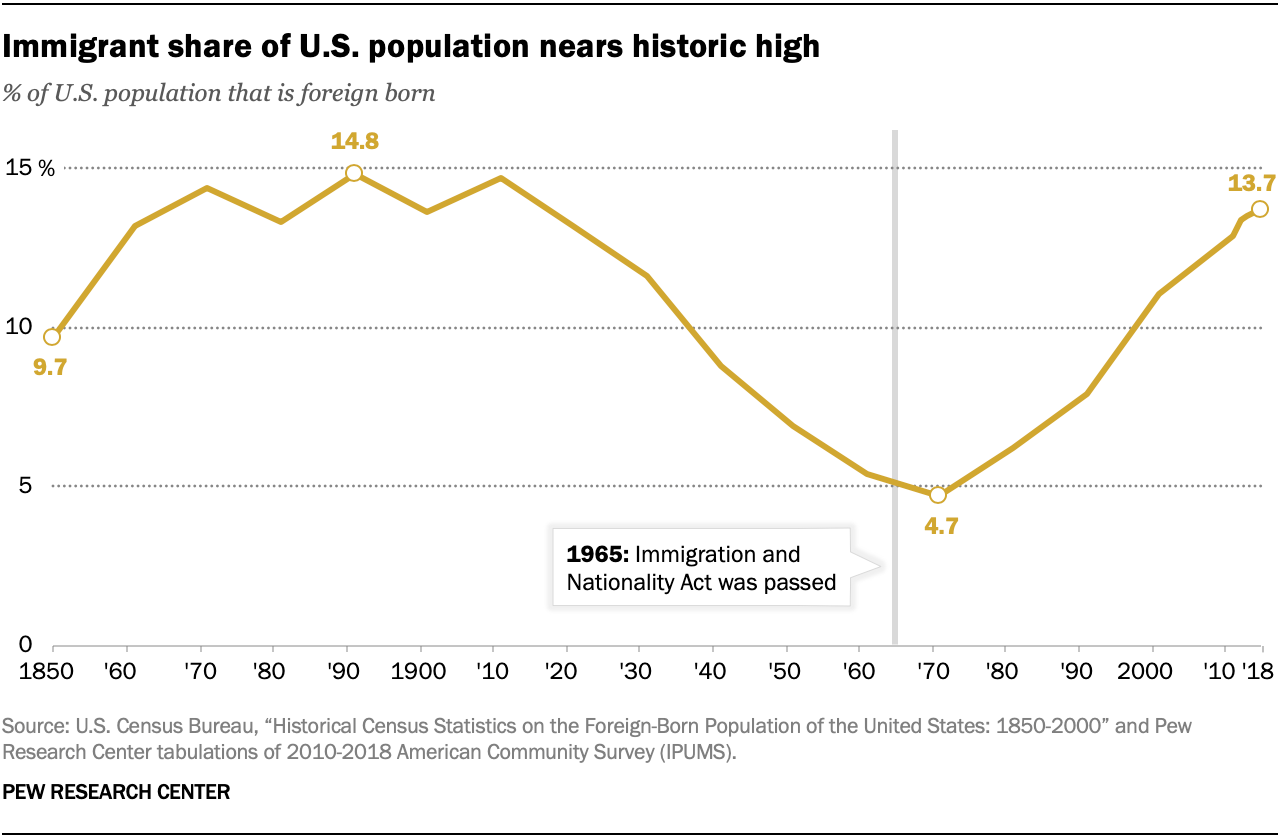

It still shocks me how many of my friends from $top_US_university got kicked out of the country (or almost did, saved only by marriage). Like, do we really want to kick out a half-Iranian nuclear engineer, who now wants to work as a SWE, because they were born in India?
I get that we can't open the flood gates. But it _does_ make a bit of sense to retain the top % of immigrants based on education in scarce fields, no?