My work sent out a memo today regarding what pronouns I'm allowed to use. We're in the middle of a cultural revolution, and the current trend seems to be for rapid acceleration rather than moderation.
The company I work for did something similar at the end of last year. We had consultants who went over everything, and made a massive document of all sorts of things they deemed "problematic". Along with a week long of seminars/training/workshops on sensitivity/inclusion/etc.
- Everyone had to list what pronouns they wanted people to use. In slack / our email footers everything. This was not optional. We were also told that referring to people by their names instead of pronouns can be offensive.
- Words such as "master", "owner", among some other ones were deemed problematic and needed to be changed. Ironically they also said use of "CRUD" was inappropriate because it was slang for poop.
- We have a bunch of things where we have an owner of users/reports/etc, and we have a bunch of code with stuff like "listUsersOwnedByUser", which apparently could be construed as offensive by certain groups of people.
- A bunch of verbs such as "see", or "visible" could be ablest, etc.
- Our company had a completely optional get out/get exercising type of thing since everyone is WFH, and apparently exercise could be considered offensive to people.
- Our company of 300 people does not have some sort of LGBTQIA+ outreach program.
Some of it made sense, but a lot of it was frankly so nitpicky and difficult to even understand. Pretty much everything we were told/taught went out the window almost immediately.
> Words such as "master", "owner", among some other ones were deemed problematic and needed to be changed.
This is slippery slope happening right before your eyes. For those who claimed that slippery slope is just a fallacy and never ever can be true.
When did Github change the default branch name from "master" to "main"? Few months ago? Now it's "owner" too, and using this word probably could get you in some real trouble.
I'm not even going to comment on "see" and "visible".
Every time I see a project on GitHub being pressured to change a term because of PC a little of me die inside. I still remember the PR where someone changed the term master to primary in Swift and Chris Lattner wrote a comment to object, only to delete it shortly after likely due to pressure.
It's a shame we can't stand up against bullshits like that because there's too much to lose.
What drives me crazy about the "master" vs "main" branch name is that before this started the branch name "master" was in my mind a completely un-racist definition. Now the debate has changed my the link in my mind to the point where I feel like a branch name has racist history and I feel dirty typing it.
That is where this movement is being counterproductive -- it's injecting racial division into places where there was none (neither systemic, nor overt, nor covert) before.
You give them too much credit. Injecting racial division is the entire point. Critical race theorists want to divide everyone up by their immutable characteristics, discriminate on the basis of race, and make everyone as hyper-conscious about skin colour as possible. They explicitly say that they want to undermine the American liberal order and do away with such concepts as legal neutrality and equality under the law; here's a quote from page 3 of Critical Race Theory: An Introduction, one of the leading textbooks:
> Unlike traditional civil rights discourse, which stresses incrementalism and step-by-step progress, critical race theory questions the very foundations of the liberal order, including equality theory, legal reasoning, Enlightenment rationalism, and neutral principles of constitutional law.
You saw this with Trump's anti-CRT executive order, widely misreported as "banning diversity training" or "banning federal employees and contractors from being taught about racism". People who claim that this is what the EO said either haven't read it or they're deliberately lying; section 10 of the order explicitly says that diversity training is still allowed.
What the EO actually banned was "diversity" or other training which teaches any of nine specific things, all of which are perfectly reasonable ideas to not want in government, for example that "one race or sex is inherently superior to another race or sex" or "an individual should be discriminated against or receive adverse treatment solely or partly because of his or her race or sex." Look it up yourself; read the full list of nine points and tell me which ones you would want to see taught to government employees (or anyone else).
Wokeists went nuts at this EO, and Biden reversed it on his first day. Why? Because they want to discriminate, scapegoat and spread stereotypes based on race and sex. What other possible explanation could there be? Wake up.
I think the discussion about “master” started within the context of “master/slave” DBs.
“Master” has both a non-racist and racist definition. After seeing it used in the context of a “slave” DB, I can see why the innocence of the word was lost for many in the programming community.
How can the definition of a word be racist? Making people slaves based on race was, obviously, horribly racist. But the words "master" and "slave" are not inherently racist.
> You mean the almost exclusively US interpretation is the most relevant.
As far as I'm considered, the worst part about this is that because of American propaganda in the mass media and popculture, people from outside the States are projecting American history and problems onto themselves, because that's a hip and cool thing to do now.
Sorry, I mean “master” can be used to describe a racist slaveowner or a non-racist skilled worker among many other definitions. But using the words master and slave together is to my knowledge primarily used in the context of describing a racist relationship, especially in America. The word pair has been co-opted by the programming community but I’m not sure why originally.
I was familiar with it in the hardware world before I was ever exposed to it in software, as in master and slave devices in SCSI, then later in context of data replication. People opposed to these words are making them racist (or acquiescing to those that want us to think that way) where their origin was never anything of the sort. The master/slave relationship predated the American continent and across the broad swath of human history has been a pretty color-blind enterprise. This accommodation to absurd American sensitivities is an embarrassing insult to basic intelligence that’s only getting worse. People need to grow the F up.
> People opposed to these words are making them racist (or acquiescing to those that want us to think that way) where their origin was never anything of the sort
I’m pretty sure actual masters and slaves were the origins of the words and predate your SCSI example.
> The master/slave relationship predated the American continent and across the broad swath of human history has been a pretty color-blind enterprise
But it’s never been healthy or admirable, wether based on racism, class, tribalism, religion, etc.
So we’re upset that we can’t personify inanimate objects and describe mechanical processes using words that were originally used to describe horrible human behavior? Is this really the hill to fight on? Does renaming a DB pair primary/secondary really mark the downfall of our society? No one is trying to make you “acquiesce”. If personifying an application with the words master/slave is super important to you, go for it.
It just seems more odd to me those that insist on using it rather than the multitude of words that aren’t associated with generational pain and suffering.
Obviously, where did you read me saying otherwise?
> [bunch of hyperbole about downfall of civilization]
The idiocy of attempting to change language like this and the rationale given is certainly making society dumber, to say nothing of the insulting nature of people pretending this buffoonery is perfectly natural.
> no one is trying to make you acquiesce
The comments on this thread contain many examples and testimonies to the contrary - corporate training programs, censorship.
> seems odd to me
Perhaps it’s odd to you because you see it as a small and limited change; it’s ridiculous to me because there’s no limiting principle to what’s offensive. This word pair is actually one of the less ridiculous attempts at linguistic overhaul (somewhat less ridiculous than trying to ban whitelist/blacklist, e.g.).
> where their origin was never anything of the sort
It sounded like you were trying to use the SCSI example or the programming example to show that “master/slave” is an innocuous word pair commonly used in ways that don’t apply to the slave trade. But their semantic origin is the slave trade. It’s like if we started referring to DB wipes as “genocides”. The origin of “genocide” and emotional impact of the word doesn’t change when the word is co-opted (poorly and for no ideal reason) down the road.
It sounds likes silly argument to argue that the origin of the word pair and it’s emotional/historical context should be secondary (or even ignored) because it was used innocently in a niche domain like hardware or software far later down the line. I guess I’m arguing the reverse that the original meaning matters the most and the latter applications of the word matter the least, simply because the original meaning is still taught in school and used as a reminder of the horrors of human behavior while the overhauled use of the word pair is a poor analogy that directly attempts to reference that original meaning.
> This word pair is actually one of the less ridiculous attempts at linguistic overhaul
Yet there’s huge resistance and debate about it. I don’t understand why one would want to draw a line in the sand here and insist on overhauling the original meaning of an emotionally charged word like “slave” to poorly personify an inanimate process. Even if I was going to personify a replica DB, I’d call it a “clone” or “twin”. I don’t think renaming “master/slave” is the social oppression / thought police we’re all worried about.
It is already difficult enough to come up with naming things that makes sense. I kind of get "master" when used in the context, however things like "owner" i struggle extremely hard with. Especially since major companies like Microsoft use it.
I remember asking what did they suggest instead of owner, and they basically gave a list of synonyms that frankly did not really work the same way, or are insanely long e.g. "Primary Account Holder".
I'm surprised I haven't seen "trunk" be suggested more as it works well with the branching analogy. It's used by SVN but I don't think that should matter.
DBs used to be master/slave. Should we keep that naming so as not to participate in a slippery slope?
It’s a fine line between a slippery slope and progress.
I remember in the 80s and 90s when older generations would complain that they couldn’t gay bash anymore. They thought it was a slippery slope that if they were forced to respect homosexuals, they’d be forced to respect other types of behavior they deemed immoral. Turns out it was just progress.
Recently, I noticed that I would refer to adult females as “girls” and adult males as “men”. I want to be careful with that in the future and try to change because I’ve been called out a few times and I can see how it’s disrespectful. And I don’t want to be those adults from the 80s I saw so resistant to change.
I guess I try to view it as each year brings new ways of communicating and interacting. It’s OK that I wrote master/slave years ago and it’s OK that I’d never allow that in my code base now.
We’re all trying to be better and that means change.
I’m glad folks are sounding the alarm because we don’t want to be complacent, but not every new social norm is suppressive either.
Personally, I don't see what the issue is with master/slave for databases. Of course it's a terrible and immoral relationship to have between two humans, but that doesn't render the words themselves immoral when used descriptively in a completely different context.
By the same logic, shouldn't it be offensive to refer to the "owner" of a house? Or the "torturous" path up the mountain? Can we also not "kill" a process? Or run a "headless" browser? Or talk about a project being a "death march"?
Counterpoint--the word "slave" does inherently refer to a relationship between humans (i.e. animals or inanimate objects cannot be slaves, as that word is defined). When it is used as a CS analogy, the analogy does refer back to that relationship between humans as its source of meaning.
"Owner" is fine because the generic, base meaning is not inherently wrong. Claiming to a person as a slave is one application of that generic meaning (which is ofc very wrong). Owning a record in a database or owning some land is another, distinct case (which is perfectly fine).
"Death march" and explicitly militaristic terms are not ideal, although many people do believe in some kind of just war, so theoretically words themselves are not fundamentally immoral, the whole topic is understandably not going to result in any positive feelings so it would be best to avoid it.
Likewise, "headless" if we really want to stretch it to a human analogy, would not refer to cutting off someone's head, but rather to a type of creature that doesn't have one in the first place.
I understand that these and other terms have historical baggage, but that seems like a property of language in general.
If we’re really thorough about this stuff, we’ll probably end up with hundreds of words and phrases that we can’t say because they could remind people of something dark or unjust in our history. Everyone will have to think about it constantly to avoid slipping up.
It strikes me as a lot of sound and fury for something that ultimately isn’t going to make a single oppressed person any better off, and that will lead to a lot of conflict and resentment when people feel that innocent patterns of speech are being policed.
> It strikes me as a lot of sound and fury for something that ultimately isn’t going to make a single oppressed person any better off
It’s not meant to make them better off, it’s meant to not make someone feel worse.
> completely innocent patterns of speech are now being policed
No one is perfect but if someone’s telling you that a word pair like “master/slave” sucks for them to have to type, why is our response anger and resentment at the “word police” rather than compassion and understanding?
If we consider the worst fates for a race or ethnicity we often think about genocide or slavery.
Just like we could “genocide” a DB by deleting everything, it would probably suck for many to see that word normalized in a new context. It’s probably good for some words to maintain their strong visceral reactions. I’d say the fact that “slave” feels like an innocent speech pattern is actually a good reason why we should want to move away from using it outside of it’s original historical context. The word “slave” should hopefully elicit fear, sadness and contemplation. Instead it seems it generates confusion as to why anyone would feel negative emotions in response to that word. Just like swear words, they carry weight largely because they’re seldom used and are often attached to emotions. To dilute their potency seems like a mistake to me.
In any event you’re not a bad person by any stretch if you use those words innocently. But I personally would rather use a different, less charged word to describe a DB if others were so inclined to indulge me.
I think the broader question is whether it's a good idea in general to go through terminology or common idioms with a fine-tooth comb looking for unintentional offense or the potential to offend.
It's of course very different when the intention is to offend, as with racial slurs, but when it comes to things like master/slave db, git master, 'sanity check', the masculine/feminine in Spanish, and others that have been mentioned in this thread, you're really talking about a project to 'reform' everyday speech, with no clear boundary on when this project would ever be complete. And really, there can be no clear boundary since 'unintentional offensiveness' is a purely subjective determination that anyone can claim in response to almost any word or phrase, no matter how benign others may find it.
However progressive someone's politics might be (mine are fairly progressive fwiw), this seems like a highly questionable undertaking. There are clear echoes to measures that have been taken by totalitarian regimes in the past, like asking citizens to call out and report each other for ideological transgressions.
Considering this danger and how much it aggravates people to feel that they must walk on eggshells with their words, there seems to be very little practical benefit toward advancing any concrete progressive goals. People not feeling bad seems like kind of a wash since it also feels bad to have your character questioned based on using common/widely accepted terms.
I hear what you’re saying about history. I studied abroad in Germany and those lessons are painfully obvious there. But for me the line is drawn at facts and opinion and words in their original historical context. No one is rewriting the definition of “slave”, they’re actually trying to preserve it.
“Master/slave” is a recent manufactured idiom. No one is hunting through dusty books trying to find things to be offended about. As more African Americans enter the field of programming the more apparent it has become how unnecessary it is to use this idiom. It certainly wasn’t coined in a programming context by an African American. It would be inherently obvious to them that it’s not even a good idiom from a semantic view. It’s only because African Americans were absent from those naming decisions that it ever gained traction.
No one is censoring facts or opinions here. They’re simply saying: “hey, now that African Americans are participating more in our programming community it’s become apparent how uncomfortable it is for African Americans to have to use this master/slave idiom that is barely even semantically appropriate. No one is blaming anybody but can we agree to use a term that’s both more semantically accurate and one that all of us including our African American colleagues feel more comfortable with?”.
It’s like if we’re in a public park and I ask you to take turns on the swing. There’s no rule about it and you could say I’m on a power trip trying to get you to give up the swing, or that I’m blaming you for not having noticed that I was getting annoyed waiting. Or we could just take turns and be friends. I want you to stop using the swing so I can use it. You being on the swing isn’t a problem, but acting like I’m oppressing you by asking you to change positions is a bit of a stretch in my opinion. No ones character is being questioned and no one is wrong. But if you say no to sharing the swing because you’re afraid of a slippery slope of me expecting you to share your house, your car, etc. then you’re operating out of fear rather than responding to my actual request. Or, you could trust that when my requests actually inconvenience you, you’ll say no.
> it also feels bad to have your character questioned based on using common/widely accepted terms
I’m know it does. But insisting you’re not offending anyone or have never offended anyone isn’t the goal. No one is perfect. No one can go through life without being a jerk or offending people. The real test is how we respond after we have done so.
If you used an idiom that made some people uncomfortable, just apologize and move on. Don’t be afraid to give up the swing worrying about everything else that might happen later. It’s just a swing and this is just an idiom. Offering understanding and compassion and even an apology costs you nothing but your ego.
I also hear what you're saying, and I agree with your point that a black person wouldn't have come up with master/slave. That said, I've also worked closely with black developers and while I don't want to make assumptions, it's really hard for me imagine them being offended by something like this. It's more like a parody of what a white person who has never spent any time with black people thinks a black person would be offended by.
But regardless, it's not that I'm so stuck on using this specific term. I don't care that much, and primary/secondary is fine, as you say. My point is that many people and groups will have more-or-less equally valid complaints about countless other words and terms, and I don't think attempting to excise all of them from our language is a helpful or productive path to go down. As many anecdotes in this thread have demonstrated, it's not "just a swing" or just a single idiom. It's already starting to snowball into a pretty long list.
> Personally, I don't see what the issue is with master/slave for databases.
Because there are other words that convey the same programming intent that don’t also personify slavery. I can think of dozens of oppressive human relationships that could also be used to describe a subordinate database architecture, but why? What do we gain by personifying our DBs with terms like “slave”?
They’re short words of convenience rather than some malicious intent, I get it, but it’s not hard to name it something just as relevant like “primary/secondary” or “source/replica” and move on to bigger and better things.
The other words you mentioned don’t have the same painful historical connotations for a large minority of the population.
Killing child processes could certainly have painful historical connotations for anyone who's miscarried, had a forced abortion, or is distressed by the historical existence of those events. I'm sure if it becomes politically advantageous to remove the kill command, a community organiser or developer advocate somewhere will immediately start lobbying for it.
> I'm sure if it becomes politically advantageous to remove the kill command, a community organiser or developer advocate somewhere will immediately start lobbying for it.
Politically advantageous? I’m not sure why social change is assumed to have ulterior motives. If one of my employees said a violent personification of a programming process was distracting or disturbing to them and made their job harder, why not change it? It’s not like these are technical terms. These are words that relate to human interaction that we’ve embedded into a non-human field.
There are tons of words throughout history that were accepted by previous generations that aren’t accepted by subsequent ones and vice versa. Language and social norms are always changing.
If you can’t speak the truth freely, that’s a huge problem. If you can’t program with others using your preferred personified analogy for a variable name when another variable name will communicate the intent just as well, that doesn’t strike me as quite the same existential threat to society and public discourse.
I don't believe that most of the cancelled terms were distracting or disturbing anyone who wasn't a political activist to any significant degree prior to being cancelled. Staking them out as unacceptable terms has brought into existence a battlefield where there didn't need to be one, and caused people to be offended by terms that hadn't offended them before. When I look for reasons why this might have been done, I find a lot of people making careers out of their advocacy, and getting a lot of dopamine hits from social media.
It's my impression that there are a lot of people looking for things to cancel, justified by their political beliefs, but motivated by social approval and career-building.
If this is the case, it's obvious why we shouldn't change our language to suit those demands: the demands are motivated by a positive feedback loop where cancelling is rewarded, and rewards enable cancellation, and so whether a term is a real problem is irrelevant so long as outrage about it can generate enough income or likes.
As the programming field becomes more diverse, isn’t it reasonable that some might have a legitimate emotional reaction to the word “slave” especially in the context of a “master/slave” relationship?
Or is it more realistic to assume that it’s people on power trips manufacturing outrage for social or physical currency? And that no African American would ever have had a problem with that word pair until a social justice warrior came along and told them to be outraged?
The latter is pretty insensitive, but not an uncommon view.
> we shouldn't change our language to suit those demands
Programmers used an analogy that attempted to change the meaning of the word pair “master/slave”. People are advocating not to change the meaning of our language but to respect the original meaning that is still taught in every school. “Master/slave” has an important historical meaning and isn’t something we should casually co-opt.
If someone wrote a script to “genocide” a DB instead of “wiping” it, I’d hope that we could see that co-opting a word that already has important historical meaning doesn’t help anyone, but surely hurts some.
I often think about how every generation I can think of had a fight over what was OK. The younger generation would set down some new standards, and everyone who grew up with the old "normal" thought it was ridiculous that the standard was changing.
So, whenever I think some "new standard" is ridiculous, I try to think on that for a moment and err towards not wasting too much time worrying about it.
Does using the new term hurt me in anyway? Does it help someone else? Alright, then. I might not get it, and it might feel ridiculous to me in the moment, but I don't want to be the guy yelling about how calling something "gay" isn't homophobic.
Maybe it doesn't "hurt" you in a direct way, but forcing people to change their behavior for a power trip is not something you should willingly bend over for. If change is for good, you should be willing to change. If it's for nothing, it's okay to resist.
I think the idea a change is "for nothing" is subjective, and that the people most likely to say a given a change is "for nothing" are the people who don't benefit from it.
Again, I go back to my example.
Were LGBT activists "forcing me" to change the way I used the word "gay"? Sort of. Did doing so hurt me? No. Did it benefit them? They say it did. Was it for "nothing"? They say it wasn't.
Language changes. I'm not going to waste a lot of energy worrying about it.
Those are examples where you examined the choices and decided that a change makes sense. That may not always be the case. Again, you are capable of deciding. "For nothing" is subjective, and, as such, you get to use your best judgement. Good luck.
My point is that because "For nothing" is subjective, my own bias will lead me towards discounting the benefit of a given change. So, I err towards being accommodating when the request requires something so small from me.
At the time, I thought the change was ridiculous. It took me a few years to realize I was just being petulant.
Isn't there a risk that, like feeding pigeons, you end up encouraging minority groups to become over-sensitive, because they become addicted to the power of controlling what other people say?
2. Going back to my example, the whole "if we let them do X, where does it stop?" was a big part of 90s discourse regarding LGB rights. So far, the slope hasn't slipped into any of the scenarios people brought up. Language changed a bit. Some people felt more included by society. I suffered no injury beyond letting go of the notion I was entitled to use certain words to mean certain things.
I found other ways to convey those things. It turned out fine.
I apologise if my analogy made you feel uncomfortable, and I'd be happy to learn a different analogy which expresses the same idea just as clearly. If there isn't an effective alternative analogy, though, then it might appear as if you are using claims of discomfort to limit legitimate criticism of your ideas, which I trust isn't the intention.
I appreciate you responding to my criticism despite my analogy, but I was concerned you might try to discourage or prevent people using such an analogy in future, without offering an alternative (and despite me having no ill intent behind it).
As for why I used an analogy, I don't know what reason will satisfy you. People use analogies to help other people get an intuitive sense of an idea which might otherwise be hard to explain. If you understood my point without needing the analogy then that's great, but I don't want to assume that analogies are never helpful.
It's possible to recognize some changes as warranted and some changes as being misguided or based on entirely false premises. You are capable of examining your thoughts and listening to other people's explainations for determine which is which.
I often like to imagine that if I were in that situation I announce that I sexually identify as military attack helicopters and insist my pronouns are apache/apachim, but I know the irony would be lost on them and really would just result in me getting fired for thought crimes.
Honestly the person running the seminars was very very strict. Several people said "I don't really care what people call me by", or can I just leave it blank to be what people want. The person explained how that attitude is disrespectful to people who do care about these things, and how it can foster an environment of hostility towards people who put them. Which in turn marginalizes those people etc.
However in January the entire sales team removed them after apparently a customer reacted negatively to the inclusion. Which lead to other external facing teams removing it to prevent the same issue. Most people have removed it from emails, and honestly many people just don't seem to care, and HR doesn't seem to be enforcing it.
The funniest thing of the whole "thou shalt list your pronouns" thing is that the actual trans folks I've talked to tend to be opposed to those policies. It paints them into a corner - either state that you want to be misgendered, or out yourself as trans.
Mandatory pronouns are a pure shibboleth in the culture war. Trans activists don't want it. Anti-trans activists don't want it. The only people who want mandatory pronouns are the folks wanting a cheap signal for how much of an ally they are and an easy way to identify and ostracize people who aren't in-line with their politics.
"It paints them into a corner - either state that you want to be misgendered, or out yourself as trans."
Huh? What do you mean? How would not listing pronouns help?
That's awfully strange they would have a problem with that, because there are some non-binary people who do welcome the use of all pronouns and even discourage people from using only one, or only the one they were initially using.
If someone is really okay with all of them and wasn't just saying it to be disrespectful, then it's fine. If they said it just to devalue someone else who did care (but really cared themselves all along and in no way would actually be okay with it), then it is wrong.
That's the whole point. It's a billion-dollar industry created by useless people with no real economic value. They need to inject racism and sexism and division into every situation so they can claim credit for opposing it. How else are they going to justify their bloated paycheques?
> Everyone had to list what pronouns they wanted people to use
I’ll be glad to demonstrate my knowledge of Unicode, Sumerian and Chữ Nôm in my signature and be OFFENDED by any "woke" idiot who get it wrong. Bonus point if the fault lies in fact in software the company uses.
In my opinion, its definitely worth getting rid of "master/slave" since after all it does directly refer to a violent and wrongful historical relationship. It may be only a metaphor, but it does clearly refer to that and I can understand how that makes some people feel unwelcome. But ownership is a little different. One object owning another doesn't make any reference to the "ownership" of people in slavery, it just as well references the ownership of literally anything else which is perfectly legal.
I also don't buy the "see is ableist" thing. Entire languages would be unacceptable if that were true. For example Japanese appends -て見る (see) to verbs for the meaning "try to <verb> and see (how it goes). That notion of "seeing" is a fundamental part of the linguistic concept of "see" in most languages and it is in no way a reference to blind people. When you say someone is "blinded by the sunlight" or describe a "deafening roar" you are obviously not saying anything about blind or deaf/Deaf people, those words clearly have included a wide variety of definitions including temporary ones which were then the basis for metaphorical ones. That's different than "master/slave" which is a metaphor for a word/concept that was inherently racist and violent from the beginning.
On the other hand, I don't think pronouns in email signature is a bad rule. Even if the pronouns you use are the same ones you have used your entire life, you do have a preference nonetheless, so I don't think there's anything inherently unfair about making people specify them. It's not like you don't want people to use any pronouns or you don't feel that they should exist at all, so it's not really harming your rights. It does help trans people feel more accepted in sharing their pronouns, and it doesn't really cost other people anything to do it.
The stuff about CRUD is just absurd. As is creating ultra-expensive outreach (that make money for the people writing these reports) for companies to small to support it. If HR was concerned about inclusion, they could add a tasteful note on their website about how their workplace was affirming/welcoming space and that they welcomed those applicants. Of course, employees should certainly be free to create such a group if there is actually interest in it.
Here in Flyover Country, these debates sound entirely bizarre. I was going to say "It sounds like everyone's lost their minds", and I noticed I didn't say "his mind", so clearly there's a lag.
That's fair. I don't think that anybody who says that is thinking much about it, but isn't that the point? To establish the default that nobody thinks about?
These conversations always crack me up. Its just so comical. An empire with the largest military presence around the world, outspending the rest of the world to buy weapons that can decimate the world population multiple times over, but, somehow that is not "offensive"..
Doublespeak is used to hide the truth, not to express the truth. The renaming happened in the late 1940s, in a United States that was reluctant to join WWII in the first place, and as the entire world got behind the idea that aggressive war was a violation of the law of nations.
"express the truth"? This is not subjective you know, USA got had more wars in the last 100 years than any other industrialised nation. No matter your political views, the truth is 'department of war'
You're right. It isn't subjective. You're wrong as a matter of numbers, as a matter of legal analysis, and as a matter of history. Stop pushing a political narrative.
Wars over, the ultra-left won via social network and Internet. They will ban more stuff. You ever heard of good people banning books and banning words? It is mostly dictators doing that.
Legitimate question for liberals of the freedom-and-mild-socialism variety: what do you think about this? Do you find that the current leftists in control of government and media are liberal like you?
> You ever heard of good people banning books and banning words?
A majority of developed democracies have laws that restrict hate speech, including Australia, Canada, Denmark, France, Germany, India, South Africa, Sweden, New Zealand, and the United Kingdom.
The point I made isn't that we should ban hate speech; it's that looking at which countries/companies ban hate speech is a bad litmus test for determining which countries/companies are bad. The parent comment asked if we "ever heard of good people banning books and banning words?". Yes, I have. The majority of democracies have done so. The U.S. is in the minority. Lack of hate speech laws doesn't correlate with any of the major freedom indices or human rights indices.
As a separate point, Canada's hate speech laws have been working quite well. They're used rarely, and only in extreme cases, like a case where a promoter of the Rwandan genocide wanted to immigrate to Canada. Judges understand that "speech I hate" isn't the legal standard for hate speech.
> Judges understand that "speech I hate" isn't the legal standard for hate speech.
They do for now. But if you'd been paying attention lately, you'd know that the dominant ideology among our elite universities and a growing number of our institutions is no longer liberalism, under which free speech is valued. Liberalism has been replaced in the univeristy by critical theory, and its offshoots like critical race theory, under which it is absolutely 100% taught that hate speech is precisely equivalent to "speech I hate", or more accurately, speech the left hates. Argue back and you'll probably get sent that meme about Popper's paradox of tolerance, but it's actually based in the Marxist philosopher Herbert Marcuse's theory of "repressive tolerance", which basically states that far-left radicalism should be tolerated and nothing else.
Critical race theory (which could best be summarised as "anti-scholarship racism masquerading as anti-racist scholarship") was born in law schools and is now being taught as unquestioned fact throughout the education system, to children at an increasingly young age (which is the whole point of cancelling Dr. Seuss - so they can shoehorn in pro-CRT books to children instead.) Lest you think I'm being paranoid, here's none other than the American Bar Assocation propping up CRT: https://www.americanbar.org/groups/crsj/publications/human_r...
Where do you think the next generation of judges is going to come from? Don't say you weren't warned.
its not a cultural revolution, its a cultural intimidation, where groups have come to realize the real power of social media is to name, shame, and blame.
there is no middle ground here, you cannot debate anything, as they consider no moral higher than what they profess.
this is some serious Soviet Union type stuff being done to rewrite the world, no limits on how back one can go for an accusation, and then erasing people from the public for a transgression.
Fake news isn't the main threat of social media, intimidation, degradation, and even threats, is.
The struggle sessions are the most visible part. In the American cultural revolution they are mainly online (for now). What's a struggle session? Think of all those fake apologies after someone did something perfectly ok but the mob goes after them.
> In the struggle sessions the accused, often teachers suspected of lacking proletarian feeling, were paraded through streets and campuses, sometimes stadiums. It was important always to have a jeering crowd; it was important that the electric feeling that comes with the possibility of murder be present. Dunce caps, sometimes wastebaskets, were placed on the victims’ heads, and placards stipulating their crimes hung from their necks. The victims were accused, berated, assaulted. Many falsely confessed in the vain hope of mercy. Were any “guilty”? It hardly mattered. Fear and terror were the point. A destroyed society is more easily dominated.
Edit:
The goal is to replace enlightenment values with critical race theory.
> Critical Race Theory presents a radically different view of our society and of us than most of us recognize or accept. They begin with the assumption of racism and look to find it. They say everyone who doesn’t do this is complicit in the problem, including just for disagreeing with Critical Race Theory. And they reject the fundamental liberal, reasonable, legal, and scientific principles upon which liberal societies operate.
https://newdiscourses.com/2021/01/what-is-critical-race-theo...
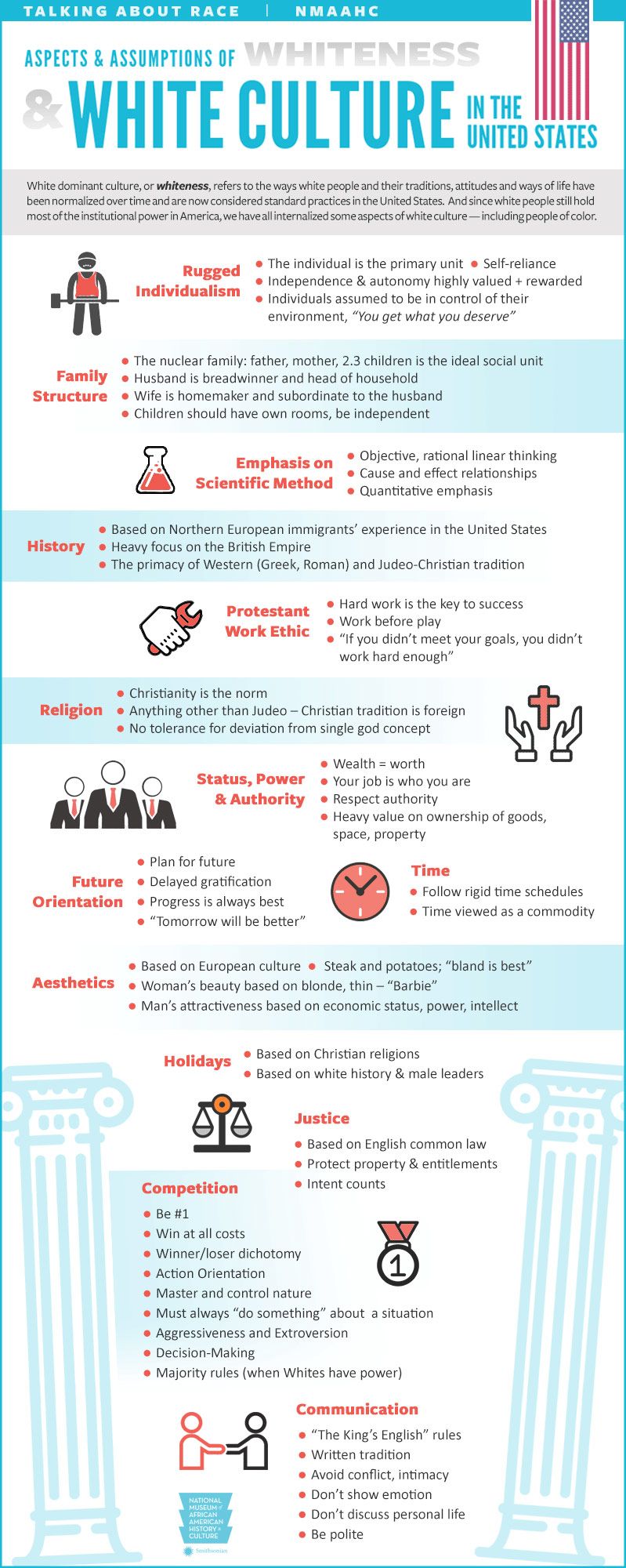
I've seen that infographic about "white culture" before (hello to my fellow New Discourses fan) and it's such a great illustration of how this movement is not only insane, but absurdly racist.
They think that aspects of "white culture" include "following rigid time schedules", "rational linear thinking" and "being polite"!!! What is the implication of this? That black culture doesn't bother with such trivialities as good timekeeping, rationality and being polite? Is this from an "anti-racist" document or a Klan pamphlet?
(Also, anyone who thinks there's anything inherently "white" about following rigid time schedules has obviously never spent much time in southern Europe.)
>And they reject the fundamental liberal, reasonable, legal, and scientific principles upon which liberal societies operate.
Is this a crime in itself? Do we really need to cancel academics over rejecting something because they find it logically or practically wrong? Isn't it a bit of a word-game to to identify liberalism with 'reasonable'?
The whole statement seems to start from the presumption that liberalism is reasonable. I can think of many arguments stipulating that it's not. As it turns out, describing your ideology (in this case liberalism) as inherently and unquestionably 'reasonable' isn't a particularly strong way to go about defending that ideology. A Communist or a Nazi could easily say the same thing about their own ideology.
> Is this a crime in itself? Do we really need to cancel academics over rejecting something because they find it logically or practically wrong?
The problem isn't "these academics aren't being canceled for their ideas"; nowhere did GP say such a thing. The problem is "these academics, and people animated by the ideas they expound, have gotten power and are using it to implement their ideas, which is eroding fundamental principles of liberalism (like tolerance of dissent) and this seems really terrible".
>"these academics, and people animated by the ideas they expound, have gotten power and are using it to implement their ideas, which is eroding fundamental principles of liberalism (like tolerance of dissent) and this seems really terrible".
This seems so ironic to me. Liberals, then, out of all people, should at least tolerate the dissent of people who don't agree with it. Further, in the interest of argumentation and creating a better society (in whatever metric that may be), we should listen to the arguments and criticisms against liberalism. That's not 'really terrible' by any stretch. If your ideology can't stand up to such criticism, it's likely deficient in some way.
We've rejected fundamental principles of societies in the past, whether slave societies or patriarchal societies or theocratic societies. The mere fact of rejecting a fundamental principle with reasoned argument is not a negative, it can be a great positive.
Liberals do tolerate, and have tolerated, the dissent of people who have disagreed with liberalism. (By "liberalism" I mean Enlightenment philosophies, not "the left wing of the U.S.".) (In this post, I'm speaking in generalities and making some assumptions...)
The problem is that a subset of the people that were so tolerated (let's call them Visigoths) have now taken control of the academies and other institutions (to varying but increasing degrees), and are establishing their own new principles—which are incompatible with the liberal principles, so they're getting rid of the latter, and also pushing out the liberals themselves. The Visigoths do not tolerate dissent, so while the Visigoths were allowed to thrive in liberal academia, liberals are not allowed to thrive in Visigoth academia.
The Visigoths didn't get there by reasoned argument, nor by democratic majority. It seems to have been a combination of (1) mendacious argumentative tactics (e.g. dismissing one's opponent as "privileged" or even as an oppressor, essentially an ad hominem; falsely smearing one's opponents as "racist" [if pressed, they claim to have redefined "racism"] and similar terms; using guilt by association and other tactics to smear one's opponents as Nazis or other villains; responding to objections by saying "Look at these horribly oppressed victims; your concerns are invalid" [optional followup: "the fact that you have the luxury of caring about that concern shows your privilege"]); (2) shaming, intimidation, and bullying tactics (some of which are closely related to the smearing); (3) claiming to represent genuinely good causes that came before them (i.e. those for equal rights and equality before the law), and using that to win the support of the naively well-intentioned and to malign opponents as being opposed to the genuinely good stuff; (4) using university classes for recruitment and training, in which some of them (as professors) teach their views while suppressing dissent (finding various excuses for doing this in a nominally liberal institution); (5) despite being a minority, aiming to sound like a majority by being loud and suppressing dissent via bullying and mob targeting.
It's a pretty interesting accomplishment. Some of it was consciously arranged; much of it is probably not, and is out of control of those who laid the groundwork. The animating mindset seems to involve always looking for oppressor-victim dynamics: always looking for someone to hate, and someone in whose name to hate. The ideology is inconsistent enough to almost always give a way to find words to condemn one's chosen target (one example: roughly speaking, a work of media can be condemned as "exclusionary" if it doesn't have certain minorities, as "tokenism" if it has them but portrays them the same as everyone else, and as "stereotyping" or "cultural appropriation" if it has them and tries to portray anything specific to that minority); probably as a result, different branches of the Visigoths fight each other a lot, which may partly explain how they get good at fighting. I suspect the sense of how to choose targets is dictated primarily by primate-dominance-contest social instincts, which likely work pretty well or else there would be a lot more chaos than there is.
Is there hope? Ideally, we could get an "everyone knows that everyone knows" moment where the well-meaning majority recognize that the Visigoths are fundamentally just destroying things and not seriously helping those whom they claim to protect (e.g. policy recommendations like affirmative action and mandatory sensitivity training are counterproductive; telling people not to aspire to "colorblindness", because it demonstrates privilege and probably racism, is counterproductive). But I doubt that shooting down particular proposals is going to work, nor would firing everyone who seems like a Visigoth be good or feasible. One interesting proposal is to get the Visigoth ideology classified as a religion, and therefore forbidden to be taught uncritically in public schools. That would be appropriate, but on a few levels I'm not sure if it's feasible. Perhaps because I'm in an immunizing mood, I wonder if it would work to get people to recognize the underlying Visigoth mindset—the "always searching for someone to hate, and someone in whose name to hate", the acceptance of logical inconsistency and ad hominem and redirection and everything else—so that, when exposed to Visigoth teachings, their reaction is to attack the logical weaknesses and eventually to perceive the destructive mindset that generates them.
Period of time when communities and organizations had to turn in their colleagues for not supporting the party. Kids reporting on their parents, coworkers reporting to each other, that sort of thing. It was a period marked by a lot of 'virtue signalling' support for the party.
Highly recommend the film "The Blue Kite" concerning the period (can't speak to the accuracy but at least the creator says its true).
I've heard reports from Chinese immigrants who lived through the Cultural Revolution and are saying the same thing - maybe not that what's happening is "exactly" the same but that we're very much heading that way.
We should be very worried, and we need to take action.
I've referred to entirely-female groups of people as "you guys". It seemed like a better bet than "hey ladies", and I'm not southern enough to pull off "y'all".
I'm not southern either, I'm from Central Florida [0] and we use Y'all often. I believe in your ability to use Y'all too! Embrace Y'all :)
[0] There's a joke in Florida that the further north you go, the more south you are. The further south you go, the more north you are. It's 100% true too.
It is only once I hear y'all from woke people that I start to understand why people dislike so-called "cultural appropriation". It is cringey and weird-sounding to me. And also if you were to speak to these same people saying "y'all" in any southern accent you would be seen as uneducated.
referring to a group of females as "you guys" has been the best way to express non-sexism through the 2000s in my view. It's like brazenly saying, "I refuse to make anything of your gender, nor would I think your gender means I should hold a door for you, because again I'm not even thinking about the existence of gender." If we lose that usage, I'll be culturally lost and disoriented.
Y'all is usually positive, but can be negative "What on earth did y'all do now?!?", and "you lot" leans negative, but can be used positively "Alright you lot, lets get it done".
Tone of voice is extremely important in both examples.
And you’d be surprised at the number of people who (validly) don’t like this but won’t speak up about it. I know women in tech who tell me this exact behavior feels constantly degrading and makes them want to leave tech. There are alternatives in English other than y’all, such as “team” or “everyone” or “all”.
I've been wondering what would happen if the same political correctness ever came to Spanish. Every noun is gendered, usually according to whether it is associated with males or female roles.
The term doesn't even have a broadly accepted spanish pronunciation yet!
I think the term exemplifies the issues that occur when (especially white) "diversity professionals" are given institutional power to speak on behalf of racial groups they are not a part of.
I'm happy to refer to individuals who identify as latinx as such, but I think it is wildly presumptive and slightly offensive to assume this form should be preferred in general when the Latino community has not yet accepted it. Something about the academic/professional class in America defining the term for a diverse group of people spread over multiple continents rubs me as off-putting and ironically colonialist. (But I'm a white dude, so my opinion doesn't even matter and we should all happily use whatever term becomes accepted by the Latino community)
Latine seems to be gaining some steam as well, and makes a lot more sense: -e is the gender neutral suffix in spanish. However, it is still not broadly accepted (as can be seen in this comment section)
Latin would be ungendered, but it's been said for years by all sorts of people so it doesn't serve the cultural signalling purposes to show that you're enlightened. Gotta use that x to demonstrate your tribal allegiance.
Latin also doesn't imply "of south or central America" in the way latino/latina/latinx/latiné (which is the other approach that's gender neutral and easier to pronounce that I've seen) do. Latin implies, at least to me central European, old and vaguely Italian, as opposed to Latino.
You could also use "Latin American", which may also work, but historically Latino/a have been preferred, possibly since "Latino" is a lot easier to say than "Latinoamericano".
The question is, preferred by whom? Most Hispanic people use "Hispanic", and almost all of the remainder use "Latino". The other terms are fashion statements to show that the speaker keeps up with new intellectual trends, so they lose preference whenever they become too well known; you can date groups like fossil records by seeing whether their name uses "Latinx", "Latina/o", "Latin@", or "Latin".
I think phrasing it as 3% is a little misleading. Another way to view that same study is roughly 15% of Hispanics (and 21% of Hispanic women) who have heard the word have almost immediately adopted using it to describe themselves. That gives a slightly different picture on its adoption.
I did some quick searching and couldn't find parallels for adoption rates among other groups for new terminology. For example, the Black community has gone through several different self identifying nomenclature changes over the years. Were any of those changes immediately and universally accepted within a handful of years? My guess is probably not.
And what about the remainder that hear it and reject it? Are they not considered?
I'm Latino myself and I find that almost no one that actually speaks either Spanish or Portuguese (or another language commonly spoken in Latin America) as their first language adopts it. The few I've seen adopt it at those that are born and raised in the US and have relatively literal cultural connection to the country of their ancestors.
If Spanish or Portuguese are truly your native tongue, Latinx feels incredibly awkward. Personally, I'm uninterested in the opinions of those who aren't native speakers of one of these two languages when it comes to using the term Latinx or not.
>And what about the remainder that hear it and reject it? Are they not considered?
I don't know how you got that from my comment. I am not advocating for Latinx as the one and only descriptor. I am simply pointing out that it is being adopted quickly considering how recently it entered the lexicon.
>I'm Latino myself and I find that almost no one that actually speaks either Spanish or Portuguese (or another language commonly spoken in Latin America) as their first language adopts it. The few I've seen adopt it at those that are born and raised in the US and have relatively literal cultural connection to the country of their ancestors.
>If Spanish or Portuguese are truly your native tongue, Latinx feels incredibly awkward.
I can't deny your experience, but I will simply say the numbers from that survey do not agree with your conclusions. The percentage of people who adopt Latinx actually grows for people who use Spanish more. The rough adoption rates are 10% for English dominant speakers, 14% for bilingual speakers, and 29% for Spanish dominant speakers.
>Personally, I'm uninterested in the opinions of those who aren't native speakers of one of these two languages when it comes to using the term Latinx or not.
I don't think this type of gatekeeping is productive. It is meant to be a ethnic identity. Anyone of that identities as part of the group should have an equal input on the naming conventions. I'm not aware of any other ethnic group in the US that is defined by different names depending on their native language.
From a data science perspective, I'd argue that "a (sub)demographic exists where >50% of people who have heard of the term use it to self identify" could be a good indication of when society should interpret a term as "meaningfully prominent". It looks like there is no demographic which exceeds a 30% proportion of heard to using Latinx.
I wonder if the term reaches this proposed 50% threshold within the college-educated LGBT 18-29y/o Latino/x/e population.
A few Hispanic that were also LGBT started Latinx. LGBT Hispanic are not some hivemind borg and when people state "LGBT Hispanic people did X" it eliminates the agency of all the individuals who are both LGBT and Hispanic.
In Spanish? I’m having a hard time imagining how a word in Spanish would sound with an “X” at the end. “Latine” seems easily pronounceable but I’m not sure what the point of adding the “e” is. It’s not like that vowel signals gender neutrality in any consistent manner in Romance languages.
Spanish speaker here. X after N is basically non existing in Spanish. Most people who don't speak other languages will struggle pronouncing that. Spanish speaking woke-alikes use "e" or "@", or unnecessarily repeat the words in both genders.
Also in Latin(American) includes Portuguese and French speakers. Limit it to Spanish language/culture/heritage would be Hispanicx, which is also nonsensical, especially because I just made it up.
But I'm just a person who speaks Spanish, French and Portuguese, so take my word with a grain of salt.
Latinx is pronounced the same in English and Spanish. It being unusual for Spanish is why Latine is more popular in countries with less English influence.
Nothing signals gender neutrality. That's why people made something up. e is a simple replacement for a and o and sounds more natural than i or u.
Way more Latino Democrats watch Fox News than listen to NPR: https://images.app.goo.gl/kpSgBJpsvVGTqPNC6. I suspect the third of Latinos who voted for Trump listen to NPR at even lower rates.
The point is that typical Latino people aren’t in the NYT’s and NPR’s target audience. That’s why those outlets use terms like “Latinx” that polling shows are unfamiliar to most Latinos. (I’m using the example of Fox News just as the banana for scale, so to speak. If you have a preconceived view that people of color who watch Fox News are relatively rare, ones who read the New York Times are rarer still by a large margin: https://images.app.goo.gl/vgyXCnAoS8TdPYU3A)
I had the opportunity to ask a very social-justice-minded friend of mine how custom pronouns and genders could possibly work in Arabic, which has many deeply integrated rules on gender modification of words. Adjectives, verbs, and pronouns all change depending on the gender of the object. Her response was that the language must be changed to suit the preferences of people with nonstandard genders.
It really feels sometimes that this is a sort of soft English imperialism, forcing other languages to the margins by making their use "impolite" to the global audience.
I find it hilarious (and sad) that I'm being downvoted because women have told me that they don't like being referred to as a guy when they're not one, and its one of the many ways that the 'default male' attributes of tech take a toll on them.
Another personal anecdote, but not only do I consider "guys" gender neutral, but I found it kind of alienating when a few people clearly stopped saying "guys" shortly after I joined the team. I was the only woman on the team that summer (internship), and I think they were just trying to be nice, but I don't like when attention is called to gender in the workplace. The more (actively) aware I am of being "different", the more it impacts interactions.
I don't doubt that some people think the way you're describing, but it just seems to me that complaining about gender-inclusive "guys" is the exact mirror of complaining about AAVE. It's extraordinarily exclusive to say that you can't be comfortable unless everyone talks the same way you do.
Not at all -- you're using a very specific word to refer to someone that they could consider inaccurate. If in AAVL there's some word that would refer to me as a woman or straight or a diff identity than I have, I wouldn't like that very much.
The problem is that "you guys" simply does not contain an assumption of anyone's identity in my dialect. Both women and men in my circles use it freely regardless of the group's gender balance. So when I hear someone say that "you guys" doesn't respect their identity, it sounds to me like saying "y'all" or "everyone" doesn't respect their identity - it's hard to wrap my mind around what such a claim could mean.
I don't know that I've ever heard someone say "guys and gals" outside of TV.
It's easy for me to understand that some people use "guys" in a gendered way, but I don't see what that has to do with people like me who don't. The argument seems to be that their dialect is "normal" and everyone else has to learn to speak like them, which sounds terribly exclusionary.
I'm pretty confident they would not. I've often asked for such courtesy with regards to terms like "male privilege", and the most courteous responses I've ever gotten are attempts to educate me on why the term is not meant to be offensive, much like the response I've offered here. (The most common responses are along the lines that my discomfort is the whole point of using the term, so I'm sure you can see why it's hard to believe there's any symmetry here.)
How does the definition of male privilege differ in your respective dialects? What is your dialect's inoffensive term for what they mean by male privilege? Or is it the concept that offends you?
I have no objection to claims like "Men have gender-based advantages in many things" or "Women face many problems which are hard to understand when not experienced daily". The problem with the term "male privilege" is that it comes across to many people (including me) as a sort of attack - it seems to suggest men should feel embarrassed or ashamed about their gender. (And this isn't just some crazy scenario I made up - I've heard mainstream figures say they're embarassed to be men as many words.)
What I dislike about things like male privilege is it points the spotlight away from women and ways they are unfairly treated to men.
To me it feels likeanti-colonialist rhetoric perversely applied to gender relations. When you comment on colonialism it makes sense, I'm using a f'ton of resources from say Africa that saps that live there aren't allowed to. But for gender relations, it's not a zero sum game.
I don't feel like I've ever satisfactorily understood why it feeling degrading to them is of greater weight than the degrading feeling of being told that your natural pattern of speech is forbidden.
leave tech because of a gender neutral saying and no ill intent whatsoever?
that's ridiculous, honestly. it's just an example of how people can always find a reason to play the victim. you don't have to play along and reinforce victim mentality.
But "guys" is not the plural of "guy" in many regional dialects of US English. It is specifically gender neutral, and used by women to speak to a group of women -- e.g. a girls' soccer coach saying to her team, "Let's go guys!"
Can you expand on why y’all makes them feel degraded? Y’all is often used to convey a feeling of warmth towards the addressee or express familiarity, which seems the opposite of degrading.
I'm not saying y'all does, I'm saying 'hey guys' does when they're, in fact, not a guy. Or a least for some. I also know women who aren't offended by it and we've had explicit discussions surrounding it. But being more thoughtful doesn't seem to hurt anyone when there are more inclusive terms you can use.
I can tell you as a gay man I appreciate when people ask about my partner (gender neutral) versus default to wife. Am I offended by it? Not really, it's right 90% of the time. But it's nice that people are considerate of other options when they don't know themselves. And you don't know that I'm gay by looking at me. Many women you do know they're not a man, so you would already know that you're using the male pronoun as default for all people when you could be more contextual to the situation (and avoid pulling the entire history of male-dominated societies and language with it).
The problem I have with the word "partner" is that it is ambiguous -- it could mean life partner, sexual partner, or business partner. Honestly I wish there were another commonly accepted word I could use to avoid the ambiguity. "Spouse" comes close (if the couple is married) but there isn't a in well-accepted gender-neutral term for the other member in an unmarried pair. "SO" (significant other) comes close, but often I have to explain what that means, so I can't consider it well-accepted. And people seem to associate "partner" with sex, so if the couple is remaining chaste until marriage, using "partner" can be offensive. Sigh - English is hard.
"Partner" is a mostly term used with gays. straights many feel strange to apply this term to husband, also wife. Can someone not simply ask about "spouse"? There previously exists term without gender for such persons.
"Spouse" implies marriage. "Significant Other" is a common safe bet, but is a bit too much of a mouthful IMO.
I've seen "partner" being used in reference to hetero relationships more frequently in the last decade, and think that's probably a good development. "Boyfriend" and "Girlfriend" sounds a bit infantilizing to me when used in reference to adults.
My wife and I still call each other boyfriend/girlfriend, but we are old fashioned. We like it because we are an dating (each other), even though we are married.
One argument in favor of using partner is that boyfriend/girlfriend is ambiguous. My wife often refers to her close female friends as "my girlfriend", even though they are clearly not dating each other. It occasionally causes some confusion with people a generation older than us who aren't familiar with that usage.
Partner/spouse/significant other... doesn't make a difference which one to me. I just picked that one at random. The fact that people create space for me not to have a wife is what I appreciate.
So as a married man, I use partner: it fits with my understanding of marriage, we’re partners, we both have a hand in managing a household. It feels good to say.
The correct form is "folx". Spelling words with an "x" is more inclusive toward marginalized groups, particularly LGBTQIA+, despite there not being an "x" in there. See also womxn, Latinx, etc.
Twitch received quite a lot of backlash two days ago for using the term womxn. The sentiment was that it isn't inclusive and is instead transphobic, because it separates trans/non-binary women from other women.
There are plenty of other alternatives (folk, team, mates, friends, pals) - please realize there are a lot of women who are bothered by it and don't feel they can speak up about it.
You really are pushing the idea that all conversations should be altered so that no one is offended, for any reason however silly, ever. Because if they say it's offensive and attributes it to their identity, one cannot argue back.
why is it so hard to respect what people want to be called and referred to as? It's no different than someone with the name William wants to be referred to as Will, but you stubbornly keep referring to them as William because its their legal name and i can damnit!!!! Just acknowledge it and move on with your life.
When I was a kid, I couldn't pronounce R's and used to be teased endlessly. Should I demand words with r be banished because they made me uncomfortable? I didn't even know that was an option.
I'm not sure this is the hill I want to die on, but where is the line? How few or many people have to feel a certain way to effect change?
i'm not sure how this is the same as asking "please call me x", "please refer to me as his/her/them" compared to "i'm not going to say your name because i can't pronounce it" ?
This is under a thread of using "guys", which is what i'm specifically referring to, nothing else. Its common use, and dictionary definition even, is a nonderogatory nongendered word. So I personally feel taking it as gendered or as disrespect is disregarding the meaning of the word, and asking me to accept whatever yours is. Just as me asking nobody to use r words is asking the world to comply with my preferences.
I'm not going to argue right vs wrong or with you directly, I'm just explaining my comment and thought process.
It's the same argument thou - when you refer to a person/group of people you imply a lot about them with the word you use, men/children/kids/elders/americans/whites/ect - guys is no different to a lot of people as its so easily taken as gendered, and if said people don't want to be referred to by guys why not use a different one?
and fwiw the first definition for guys/guy in most dictionaries is "a man".
Because it is exhausting, and constant, and I believe rife with the chance at abuse in bad faith by those who want to feel constantly relevant and woke by redefining the lexicon.
your comment comes off as very condescending - you could have left out everything after "bad faith" and made a better argument - ever think how exhausting it is for people on the other side day in and out? and your complaining about having to not say a couple words? it's literally the least you can do and one step removed from doing nothing.
The name William has no commonly accepted or used meaning apart from as an identifier. I have no problem calling anyone by whatever identifier they choose, so long as they aren't asking me to apply an incorrect definition to that word.
The OED defines "guys" as a word used to refer to a group of people (male, female, or mixed). So if you ask me to not use a word because you refuse to accept its definition, that's very different to asking me to not use a word that is purely an identifier.
The first definition of "guy" in most dictionaries is "A Man", including the oxford english dictionary so while common use is that guys is genderless consider maybe it's not as clear cut and dry as you would like? And there is a reason why it's becoming an issue (the women and non binary folk who don't like it finally feel like they can speak out against it?)
And if you do a dictionary search for "You Guys" you get:
"used in speech and informal writing to refer to or address two or more people"[1]
which seems to imply that it is a gender neutral phrase, despite what the definition for "guys" is. Words can have wildly different definitions depending on the context in which they are used.
I can't say I agree with your reasoning of why some people think this type of thing is an issue. Also, your screenshot—I’ll assume unintentionally—has the plural definition hidden.
I'd really encourage you to take a step back here and think about how you'd react if it was your speech being policed. Imagine someone sent you an email declaring that the words "pop" and "soda" are exclusionary to Southerners, and from now on you need to refer to carbonated soft drinks only as "coke". It's an easy one-word substitution - would you do it?
What makes you think their speech isn’t policed as well? Is your victimhood that ingrained that you believe the other side doesn’t play by the rules, they’re only out to get you?
I assure you the “woke left” polices their own —- it’s a constant source of tension between unity of political power and unity of beliefs.
I'm sure the groups you're calling the "woke left" have intramural disputes about what's right to say. But I'm also quite confident that they have no general interest in making people comfortable. Indeed, most argue that people who don't think like them should be uncomfortable, because that discomfort will help enact social changes they'd like to see.
> because that discomfort will help enact social changes they'd like to see.
Yes, and they completely miss the fact that when other people make them feel uncomfortable, they don't respond by falling in line with the majority way of thinking, but instead react by becoming more radical or even violent.
I don't dispute the logic of people wanting to change an unjust status quo, I'm just trying to see the bigger picture, that the side supporting the status quo is worried that certain changes would cause society to degrade or become unstable.
There probably are cases where making people feel uncomfortable does lead to them changing their minds and accepting the position of the person making them uncomfortable, but I think the assumption should be that supporters of the status quo will just become more entrenched if they see people trying to make them uncomfortable, just as those working against injustice can become more committed to their cause when they face opposition.
I would prefer to identify as male. I don't want to be trans, I don't want to be cis. I just want to be a male, and _ANYONE_ who wants to join me is welcome.
trans- is a prefix that means on the “opposite side of.” And so that’s where transgender came from. But then people wanted a term for people who aren’t trans and “not transgender” is awkward. So people looked and found that cis- is a prefix that means “on the same side of” and just went with that. Kinda clever honestly.
I am agreeing with you in this problem. I have a large dislike for this term. The gays pick so many words on how to say about them. And we then get word placed on us. Also word that I heard only in derogatory contexts as to this day.
Even if I loved the company, this would probably be a tipping point of some kind. Hypothetically, if I didn't quit in a comparable situation, I'd gradually resent the company to the point where I'd become sufficiently unproductive enough to be fired. How are you thinking about it?
Yikes. It's a bold move to compare a colloquial casual term to literally the most foul term in American history.
It's absolutely a matter of principle, which I don't think is a surprise to you. I find that it's common to conflate refusal to oblige what amounts to policing my ability to communicate, with refusal to oblige someone's request to be addressed a certain way. One is just a matter of retaining my right to decide for myself how I communicate, but I've never had the right to say anything I want and have it not be capable of being interpreted as rude.
The thing is, you don't get to decide objectively what is wrong and right, or what I find difficult to fluently introduce into my vocabulary. A business kind of does, in so much as they can keep employees, but generally we've accepted a high bar for that, largely relying on subjectivity rather than them deciding to legislate bad words for adults.
You can't just decide that a term is objectively sexist or a personal attack, and "I really doubt" arguments aren't convincing, evidenced in part by you already implying it's anti-woman.
edit: I'd add that I'm not particularly attached to specific phrases like this, it all depends on circumstances and context, and a matter of what would make me start thinking about a change. Generally, I do think about how I'd address a group of people, because some opt not to use this or that, and it's best to find that comfortable common ground, and if you're speaking with customers I could probably more easily grasp a business wanting to pick the safest option, especially if it's likely to make it's way onto Twitter when my barista commits a faux-pas. If I worked at Reddit when they implemented their new policies for example, I'd probably start looking elsewhere. Pick your battles, and not every fight is worth your job. But if my company decides for me that this isn't an interpersonal issue, and I don't get to make these choices for myself, but that it's by definition hate speech, then maybe I'll go work on a farm or whatever you'd have me do. One that butches animals for mass human consumption; I hope that's ok ;)
In a thread full of bad takes you are right at the top. Comparing someone throwing out a completely friendly "hey guys" to a group that has both males and females is no where close to the same fucking galaxy as using a racial slur.
If it’s not that hard as you say, then it’s not that hard to accept that these are just sounds coming out of a bag of flesh trying to get your attention, instead of inconveniencing the entire world of English speakers to keep a fragile ego and identity placated.
This feels pretty extreme. I was raised in the Midwest where everyone calls everyone 'guys.' Even if I could successfully stop saying it...why? It's very obviously meant with no ill intention.
The modern far left understanding is that intention doesn't matter one whit. Only outcome does. And if the outcome is that someone was offended, the only valid reason is that you are a bad person and should be made to feel bad -- ideally, as publicly as possible. Of course, this is only true if the offended party falls into one of a number of sanctioned buckets.
One of my favorite quotes, because it was so eye opening to me, was along the lines of "we judge ourselves by our intentions, but others by their actions."
I realized how true and unfair that is, and tried since to understand intentions before making judgment.
Frankly, anyone who tells me that is wrong will never convince me. Maybe I don't fit in this world anymore.
It's the purest of narcissism. When you say "intent doesn't matter", what you're actually saying is "you don't matter. The only thing that matters is how I feel about it". It's a manipulative trick used to invalidate everyone's feelings except your own. I'd expect it from a child, and it astonishes me that grown adults can't see through it.
I came to the US at 20 and was surprised girls used guys to refer to other a group of girls. I stored it like that and sparingly used it and nobody ever got visibly offended but now I can’t be certain. Now i have to erase it from my informal repertoire lest I offend someone or even worse get sued or something. As I i got older I find it hard to change these autopilot things. Again, I am not wishing to degrade anyone but am afraid someone will punish me for it. There are other examples that I could probably have a hard time unlearning as well and this only gives me more anxiety everytime I open my mouth in public. Im lucky Im somewhat a goofy person and blunders are forgiven easier but in these times one never know. Some anxiety is unavoidable these times and frankly I think this is a force that will drive groups of people apart
I've been trying to stop saying "you guys" to refer to groups of people because while I don't mean any harm, it's really not a big deal to prevent some potential discomfort to someone.
I think it's really hard to understand gender dysphoria if you haven't been through it. I haven't, but if I can prevent reminding them that some people don't see them as the gender they see themselves, I should make the small effort.
Having one of my direct reports mention that they are trans and that using "guys" to refer to the team made them feel left out was really all it took... you have to take people at their word at some level and "consider alternatives to 'guys'" is a pretty minor ask.
I've heard people say it's racist for white people to say "y'all" too, since black people say "y'all" therefore it's cultural appropriation.
Nevermind that "y'all" is common among white Southerners (where do you think African Americans picked it up from?). Why let facts get in the way of your attempts to control people?
Lot a job over it. Did everything I could to be polite, but was not going to use weird terms. Never mind they were biggest bunch of bigots I’ve ever seen.
Most here seem to disagree with you, and rigidly believe that "you guys" should be the way to address girls. They're not willing to be flexible and accommodating of "others".
Being from the UK (living in the US now), I've never used the term 'hey guys', with my English accent it would sound like I'm being a fake or trying to hard to be hip.
Likewise, there's not a chance in hell I can pull off "hey y'all", well maybe if I was wearing a cowboy hat... :)
In any case, I use "Hey peeps..." (peeps -> people), which doesn't offend people (afaik).
Really? I'm from the UK and I find "hey guys" and "you guys" to be quite common there. Maybe it's a generational thing - I'm sure it's something we picked up from the U.S..
The idea that it's sexist or problematic to address a mixed group as "guys" doesn't quite seem to have crossed the Atlantic yet, but I'm sure it's coming. The U.K. is never too far behind American cultural trends, especially the insane ones.
That's the beauty of language. We can choose our phrases and words, influenced by the people of our geography. You are free to choose peeps, and I am free to choose guys, until there are laws against it (coming soon, I'm sure).
Someone can also choose to be offended or not. Apparently this has been forgotten in modern times.
Well, we’re not allowed to use “hey guys” anymore or anything which refers to the gender of someone in whole or individually. So..to keep my job: “Good Evening, Colleagues!”
ya'll, folks, people, team, everyone, friends, pals, peeps, chums, gang, squad, crew, mates, peers - i mean c'mon, there are just so many non-gendered ones out there to pick from (and inb4 "but guys is not gendered!!" - how do you explain the phrase "guys and gals" then?)
"guys and gals" explain in way same as "cow" refer in technical for woman bovine but in usual term to any bovine. Either woman or man bovine is "cow" in group. Unless archaic "kine" I have not ever heard used in speech. Also "duck" is refer for man and both woman water fowl. Drake correct word for man in the species.
USA in itself has many microcosms of culture, it's not one homogeneous clump. The fact that your company is USA based offers no indication of the cultural backgrounds of people working there.
You can try to homogenize language and culture to suit your own sensibilities. Since I view "guy" as a gendered term, then that's clearly the only acceptable definition and interpretation of the term. Other people's usage is obviously problematic and I want to compel them to change their language to meet my requirements and sense of acceptable terminology.
Alternatively you can embrace the fact that people's language is their own and acknowledge that the person's intent here does indeed matter. You don't need to adapt the same language that they use, but you could be mindful that people speak differently than you and that your discomfort with terminology is sometimes maligned.
Yeah it’s region dependent. In the Midwest it’s super gender neutral to the point where people will “hey guys” or “hey man” to refer to women. Really really jarring.
So a because a term in one language doesn't have one to one translation with the exact same connotations in another we have to make up a new term? Seems more like a this would simply make the case for folks to become a loan word rather than creating a new term altogether. there are many words in other languages that don't have a direct translation to a English term we don't make up a new word in those cases.
> Of concern with the term “folks,” for example, is that its translation in some languages is gendered, such as “la gente” in Spanish, which is gendered feminine (see also, phallogocentrism, Derrdiean, and deconstruction).
I'm guessing it's because that explanation still makes no sense at all. Of course "la gente" has a gender - it's a noun in a language where every noun has a grammatical gender. Any noun that you would translate into in Spanish would have a gender after being translated. This is something someone would learn about in the first day of class for any language with grammatical gender...
Also, it's ridiculous to imply that the English language, which already lacks grammatical gender, needs to modified so that a translator working with gendered language knows that a noun lacks gender. It's English - they already know that! Besides, the translators choose which word to use when translating anyhow. There's not like there's a strict 1-1 mapping of "folks" to "la gente". In some contexts, you would translate it differently.
It's just such an absurd claim, and it doesn't pass the sniff test at all.
> “folks” can’t be gender-neutrally translated in some languages (e.g. spanish) so folx is considered more inclusive
That makes sense to you? Help me out here, because I feel like I'm going crazy trying to understand this.
"Folk", is just an English word for "people". Isn't it just going to get translated into a totally different word in Spanish anyhow? Why would altering the plural spelling of an English word affect the translation of that word to another language? The meaning wasn't altered by changing spelling. It was gender-neutral to begin with.
This is why so many people just can't take this stuff anymore. It never ends. Someone is always going to be offended. That's the world we live in. I know of people who are offended by my mere existence. Shall I submit to their preferences as well? :)
Probably women feeling excluded by the use of the inherently gendered term "guys" and the refusal of men to stop using it/brushing off their concerns/not feeling comfortable bringing it up.
I don't know where you're from but where I live "guys" is a completely neutral term for any group of humans. My wife used it today on a call to three other females.
It’s really region dependent. But since “girls” definitely isn’t gender neutral to you all you have to do is reverse it to understand the potential awkwardness.
Imagine you took a job somewhere where in their region your field was overwhelmingly female dominated and “hey girls” was considered gender neutral. And you already felt pretty excluded being the only guy on the team and one of less than 10 guys in the whole company. And they’re not purposely excluding you but they didn’t even think that having outside of work team bonding of getting mani-pedis might be uncomfortable for you. Or the fact that all their reaction gifs and references in Slack are of girly shows you’re never seen. And so the fact that at every Zoom call, every company wide meeting it’s “hey girls” just reminds you of how excluded you already feel. So you being it up and ask them to maybe use a different phrase that is a little more gender neutral to you and they brush you off, say that “girls” IS gender neutral and that it’s not their problem.
I don't need to reverse it to imagine it - I'm a woman who has worked on teams that were otherwise all men, and I've never once felt excluded by a "hey guys", or even "hey dudes".
You know what does feel super awkward though? When someone says "hey guys" in the chat, and then immediately trips over themselves to "correct" themselves, because they're afraid they've hurt my feelings or that they will be called out for uttering "wrongspeak". It's absurd to assign ill-intent to someone for simply using a slightly different dialect of American English than yourself. I'm from the south, so I say "y'all", and nobody gives me a hard time over it.
Also - who cares if your coworkers have different tastes in things than you do? You're not at work to talk about TV shows or trade gifs. The whole "you should bond with your coworkers like they're your friends" thing is a toxic myth that companies promote for purely selfish reasons.
I’m in the same boat being form the Midwest so I just think it’s funny at this point — “good morning guys… uhh and lady.” But I empathize with my out of town coworkers for whom it’s really jarring so I picked up folks or peeps. I’ve never thought anyone using guys was being malicious just that some people feel more included with a different word. Like it was basically no effort for me to switch and made someone else feel just a little bit better I hope.
And It doesn’t really bother me that I don’t have many boyish interests and so my entirely male rest of my team don’t talk to me very much about TV and movies or their hobbies but I still make an effort to be their friends because like we’re a small team and spend all day together. Being friends with my coworkers is honestly good for my mental health, the company be damned.
If "girls" was defined in the dictionary as "a group of people", then no, I wouldn't care, not in the slightest. I wouldn't try to convince others that the dictionary was wrong, or that some definition I subscribe to is somehow more accurate.
The team I'm currently working with are exclusively of Indian heritage, I'm white. They often talk about Bollywood films, what they did for Diwali, etc. Should this make me feel awkward or excluded?
I don't really care if the company I work for is overwhelmingly anything. I usually manage to find some common ground with any person on an individual level. I don't really consider what the identify as, or what social grouping they've been deemed to belong to, as having any significance.
Wait until smiling or even looking at someone will be deemed offensive if you don’t do it the only right way. Cameras will be everywhere and and wrong look will be penalized harshly
And yet it keeps coming up at the american based global company i work at as a term many women do not like or consider gender neutral, consider maybe that there are people outside your limited social circle who view it differently and in large companies spanning the globe they need to take into account other cultures and people who are not in america?
It’s not. The parent is leaving out basically all the context so that this kind of thing sounds inherently unreasonable.
Bailey: I’m avoiding using someone’s preferred pronouns because I don’t respect their gender identity.
Motte: “What so using someone’s name is offensive now?”
From what they did say I think it’s reasonably safe to assume that the person they we’re talking about was non-binary, agender, and went by they/them but it really doesn’t matter.
A very common experience that trans people face is people unnaturally avoiding the use of their pronouns and either structuring sentences awkwardly or by using their name all the time. The literal act of using someone’s name isn’t offensive but when it’s done because you’re avoiding using their pronouns then it’s rude. And it’s super obvious when people do it which makes everyone feel uncomfortable.
Now because trans people deal with this all the time it’s possible that they were more sensitive to it than normal and overreacted but given the parent took offense to being called out and they used dismissive scare quotes to describe the person’s gender identity rather than it being a two second “oh my bad” thing I think suggests not.
In my case - the downside to misgendering someone is extremely high. If my work day was to skip work and go hiking, or go into work and misgender someone, the latter has much higher downside consequences in some areas.
The other issue, I've had preferred pronouns change. I'm not sure if that has settled down, but there was a lot of new language / wording constantly churning. There was a him that was a her, but then I found out they preferred they instead of her - so I'd been mis-pronouning them even though I wasn't misgendering them.
Given the amount of risk involved in getting this stuff wrong, it really is safer just to use names.
If you use names, you need to use them for everyone. This can get complicated for some folks because names like Ted, Bob, Sue, Joe etc may be more familiar from a pronunciation standpoint for a white person for example, but then that person avoids pronouncing Khamala or Nkosazana because they are uneasy with how to pronounce the name. That becomes obvious pretty quickly.
Managers also have had some awkward situations correcting minority employees use of terms if the manager is of a different background, ie, someone saying latino community (who is themselves latino), and manager has to correct them that it is latinx not latino.
I think you’re thinking about this too mechanically. Context and intent matter here. It’s not at all about the literal act.
Using someone’s name instead of their pronouns isn’t offensive and vice versa. The thing that’s invalidating [1] is when someone goes out of their way to not use your preferred name or pronouns when that someone would have called you by your name or used your pronouns if you were cis. That kind of thing is noticed by people who are trans and feels supper shitty.
So yeah anyone who tries to make a rule saying “you must always use pronouns after using their name in a sentence” or something like that is being ridiculous and also missing the point.
[1] I don’t think offended really makes sense in this situation because that’s not really the emotion at play.
So you singled out this person by using a different speech pattern than you would normally use so that you wouldn't have to accommodate a request to use a different set of pronouns in your normal speech while referring to that person?
I don't know, but it just feels like it could be. It can certainly be illegal in some places if you intentionally misgender someone, so if the bar is that low, anything more reasonable isn't that fanciful.